Black Egg Cartons

  • Deepest pigment load in the range, giving a true black rather than charcoal
  • Holds embossed and debossed detail more sharply than any other shade
  • Pigment blended into the slurry, so a scuffed edge shows black underneath
  • White, metallic, and foil print all read strongly against the base
  • Compostable and plastic free, with no surface coating
  • Most consistent shade we produce, since dark pigment covers base fiber variation
  • Available across every cell count from 4 through 20

Moule public

Solutions d'emballage

Conception en 3D

Moule personnalisé

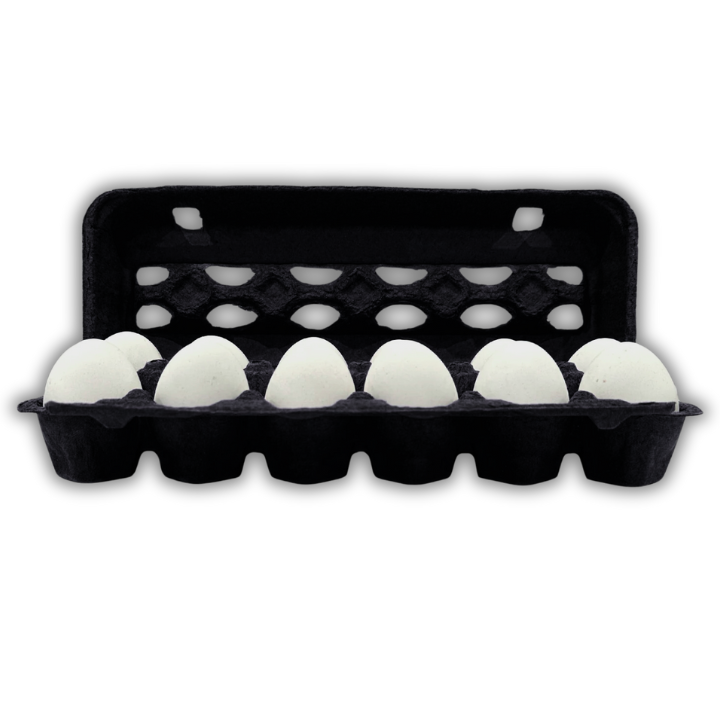
Black egg cartons in molded pulp holding white eggs with the lid open

Description du produit

Spécifications Détails
Nom de la marque BonitoPak
Numéro de modèle EC-BLK-C series
Nom du produit Black Egg Cartons / Black Pigmented Pulp Cartons
Matériau Recycled paper pulp with slurry-blended pigment
Technique Molded pulp forming (wet-pressed), wet end pigmentation
Cell Count 4, 6, 10, 12, 18, or 20 cells
Shade True black; charcoal available as a lighter alternative
Color Method Pigment blended into slurry before forming, not surface coated
Emboss Performance Highest contrast in the range
Print Contrast Strong with white, metallic, and foil
Shade Consistency Highest in the range
Impression de logos Embossed, debossed, or flexographic print
Utilisation industrielle Premium farm brands, gift retail, hospitality, specialty grocery
Application Premium egg lines, gift sets, high end retail positioning
Avantages Biodegradable, home compostable, plastic free, no coating
Commande personnalisée Accepté
MOQ Confirm with sales; stock black carries a lower minimum than custom shades

Galerie de Black Egg Cartons pièces

Cette galerie présente la qualité exceptionnelle et l'attention portée aux détails que nous apportons à chaque projet. Des conceptions complexes aux finitions impeccables, chaque image reflète notre engagement en faveur de l'excellence dans les domaines suivants Black Egg Cartons .

40%

Gain de temps et d'argent

Faites l'expérience de solutions d'emballage de pointe qui optimisent vos coûts et votre temps, en fournissant des processus efficaces et en maximisant votre retour sur investissement.

50%

Plus durable

Réalisez des emballages respectueux de l'environnement avec des matériaux durables, en réduisant les déchets et en promouvant la responsabilité environnementale dans toutes vos gammes de produits.

25%

Augmentation des ventes

Améliorez l'attrait de votre produit en rayon grâce à des designs innovants qui augmentent la visibilité et les ventes sur les marchés de détail et en ligne.

100%

Plus fiable

Faites confiance à l'engagement de BonitoPak en matière de qualité, en vous assurant que chaque produit répond à nos normes élevées avec un service constant et fiable.

Black is the easiest color we make

That sounds counterintuitive for the most dramatic shade in the range, but it follows directly from how pigmented pulp works.

Recycled fiber arrives gray-brown and varies batch to batch depending on the waste stream. Every pigment has to work against that moving base. Light tints show the variation, which is why pink is the hardest shade we produce.

Black overwhelms it. The pigment load is high enough that incoming fiber color has almost no influence on the finished shade. A grayer batch and a warmer batch produce the same black.

The practical consequence for buyers is consistency. Black reorders match the original more reliably than any other shade, which matters for a brand running the same carton across years rather than a single seasonal run.

Why embossing works best here

Embossed detail is read through shadow, not through color contrast. The mark is the same material as the carton around it, so what the eye picks up is the way light falls into and out of the raised or recessed area.

Shadow depth depends on how much tonal range the surface has. A pale surface reflects light into its own shadows and softens them. A dark surface absorbs that bounced light, so the shadow stays dark and the edge of the emboss stays sharp.

Black has more tonal depth than anything else we produce. An embossed logo on black reads clearly at a distance where the same logo on natural pulp is barely visible.

For a producer who wants permanent branding with no per unit print cost, black plus embossing is the strongest combination in the catalog.

Print behavior

Black is a limited print substrate with two very strong options.

White ink is the workhorse. Maximum contrast, clean reproduction, and it photographs well, which matters for producers selling through social channels where the pack appears in images.

Metallic and foil effects read dramatically on black in a way they do not on lighter pulp, where they compete with the base brightness. Gold and copper on black is a common specification for gift and premium lines.

What does not work is any dark ink, and any design relying on tonal gradation. Black is an absolute floor, so there is nothing below it to build shading against.

Colored inks other than white and metallic generally come out muddy, because ink sitting on a black absorbent surface loses most of its chroma. Designs needing color should specify a lighter carton.

Soil and scuff behavior

Dark packaging shows marks differently from pale packaging, and the difference is not what most buyers expect.

Black hides the gray scuffing that pale cartons pick up from handling and from sliding against each other in a case. A natural pulp carton that has moved through distribution often arrives looking handled. A black one does not.

What black does show is dust and dried moisture spotting, which sit lighter than the surface. Cartons stored in a dusty environment will need more care in presentation than natural pulp would. For refrigerated retail and indoor market selling this never arises, and the scuff advantage is what dominates.

Where black sells

Black carries specific associations in food retail that work for and against it.

It reads premium, which is why gift, hospitality, and high end specialty grocery are the natural channels. A black carton on a market table against a row of gray ones is an immediate signal of a producer who has made a decision.

It also reads as unusual for eggs specifically, since consumers associate egg packaging with natural fiber tones. That cuts both ways. For a premium line it is differentiation. For a mainstream line it can read as incongruous, and producers selling on value should not reach for it.

Black also conceals the eggs visually more than a pale carton does when the lid is open, which matters for producers whose shell color is part of the product. Blue and olive shells from Ameraucana and Olive Egger flocks pop against black. White eggs do too. Brown eggs sit flatter against it.

Pairing with format

Black works hardest on premium formats.

On molded pulp octagon egg cartons it produces the strongest premium presentation we can make in fiber, since an unusual shape and an unusual shade reinforce each other.

On a molded pulp 6 egg carton it suits a premium half dozen line sold alongside standard packaging.

On a molded pulp dozen egg carton it works as a permanent brand identity for producers positioning above the category.

For the full pigment detail, shade control, and how color is held across reorders, see molded pulp colored egg cartons. For embossing and printing specifications, see boîtes à œufs personnalisées.

Black is the easiest color we make

That sounds counterintuitive for the most dramatic shade in the range, but it follows directly from how pigmented pulp works.

Recycled fiber arrives gray-brown and varies batch to batch depending on the waste stream. Every pigment has to work against that moving base. Light tints show the variation, which is why pink is the hardest shade we produce.

Black overwhelms it. The pigment load is high enough that incoming fiber color has almost no influence on the finished shade. A grayer batch and a warmer batch produce the same black.

The practical consequence for buyers is consistency. Black reorders match the original more reliably than any other shade, which matters for a brand running the same carton across years rather than a single seasonal run.

Why embossing works best here

Embossed detail is read through shadow, not through color contrast. The mark is the same material as the carton around it, so what the eye picks up is the way light falls into and out of the raised or recessed area.

Shadow depth depends on how much tonal range the surface has. A pale surface reflects light into its own shadows and softens them. A dark surface absorbs that bounced light, so the shadow stays dark and the edge of the emboss stays sharp.

Black has more tonal depth than anything else we produce. An embossed logo on black reads clearly at a distance where the same logo on natural pulp is barely visible.

For a producer who wants permanent branding with no per unit print cost, black plus embossing is the strongest combination in the catalog.

Print behavior

Black is a limited print substrate with two very strong options.

White ink is the workhorse. Maximum contrast, clean reproduction, and it photographs well, which matters for producers selling through social channels where the pack appears in images.

Metallic and foil effects read dramatically on black in a way they do not on lighter pulp, where they compete with the base brightness. Gold and copper on black is a common specification for gift and premium lines.

What does not work is any dark ink, and any design relying on tonal gradation. Black is an absolute floor, so there is nothing below it to build shading against.

Colored inks other than white and metallic generally come out muddy, because ink sitting on a black absorbent surface loses most of its chroma. Designs needing color should specify a lighter carton.

Soil and scuff behavior

Dark packaging shows marks differently from pale packaging, and the difference is not what most buyers expect.

Black hides the gray scuffing that pale cartons pick up from handling and from sliding against each other in a case. A natural pulp carton that has moved through distribution often arrives looking handled. A black one does not.

What black does show is dust and dried moisture spotting, which sit lighter than the surface. Cartons stored in a dusty environment will need more care in presentation than natural pulp would. For refrigerated retail and indoor market selling this never arises, and the scuff advantage is what dominates.

Where black sells

Black carries specific associations in food retail that work for and against it.

It reads premium, which is why gift, hospitality, and high end specialty grocery are the natural channels. A black carton on a market table against a row of gray ones is an immediate signal of a producer who has made a decision.

It also reads as unusual for eggs specifically, since consumers associate egg packaging with natural fiber tones. That cuts both ways. For a premium line it is differentiation. For a mainstream line it can read as incongruous, and producers selling on value should not reach for it.

Black also conceals the eggs visually more than a pale carton does when the lid is open, which matters for producers whose shell color is part of the product. Blue and olive shells from Ameraucana and Olive Egger flocks pop against black. White eggs do too. Brown eggs sit flatter against it.

Pairing with format

Black works hardest on premium formats.

On molded pulp octagon egg cartons it produces the strongest premium presentation we can make in fiber, since an unusual shape and an unusual shade reinforce each other.

On a molded pulp 6 egg carton it suits a premium half dozen line sold alongside standard packaging.

On a molded pulp dozen egg carton it works as a permanent brand identity for producers positioning above the category.

For the full pigment detail, shade control, and how color is held across reorders, see molded pulp colored egg cartons. For embossing and printing specifications, see boîtes à œufs personnalisées.

Matériaux pour Black Egg Cartons Pièces détachées

Des entreprises et des ingénieurs de premier plan font confiance à BonitoPak pour des itérations rapides et des pièces durables et de haute qualité. Qu'il s'agisse de prototypage ou de production à grande échelle, notre large gamme de matériaux nous permet de répondre aux exigences uniques de n'importe quelle entreprise. Black Egg Cartons avec précision et rapidité.

Compostable kraft paper is the strongest fiber we form. Made from virgin

Colored pulp is not a separate fiber. It is any of our

Bleached pulp is the material to specify when the part has to

Natural plant fiber covers the non-wood cellulose sources we blend outside the

Corrugated paper as a molded pulp material means recovered cardboard boxes repulped

Straw fiber is made from the stalks left after grain harvest, material

Personnalisé Écologique Fiable

Excellence en matière d'emballage personnalisé et respectueux de l'environnement

Entièrement personnalisable

Personnalisez votre emballage avec des styles, des tailles, des couleurs et des finitions sur mesure pour répondre à des besoins spécifiques.

Soutien des experts

Bonitopak fournit des conseils experts en matière de conception et de logistique afin de maximiser l'efficacité de l'emballage et d'augmenter le retour sur investissement.

Solutions écologiques

Choisissez des emballages durables et écologiques pour réduire l'impact sur l'environnement et soutenir les objectifs écologiques de votre marque.

Assurance qualité

Bonitopak garantit un service de qualité supérieure et l'excellence du produit pour chaque solution d'emballage.

Questions fréquemment posées

Black Egg Cartons

  • Will black pigment rub off onto eggshells?

    No. The pigment is bound within the fiber rather than applied to the surface, so there is nothing loose to transfer. Transfer onto eggs would indicate a surface coated carton with poor adhesion, which is one of the practical reasons we color at the wet end rather than coating afterward.

  • Does black cost more than your other stock colors?

    Slightly, because the pigment loading is higher by mass than for a light tint. That is partly offset by a lower rejection rate, since black does not fail shade checks the way pink and pastels do. Net difference against other stock colors is small.

  • Can you print a photograph in white on black?

    No, and not because of the color. Fiber texture breaks up continuous tone regardless of substrate, so photographic reproduction fails on pulp generally. A bold single color illustration in white on black reproduces well. A halftone image does not.

  • Will a black carton fade in sunlight?

    Less than any other shade we produce. Black pigment has more lightfastness headroom than light tints, because fading is a proportional loss and there is far more pigment present to lose. Cartons held in strong sun for months will dull toward charcoal, but the effect is slower and less visible than on pastels.

  • Does a black carton compost as readily as a natural one?

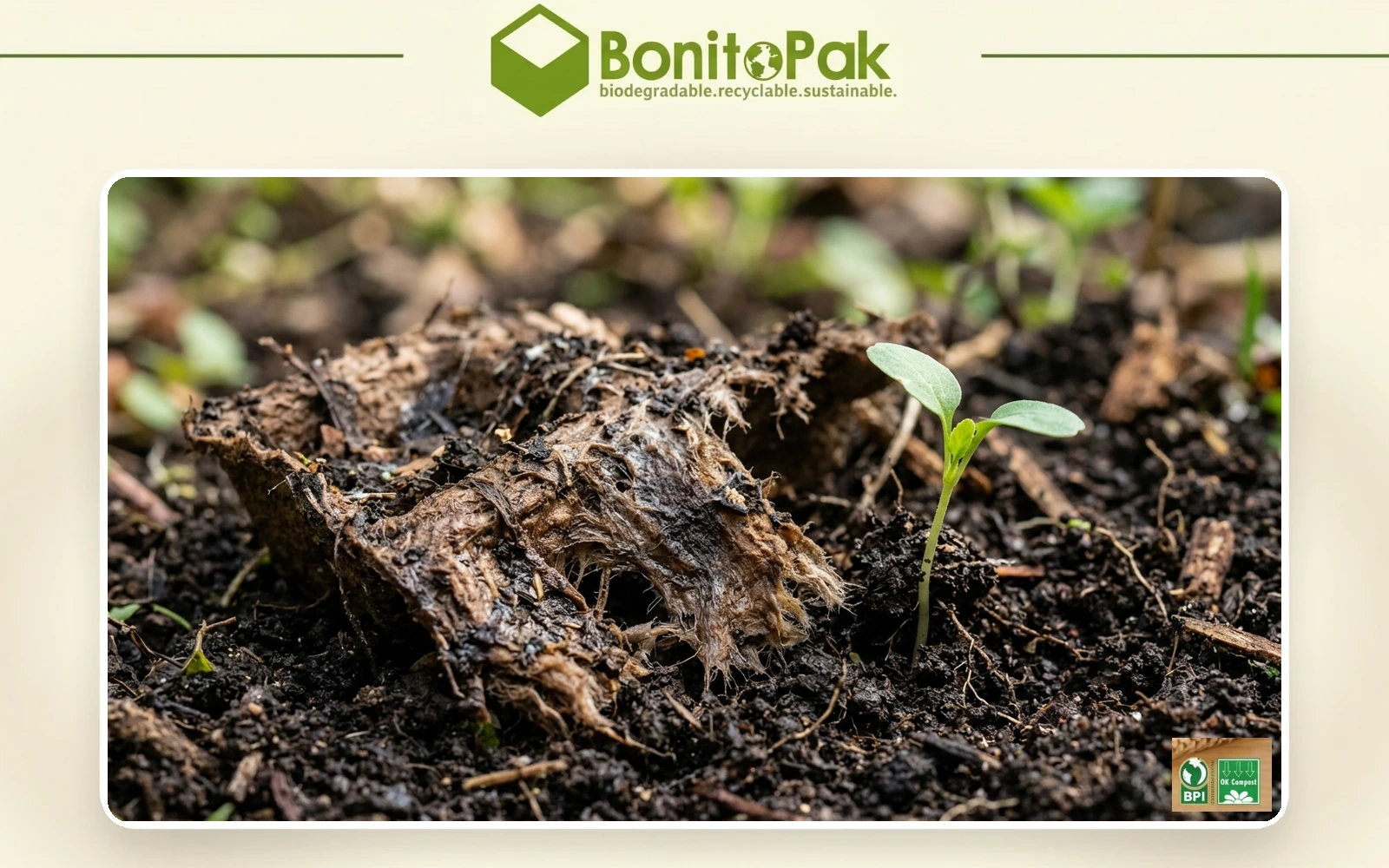
    Yes. The pigment is a very small fraction by mass and is selected for compostable packaging use, with no coating or film involved. Buyers sometimes assume heavy pigmentation means heavy additives, but the loading required to reach black in fiber is still minor against the mass of the fiber itself.

Biodégradable Résultat

0 jours

7 jours

14 jours

30 jours

Industries spécialisées

Ayant produit des millions de pièces, BonitoPak possède une connaissance approfondie de nombreuses applications. Nous excellons particulièrement dans les industries qui exigent la fabrication de composants précis et complexes. Faites-nous confiance pour vous apporter expertise et qualité, quelle que soit la complexité.

Solutions d'emballage OEM et ODM

Bonitopak propose des solutions d'emballage sur mesure (OEM) et préconçues (ODM). Que vous ayez besoin d'un design entièrement personnalisé ou d'un emballage prêt à l'emploi, nous vous proposons des options de haute qualité, efficaces et flexibles pour répondre aux besoins de votre marque.

Services OEM

Les solutions d'emballage OEM vous permettent de créer des produits entièrement personnalisés, conçus et fabriqués pour répondre à vos besoins spécifiques. Chez Bonitopak, nous offrons un soutien complet tout au long du processus de conception, de prototypage et de fabrication, afin que votre emballage reflète l'identité unique de votre marque. Nos capacités de fabrication de précision garantissent une production de haute qualité et cohérente, quelle que soit la complexité de la conception. Avec un service complet, nous nous occupons de tout, de la conception à la livraison, pour vous aider à rationaliser vos besoins en matière d'emballage.

Services ODM

Les solutions d'emballage ODM offrent des produits préconçus qui peuvent être adaptés aux exigences de votre marque. Grâce à l'expertise de Bonitopak en matière de conception innovante et à son processus de production efficace, vous pouvez choisir parmi une large gamme d'options d'emballage prêtes à l'emploi. Nous offrons une personnalisation flexible, vous permettant d'ajouter votre marque et de choisir parmi différentes finitions, couleurs et tailles. Cette solution permet d'économiser du temps et de l'argent tout en garantissant un emballage de haute qualité qui répond aux normes de votre marque.
Prêt à élever votre projet ?

Donnez vie à vos dessins avec BonitoPak

Faites l'expérience de l'ingénierie de précision avec BonitoPak. Des prototypes détaillés à la production en grande quantité, nous sommes là pour transformer vos concepts en réalité. Contactez-nous dès aujourd'hui pour discuter des besoins de votre projet !

Nos catégories de produits

Découvrez la gamme diversifiée de solutions d'emballage de Bonitopak, y compris les plateaux de pulpe moulée, les emballages alimentaires, les conceptions personnalisées et les options durables. Chaque catégorie est conçue dans un souci de durabilité, de fonctionnalité et de responsabilité environnementale, afin de répondre à vos besoins spécifiques.

Black is the easiest color we make

That sounds counterintuitive for the most dramatic shade in the range, but it follows directly from how pigmented pulp works.

Recycled fiber arrives gray-brown and varies batch to batch depending on the waste stream. Every pigment has to work against that moving base. Light tints show the variation, which is why pink is the hardest shade we produce.

Black overwhelms it. The pigment load is high enough that incoming fiber color has almost no influence on the finished shade. A grayer batch and a warmer batch produce the same black.

The practical consequence for buyers is consistency. Black reorders match the original more reliably than any other shade, which matters for a brand running the same carton across years rather than a single seasonal run.

Why embossing works best here

Embossed detail is read through shadow, not through color contrast. The mark is the same material as the carton around it, so what the eye picks up is the way light falls into and out of the raised or recessed area.

Shadow depth depends on how much tonal range the surface has. A pale surface reflects light into its own shadows and softens them. A dark surface absorbs that bounced light, so the shadow stays dark and the edge of the emboss stays sharp.

Black has more tonal depth than anything else we produce. An embossed logo on black reads clearly at a distance where the same logo on natural pulp is barely visible.

For a producer who wants permanent branding with no per unit print cost, black plus embossing is the strongest combination in the catalog.

Print behavior

Black is a limited print substrate with two very strong options.

White ink is the workhorse. Maximum contrast, clean reproduction, and it photographs well, which matters for producers selling through social channels where the pack appears in images.

Metallic and foil effects read dramatically on black in a way they do not on lighter pulp, where they compete with the base brightness. Gold and copper on black is a common specification for gift and premium lines.

What does not work is any dark ink, and any design relying on tonal gradation. Black is an absolute floor, so there is nothing below it to build shading against.

Colored inks other than white and metallic generally come out muddy, because ink sitting on a black absorbent surface loses most of its chroma. Designs needing color should specify a lighter carton.

Soil and scuff behavior

Dark packaging shows marks differently from pale packaging, and the difference is not what most buyers expect.

Black hides the gray scuffing that pale cartons pick up from handling and from sliding against each other in a case. A natural pulp carton that has moved through distribution often arrives looking handled. A black one does not.

What black does show is dust and dried moisture spotting, which sit lighter than the surface. Cartons stored in a dusty environment will need more care in presentation than natural pulp would. For refrigerated retail and indoor market selling this never arises, and the scuff advantage is what dominates.

Where black sells

Black carries specific associations in food retail that work for and against it.

It reads premium, which is why gift, hospitality, and high end specialty grocery are the natural channels. A black carton on a market table against a row of gray ones is an immediate signal of a producer who has made a decision.

It also reads as unusual for eggs specifically, since consumers associate egg packaging with natural fiber tones. That cuts both ways. For a premium line it is differentiation. For a mainstream line it can read as incongruous, and producers selling on value should not reach for it.

Black also conceals the eggs visually more than a pale carton does when the lid is open, which matters for producers whose shell color is part of the product. Blue and olive shells from Ameraucana and Olive Egger flocks pop against black. White eggs do too. Brown eggs sit flatter against it.

Pairing with format

Black works hardest on premium formats.

On molded pulp octagon egg cartons it produces the strongest premium presentation we can make in fiber, since an unusual shape and an unusual shade reinforce each other.

On a molded pulp 6 egg carton it suits a premium half dozen line sold alongside standard packaging.

On a molded pulp dozen egg carton it works as a permanent brand identity for producers positioning above the category.

For the full pigment detail, shade control, and how color is held across reorders, see molded pulp colored egg cartons. For embossing and printing specifications, see boîtes à œufs personnalisées.

Articles et réflexions connexes

Restez informé des dernières mises à jour sur les tendances en matière d'emballage durable, les perspectives du secteur et les conseils d'experts grâce à notre blog. Explorez des idées et des solutions innovantes pour améliorer vos connaissances en matière d'emballage.

Par Leo Chan | Rédacteur, BonitoPak | Plus de 20 ans d'expérience dans le domaine des emballages en pâte moulée. La vodka, c'est

Par Leo Chan | Rédacteur, BonitoPak | Plus de 20 ans d'expérience dans le domaine des emballages en pâte moulée Presque tous les

Par Leo Chan | Rédacteur, BonitoPak | Plus de 20 ans d'expérience dans le domaine des emballages en pâte moulée Rechercher ceci

Questions fréquemment posées

Black Egg Cartons

  • Will black pigment rub off onto eggshells?

    No. The pigment is bound within the fiber rather than applied to the surface, so there is nothing loose to transfer. Transfer onto eggs would indicate a surface coated carton with poor adhesion, which is one of the practical reasons we color at the wet end rather than coating afterward.

  • Does black cost more than your other stock colors?

    Slightly, because the pigment loading is higher by mass than for a light tint. That is partly offset by a lower rejection rate, since black does not fail shade checks the way pink and pastels do. Net difference against other stock colors is small.

  • Can you print a photograph in white on black?

    No, and not because of the color. Fiber texture breaks up continuous tone regardless of substrate, so photographic reproduction fails on pulp generally. A bold single color illustration in white on black reproduces well. A halftone image does not.

  • Will a black carton fade in sunlight?

    Less than any other shade we produce. Black pigment has more lightfastness headroom than light tints, because fading is a proportional loss and there is far more pigment present to lose. Cartons held in strong sun for months will dull toward charcoal, but the effect is slower and less visible than on pastels.

  • Does a black carton compost as readily as a natural one?

    Yes. The pigment is a very small fraction by mass and is selected for compostable packaging use, with no coating or film involved. Buyers sometimes assume heavy pigmentation means heavy additives, but the loading required to reach black in fiber is still minor against the mass of the fiber itself.

Remplir ce formulaire détaillé