Black Egg Cartons

  • Deepest pigment load in the range, giving a true black rather than charcoal
  • Holds embossed and debossed detail more sharply than any other shade
  • Pigment blended into the slurry, so a scuffed edge shows black underneath
  • White, metallic, and foil print all read strongly against the base
  • Compostable and plastic free, with no surface coating
  • Most consistent shade we produce, since dark pigment covers base fiber variation
  • Disponível em todas as faixas de contagem de células, de 4 a 20

Molde público

Soluções de embalagem

Design 3D

Molde personalizado

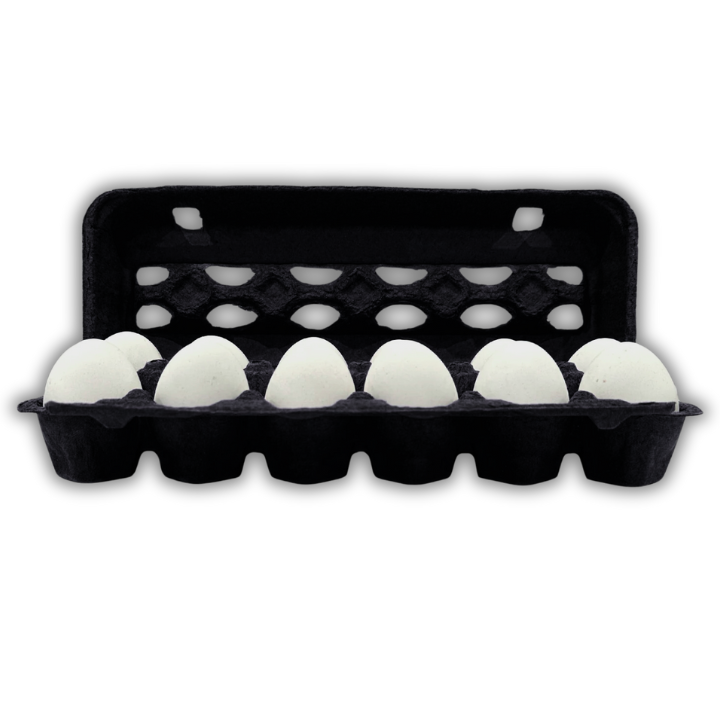
Black egg cartons in molded pulp holding white eggs with the lid open

Descrição do produto

Especificação Detalhes
Nome da marca BonitoPak
Número do modelo EC-BLK-C series
Nome do produto Black Egg Cartons / Black Pigmented Pulp Cartons
Material Polpa de papel reciclada com pigmento incorporado em pasta líquida
Técnica Moldagem de polpa (prensagem úmida), pigmentação na fase úmida
Contagem de células 4, 6, 10, 12, 18, or 20 cells
Shade True black; charcoal available as a lighter alternative
Método de cor O pigmento é incorporado à pasta antes da moldagem, e não aplicado como revestimento superficial
Emboss Performance Highest contrast in the range
Print Contrast Strong with white, metallic, and foil
Shade Consistency Highest in the range
Impressão do logotipo Estampagem em relevo, em baixo-relevo ou flexográfica
Uso industrial Premium farm brands, gift retail, hospitality, specialty grocery
Aplicativo Premium egg lines, gift sets, high end retail positioning
Vantagens Biodegradável, compostável em casa, sem plástico, sem revestimento
Pedido personalizado Aceito
MOQ Confirm with sales; stock black carries a lower minimum than custom shades

Galeria de Black Egg Cartons peças

Esta galeria mostra a qualidade excepcional e a atenção aos detalhes que oferecemos em cada projeto. De designs complexos a acabamentos impecáveis, cada imagem reflete nosso compromisso com a excelência em Black Egg Cartons .

40%

Economia de tempo e custo

Experimente as principais soluções de embalagem que otimizam seus custos e tempo, proporcionando processos eficientes e maximizando seu ROI.

50%

Mais sustentável

Obtenha embalagens ecologicamente corretas com materiais sustentáveis, reduzindo o desperdício e promovendo a responsabilidade ambiental em todas as suas linhas de produtos.

25%

Aumento nas vendas

Aumente o apelo do seu produto nas prateleiras com designs inovadores que aumentam a visibilidade e as vendas nos mercados de varejo e on-line.

100%

Mais confiável

Confie no compromisso da BonitoPak com a qualidade, garantindo que cada produto atenda aos nossos altos padrões com um serviço consistente e confiável.

Black is the easiest color we make

That sounds counterintuitive for the most dramatic shade in the range, but it follows directly from how pigmented pulp works.

Recycled fiber arrives gray-brown and varies batch to batch depending on the waste stream. Every pigment has to work against that moving base. Light tints show the variation, which is why pink is the hardest shade we produce.

Black overwhelms it. The pigment load is high enough that incoming fiber color has almost no influence on the finished shade. A grayer batch and a warmer batch produce the same black.

The practical consequence for buyers is consistency. Black reorders match the original more reliably than any other shade, which matters for a brand running the same carton across years rather than a single seasonal run.

Why embossing works best here

Embossed detail is read through shadow, not through color contrast. The mark is the same material as the carton around it, so what the eye picks up is the way light falls into and out of the raised or recessed area.

Shadow depth depends on how much tonal range the surface has. A pale surface reflects light into its own shadows and softens them. A dark surface absorbs that bounced light, so the shadow stays dark and the edge of the emboss stays sharp.

Black has more tonal depth than anything else we produce. An embossed logo on black reads clearly at a distance where the same logo on natural pulp is barely visible.

For a producer who wants permanent branding with no per unit print cost, black plus embossing is the strongest combination in the catalog.

Print behavior

Black is a limited print substrate with two very strong options.

White ink is the workhorse. Maximum contrast, clean reproduction, and it photographs well, which matters for producers selling through social channels where the pack appears in images.

Metallic and foil effects read dramatically on black in a way they do not on lighter pulp, where they compete with the base brightness. Gold and copper on black is a common specification for gift and premium lines.

What does not work is any dark ink, and any design relying on tonal gradation. Black is an absolute floor, so there is nothing below it to build shading against.

Colored inks other than white and metallic generally come out muddy, because ink sitting on a black absorbent surface loses most of its chroma. Designs needing color should specify a lighter carton.

Soil and scuff behavior

Dark packaging shows marks differently from pale packaging, and the difference is not what most buyers expect.

Black hides the gray scuffing that pale cartons pick up from handling and from sliding against each other in a case. A natural pulp carton that has moved through distribution often arrives looking handled. A black one does not.

What black does show is dust and dried moisture spotting, which sit lighter than the surface. Cartons stored in a dusty environment will need more care in presentation than natural pulp would. For refrigerated retail and indoor market selling this never arises, and the scuff advantage is what dominates.

Where black sells

Black carries specific associations in food retail that work for and against it.

It reads premium, which is why gift, hospitality, and high end specialty grocery are the natural channels. A black carton on a market table against a row of gray ones is an immediate signal of a producer who has made a decision.

It also reads as unusual for eggs specifically, since consumers associate egg packaging with natural fiber tones. That cuts both ways. For a premium line it is differentiation. For a mainstream line it can read as incongruous, and producers selling on value should not reach for it.

Black also conceals the eggs visually more than a pale carton does when the lid is open, which matters for producers whose shell color is part of the product. Blue and olive shells from Ameraucana and Olive Egger flocks pop against black. White eggs do too. Brown eggs sit flatter against it.

Pairing with format

Black works hardest on premium formats.

On molded pulp octagon egg cartons it produces the strongest premium presentation we can make in fiber, since an unusual shape and an unusual shade reinforce each other.

On a molded pulp 6 egg carton it suits a premium half dozen line sold alongside standard packaging.

On a molded pulp dozen egg carton it works as a permanent brand identity for producers positioning above the category.

For the full pigment detail, shade control, and how color is held across reorders, see molded pulp colored egg cartons. For embossing and printing specifications, see custom printed egg cartons.

Black is the easiest color we make

That sounds counterintuitive for the most dramatic shade in the range, but it follows directly from how pigmented pulp works.

Recycled fiber arrives gray-brown and varies batch to batch depending on the waste stream. Every pigment has to work against that moving base. Light tints show the variation, which is why pink is the hardest shade we produce.

Black overwhelms it. The pigment load is high enough that incoming fiber color has almost no influence on the finished shade. A grayer batch and a warmer batch produce the same black.

The practical consequence for buyers is consistency. Black reorders match the original more reliably than any other shade, which matters for a brand running the same carton across years rather than a single seasonal run.

Why embossing works best here

Embossed detail is read through shadow, not through color contrast. The mark is the same material as the carton around it, so what the eye picks up is the way light falls into and out of the raised or recessed area.

Shadow depth depends on how much tonal range the surface has. A pale surface reflects light into its own shadows and softens them. A dark surface absorbs that bounced light, so the shadow stays dark and the edge of the emboss stays sharp.

Black has more tonal depth than anything else we produce. An embossed logo on black reads clearly at a distance where the same logo on natural pulp is barely visible.

For a producer who wants permanent branding with no per unit print cost, black plus embossing is the strongest combination in the catalog.

Print behavior

Black is a limited print substrate with two very strong options.

White ink is the workhorse. Maximum contrast, clean reproduction, and it photographs well, which matters for producers selling through social channels where the pack appears in images.

Metallic and foil effects read dramatically on black in a way they do not on lighter pulp, where they compete with the base brightness. Gold and copper on black is a common specification for gift and premium lines.

What does not work is any dark ink, and any design relying on tonal gradation. Black is an absolute floor, so there is nothing below it to build shading against.

Colored inks other than white and metallic generally come out muddy, because ink sitting on a black absorbent surface loses most of its chroma. Designs needing color should specify a lighter carton.

Soil and scuff behavior

Dark packaging shows marks differently from pale packaging, and the difference is not what most buyers expect.

Black hides the gray scuffing that pale cartons pick up from handling and from sliding against each other in a case. A natural pulp carton that has moved through distribution often arrives looking handled. A black one does not.

What black does show is dust and dried moisture spotting, which sit lighter than the surface. Cartons stored in a dusty environment will need more care in presentation than natural pulp would. For refrigerated retail and indoor market selling this never arises, and the scuff advantage is what dominates.

Where black sells

Black carries specific associations in food retail that work for and against it.

It reads premium, which is why gift, hospitality, and high end specialty grocery are the natural channels. A black carton on a market table against a row of gray ones is an immediate signal of a producer who has made a decision.

It also reads as unusual for eggs specifically, since consumers associate egg packaging with natural fiber tones. That cuts both ways. For a premium line it is differentiation. For a mainstream line it can read as incongruous, and producers selling on value should not reach for it.

Black also conceals the eggs visually more than a pale carton does when the lid is open, which matters for producers whose shell color is part of the product. Blue and olive shells from Ameraucana and Olive Egger flocks pop against black. White eggs do too. Brown eggs sit flatter against it.

Pairing with format

Black works hardest on premium formats.

On molded pulp octagon egg cartons it produces the strongest premium presentation we can make in fiber, since an unusual shape and an unusual shade reinforce each other.

On a molded pulp 6 egg carton it suits a premium half dozen line sold alongside standard packaging.

On a molded pulp dozen egg carton it works as a permanent brand identity for producers positioning above the category.

For the full pigment detail, shade control, and how color is held across reorders, see molded pulp colored egg cartons. For embossing and printing specifications, see custom printed egg cartons.

Materiais para Black Egg Cartons Peças

Empresas e engenheiros líderes confiam no BonitoPak para iterações rápidas e peças duráveis e de alta qualidade. Seja para prototipagem ou produção em escala real, nossa ampla gama de materiais garante que atendamos aos requisitos exclusivos de qualquer Black Egg Cartons projeto com precisão e rapidez.

Compostable kraft paper is the strongest fiber we form. Made from virgin

Colored pulp is not a separate fiber. It is any of our

Bleached pulp is the material to specify when the part has to

Natural plant fiber covers the non-wood cellulose sources we blend outside the

Corrugated paper as a molded pulp material means recovered cardboard boxes repulped

Straw fiber is made from the stalks left after grain harvest, material

Personalizado, ecológico e confiável

Excelência em embalagens personalizadas e ecologicamente corretas

Totalmente personalizável

Personalize sua embalagem com estilos, tamanhos, cores e acabamentos sob medida para atender a necessidades específicas.

Suporte especializado

A Bonitopak oferece consultoria especializada em design e logística para maximizar a eficiência da embalagem e aumentar o ROI.

Soluções ecológicas

Escolha embalagens sustentáveis e ecologicamente corretas para reduzir o impacto ambiental e apoiar as metas ecológicas de sua marca.

Garantia de qualidade

A Bonitopak garante serviço de alta qualidade e excelência de produto em cada solução de embalagem.

Perguntas frequentes (FAQ)

Black Egg Cartons

  • Will black pigment rub off onto eggshells?

    No. The pigment is bound within the fiber rather than applied to the surface, so there is nothing loose to transfer. Transfer onto eggs would indicate a surface coated carton with poor adhesion, which is one of the practical reasons we color at the wet end rather than coating afterward.

  • Does black cost more than your other stock colors?

    Slightly, because the pigment loading is higher by mass than for a light tint. That is partly offset by a lower rejection rate, since black does not fail shade checks the way pink and pastels do. Net difference against other stock colors is small.

  • Can you print a photograph in white on black?

    No, and not because of the color. Fiber texture breaks up continuous tone regardless of substrate, so photographic reproduction fails on pulp generally. A bold single color illustration in white on black reproduces well. A halftone image does not.

  • Will a black carton fade in sunlight?

    Less than any other shade we produce. Black pigment has more lightfastness headroom than light tints, because fading is a proportional loss and there is far more pigment present to lose. Cartons held in strong sun for months will dull toward charcoal, but the effect is slower and less visible than on pastels.

  • Does a black carton compost as readily as a natural one?

    Yes. The pigment is a very small fraction by mass and is selected for compostable packaging use, with no coating or film involved. Buyers sometimes assume heavy pigmentation means heavy additives, but the loading required to reach black in fiber is still minor against the mass of the fiber itself.

Resultado biodegradável

0 dias

7 dias

14 dias

30 dias

Setores especializados

Tendo produzido milhões de peças, a BonitoPak possui profundo conhecimento em diversas aplicações. Nós nos destacamos especialmente em setores que exigem a fabricação de componentes precisos e intrincados. Confie em nós para oferecer experiência e qualidade, independentemente da complexidade.

Soluções de embalagem OEM e ODM

A Bonitopak oferece soluções de embalagem personalizadas (OEM) e pré-projetadas (ODM). Independentemente de você precisar de designs totalmente personalizados ou de embalagens prontas para uso, fornecemos opções de alta qualidade, eficientes e flexíveis para atender às necessidades da sua marca.

Serviços OEM

As soluções de embalagem OEM permitem que você crie produtos totalmente personalizados, projetados e fabricados para atender às suas necessidades específicas. Na Bonitopak, oferecemos suporte abrangente durante todo o processo de design, prototipagem e fabricação, garantindo que sua embalagem reflita a identidade exclusiva de sua marca. Nossos recursos de fabricação de precisão garantem uma produção consistente e de alta qualidade, independentemente da complexidade do projeto. Com serviço de ponta a ponta, cuidamos de tudo, desde o conceito até a entrega, ajudando-o a otimizar suas necessidades de embalagem.

Serviços ODM

As soluções de embalagem ODM oferecem produtos pré-projetados que podem ser adaptados aos requisitos de sua marca. Com a experiência em design inovador e o processo de produção eficiente da Bonitopak, você pode escolher entre uma ampla gama de opções de embalagens prontas para uso. Oferecemos personalização flexível, permitindo que você adicione sua marca e selecione entre vários acabamentos, cores e tamanhos. Essa solução economiza tempo e custos e, ao mesmo tempo, garante embalagens de alta qualidade que atendem aos padrões de sua marca.
Pronto para elevar seu projeto?

Dê vida aos seus projetos com o BonitoPak

Experimente a engenharia de precisão com a BonitoPak. De protótipos detalhados à produção de alto volume, estamos aqui para transformar seus conceitos em realidade. Entre em contato conosco hoje mesmo para discutir as necessidades do seu projeto!

Nossas categorias de produtos

Descubra a gama diversificada de soluções de embalagem da Bonitopak, incluindo bandejas de polpa moldada, embalagens para alimentos, designs personalizados e opções sustentáveis. Cada categoria é criada para oferecer durabilidade, funcionalidade e responsabilidade ambiental, adaptada para atender às suas necessidades específicas.

Black is the easiest color we make

That sounds counterintuitive for the most dramatic shade in the range, but it follows directly from how pigmented pulp works.

Recycled fiber arrives gray-brown and varies batch to batch depending on the waste stream. Every pigment has to work against that moving base. Light tints show the variation, which is why pink is the hardest shade we produce.

Black overwhelms it. The pigment load is high enough that incoming fiber color has almost no influence on the finished shade. A grayer batch and a warmer batch produce the same black.

The practical consequence for buyers is consistency. Black reorders match the original more reliably than any other shade, which matters for a brand running the same carton across years rather than a single seasonal run.

Why embossing works best here

Embossed detail is read through shadow, not through color contrast. The mark is the same material as the carton around it, so what the eye picks up is the way light falls into and out of the raised or recessed area.

Shadow depth depends on how much tonal range the surface has. A pale surface reflects light into its own shadows and softens them. A dark surface absorbs that bounced light, so the shadow stays dark and the edge of the emboss stays sharp.

Black has more tonal depth than anything else we produce. An embossed logo on black reads clearly at a distance where the same logo on natural pulp is barely visible.

For a producer who wants permanent branding with no per unit print cost, black plus embossing is the strongest combination in the catalog.

Print behavior

Black is a limited print substrate with two very strong options.

White ink is the workhorse. Maximum contrast, clean reproduction, and it photographs well, which matters for producers selling through social channels where the pack appears in images.

Metallic and foil effects read dramatically on black in a way they do not on lighter pulp, where they compete with the base brightness. Gold and copper on black is a common specification for gift and premium lines.

What does not work is any dark ink, and any design relying on tonal gradation. Black is an absolute floor, so there is nothing below it to build shading against.

Colored inks other than white and metallic generally come out muddy, because ink sitting on a black absorbent surface loses most of its chroma. Designs needing color should specify a lighter carton.

Soil and scuff behavior

Dark packaging shows marks differently from pale packaging, and the difference is not what most buyers expect.

Black hides the gray scuffing that pale cartons pick up from handling and from sliding against each other in a case. A natural pulp carton that has moved through distribution often arrives looking handled. A black one does not.

What black does show is dust and dried moisture spotting, which sit lighter than the surface. Cartons stored in a dusty environment will need more care in presentation than natural pulp would. For refrigerated retail and indoor market selling this never arises, and the scuff advantage is what dominates.

Where black sells

Black carries specific associations in food retail that work for and against it.

It reads premium, which is why gift, hospitality, and high end specialty grocery are the natural channels. A black carton on a market table against a row of gray ones is an immediate signal of a producer who has made a decision.

It also reads as unusual for eggs specifically, since consumers associate egg packaging with natural fiber tones. That cuts both ways. For a premium line it is differentiation. For a mainstream line it can read as incongruous, and producers selling on value should not reach for it.

Black also conceals the eggs visually more than a pale carton does when the lid is open, which matters for producers whose shell color is part of the product. Blue and olive shells from Ameraucana and Olive Egger flocks pop against black. White eggs do too. Brown eggs sit flatter against it.

Pairing with format

Black works hardest on premium formats.

On molded pulp octagon egg cartons it produces the strongest premium presentation we can make in fiber, since an unusual shape and an unusual shade reinforce each other.

On a molded pulp 6 egg carton it suits a premium half dozen line sold alongside standard packaging.

On a molded pulp dozen egg carton it works as a permanent brand identity for producers positioning above the category.

For the full pigment detail, shade control, and how color is held across reorders, see molded pulp colored egg cartons. For embossing and printing specifications, see custom printed egg cartons.

Artigos e insights relacionados

Mantenha-se informado com as últimas atualizações sobre tendências de embalagens sustentáveis, percepções do setor e dicas de especialistas em nosso blog. Explore ideias e soluções inovadoras para aprimorar seu conhecimento sobre embalagens.

Por Leo Chan | Redator, BonitoPak | Mais de 20 anos na área de embalagens de polpa moldada. A vodca é

Por Leo Chan | Redator, BonitoPak | Mais de 20 anos na área de embalagens de polpa moldada Quase todas as

Por Leo Chan | Redator, BonitoPak | Mais de 20 anos na área de embalagens de polpa moldada Pesquisar isto

Perguntas frequentes (FAQ)

Black Egg Cartons

  • Will black pigment rub off onto eggshells?

    No. The pigment is bound within the fiber rather than applied to the surface, so there is nothing loose to transfer. Transfer onto eggs would indicate a surface coated carton with poor adhesion, which is one of the practical reasons we color at the wet end rather than coating afterward.

  • Does black cost more than your other stock colors?

    Slightly, because the pigment loading is higher by mass than for a light tint. That is partly offset by a lower rejection rate, since black does not fail shade checks the way pink and pastels do. Net difference against other stock colors is small.

  • Can you print a photograph in white on black?

    No, and not because of the color. Fiber texture breaks up continuous tone regardless of substrate, so photographic reproduction fails on pulp generally. A bold single color illustration in white on black reproduces well. A halftone image does not.

  • Will a black carton fade in sunlight?

    Less than any other shade we produce. Black pigment has more lightfastness headroom than light tints, because fading is a proportional loss and there is far more pigment present to lose. Cartons held in strong sun for months will dull toward charcoal, but the effect is slower and less visible than on pastels.

  • Does a black carton compost as readily as a natural one?

    Yes. The pigment is a very small fraction by mass and is selected for compostable packaging use, with no coating or film involved. Buyers sometimes assume heavy pigmentation means heavy additives, but the loading required to reach black in fiber is still minor against the mass of the fiber itself.

Preencha este formulário detalhado