By Leo Chan | Writer, BonitoPak | 20+ years in molded pulp packaging
A white molded pulp carton is not naturally white. Fiber comes out of the pulping process grey or brown, and white is a processing decision made upstream. Understanding how that decision is made tells you what white cartons cost, why some are whiter than others, and whether you actually need them.
Most content on white egg cartons stops at “they look clean on shelf.” This article covers the bleaching chemistry, the brightness measurement that lets you specify white properly, the cost and food-safety considerations, and the cases where natural grey is genuinely the better commercial choice.
Why Fiber Is Not White to Begin With
Molded pulp starts as recycled paper, sugarcane bagasse, bamboo or wood pulp. Each carries its own base tone.
Recycled paper produces the familiar grey. It is a mixture of newsprint, cardboard and office waste, carrying residual ink and varied fiber, which averages out to grey.
Sugarcane bagasse gives a light tan or straw tone, noticeably lighter than recycled grey before any bleaching.
Bamboo sits between the two, generally pale.
Virgin wood pulp is the lightest starting point and the most expensive.
That base tone matters because it determines how much work white requires. Reaching clean white over grey recycled fiber takes substantially more processing than reaching it over bagasse, and the finished surface will still not match. This is the single most useful fact in specifying white cartons and the one most buyers learn after their first order.
How White Actually Gets Made
Two things remove colour from pulp: removing lignin, and destroying the colour-causing structures within it.
Lignin is the problem. It is the rigid polymer in plant cell walls, and it is what darkens and yellows fiber. Chemical pulps have most lignin removed. Mechanical pulps retain it, which is why mechanical pulp brightens only partly and tends to yellow again over time.
Hydrogen peroxide bleaching is the method used for food-contact molded fiber. Peroxide oxidises the colour-causing groups in the pulp. On mechanical pulp it works under alkaline conditions at lower temperatures, removing chromophores while leaving most lignin in place, which means some of the brightness gain is temporary. On chemical pulp it needs higher pH and temperature and works more like oxygen delignification, sometimes combined with oxygen in a single stage.
At BonitoPak, natural colour is unbleached, and white is bleached using hydrogen peroxide as the eco-friendly safety method. For food applications we recommend white and natural rather than the pigmented colours, which use colour additives.
ECF and TCF, and Why Buyers Should Ask
This is the part almost no egg carton content covers, and it is a legitimate procurement question.
ECF, elemental chlorine free, bleaches without elemental chlorine, typically using chlorine dioxide as the main agent. It is the dominant method, applied to roughly 95% of bleached kraft pulp. It greatly reduces chlorinated organic compounds including dioxins, but does not eliminate them.
TCF, totally chlorine free, uses no chlorine-containing chemicals at all, relying on oxygen, ozone and hydrogen peroxide. It reduces chlorinated organics in mill effluent to background levels. As of 2005 it accounted for only around 5 to 6% of kraft pulp production.
If your brand makes environmental claims about its packaging, knowing which route your supplier’s white pulp takes is worth asking. Hydrogen peroxide bleaching is a TCF-compatible method, which is a meaningfully stronger position than ECF.
Specifying White Properly
“White” is not a specification. Brightness is.
Brightness is the percentage of incident light a surface reflects under defined conditions. In the United States it is measured to TAPPI standards T 452 or T 525. Internationally, ISO standards apply.
One quirk worth knowing: ISO brightness values can exceed 100, because modern white paper often contains fluorescent whitening agents and the ISO test measures only a narrow band of blue light. That means ISO brightness does not map directly onto what a human eye reads as white.
What to do with that. Rather than asking for “white,” ask your supplier for a physical sample of their white pulp in your format, and approve against the sample. Numbers are useful for consistency between batches. Samples are what tell you whether the shelf impression is what you wanted.
White Pulp Egg Cartons, Natural and Coloured Compared
|
Factor |
White (bleached) |
Natural (unbleached) |
In-pulp colour |
|---|---|---|---|
|
Base material |
Usually bagasse, bamboo or virgin pulp |
Any, commonly recycled paper |
Any, plus pigment |
|
Unit cost |
Higher |
Lowest |
Higher, varies by shade |
|
Shelf impression |
Clean, clinical, premium food |
Natural, farm, eco |
Distinctive, brand-owned |
|
Print contrast |
Best |
Limited |
Depends on shade |
|
Shows soiling |
Readily |
Conceals it |
Varies |
|
Recyclability |
Recycles with paper |
Recycles with paper |
Recycles with paper |
|
Compostability |
Yes, if uncoated and certified |
Yes, if uncoated and certified |
Yes, if pigment is suitable |
|
Batch consistency |
Needs managing |
Varies with recycled input |
Needs managing |
Three points from that table deserve expanding.
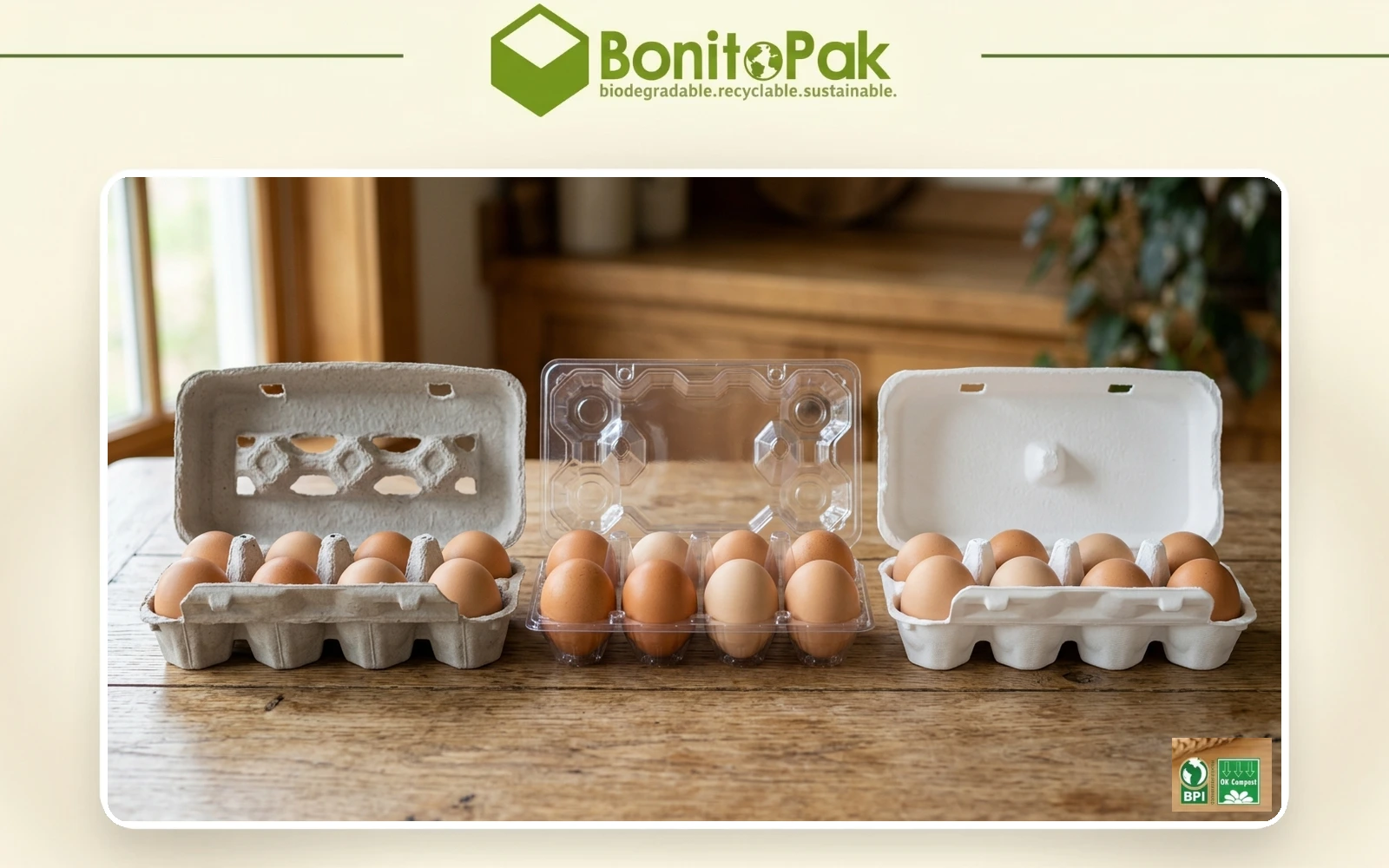
White shows dirt. White pulp egg cartons reveal a smudge, a shell fragment or a damp mark that natural grey hides. For eggs this matters, because eggs are not sterile and handling is physical. Some producers choose natural specifically for this reason.
White gives the best print contrast. If your branding depends on printed detail, white is the better canvas. Molded fiber is textured and absorbent either way, so fine detail is limited, but white maximises what you have. Our article on blank versus printed egg cartons covers when printing is worth it at all.
Batch consistency needs a conversation. Bleaching a variable recycled input produces variable results. If your retail listing depends on cartons matching across a year of production, agree a tolerance with your supplier up front rather than discovering drift at the third order.
When White Is the Right Choice
- Retail food positioning where a clinical, clean impression supports the product
- Premium or specialty eggs where the pack carries a price premium
- Printed branding needing maximum contrast
- Food-contact applications beyond eggs, where white and natural are the recommended choices over pigmented fiber
- Matching an existing white pack across a product range
When Natural Egg Cartons Beat White
Being straight about this is more useful than selling the upgrade.
- Cost-sensitive volume programs. Natural is the cheapest option and the difference compounds across a container.
- Farm, organic or artisanal positioning. Natural grey or bagasse tan signals exactly that, and white can read as industrial.
- Operations where cartons get handled hard. Natural conceals marks that white displays.
- Recycled-content stories. Unbleached recycled fiber is the simplest claim to defend, with no bleaching step to explain.
- When the carton is not the brand. If a printed label or sleeve carries your identity, the carton underneath can be natural.
Our guide to egg carton sizes and counts covers format selection, which matters more to protection than colour does.
What White Cartons Do Not Change
A few things buyers sometimes assume, which are worth correcting.
Bleached egg cartons are not more food safe. Hydrogen peroxide bleached fiber and unbleached fiber are both suitable for food contact. White signals cleanliness; it does not deliver it.
White does not protect eggs better. Protection comes from cell geometry and wall thickness, not colour. Our article on why eggs crack in transit covers what actually prevents breakage.
White does not change recyclability. Plain white molded fiber recycles with paper the same as natural does.
White is not automatically brighter than bagasse natural. A good unbleached bagasse carton is lighter than many buyers expect, and in some cases close enough that bleaching is not worth paying for. Ask to see both before deciding.
Specifying a White Carton Order
Send your supplier these and the quote will be accurate:
- Base fiber preference, since bagasse reaches white more cleanly than recycled paper
- A reference sample or brightness target, with the measurement standard named
- Acceptable batch-to-batch tolerance
- Whether you need bleaching route information for environmental claims
- Count, format and cell geometry, with sample eggs sent
- Print, label or embossing requirements
- Annual volume, which decides whether a custom tool amortises
At BonitoPak we run six pulp colour systems including white and natural, bleaching white with hydrogen peroxide, across recycled paper, bagasse and bamboo. You can see the range on our molded pulp egg cartons and colored egg cartons pages, or send us your eggs and a reference sample and we will match against it.
FAQs
Q: Are white egg cartons bleached? A: Yes. Molded pulp is grey, tan or brown depending on the fiber, so white is produced by bleaching. For food-contact fiber the usual method is hydrogen peroxide, which is a totally chlorine free compatible route rather than a chlorine-based one.
Q: Are bleached egg cartons still recyclable and compostable? A: Yes. Plain bleached molded fiber recycles with paper and composts like unbleached fiber, provided it carries no coating or plastic layer. Certification to ASTM D6400 or EN 13432 covers compostability if you need to make a claim.
Q: Do white egg cartons cost more than natural? A: Yes, because bleaching is an added processing step and white is usually run over lighter, costlier fiber such as bagasse rather than recycled grey. The gap widens if you need high brightness over a recycled base.
Q: Are natural egg cartons better for free range and organic eggs? A: Natural usually suits that positioning better, since grey or bagasse tan reads as farm and organic while white can read as industrial. Test both on your shelf, because category norms vary by retailer and region.
Q: How do I make sure white cartons match between orders? A: Agree a reference sample and a batch tolerance in writing before the first production run. Bleaching a variable recycled input produces variable results, so drift is a real risk across a year of production.