
Canada banned plastic ring carriers, and a lot of breweries went looking for a drop-in replacement that still looked and behaved like a ring. Compostable ring carriers exist and they are a real product. But they are not the only answer, and for many Canadian brewers they are not the best one.
This guide covers what the prohibition actually says, what eco friendly six pack rings Canada brewers can genuinely use, how rings compare with the fibre carrier alternatives, and the checks worth running before you commit a season of production to any of them.
What the Plastic Ring Carrier Ban Says
Canada’s Single-use Plastic Prohibition Regulations list plastic ring carriers among six prohibited single-use plastic items. The staged timetable was:
|
Activity |
Prohibited from |
|---|---|
|
Manufacture and import for sale in Canada |
June 20, 2023 |
|
Sale in Canada |
June 20, 2024 |
|
Manufacture, import and sale for export |
December 20, 2025 |
The key point for sourcing is that the plastic ring carrier ban prohibits the item itself, not just a labelling claim. A conventional plastic ring carrier is not a compliant option for the Canadian market regardless of its recycled content or how it is marketed.
What this does not settle: whether a given alternative material falls inside or outside the prohibition’s definition. That definition matters, and it is the first thing to confirm with a supplier in writing rather than inferring from marketing language. Confirm your own position with Environment and Climate Change Canada or a regulatory adviser before you commit, since this article is general information rather than legal advice.
The Compostable Ring Option
Compostable six pack rings are the closest like-for-like replacement, and the best-known product in this category is E6PR, the Eco Six Pack Ring, a fibre-based ring carrier made from by-product material rather than conventional plastic. It is distributed in North America through packaging suppliers and has been adopted by craft breweries across Canada and the United States.
What it offers:
- A familiar ring format that keeps the look and shelf presence brewers already know
- Compostable construction rather than conventional plastic
- Compatibility with ring applicator equipment some breweries already own
What to verify before committing:
- Which standard the compostability claim is certified against. BPI certification covers commercial composting under ASTM D6400 or D6868. European OK Compost uses EN 13432. A claim without a named standard and a certificate is marketing rather than specification.
- Whether Canadian composting facilities accept it. Certification says a material can compost. It does not say your province’s facilities take it. These are separate questions and buyers routinely conflate them.
- Moisture and cold-chain performance. Fibre-based rings sit against wet cans in refrigerated conditions. Ask for performance data in your actual storage and transit conditions, not laboratory conditions.
- Applicator compatibility. Confirm it runs on your equipment at your line speed before ordering volume.
- Regulatory position. Get the supplier’s written position on how the product sits relative to the prohibition.
Those five questions sort a real supplier from a reseller quickly.
Rings Versus Carriers
This is the comparison most brewers skip, and it often changes the decision.
|
Factor |
Compostable rings |
Moulded fibre carrier |
Paperboard basket |
|---|---|---|---|
|
Familiar format |
Yes |
No, a different look |
Yes, retail standard |
|
Material used per pack |
Least |
Moderate |
Most |
|
Disposal route |
Compost, where accepted |
Paper recycling or compost |
Paper recycling |
|
Print and branding area |
Minimal |
Moderate, plus embossing |
Largest |
|
Moisture tolerance |
Ask for data |
Moderate |
Lower |
|
Applicator needed |
Usually yes |
Often hand-applied at low volume |
Forming equipment |
|
Carries full pack weight by handle |
Limited |
Yes, if designed for it |
Yes |
Where rings win: minimum material use, a familiar format, and compatibility with existing ring equipment. If you already own an applicator and your brand identity is built on the ring look, this is a genuine advantage.
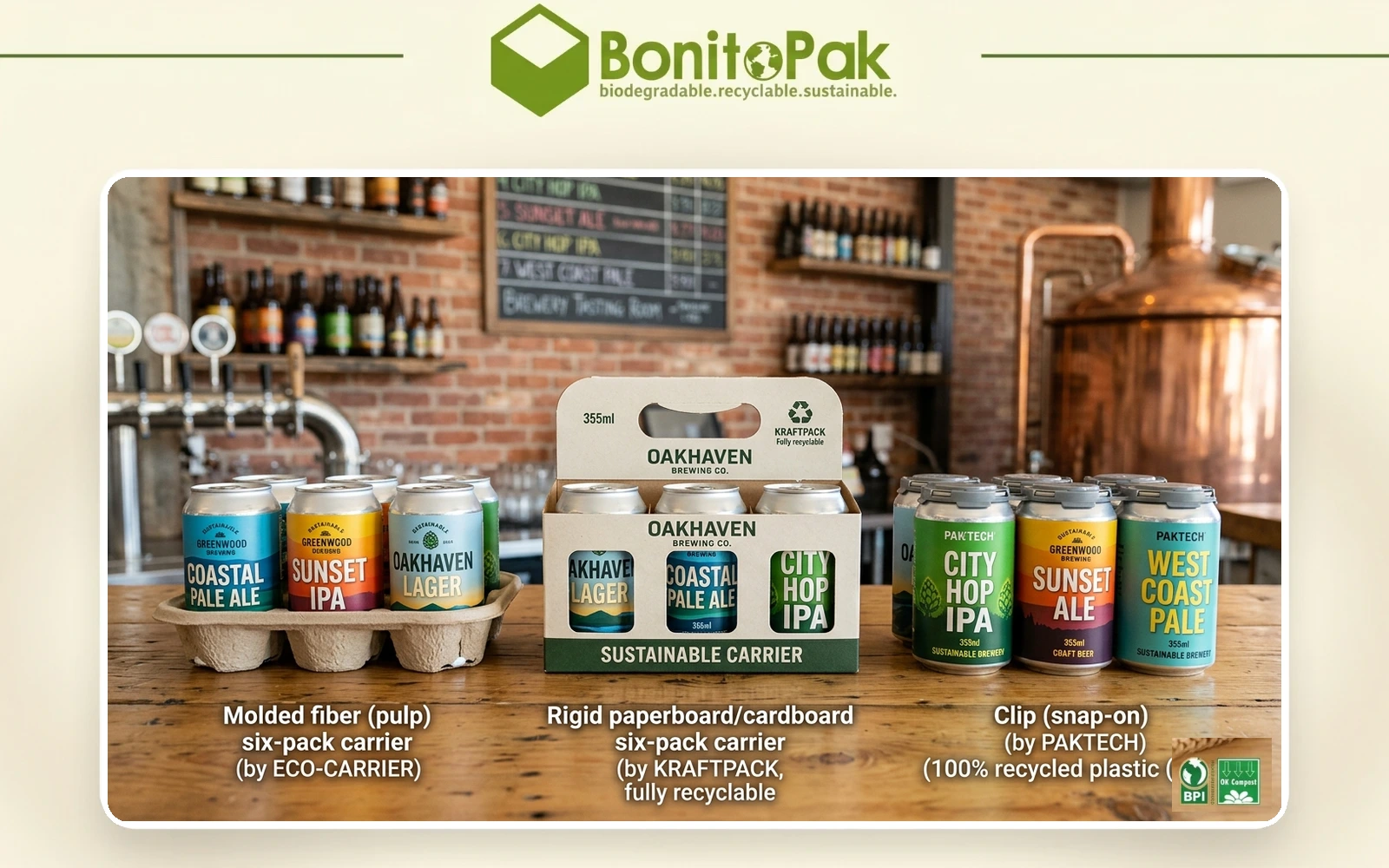
Where fibre carriers win: disposal is simpler for the consumer, because paper recycling is available to far more Canadians than industrial composting. Branding area is larger, embossing is possible, and the carrier can take the pack’s weight through a handle.
Where paperboard wins: shelf presence and print area, which matters for provincial liquor board retail listings. All three count as sustainable can carriers; they simply route differently at end of life.
Our comparison of the four types of moulded pulp covers why a dry-pressed carrier cushions differently from a wet-pressed one, our article on can carrier sizing covers the fit question that applies to every format, and our guide to wet pressing versus dry pressing covers the process choice behind it.
The Composting Access Problem
This is the honest weakness of any compostable packaging claim in North America, and it deserves stating plainly rather than glossed over.
Industrial composting access is limited. In the United States, BioCycle’s 2023 survey found municipal food waste collection reaching roughly 12% of households, and relatively few of those programmes accept moulded fibre containers. Canadian access is better in some municipalities and absent in others, and it varies by province rather than nationally.
What that means practically. A compostable ring carrier sold into a market with no composting access will usually end up in landfill, where its compostability does little. A fibre carrier that recycles with paper reaches a far larger share of Canadian households through existing kerbside paper collection.
That is not an argument against compostable rings. It is an argument for matching the disposal route to where you actually sell. Our article on whether egg cartons are recyclable or compostable covers the same distinction for fibre packaging generally, and the logic transfers directly.
Provincial EPR and Fees
Federal rules decide what you may use. Provincial rules decide what you pay.
Extended producer responsibility programmes for packaging operate across several Canadian provinces, with producer fees that vary by material category. Fibre materials recycling through established paper streams generally sit in lower fee bands than plastics.
Two things to confirm if you sell across provinces:
- Your registration and reporting obligations in each province
- Which provincial programmes actually accept the carrier you have chosen, since a technically recyclable or compostable item that no local programme accepts does not improve your fee position
Ask suppliers for their position on this in writing. Most will give you a material description; fewer will tell you which Canadian programmes accept the finished item.
Making the Claim Correctly
If you print a sustainability claim on your pack, the claim has to hold up.
- “Compostable” needs a named standard and a certificate. Ask which one, and whether it covers commercial composting only or home composting too. These are separate certifications.
- “Recyclable” needs to reflect real local acceptance, not technical recyclability.
- Avoid unqualified “biodegradable.” It is the weakest and most challenged claim in packaging, and regulators in multiple jurisdictions have pushed back on it.
- Keep artwork space for mandatory text. Alcohol packaging carries its own requirements in Canada, and a compliance element with nowhere to sit becomes a reprint.
Have your final wording reviewed by someone qualified before printing. A wrong claim on a season of packaging is expensive to withdraw.
Choosing Between Sustainable Can Carriers
Work through this before you commit a season of packaging.
- Confirm the regulatory position of any candidate product in writing from the supplier.
- Map your disposal reality. Which provinces do you sell into, and what do their programmes accept?
- Check your equipment. Do you own an applicator, and will the candidate run on it at line speed?
- Request samples and test properly. Real cans, real line speed, real cold storage, real transit route.
- Price the full picture. Unit cost, plus labour, plus provincial fees, plus freight. Fibre nests, which affects freight meaningfully.
- Then choose. And only then order volume. Our guide to the landed cost of moulded pulp packaging covers how to price an imported option against a domestic one.
Most brewers who follow that order end up somewhere different from where they started, which is the point of running it.
Choosing Well After the Ban
Eco friendly six pack rings Canada brewers can buy are a legitimate option, and a good fit for breweries with ring equipment, a ring-based brand identity and sales into regions with composting access. For everyone else, a moulded fibre carrier usually gives a simpler disposal story to the consumer, more branding area, and a disposal route that most Canadian households can actually use.
The deciding questions are not about which material sounds greenest. They are about where you sell, what your line can run, and what your customer can realistically do with the pack.
At BonitoPak we make moulded fibre carriers and trays through our mould design and tooling team, with moulds cut per project from 1,000 pieces, in six pulp colour systems with embossing, BPI and OK Compost certified. We do not make ring carriers, so if a ring format is right for your brand we are not your supplier and will say so. If a fibre carrier is worth comparing, send us a few of your cans and your annual volume.
FAQs
Q: Are compostable six pack rings legal in Canada? A: The prohibition targets plastic ring carriers, and whether a specific alternative material falls inside its definition depends on the product. Get the supplier’s regulatory position in writing and confirm with Environment and Climate Change Canada rather than relying on marketing claims.
Q: What are the main eco friendly alternatives to plastic six pack rings? A: Fibre-based compostable rings such as E6PR, moulded fibre can carriers, fibre can collars and printed paperboard baskets. Each differs on material use, disposal route, branding area and whether an applicator is needed.
Q: Do compostable rings actually get composted in Canada? A: Often not, because industrial composting access varies by municipality and many programmes do not accept fibre packaging. Check acceptance in the provinces you sell into before relying on composting as the disposal story on your pack.
Q: Are moulded fibre carriers better than compostable rings? A: Neither is universally better. Rings use less material and keep a familiar format. Fibre carriers recycle through paper streams most Canadians can access, offer more branding area and can carry pack weight through a handle.
Q: What should I check before switching carrier format? A: The supplier’s regulatory position in writing, which compostability standard any claim is certified against, provincial programme acceptance, applicator compatibility at your line speed, and sample performance in your real cold storage and transit conditions.