Canadian breweries have had to rethink six-pack packaging faster than most. The federal Single-use Plastic Prohibition Regulations banned plastic ring carriers on a staged timetable, and the industry moved to fibre carriers, paperboard baskets and moulded plastic clips in response. Each behaves differently on a canning line, costs differently per unit, and fits a different can profile.
This guide covers the formats available for a 6 pack can carrier Canada brewers can actually buy, why can diameter decides fit more than volume does, where the regulatory lines sit, and how to specify a carrier properly.
Why the Canadian Market Changed
Canada’s Single-use Plastic Prohibition Regulations list plastic ring carriers among the prohibited single-use plastic items. The timetable ran as follows:
|
Activity |
Prohibited from |
|---|---|
|
Manufacture and import for sale in Canada |
June 20, 2023 |
|
Sale in Canada |
June 20, 2024 |
|
Manufacture, import and sale for export |
December 20, 2025 |
The practical effect is that conventional plastic ring carriers are no longer a route for the Canadian market. Breweries moved to alternatives, and the alternatives are now the market rather than the exception.
If you are weighing compostable ring carriers specifically, those sit in a different category with their own considerations, and are worth assessing separately from the fibre and paperboard formats covered here.
The Four Format Families
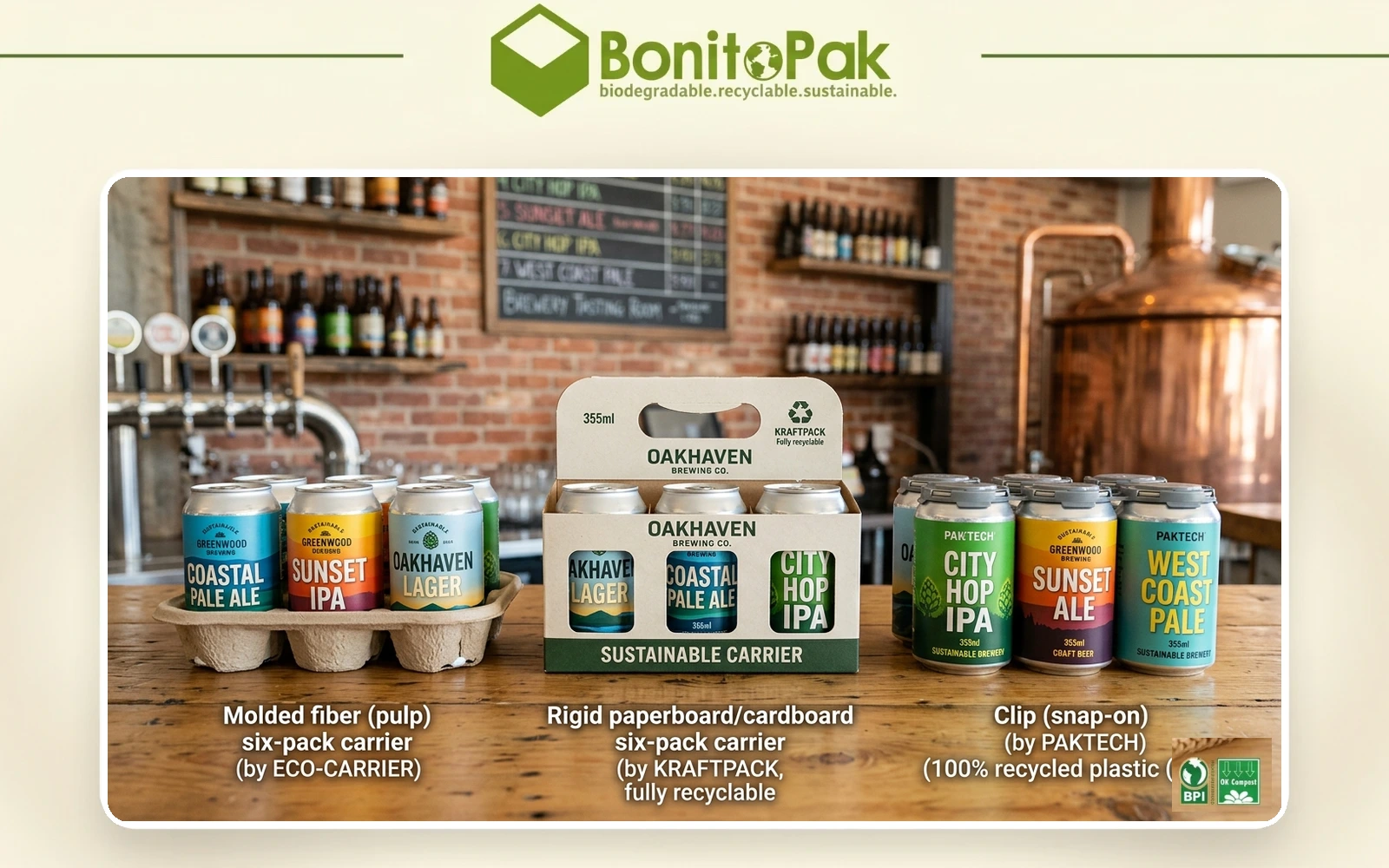
Four families of can carriers Canada brewers use have replaced the plastic ring.
|
Format |
What it is |
Strengths |
Trade-offs |
|---|---|---|---|
|
Fibre can carrier |
Pulp tray or clip formed from recycled fibre or bagasse |
Recyclable with paper, compostable, printable, plastic-free |
Needs tooling for bespoke shapes |
|
Fibre can collar |
A fibre collar applied over can tops, such as CanCollar |
Minimal material, plastic-free |
Requires compatible applicator |
|
Paperboard basket or wrap |
Folded printed board carrier |
Large print area, familiar retail look |
More material, less moisture tolerant |
|
Moulded plastic clip |
Injection-moulded handle carriers such as PakTech |
Durable, reusable, widely used in craft beer |
Plastic, though often recycled HDPE |
Each has a legitimate place. A taproom selling four-packs over the counter has different needs from a brewery shipping pallets to provincial liquor boards.
Can Diameter Decides Fit
This is the single most common specification error, and it costs a mould.
Canadian beverage cans come in several profiles, and a carrier cut for one will not hold another securely. The 355 ml standard can and the 355 ml sleek can hold the same volume with different diameters. A carrier sized for a standard can leaves a sleek can loose, and a carrier cut for sleek cans will not accept a standard can at all.
What to measure and send your supplier:
- Can body diameter at the widest point
- Can height
- End diameter, since the 202 end is standard on many formats but not all
- Filled can weight
- Whether you run more than one can profile on the same line
Send physical cans, not a spec sheet. Our article on why can carrier sizing depends on diameter rather than volume covers this in more depth, and it is the first thing to settle before anyone quotes tooling.
Where to Buy in Canada
The Canadian market is served by a mix of domestic manufacturers, distributors and importers.
Domestic brewery can carriers. CKF Inc is the principal Canadian-owned moulded pulp manufacturer, running four pulp plants across Canada with locations including Hantsport in Nova Scotia, Rexdale in Ontario and Langley in British Columbia. Its range includes moulded fibre cup carriers, which is directly adjacent capability.
Plastic clip carriers. PakTech handle carriers are widely used across North American craft beer and are stocked by Canadian homebrew and brewery supply retailers. Roberts PolyPro produces Craft-Pak can carriers in four and six-pack standard configurations.
Fibre collars. CanCollar, from Smurfit Westrock, is a fibre can collar system used by breweries moving away from plastic.
Paperboard carriers. Canadian suppliers including Kimeco Pak list six-pack cardboard beer carriers, and Pakit Products offers a recyclable six-pack cardboard can carrier. Liquor Store Products carries plain and printed board carriers.
Importers and bespoke manufacturers. For a custom carrier in a specific colour or with embossed branding, import is usually the route, since domestic tooling options for bespoke brewery can carriers are limited.
Ask every supplier: which can profile the carrier is cut for, carriers per pallet, whether it runs on your existing applicator or needs hand packing, and what the lead time is for restocking.
Line Compatibility Is the Hidden Cost
The format that looks cheapest per unit can be the dearest once labour is counted.
Hand-applied carriers suit small taproom volumes and need no capital. They also need a person, and at a few thousand units a week that labour cost outruns the unit price difference quickly.
Applicator-dependent formats, including most fibre collars and some clip systems, need compatible equipment. If you do not already have it, the capital cost belongs in your comparison.
Nesting and storage. Moulded pulp carriers nest, which saves both freight and warehouse space. Paperboard arrives flat and needs forming. Plastic clips nest tightly. These differences are small per unit and real at pallet scale.
Test before committing. Run a sample through your actual line, with your actual cans, at your actual speed. A carrier that works by hand on a bench may jam at line speed.
Provincial Recycling and EPR
Federal rules set what you cannot use. Provincial rules shape what you pay.
Extended producer responsibility programmes for packaging operate across several Canadian provinces, with producer fees that vary by material. Fibre generally sits in a lower fee band than plastic because it recycles through established paper streams.
If you sell across provinces, confirm your registration and reporting obligations in each, and ask any supplier offering a recyclability claim which Canadian programmes actually accept the item. A carrier that is technically recyclable but not accepted in the provinces you sell into does not help your fee position.
Choosing a Format
|
Your situation |
Likely best fit |
|---|---|
|
Taproom and farmers market sales |
Paperboard basket or hand-applied fibre carrier |
|
Growing brewery, no applicator capital |
Plastic clip carriers or board |
|
Plastic-free brand positioning |
Moulded fibre carrier or fibre collar |
|
Provincial liquor board retail listings |
Printed paperboard or printed fibre, for shelf presence |
|
High volume, bespoke branding |
Moulded fibre with custom tooling |
|
Multiple can profiles on one line |
A carrier specified for your largest profile, tested on both |
Our comparison of the four types of moulded pulp covers why a dry-pressed carrier behaves differently from a wet-pressed one, and our guide to wet pressing versus dry pressing covers how to choose between them.
Specifying a Bespoke Fibre Carrier
If you go the custom route, these are the inputs that decide the quote.
- Can profile measurements, with physical samples sent
- Pack configuration, six-pack in a 2×3 or other layout
- Whether you need a handle, and what weight it must carry
- Print, embossing or plain fibre
- Pulp colour, if not natural
- Annual volume, which decides whether tooling amortises sensibly
- Whether the carrier must run on an existing applicator
Our page on mould design and tooling covers what gets cut. Expect a sample before production tooling, and test it properly. A production mould that needs a geometry change is generally replaced rather than modified, so the sample stage is the cheapest insurance in the project. Our guide to the custom moulded pulp development timeline sets out the stages.
Getting the Specification Right
The 6 pack can carrier Canada market settled quickly after the ring carrier prohibition, and the formats available now are mature. The decisions that actually matter are can diameter fit, line compatibility and provincial fee exposure, in that order. Unit price is the one most buyers lead with and the one that moves least.
Measure your cans. Send samples. Test on your real line at real speed. And ask every supplier for carriers per pallet, because with a bulky light product that figure decides your landed cost more than the quote does.
At BonitoPak we make moulded fibre carriers and trays with moulds cut per project from 1,000 pieces, in six pulp colour systems with embossing available. Send us a few of your cans and your annual volume and we will come back with a drawing. For stock paperboard or clip carriers next week, a Canadian distributor will serve you better and we will say so.
FAQs
Q: Are plastic ring carriers still legal in Canada? A: No. Canada’s Single-use Plastic Prohibition Regulations banned manufacture and import for sale from June 20, 2023, sale from June 20, 2024, and manufacture, import and sale for export from December 20, 2025. Breweries use fibre, board or clip alternatives instead.
Q: Will a 6 pack can carrier fit both standard and sleek 355 ml cans? A: Usually not. The two profiles hold the same volume at different diameters, so a carrier cut for one holds the other loosely or not at all. Specify your largest profile and test both before committing to tooling.
Q: What do can carriers Canada breweries use most? A: It varies by scale. Small taprooms lean on paperboard baskets and hand-applied carriers. Growing breweries commonly use moulded plastic clip carriers. Brands positioning as plastic-free move to moulded fibre carriers or fibre collars.
Q: Do I need special equipment for a fibre can carrier? A: It depends on the format. Many moulded fibre carriers can be hand-applied at low volume, while fibre collar systems generally need a compatible applicator. Include any capital cost in your comparison rather than judging on unit price alone.
Q: How do provincial EPR fees affect carrier choice? A: Producer fees vary by material across the provinces running packaging EPR, and fibre usually sits in a lower band than plastic. Confirm obligations in each province you sell into, and check which programmes actually accept the carrier.