Buyers order egg cartons by cell count. They should be ordering by egg grade first.
The USDA weight classes run peewee at 35 grams per egg, small at 43, medium at 50, large at 57, extra large at 64, and jumbo at 71 grams and above. Those weights translate directly into physical dimensions. A jumbo egg is roughly 8 mm taller and 5 mm wider than a large egg. That difference decides whether the lid closes on the shell or clears it.
A carton cut for large eggs will hold jumbos, but the lid contacts the shell tops. Under stacking load, that contact becomes point pressure on the strongest but most brittle part of the egg. The result is hairline cracking that shows up as leakage days later, and the packer usually blames handling rather than the carton.
We tool a standard bed for peewee through large, and a deep bed for extra large and jumbo. Producers running a mixed flock, which is most small and mid-size operations, generally specify the deep bed and accept a slightly looser fit on smaller eggs. Loose is safe. Tight is not.
What a grading station needs that a farm stand does not
Commercial packers and direct sellers want opposite things from the same product.
A grading station is running eggs through automated equipment at speed. The carton has to arrive with consistent dimensions run to run, hold tolerance on the infeed width, and open and close under machine force without hinge failure. Branding is usually irrelevant, since the eggs are packed for a retailer who applies their own labeling.
A farm direct seller wants the opposite. Volume is low, hand packing is normal, dimensional tolerance is forgiving, and the carton is a large part of how the product presents. Branding is the whole point.
We supply both from the same molds. What changes is the finishing: blank and bulk nested for the packer, embossed or printed and often color matched for the direct seller.
Cell geometry and how load actually travels
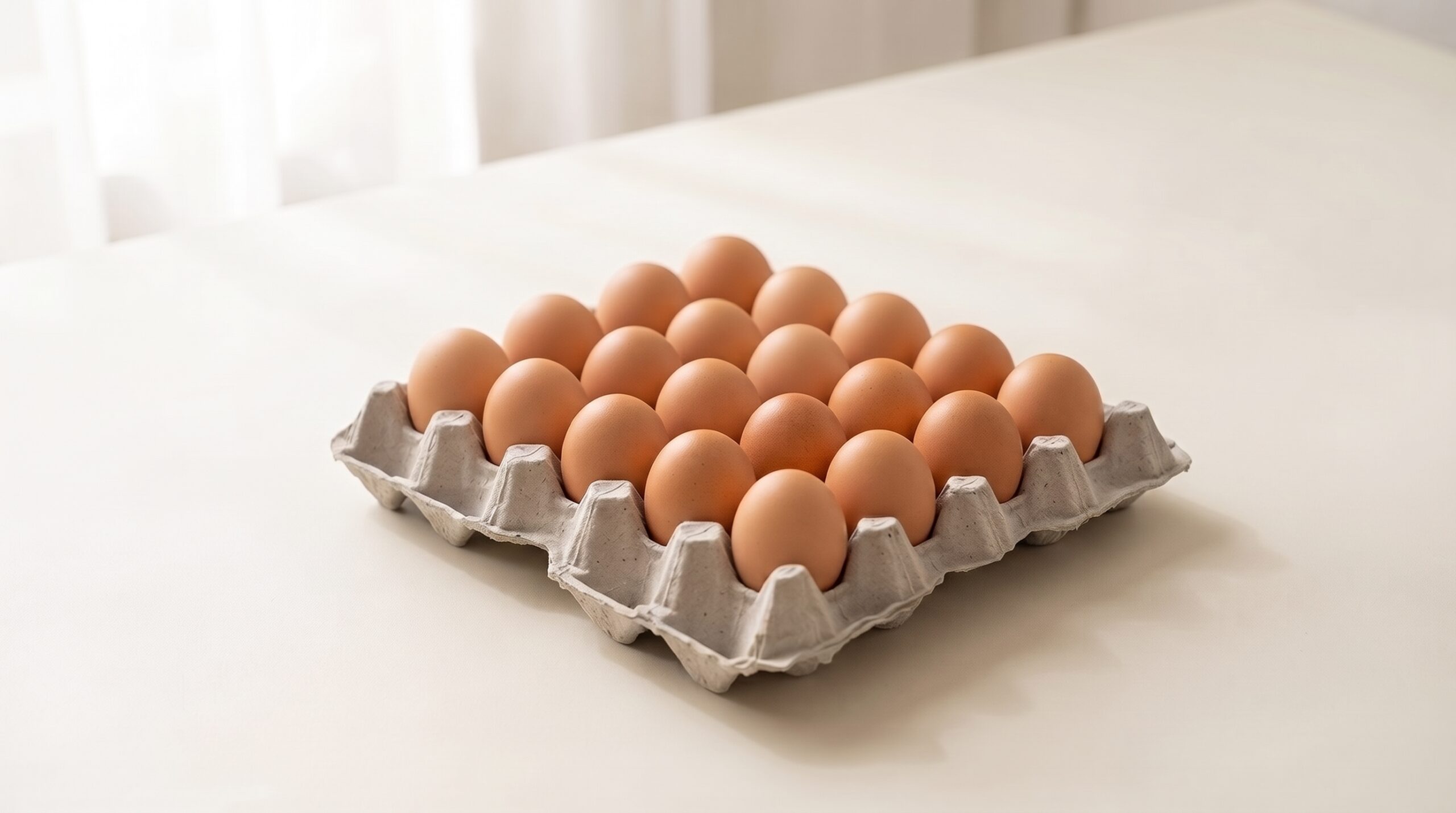
The visible part of the carton is the cell. The functional part is the cone between cells.
Each cone rises from the base to meet the lid when the carton closes. In a filled and closed carton, those cones become short vertical columns. Weight from the carton above lands on the cone tops, travels down through the cone walls, and lands on the base. The eggs sit in the voids between the columns and carry none of it.
This is why a molded pulp carton weighing 50 grams can support several kilograms in a pallet stack without deforming. It is also why cartons fail when they are packed open or short filled, since an unclosed lid leaves the columns disengaged and the structure incomplete.
Practically, this means cartons should be closed before stacking, and half filled cartons should not go to the bottom of a pallet. Packers know this. Farm sellers often do not.
Fiber source and what recycled means here
Chicken egg cartons are one of the oldest recycled paper products in continuous production. The fiber going into them has typically been through several use cycles already, which is why it is short, why it forms well, and why it is not suitable for most other paper products.
Short fiber is an advantage in molding. It flows into detail, drains predictably on the mold screen, and produces a dense wall without the long fiber tangles that cause thin spots. The characteristic gray-brown color comes from mixed recycled stock rather than from any added pigment.
That same short fiber is why municipal recycling programs vary in whether they accept egg cartons. The fibers are near the end of their usable life for repulping. Home composting is reliable across the board, since the material is untreated cellulose with no coating, film, or adhesive.
Storage before the eggs go in
Empty cartons need dry storage, and this is where a surprising share of quality complaints originate. Pulp will take on moisture from a damp warehouse over weeks, softening the hinge and reducing top load strength before the carton has held a single egg. Store nested stacks off the floor, away from exterior walls, and under cover. Cartons stored correctly hold their specification for a year or more.
Choosing the right count for a flock
Cell count should follow production volume and sales channel, not habit.
Le dozen egg carton remains the volume standard for anything going to retail. The 6 egg carton suits small flocks and premium lines where full dozens are hard to fill or too expensive at the shelf. The 18 egg carton covers value packs and club formats. The 4 egg carton handles gift and sampler sales.
Producers who also keep quail should specify quail egg cartons separately rather than using a chicken carton, since the cell geometry is not compatible in either direction.