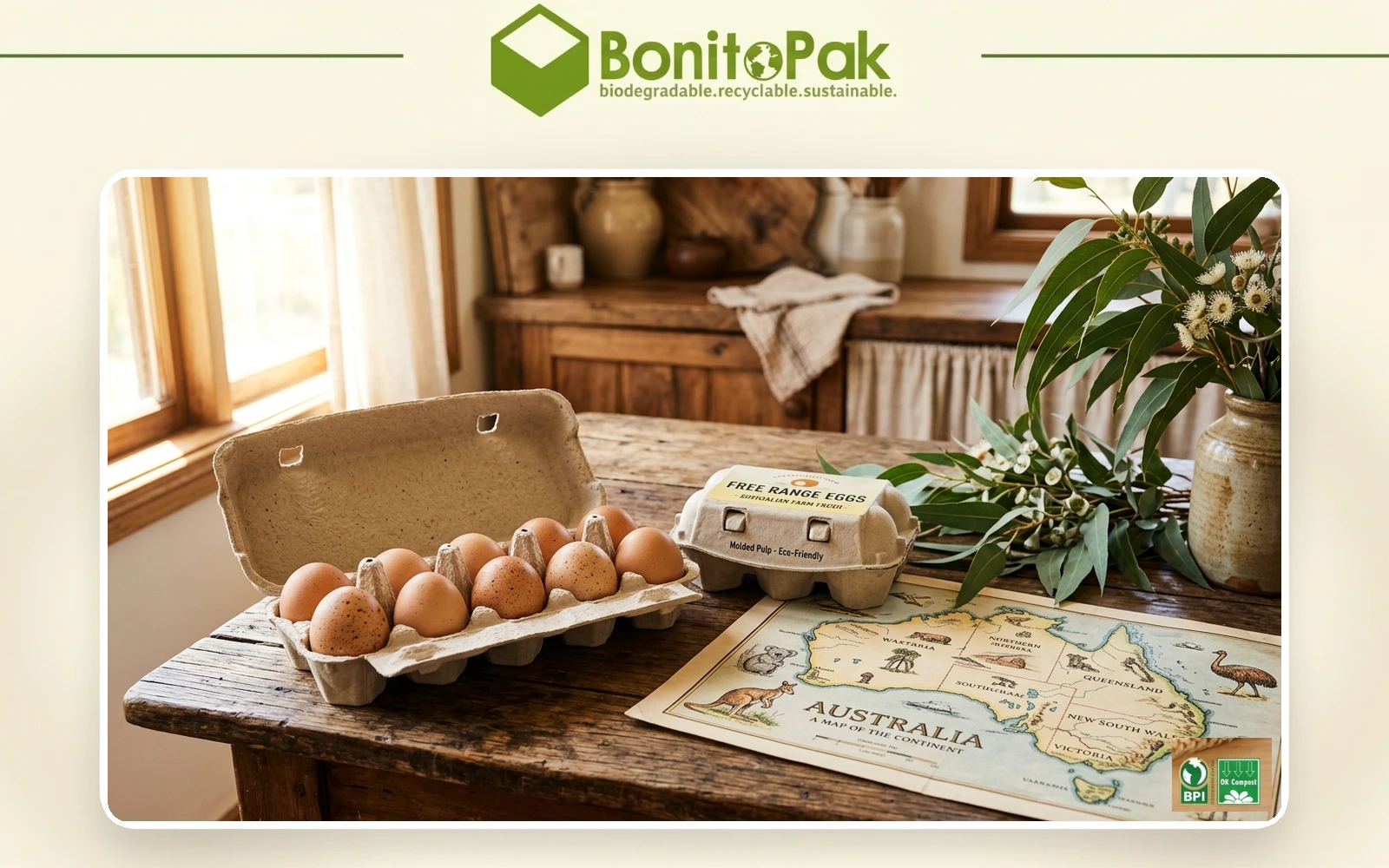
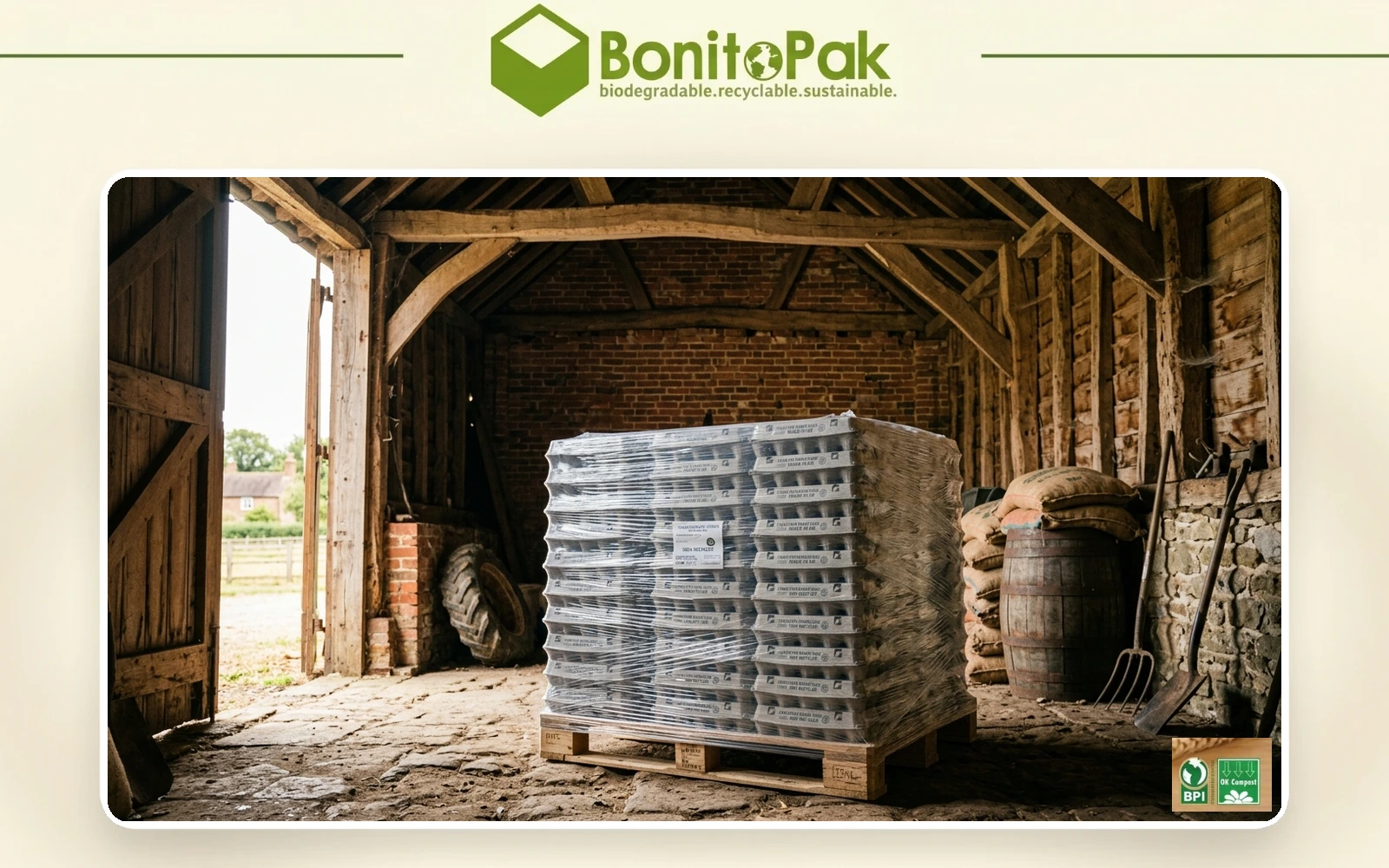
Molded Pulp Chicken Egg Cartons

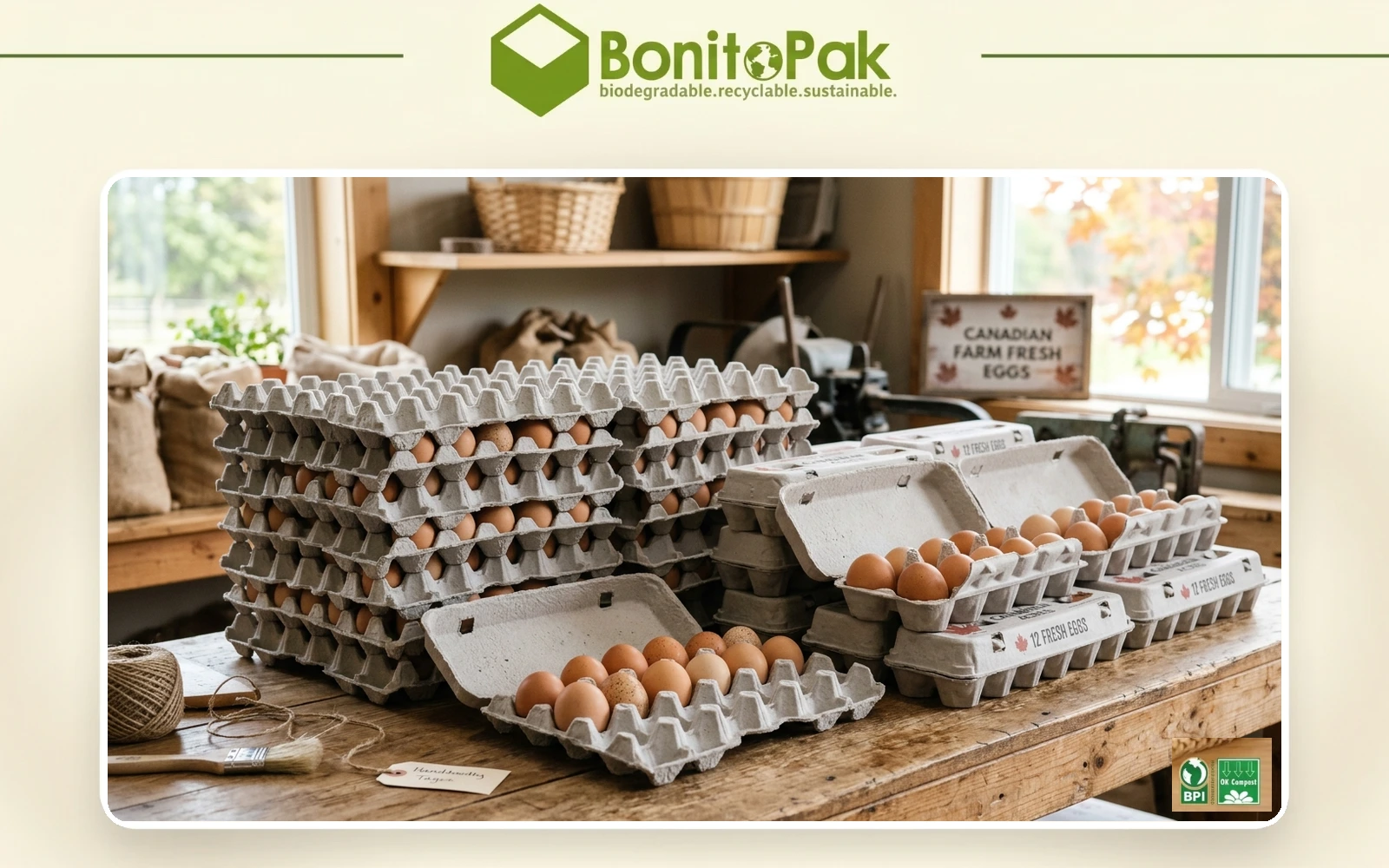
The BonitoPak molded pulp chicken egg carton is formed to the USDA weight grades, from peewee through jumbo, in every standard cell count.

  • Cell depth specified by egg weight grade rather than one depth for all sizes
  • Available in 4, 6, 12, 18, and 20 cell configurations
  • Formed from 100% recycled paper pulp, biodegradable and home compostable
  • Rib and cone geometry carries stacking load around the eggs rather than through them
  • Supplied blank for grading stations or printed for farm direct and retail brands
  • Natural pulp plus six stock colors; custom shade matching available
  • OEM and ODM sizing accepted; compatible with common packing line specifications

Public Mould

Packaging Solutions

3D Design

Customized Mould

Product Description

Specification Details
Brand Name BonitoPak
Model Number EC-CH series
Product Name Chicken Egg Carton / Molded Pulp Egg Carton
Material Recycled paper pulp
Paper Type Post-consumer recycled paper
Technique Molded pulp forming (wet-pressed)
Cell Count 4, 6, 12, 18, or 20 cells
Egg Size Range Peewee (35 g) through jumbo (71 g and above)
Cell Depth Options Standard bed and deep bed for extra large and jumbo
Unit Weight 20 to 85 g depending on cell count
Color Natural pulp; six stock colors; custom color matching
Shape & Style Top-fold clamshell, front locking tab; flat top available
Logo Printing Embossed, debossed, or flexographic print
Industrial Use Layer farms, grading stations, packers, retail grocery
Application Commercial and farm direct chicken egg packing across all grades
Size OEM and custom dimensions accepted
Advantages Biodegradable, home compostable, nestable, plastic free
Packaging Bulk nested in export cartons; custom packing accepted
Custom Order Accepted
MOQ Confirm with sales; stock molds carry a lower minimum than custom tooling

Gallery of Molded Pulp Chicken Egg Cartons parts

This gallery showcases the exceptional quality and attention to detail we deliver in every project. From complex designs to flawless finishes, each image reflects our commitment to excellence in Molded Pulp Chicken Egg Cartons .

40%

Cost & Time Saved

Experience leading packaging solutions that optimize your costs and time, delivering efficient processes and maximizing your ROI.

50%

More sustainable

Achieve eco-friendly packaging with sustainable materials, reducing waste and promoting environmental responsibility across your product lines.

25%

Increase in Sales

Enhance your product’s shelf appeal with innovative designs that boost visibility and sales in both retail and online markets.

100%

More Reliable

Trust in BonitoPak’s commitment to quality, ensuring that every product meets our high standards with consistent, reliable service.

Grade, not count, decides the carton

Buyers order egg cartons by cell count. They should be ordering by egg grade first.

The USDA weight classes run peewee at 35 grams per egg, small at 43, medium at 50, large at 57, extra large at 64, and jumbo at 71 grams and above. Those weights translate directly into physical dimensions. A jumbo egg is roughly 8 mm taller and 5 mm wider than a large egg. That difference decides whether the lid closes on the shell or clears it.

A carton cut for large eggs will hold jumbos, but the lid contacts the shell tops. Under stacking load, that contact becomes point pressure on the strongest but most brittle part of the egg. The result is hairline cracking that shows up as leakage days later, and the packer usually blames handling rather than the carton.

We tool a standard bed for peewee through large, and a deep bed for extra large and jumbo. Producers running a mixed flock, which is most small and mid-size operations, generally specify the deep bed and accept a slightly looser fit on smaller eggs. Loose is safe. Tight is not.

What a grading station needs that a farm stand does not

Commercial packers and direct sellers want opposite things from the same product.

A grading station is running eggs through automated equipment at speed. The carton has to arrive with consistent dimensions run to run, hold tolerance on the infeed width, and open and close under machine force without hinge failure. Branding is usually irrelevant, since the eggs are packed for a retailer who applies their own labeling.

A farm direct seller wants the opposite. Volume is low, hand packing is normal, dimensional tolerance is forgiving, and the carton is a large part of how the product presents. Branding is the whole point.

We supply both from the same molds. What changes is the finishing: blank and bulk nested for the packer, embossed or printed and often color matched for the direct seller.

Cell geometry and how load actually travels

The visible part of the carton is the cell. The functional part is the cone between cells.

Each cone rises from the base to meet the lid when the carton closes. In a filled and closed carton, those cones become short vertical columns. Weight from the carton above lands on the cone tops, travels down through the cone walls, and lands on the base. The eggs sit in the voids between the columns and carry none of it.

This is why a molded pulp carton weighing 50 grams can support several kilograms in a pallet stack without deforming. It is also why cartons fail when they are packed open or short filled, since an unclosed lid leaves the columns disengaged and the structure incomplete.

Practically, this means cartons should be closed before stacking, and half filled cartons should not go to the bottom of a pallet. Packers know this. Farm sellers often do not.

Fiber source and what recycled means here

Chicken egg cartons are one of the oldest recycled paper products in continuous production. The fiber going into them has typically been through several use cycles already, which is why it is short, why it forms well, and why it is not suitable for most other paper products.

Short fiber is an advantage in molding. It flows into detail, drains predictably on the mold screen, and produces a dense wall without the long fiber tangles that cause thin spots. The characteristic gray-brown color comes from mixed recycled stock rather than from any added pigment.

That same short fiber is why municipal recycling programs vary in whether they accept egg cartons. The fibers are near the end of their usable life for repulping. Home composting is reliable across the board, since the material is untreated cellulose with no coating, film, or adhesive.

Storage before the eggs go in

Empty cartons need dry storage, and this is where a surprising share of quality complaints originate. Pulp will take on moisture from a damp warehouse over weeks, softening the hinge and reducing top load strength before the carton has held a single egg. Store nested stacks off the floor, away from exterior walls, and under cover. Cartons stored correctly hold their specification for a year or more.

Choosing the right count for a flock

Cell count should follow production volume and sales channel, not habit.

The dozen egg carton remains the volume standard for anything going to retail. The 6 egg carton suits small flocks and premium lines where full dozens are hard to fill or too expensive at the shelf. The 18 egg carton covers value packs and club formats. The 4 egg carton handles gift and sampler sales.

Producers who also keep quail should specify quail egg cartons separately rather than using a chicken carton, since the cell geometry is not compatible in either direction.

Grade, not count, decides the carton

Buyers order egg cartons by cell count. They should be ordering by egg grade first.

The USDA weight classes run peewee at 35 grams per egg, small at 43, medium at 50, large at 57, extra large at 64, and jumbo at 71 grams and above. Those weights translate directly into physical dimensions. A jumbo egg is roughly 8 mm taller and 5 mm wider than a large egg. That difference decides whether the lid closes on the shell or clears it.

A carton cut for large eggs will hold jumbos, but the lid contacts the shell tops. Under stacking load, that contact becomes point pressure on the strongest but most brittle part of the egg. The result is hairline cracking that shows up as leakage days later, and the packer usually blames handling rather than the carton.

We tool a standard bed for peewee through large, and a deep bed for extra large and jumbo. Producers running a mixed flock, which is most small and mid-size operations, generally specify the deep bed and accept a slightly looser fit on smaller eggs. Loose is safe. Tight is not.

What a grading station needs that a farm stand does not

Commercial packers and direct sellers want opposite things from the same product.

A grading station is running eggs through automated equipment at speed. The carton has to arrive with consistent dimensions run to run, hold tolerance on the infeed width, and open and close under machine force without hinge failure. Branding is usually irrelevant, since the eggs are packed for a retailer who applies their own labeling.

A farm direct seller wants the opposite. Volume is low, hand packing is normal, dimensional tolerance is forgiving, and the carton is a large part of how the product presents. Branding is the whole point.

We supply both from the same molds. What changes is the finishing: blank and bulk nested for the packer, embossed or printed and often color matched for the direct seller.

Cell geometry and how load actually travels

The visible part of the carton is the cell. The functional part is the cone between cells.

Each cone rises from the base to meet the lid when the carton closes. In a filled and closed carton, those cones become short vertical columns. Weight from the carton above lands on the cone tops, travels down through the cone walls, and lands on the base. The eggs sit in the voids between the columns and carry none of it.

This is why a molded pulp carton weighing 50 grams can support several kilograms in a pallet stack without deforming. It is also why cartons fail when they are packed open or short filled, since an unclosed lid leaves the columns disengaged and the structure incomplete.

Practically, this means cartons should be closed before stacking, and half filled cartons should not go to the bottom of a pallet. Packers know this. Farm sellers often do not.

Fiber source and what recycled means here

Chicken egg cartons are one of the oldest recycled paper products in continuous production. The fiber going into them has typically been through several use cycles already, which is why it is short, why it forms well, and why it is not suitable for most other paper products.

Short fiber is an advantage in molding. It flows into detail, drains predictably on the mold screen, and produces a dense wall without the long fiber tangles that cause thin spots. The characteristic gray-brown color comes from mixed recycled stock rather than from any added pigment.

That same short fiber is why municipal recycling programs vary in whether they accept egg cartons. The fibers are near the end of their usable life for repulping. Home composting is reliable across the board, since the material is untreated cellulose with no coating, film, or adhesive.

Storage before the eggs go in

Empty cartons need dry storage, and this is where a surprising share of quality complaints originate. Pulp will take on moisture from a damp warehouse over weeks, softening the hinge and reducing top load strength before the carton has held a single egg. Store nested stacks off the floor, away from exterior walls, and under cover. Cartons stored correctly hold their specification for a year or more.

Choosing the right count for a flock

Cell count should follow production volume and sales channel, not habit.

The dozen egg carton remains the volume standard for anything going to retail. The 6 egg carton suits small flocks and premium lines where full dozens are hard to fill or too expensive at the shelf. The 18 egg carton covers value packs and club formats. The 4 egg carton handles gift and sampler sales.

Producers who also keep quail should specify quail egg cartons separately rather than using a chicken carton, since the cell geometry is not compatible in either direction.

Materials for Molded Pulp Chicken Egg Cartons Parts

Leading companies and engineers rely on BonitoPak for rapid iterations and durable, high-quality parts. Whether it’s for prototyping or full-scale production, our wide range of materials ensures we meet the unique requirements of any Molded Pulp Chicken Egg Cartons project with precision and speed.

Compostable kraft paper is the strongest fiber we form. Made from virgin

Colored pulp is not a separate fiber. It is any of our

Bleached pulp is the material to specify when the part has to

Natural plant fiber covers the non-wood cellulose sources we blend outside the

Corrugated paper as a molded pulp material means recovered cardboard boxes repulped

Straw fiber is made from the stalks left after grain harvest, material

Custom Eco-Friendly Reliable

Custom, Eco-Friendly Packaging Excellence

Fully Customizable

Customize your packaging with tailored styles, sizes, colors, and finishes to meet specific needs.

Expert Support

Bonitopak provides expert design and logistics advice to maximize packaging efficiency and boost ROI.

Eco Solutions

Choose sustainable, eco-friendly packaging to reduce environmental impact and support your brand’s green goals.

Quality Assurance

Bonitopak guarantees top-quality service and product excellence with every packaging solution.

Frequently Asked Questions

Chicken Egg Carton

  • Do you supply cartons that work on Moba or Diamond grading equipment?

    We supply to dimensional specification, and buyers running Moba, Diamond, or Sanovo equipment provide us the required carton tolerances from their machine documentation. We then produce and sample against those figures. We do not certify against specific equipment brands, since certification sits with the machine operator’s own trial.

  • How does molded pulp compare to foam on egg breakage rates?

    Both perform well in transit, and neither has a decisive edge on breakage when correctly specified. The differences that matter commercially are elsewhere: pulp composts and foam does not, pulp nests for lower inbound freight, and an increasing number of retailers and jurisdictions restrict foam. We do not produce foam, so we would rather state that plainly than argue a performance gap that the data does not support.

  • Can I use the same carton for washed and unwashed eggs?

    The carton does not differ. What differs is handling and storage, since washed eggs have lost the natural cuticle and need refrigeration, while unwashed eggs can be held at room temperature in many jurisdictions. Pulp handles both because it regulates moisture rather than sealing it in.

  • Does a pullet egg need a different carton?

    Pullet eggs from young hens fall into the peewee and small grades, roughly 35 to 43 grams, and they sit low in a standard bed. They are safe there, but they look sparse in the carton, which matters for retail presentation. Producers selling pullet eggs as a distinct product often use a shallower dedicated mold so the pack looks full.

  • What egg grade should I specify if my flock lays inconsistently?

    Specify to your largest regular egg, not your average. A smaller egg in a deeper cell is protected. A larger egg in a shallow cell takes lid pressure and cracks. Most mixed flocks are best served by the deep bed, which covers extra large and jumbo while still holding large eggs securely enough for transport.

Biodegradable Result

0 Days

7 Days

14 Days

30 Days

Specialist industries

Having produced millions of parts, BonitoPak holds deep knowledge in numerous applications. We excel particularly in industries requiring precise and intricate component fabrication. Trust us to deliver expertise and quality, no matter the complexity.

OEM and ODM Packaging Solutions

Bonitopak offers both custom (OEM) and pre-designed (ODM) packaging solutions. Whether you need fully tailored designs or ready-to-use packaging, we provide high-quality, efficient, and flexible options to meet your brand’s needs.

OEM Services

OEM packaging solutions allow you to create fully customized products designed and manufactured to meet your specific requirements. At Bonitopak, we offer comprehensive support throughout the design, prototyping, and manufacturing process, ensuring your packaging reflects your brand’s unique identity. Our precision manufacturing capabilities guarantee high-quality and consistent production, no matter the complexity of the design. With end-to-end service, we handle everything from concept to delivery, helping you streamline your packaging needs.

ODM Services

ODM packaging solutions offer pre-designed products that can be tailored to your brand’s requirements. With Bonitopak’s innovative design expertise and efficient production process, you can choose from a wide range of ready-to-use packaging options. We provide flexible customization, allowing you to add your branding and select from various finishes, colors, and sizes. This solution saves time and cost while ensuring high-quality packaging that meets your brand standards.
Ready to Elevate Your Project?

Bring Your Designs to Life with BonitoPak

Experience precision engineering with BonitoPak. From detailed prototypes to high-volume production, we’re here to turn your concepts into reality. Contact us today to discuss your project needs!

Our Product Categories

Discover Bonitopak’s diverse range of packaging solutions, including molded pulp trays, food packaging, custom designs, and sustainable options. Each category is crafted for durability, functionality, and environmental responsibility, tailored to meet your specific needs.

Grade, not count, decides the carton

Buyers order egg cartons by cell count. They should be ordering by egg grade first.

The USDA weight classes run peewee at 35 grams per egg, small at 43, medium at 50, large at 57, extra large at 64, and jumbo at 71 grams and above. Those weights translate directly into physical dimensions. A jumbo egg is roughly 8 mm taller and 5 mm wider than a large egg. That difference decides whether the lid closes on the shell or clears it.

A carton cut for large eggs will hold jumbos, but the lid contacts the shell tops. Under stacking load, that contact becomes point pressure on the strongest but most brittle part of the egg. The result is hairline cracking that shows up as leakage days later, and the packer usually blames handling rather than the carton.

We tool a standard bed for peewee through large, and a deep bed for extra large and jumbo. Producers running a mixed flock, which is most small and mid-size operations, generally specify the deep bed and accept a slightly looser fit on smaller eggs. Loose is safe. Tight is not.

What a grading station needs that a farm stand does not

Commercial packers and direct sellers want opposite things from the same product.

A grading station is running eggs through automated equipment at speed. The carton has to arrive with consistent dimensions run to run, hold tolerance on the infeed width, and open and close under machine force without hinge failure. Branding is usually irrelevant, since the eggs are packed for a retailer who applies their own labeling.

A farm direct seller wants the opposite. Volume is low, hand packing is normal, dimensional tolerance is forgiving, and the carton is a large part of how the product presents. Branding is the whole point.

We supply both from the same molds. What changes is the finishing: blank and bulk nested for the packer, embossed or printed and often color matched for the direct seller.

Cell geometry and how load actually travels

The visible part of the carton is the cell. The functional part is the cone between cells.

Each cone rises from the base to meet the lid when the carton closes. In a filled and closed carton, those cones become short vertical columns. Weight from the carton above lands on the cone tops, travels down through the cone walls, and lands on the base. The eggs sit in the voids between the columns and carry none of it.

This is why a molded pulp carton weighing 50 grams can support several kilograms in a pallet stack without deforming. It is also why cartons fail when they are packed open or short filled, since an unclosed lid leaves the columns disengaged and the structure incomplete.

Practically, this means cartons should be closed before stacking, and half filled cartons should not go to the bottom of a pallet. Packers know this. Farm sellers often do not.

Fiber source and what recycled means here

Chicken egg cartons are one of the oldest recycled paper products in continuous production. The fiber going into them has typically been through several use cycles already, which is why it is short, why it forms well, and why it is not suitable for most other paper products.

Short fiber is an advantage in molding. It flows into detail, drains predictably on the mold screen, and produces a dense wall without the long fiber tangles that cause thin spots. The characteristic gray-brown color comes from mixed recycled stock rather than from any added pigment.

That same short fiber is why municipal recycling programs vary in whether they accept egg cartons. The fibers are near the end of their usable life for repulping. Home composting is reliable across the board, since the material is untreated cellulose with no coating, film, or adhesive.

Storage before the eggs go in

Empty cartons need dry storage, and this is where a surprising share of quality complaints originate. Pulp will take on moisture from a damp warehouse over weeks, softening the hinge and reducing top load strength before the carton has held a single egg. Store nested stacks off the floor, away from exterior walls, and under cover. Cartons stored correctly hold their specification for a year or more.

Choosing the right count for a flock

Cell count should follow production volume and sales channel, not habit.

The dozen egg carton remains the volume standard for anything going to retail. The 6 egg carton suits small flocks and premium lines where full dozens are hard to fill or too expensive at the shelf. The 18 egg carton covers value packs and club formats. The 4 egg carton handles gift and sampler sales.

Producers who also keep quail should specify quail egg cartons separately rather than using a chicken carton, since the cell geometry is not compatible in either direction.

Grade, not count, decides the carton

Buyers order egg cartons by cell count. They should be ordering by egg grade first.

The USDA weight classes run peewee at 35 grams per egg, small at 43, medium at 50, large at 57, extra large at 64, and jumbo at 71 grams and above. Those weights translate directly into physical dimensions. A jumbo egg is roughly 8 mm taller and 5 mm wider than a large egg. That difference decides whether the lid closes on the shell or clears it.

A carton cut for large eggs will hold jumbos, but the lid contacts the shell tops. Under stacking load, that contact becomes point pressure on the strongest but most brittle part of the egg. The result is hairline cracking that shows up as leakage days later, and the packer usually blames handling rather than the carton.

We tool a standard bed for peewee through large, and a deep bed for extra large and jumbo. Producers running a mixed flock, which is most small and mid-size operations, generally specify the deep bed and accept a slightly looser fit on smaller eggs. Loose is safe. Tight is not.

What a grading station needs that a farm stand does not

Commercial packers and direct sellers want opposite things from the same product.

A grading station is running eggs through automated equipment at speed. The carton has to arrive with consistent dimensions run to run, hold tolerance on the infeed width, and open and close under machine force without hinge failure. Branding is usually irrelevant, since the eggs are packed for a retailer who applies their own labeling.

A farm direct seller wants the opposite. Volume is low, hand packing is normal, dimensional tolerance is forgiving, and the carton is a large part of how the product presents. Branding is the whole point.

We supply both from the same molds. What changes is the finishing: blank and bulk nested for the packer, embossed or printed and often color matched for the direct seller.

Cell geometry and how load actually travels

The visible part of the carton is the cell. The functional part is the cone between cells.

Each cone rises from the base to meet the lid when the carton closes. In a filled and closed carton, those cones become short vertical columns. Weight from the carton above lands on the cone tops, travels down through the cone walls, and lands on the base. The eggs sit in the voids between the columns and carry none of it.

This is why a molded pulp carton weighing 50 grams can support several kilograms in a pallet stack without deforming. It is also why cartons fail when they are packed open or short filled, since an unclosed lid leaves the columns disengaged and the structure incomplete.

Practically, this means cartons should be closed before stacking, and half filled cartons should not go to the bottom of a pallet. Packers know this. Farm sellers often do not.

Fiber source and what recycled means here

Chicken egg cartons are one of the oldest recycled paper products in continuous production. The fiber going into them has typically been through several use cycles already, which is why it is short, why it forms well, and why it is not suitable for most other paper products.

Short fiber is an advantage in molding. It flows into detail, drains predictably on the mold screen, and produces a dense wall without the long fiber tangles that cause thin spots. The characteristic gray-brown color comes from mixed recycled stock rather than from any added pigment.

That same short fiber is why municipal recycling programs vary in whether they accept egg cartons. The fibers are near the end of their usable life for repulping. Home composting is reliable across the board, since the material is untreated cellulose with no coating, film, or adhesive.

Storage before the eggs go in

Empty cartons need dry storage, and this is where a surprising share of quality complaints originate. Pulp will take on moisture from a damp warehouse over weeks, softening the hinge and reducing top load strength before the carton has held a single egg. Store nested stacks off the floor, away from exterior walls, and under cover. Cartons stored correctly hold their specification for a year or more.

Choosing the right count for a flock

Cell count should follow production volume and sales channel, not habit.

The dozen egg carton remains the volume standard for anything going to retail. The 6 egg carton suits small flocks and premium lines where full dozens are hard to fill or too expensive at the shelf. The 18 egg carton covers value packs and club formats. The 4 egg carton handles gift and sampler sales.

Producers who also keep quail should specify quail egg cartons separately rather than using a chicken carton, since the cell geometry is not compatible in either direction.

Related Articles and Insights

Stay informed with the latest updates on sustainable packaging trends, industry insights, and expert tips through our blog. Explore innovative ideas and solutions to enhance your packaging knowledge.

Canada has a smaller domestic moulded pulp sector than the United States, but it has

Australia has one domestic moulded fibre egg carton manufacturer. Huhtamaki Australia describes itself as the

British egg packaging is sold differently from the American market. Where US suppliers talk in

Frequently Asked Questions

Chicken Egg Carton

  • Do you supply cartons that work on Moba or Diamond grading equipment?

    We supply to dimensional specification, and buyers running Moba, Diamond, or Sanovo equipment provide us the required carton tolerances from their machine documentation. We then produce and sample against those figures. We do not certify against specific equipment brands, since certification sits with the machine operator’s own trial.

  • How does molded pulp compare to foam on egg breakage rates?

    Both perform well in transit, and neither has a decisive edge on breakage when correctly specified. The differences that matter commercially are elsewhere: pulp composts and foam does not, pulp nests for lower inbound freight, and an increasing number of retailers and jurisdictions restrict foam. We do not produce foam, so we would rather state that plainly than argue a performance gap that the data does not support.

  • Can I use the same carton for washed and unwashed eggs?

    The carton does not differ. What differs is handling and storage, since washed eggs have lost the natural cuticle and need refrigeration, while unwashed eggs can be held at room temperature in many jurisdictions. Pulp handles both because it regulates moisture rather than sealing it in.

  • Does a pullet egg need a different carton?

    Pullet eggs from young hens fall into the peewee and small grades, roughly 35 to 43 grams, and they sit low in a standard bed. They are safe there, but they look sparse in the carton, which matters for retail presentation. Producers selling pullet eggs as a distinct product often use a shallower dedicated mold so the pack looks full.

  • What egg grade should I specify if my flock lays inconsistently?

    Specify to your largest regular egg, not your average. A smaller egg in a deeper cell is protected. A larger egg in a shallow cell takes lid pressure and cracks. Most mixed flocks are best served by the deep bed, which covers extra large and jumbo while still holding large eggs securely enough for transport.

Fill This Detailed Form