Fibre de bambou

Bamboo fiber comes from a grass rather than a tree, and that single fact is why it sits apart in our range. It reaches harvest maturity in three to five years against 25 to 40 for a softwood plantation, regrows from the existing root system without replanting, and yields fibers at 1.5 to 3.0 mm that approach softwood strength. It is the one material that does not force a trade between structural performance and a fast renewal cycle.

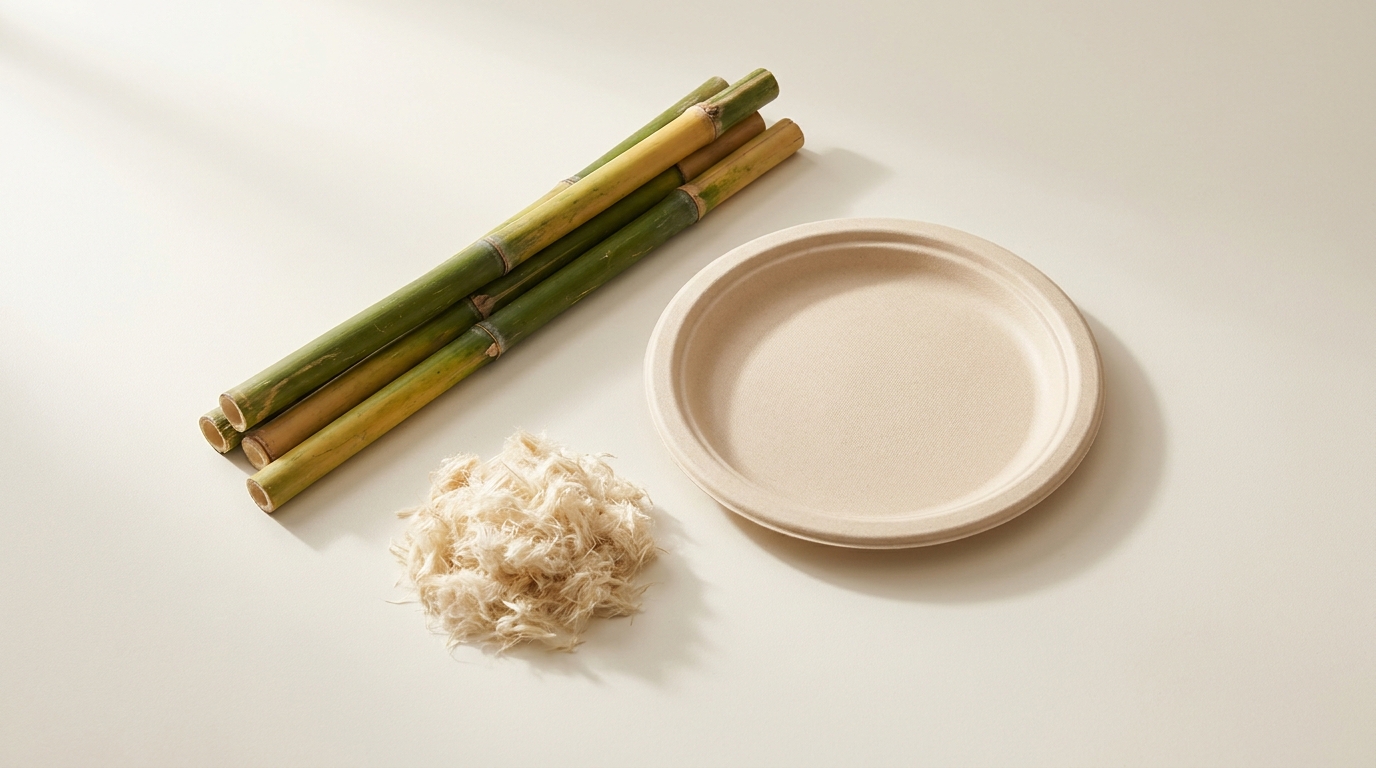
Why bamboo fiber resolves the usual trade-off

  • Near-softwood fiber length. At 1.5 to 3.0 mm, bamboo fiber builds a bonded network close to what softwood kraft achieves, and well above any agricultural residue.
  • Three to five year harvest cycle. A managed grove is cut on rotation and regrows from the same rhizome system. No replanting, no soil disturbance between harvests.
  • Regrows from the root, not from seed. Harvesting a culm does not kill the plant. The root network stays intact and continues sequestering carbon between cuts.
  • Naturally pale. Forms lighter than wood and considerably lighter than recycled fiber, so a clean-looking part is achievable without a bleaching stage.
  • High tensile strength per unit weight. The same property that makes bamboo a structural material in construction carries through into formed fiber parts.
  • No competition with food crops. Bamboo grows on land often unsuitable for agriculture, including degraded slopes where it also stabilizes soil.

The processing consideration is that bamboo is dense and silica-bearing, so it needs more energy to pulp than wood and more process control than a soft agricultural residue. Suppliers who treat it as a drop-in wood substitute get inconsistent fiber separation and variable part strength.

The second consideration is honest sourcing. Bamboo’s environmental credentials depend on the grove being managed rather than wild-cut, and on processing chemistry being controlled. Bamboo is not automatically sustainable because it grows quickly. The management practice is what makes the claim true.

Tableau des caractéristiques techniques

Spécifications Détails
Nom du matériau Fibre de bambou
Type de matériau Bamboo culm cellulose
Source de fibres Managed bamboo groves
Average Fiber Length 1.5 to 3.0 mm
Harvest Cycle 3 to 5 years
Regeneration From existing rhizome; no replanting required
Natural Color Pale natural
Finition de la surface Fine, smooth
Relative Strength Very high; second only to softwood kraft
Typical Wall Thickness 0.8 to 4.0 mm
Compatibilité des processus Wet pressing, dry pressing, thermoformed fiber
Types de pâte à papier moulée Type 2, Type 3, Type 4
Compostabilité Meets the chemistry basis for EN 13432 and ASTM D6400 uncoated
Recyclabilité Accepted in paper streams uncoated
Food Contact Use bleached variant; confirm for your market
Options de couleur Natural pale; takes pigment cleanly
Processing Energy Higher than wood; dense and silica-bearing
Relative Cost Medium-high

Where bamboo fiber is the right specification

Parts needing strength and a sustainability narrative. This is the combination bamboo exists to serve. Where kraft delivers strength but reads as conventional virgin wood, and where straw delivers the story but not the structural performance, bamboo does both.

Premium retail packaging. The naturally pale finish and fine surface suit parts that a customer sees and handles, without the processing cost of bleaching.

Brands with explicit deforestation policies. Procurement policies that restrict or exclude wood fiber can usually accommodate bamboo, because it is a grass harvested on rotation rather than a felled tree.

Type 3 thermoformed parts. Bamboo supports the smooth, densified finish that cure-in-the-mold tooling produces, alongside pâte de bois et pâte blanchie.

Where bamboo is the wrong call: cost-driven volume parts, where pâte à papier recyclée ou fibre de paille do the job for considerably less, and parts where absolute maximum tear strength governs, where papier kraft compostable still leads.

Buyers comparing bamboo against virgin wood are usually weighing a slightly lower strength ceiling against a renewal cycle roughly eight times faster. Which matters more depends on whether the binding constraint is the part’s performance or the customer’s reporting.

Foire aux questions (FAQ)

Is bamboo actually more sustainable than wood for packaging?
On renewal rate, clearly: three to five years against 25 to 40, with regrowth from the existing root system and no replanting. On the full picture it depends on management and processing. Bamboo needs more energy to pulp than wood, and wild-cut bamboo from unmanaged stands carries real ecological cost. The material has a strong case when the grove is managed and the processing is controlled, and a weak one when neither is verified.
Close, and below it. Bamboo fibers run 1.5 to 3.0 mm against 2.5 to 4.5 mm for softwood kraft, so the bonded network is slightly less interconnected and tear resistance is correspondingly lower. For most packaging the gap does not govern the design. For edge protectors and heavy cradles carrying serious compression, kraft is still the specification.
This claim circulates widely and does not survive the pulping process. Bamboo plants contain a compound sometimes described as antibacterial, but chemical pulping removes it along with the lignin. A finished molded bamboo part should not be marketed as antimicrobial. We would rather tell you that than let the claim go on a pack and fail a substantiation challenge.
Collection and processing. Straw is a residue already aggregated at harvest, so it arrives cheaply. Bamboo is a primary crop that has to be cut, transported, and pulped, and it is dense enough to need more energy to separate into fibers. You are paying for the strength advantage, which straw cannot match.
Yes, through bleaching, which produces the material described on our bleached pulp page using bamboo as the fiber source. Bamboo bleaches to a clean white and retains more strength through the process than many wood pulps do. Unbleached bamboo is already pale enough for most applications, so bleaching is usually specified for food contact rather than for appearance alone.
Nom du matériau

Fibre de bambou

Type de matériau

Fibre végétale durable

Compatibilité des processus

Matériaux d'emballage Bonitopak

Nos solutions d'emballage sont fabriquées à partir de matériaux durables tels que la fibre de canne à sucre, le bambou et la pâte à papier recyclée, offrant ainsi des options écologiques et biodégradables pour une large gamme de produits.

Le papier kraft compostable est la fibre la plus résistante que nous produisons. Fabriqué à partir de matière première vierge

La pâte colorée n'est pas une fibre à part entière. Il s'agit de l'une de nos

La pâte blanchie est le matériau à spécifier lorsque la pièce doit

Le terme « fibres végétales naturelles » désigne les sources de cellulose autres que le bois que nous incorporons dans nos mélanges en dehors de la

Le papier ondulé, en tant que matériau à base de pâte moulée, désigne des cartons de récupération qui ont été transformés en pâte.

La fibre de paille est fabriquée à partir des tiges restantes après la récolte des céréales, un matériau

Nos catégories de produits

Découvrez la gamme diversifiée de solutions d'emballage de Bonitopak, y compris les plateaux de pulpe moulée, les emballages alimentaires, les conceptions personnalisées et les options durables. Chaque catégorie est conçue dans un souci de durabilité, de fonctionnalité et de responsabilité environnementale, afin de répondre à vos besoins spécifiques.
Prêt à élever votre projet ?

Donnez vie à vos dessins avec BonitoPak

Faites l'expérience de l'ingénierie de précision avec BonitoPak. Des prototypes détaillés à la production en grande quantité, nous sommes là pour transformer vos concepts en réalité. Contactez-nous dès aujourd'hui pour discuter des besoins de votre projet !

Articles et réflexions connexes

Restez informé des dernières mises à jour sur les tendances en matière d'emballage durable, les perspectives du secteur et les conseils d'experts grâce à notre blog. Explorez des idées et des solutions innovantes pour améliorer vos connaissances en matière d'emballage.

By Leo Chan, Senior Packaging Consultant · November 14, 2026 Molded fiber food containers are

By Leo Chan, Senior Packaging Consultant · November 14, 2026 Yes, egg cartons are compostable

By Leo Chan, Senior Packaging Consultant · November 14, 2026 The molded pulp packaging market

Remplir ce formulaire détaillé