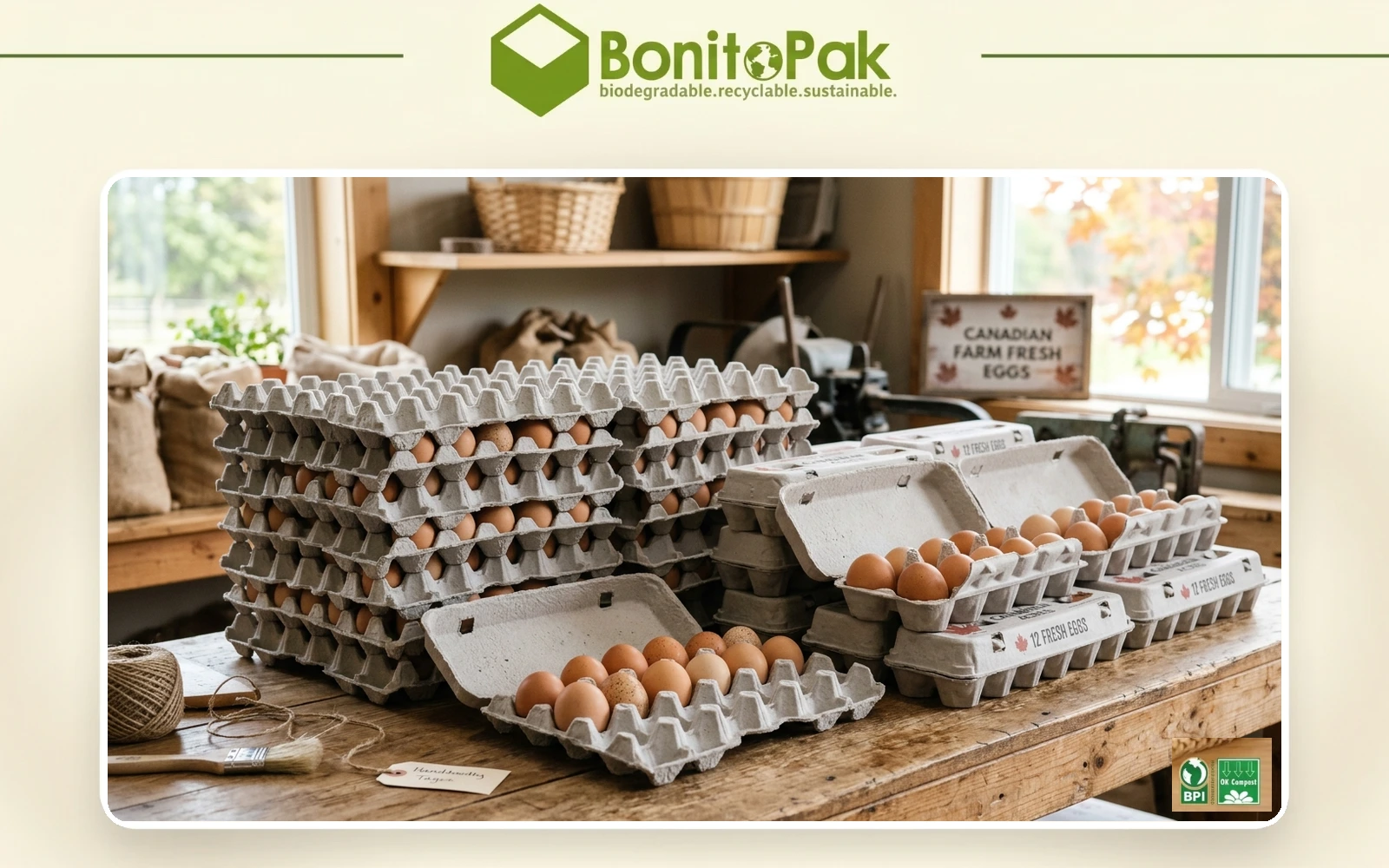

En bref : Molded pulp egg trays are recyclable in most curbside paper programs and compostable in home and industrial systems. Foam and clear plastic versions are not. The material determines everything. This guide covers how to identify what you have, how many times pulp fiber can actually be recycled, what compostability certification means for B2B buyers, and where local rules override general advice.
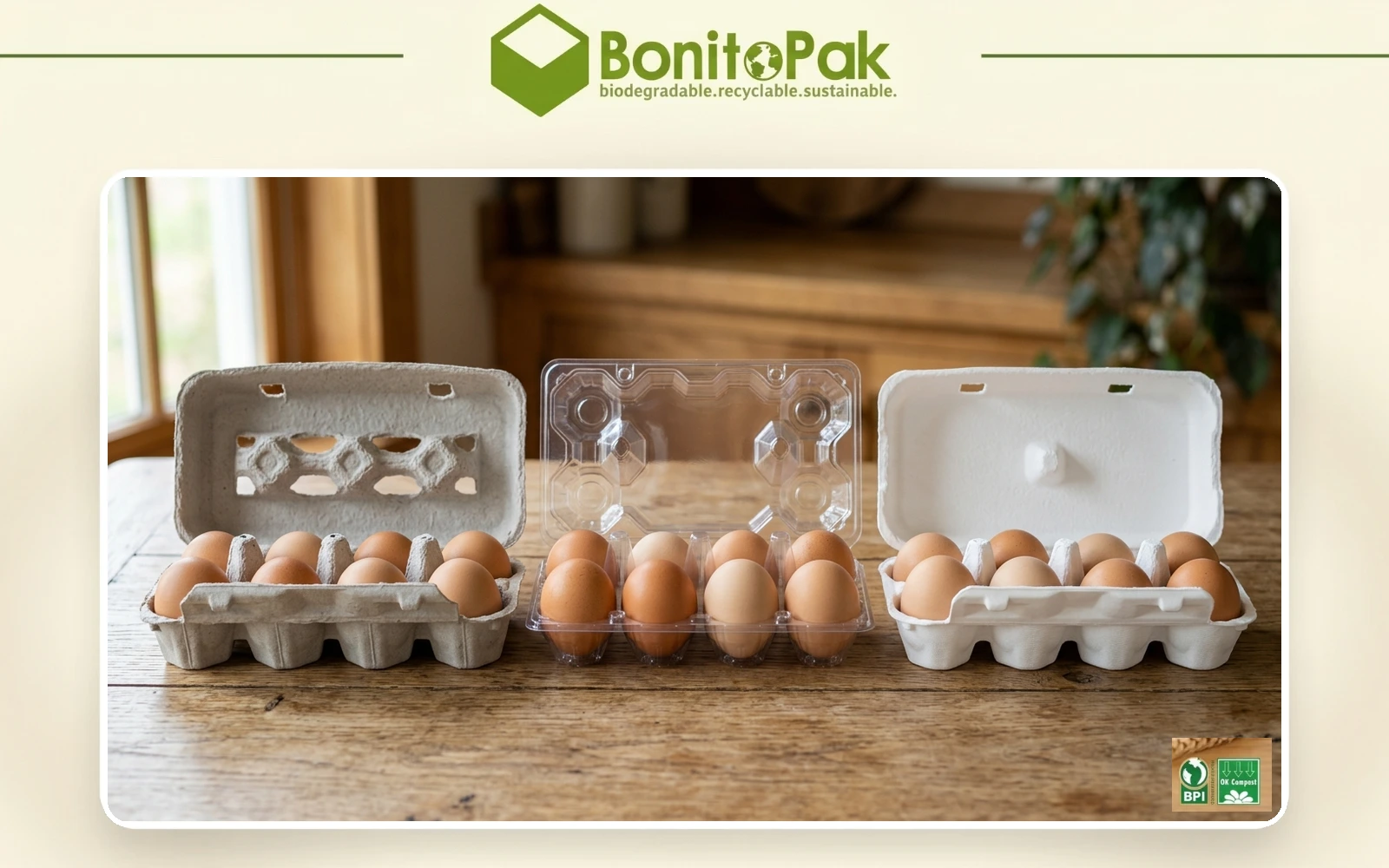
Pick up an egg tray and look at the underside. If it is dull, slightly rough, and grey or brown, it is molded pulp, and it belongs in your paper recycling. If it is white and squeaky, it is foam. If it is clear and crackles when you squeeze it, it is plastic.
That three second check answers the recycling question faster than any label will, because most egg trays carry no disposal marking at all.
| Matériau | Look and feel | Collecte sélective en bordure de trottoir | Compostable | Persistance en décharge |
| Pâte à papier moulée | Dull, rough, gray or brown | Yes, with paper | Yes, home and industrial | Semaines |
| Clear plastic (PET #1) | Clear, crackles when squeezed | Sometimes, varies by program | Non | Siècles |
| Foam (EPS #6) | White, squeaky | Peu souvent accepté | Non | Décennies |
That gap is wider than it looks. Expanded polystyrene foam does not biodegrade, so foam egg cartons sit in landfill for decades, breaking into smaller and smaller fragments that make cleanup harder the longer they are left. A molded pulp tray in the same bin is gone in weeks. If you want the full disposal contrast between fiber and every common plastic, it is laid out in molded pulp vs plastic.
For a household, this is a bin decision. For a packaging buyer it is not. Egg producers, distributors and retailers are increasingly asked by their own customers to prove what happens to the tray once the eggs are gone, and “it’s recyclable” no longer clears that bar. The rest of this guide is the version that does.
What Are Egg Trays Actually Made From?
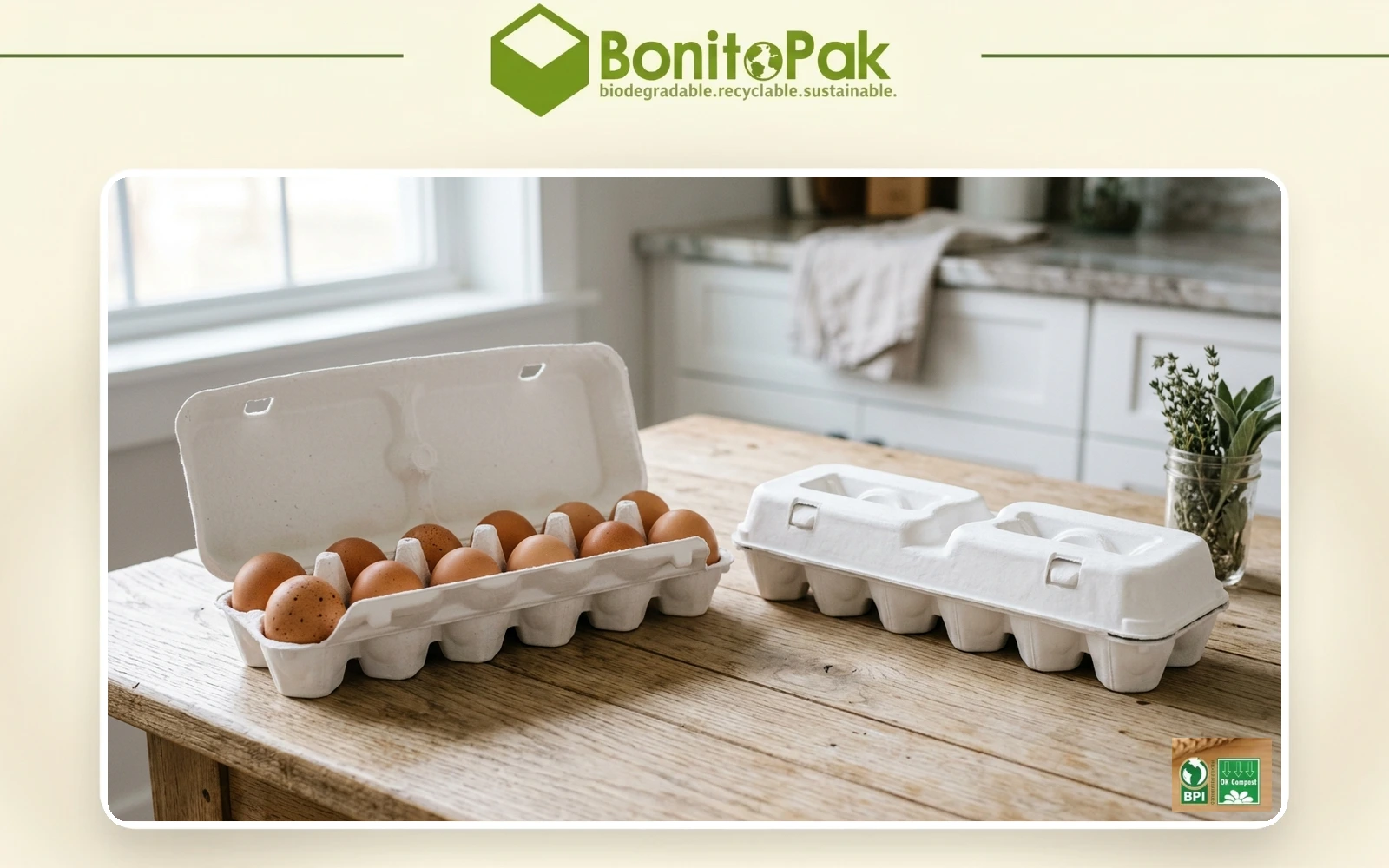
Molded pulp egg trays are formed from natural plant fiber suspended in water, vacuum-pressed into a mold, then dried. That forming sequence is covered stage by stage in our guide to how egg trays are made. The three common feedstocks are sugarcane bagasse, bamboo fiber, and recycled paper pulp. No plastic, no resin, no adhesive. The fiber holds its shape through hydrogen bonding as it dries, which is why the material is single-stream recyclable.
Paper-based egg cartons made from molded pulp sit among the most environmentally friendly packaging options available and are widely accepted in curbside recycling programs.
Bagasse deserves a note here. It is the fibrous residue left after sugarcane is crushed for juice, a waste stream that was historically burned. Using it for packaging diverts an agricultural byproduct rather than harvesting new material. Bamboo behaves similarly but regrows faster than most crops.
Recycled paper pulp is the lowest cost input and the most common in commodity 30-count trays. It produces the grey tray everyone recognises from the supermarket.
The performance gap between the three is narrower than most buyers think. Bagasse gives a smoother surface and takes colour better. Recycled paper is cheaper and a touch rougher. All three compost, and for a plain grey egg tray you would struggle to tell them apart once they are on the shelf.
Are Molded Pulp Egg Trays Recyclable in Curbside Programs?
Yes. Molded pulp egg trays go in the paper recycling bin in most municipal programs. The tray is mixed paper fiber, so it is processed alongside cardboard and newsprint. The one condition is cleanliness: dry, no shell fragments, no egg residue.
Municipal recycling guidance confirms that egg cartons made of molded pulp or paper can be recycled in regular curbside recycling, while Styrofoam and clear plastic versions cannot and should go in the trash.
Contamination is the failure point, not the material. Egg residue or food waste on the tray can contaminate the wider recycling process. Heavily soiled or wet trays are better composted or binned, because contamination can cause entire batches of recyclable material to be rejected.
This is the part people get wrong. One greasy tray does not just fail to recycle on its own — it can drag a whole bale down with it at the sorting facility. So if a tray is stained or damp, put it in the compost, not the recycling. That is not settling for second best. It is the right bin.
Labels and stickers should come off first. These materials can contaminate the recycling stream, though small paper labels are sometimes removed during processing anyway.
How Many Times Can Egg Tray Fiber Be Recycled?
Paper fiber shortens every time it goes through the recycling process. Molded pulp trays are typically made from already-recycled fiber, which means they often sit near the end of the fiber lifecycle rather than the start of it.
Because paper fibers can become too short to be reused, egg trays cannot be recycled indefinitely.
Most consumer guides skip this, and it quietly changes the advice. A tray made from virgin bagasse has more fiber life left in it than one made from post-consumer paper that has already been through the mill three or four times.
Some paper cartons have already been broken down to their thinnest usable form during production, and facilities cannot reuse them to make new paper products, so they end up in the trash.
Composting sidesteps the problem entirely. Short fiber composts exactly as well as long fiber. When the tray has reached the end of its recyclable life, the compost bin is the better destination, and for producers marketing on sustainability it is often the stronger claim.
Can You Compost Egg Trays at Home?
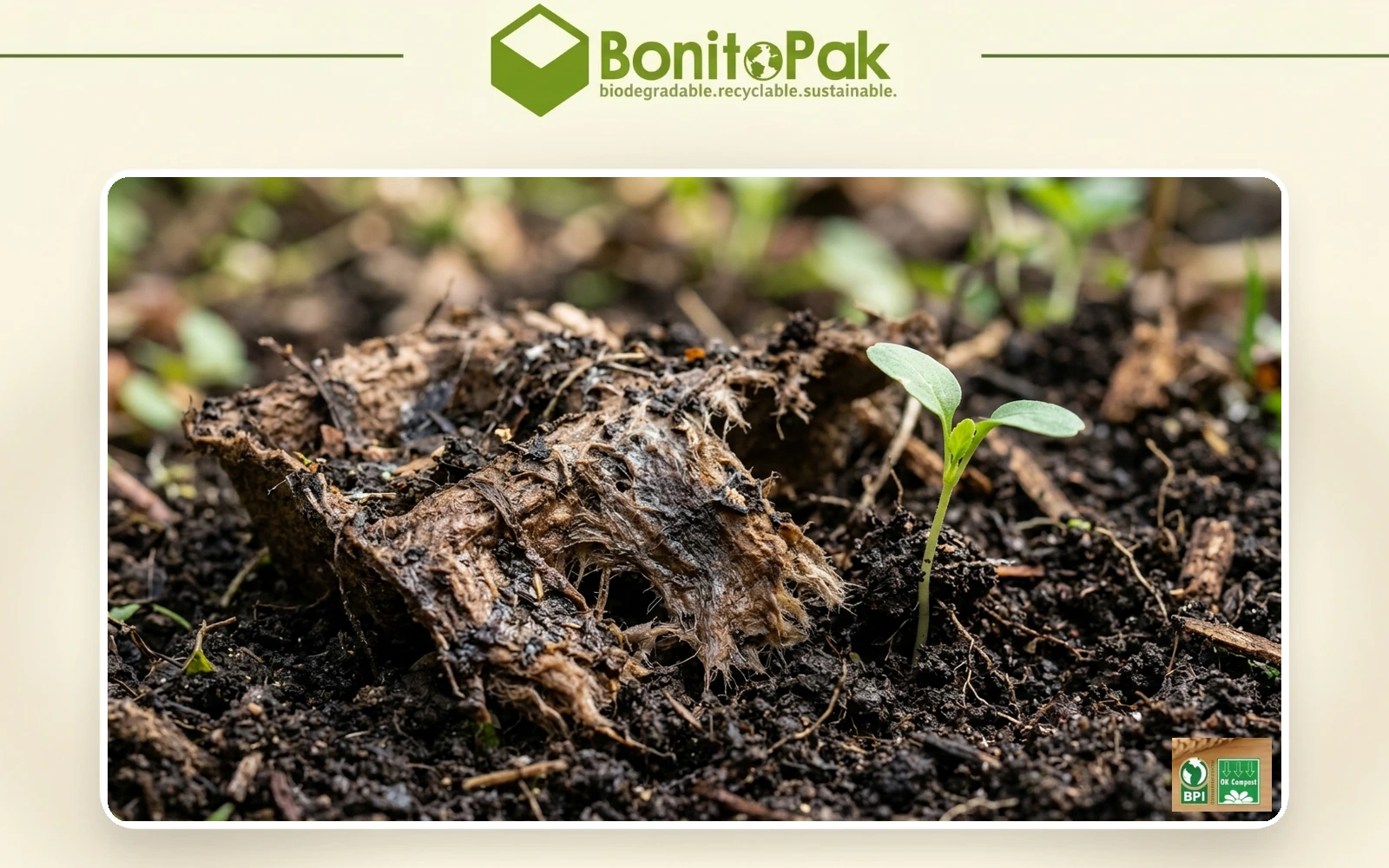
Yes. Molded pulp egg trays compost in home systems without any special conditions. Tear the tray into pieces, wet it, and add it to the pile as a carbon-rich brown material to balance nitrogen-heavy food scraps.
Molded pulp cartons compost easily because they are made from natural paper fibers, and tearing them into smaller pieces before adding them to a home pile lets them break down within weeks.
Three things anyone who actually runs a compost pile will tell you:
Tear it, don’t shred it. Whole trays trap air pockets and break down unevenly. Hand-torn pieces about the size of a playing card are the sweet spot.
Wet the pieces first. Dry pulp shrugs off water on first contact, and a dry tray will sit there unchanged for a fortnight if the rest of the pile is dry too.
Leave out heavily printed sections if you are not sure of the ink. Most pulp trays use soy or water-based inks that compost fine, but a solid block of print you cannot vouch for is easy enough to tear off first.
Worm bins handle pulp trays particularly well. Cut or soaked paper carton pieces added alongside food waste and leaves are readily consumed in worm composting systems.
What Does “Certified Compostable” Actually Require?
For a product to carry a compostable certification it must be independently tested against a defined standard, not simply be made from a compostable material. Certification confirms the product breaks down completely in a specific composting environment within a defined timeframe, leaves no toxic residue, and creates no microplastics.
Two standards dominate, split by market, and the International Molded Fiber Association notes that molded fiber’s single-material construction is what makes certification straightforward compared to laminated alternatives. ASTM D6400 is the United States standard and the explicit reference for Biodegradable Products Institute certification, California’s SB 54 legislation, and most US state plastic-ban rules. EN 13432 is its European equivalent.
| Standard | Market | Certifying body | Mark |
| ASTM D6400 | North America | Institut des produits biodégradables | Certifié BPI |
| EN 13432 | L'Europe | TUV Austria | OK Compost |
| NF T 51-800 | Home composting | BPI, launched 2025 | Accueil Compostable |
The ASTM D6400 thresholds are specific: at least 90% conversion of organic carbon to CO₂ within 180 days, at least 90% of the material passing a 2mm sieve after 84 days, no negative effect on plant growth in the resulting compost, and heavy metals below defined limits.
Two things trip up buyers here.
First, industrial does not mean home. ASTM D6400 is written exclusively for industrial composting facilities that hold sustained temperatures of 50°C to 60°C with managed moisture and aeration. Home systems rarely exceed 35°C to 40°C. Uncoated pulp trays compost at home anyway because the fiber needs no heat to break down, but a D6400 mark on its own does not prove home compostability. BPI launched a separate Home Compostability Certification Program in 2025, based on the French standard NF T 51-800.
Second, certification attaches to the finished product, not the raw material. A supplier claiming “our materials are certified” is not making a sufficient claim, because the finished product must be certified and the manufacturing process itself can affect compostability. A bagasse bowl with a PET lid is a common failure case: the bagasse meets D6400, the lid does not, and marketing the whole product as compostable is non-compliant.
Uncoated molded pulp egg trays avoid that trap by construction. There is nothing laminated to them.
Does Certification Matter If You Are Buying Trays?
If you sell into the US or EU and make any environmental claim on your packaging, yes. Unsupported claims now carry regulatory exposure rather than just reputational risk.
Federal Trade Commission Green Guides treat “biodegradable” as a misleading claim without specific testing evidence, with ASTM D6400 recognized as the proof. Packaging marketed as compostable and sold in Europe or North America must be certified to EN 13432 or ASTM D6400 respectively, and without the label a product may violate FTC Green Guides and expose the brand to greenwashing liability.
Multi-market suppliers hold both. For suppliers shipping to several regions, carrying BPI certification under ASTM D6400 alongside TÜV Austria OK Compost under EN 13432 is standard practice. A BPI compliance declaration does not satisfy EU market requirements, and an OK Compost certificate does not meet US regulatory definitions. They are not interchangeable.
When you are qualifying a supplier, ask for the certificate number rather than the claim. Certifying bodies issue unique licence numbers to certified manufacturers, and asking for the number is the first verification step.
What About Colored and Printed Egg Trays?
Color changes nothing about recyclability if the pigment is added to the pulp slurry rather than applied as a surface coating. The fiber is still fiber.
Bonitopak runs six separate pulp systems covering white, natural, black, orange, grey and blue, with Pantone-based custom matching to better than 95%. Whitening uses hydrogen peroxide rather than chlorine bleaching, which keeps the fiber food-safe and keeps the effluent stream cleaner.
Printed trays need slightly more care. Water-based and soy inks compost and recycle without issue. Solvent-based inks and any laminated or film-finished surface do not, and a film layer converts a compostable tray into a non-compostable composite. If a supplier offers a glossy finish on a pulp tray, ask what creates the gloss before you specify it.
For most egg packaging, in-pulp colour plus water-based print keeps the whole sustainability claim intact. Specify that combination and hold the line on it.
Where Local Rules Override Everything
General guidance gets you most of the way, and then local reality takes over. Whatever a national body recommends, the local ordinance wins. Acceptance can change between two neighbouring towns, and some programs that happily take flat cardboard reject molded shapes because their sorting equipment cannot handle them.
Before you print a disposal instruction on packaging destined for a specific market, check that market’s actual program. A tray labelled “recyclable” in a region that does not accept it produces contamination and complaints.
The safer label for uncoated pulp is a dual instruction: recycle if clean, compost if soiled. Both routes are genuinely available for the material, and the instruction stays true regardless of which local program the tray lands in.
Conclusion
Three things to take away.
Material identification is the whole question. Molded pulp recycles and composts; foam does neither and clear plastic sits somewhere unreliable in between. The underside texture tells you which you have in about three seconds.
Cleanliness decides the route, not the material. A clean dry pulp tray belongs in paper recycling. A soiled or damp one belongs in compost, where it performs just as well and carries no contamination risk.
For B2B buyers, the certificate number is the claim. Certification attaches to the finished product, splits by market between ASTM D6400 and EN 13432, and cannot be inherited from a raw material supplier.
If you are sourcing egg trays and need documentation that survives a customer audit, start by asking your supplier which standard their finished trays are tested against and for which market. Bonitopak manufactures uncoated molded pulp egg trays in bagasse, bamboo and recycled paper at its Dongguan facility, in 6, 18, 30 and 36-egg capacities with custom color matching. Send a specification and we will come back with material options and documentation within two working days.
Questions fréquemment posées
Are egg trays recyclable in normal household recycling?
Molded pulp and paper egg trays go in curbside paper recycling in most municipal programs, because the tray is mixed paper fiber processed alongside cardboard and newsprint. The tray must be clean and dry, with no shell fragments or egg residue, since food contamination can cause an entire batch of recyclable material to be rejected. Foam and clear plastic egg trays are a different matter and are usually refused. Local program rules always override general guidance, so check your municipality before assuming acceptance.
Can egg trays be composted at home rather than recycled?
Yes, and for a soiled or damp tray composting is the better route. Molded pulp trays are natural plant fiber with no plastic or adhesive, so they break down in a home pile within weeks once torn into small pieces. Wet the pieces before adding them, because dry pulp repels water on first contact and will sit unchanged for a fortnight in a dry pile. Torn pulp also works well in worm bins as a carbon-rich brown material balancing nitrogen-heavy food scraps.
How many times can an egg tray be recycled before the fiber is finished?
Paper fiber shortens on every pass through the recycling process, and most egg trays are already made from recycled fiber, so they sit near the end of the fiber lifecycle rather than the start. Some trays have been pressed to their thinnest usable form during production and cannot be reprocessed into new paper at all. When fiber reaches that point, composting is the correct destination, since short fiber composts exactly as well as long fiber. Trays made from virgin bagasse or bamboo have more recyclable life ahead of them than those made from post-consumer paper.
Does a compostable certification mean the tray will break down in my garden compost?
Not automatically. ASTM D6400 and EN 13432 both certify industrial composting only, which assumes sustained temperatures of 50°C to 60°C with managed moisture and aeration that a backyard bin never reaches. Uncoated molded pulp trays do compost at home regardless, because plain plant fiber needs no heat to break down, but the industrial certification alone is not proof of that. If home compostability is the specific claim you need, look for a dedicated home certification such as the BPI program launched in 2025 or TÜV Austria OK Compost HOME.
What should I ask a supplier to verify their compostability claims?
Ask for the certificate number, not the claim, since certifying bodies issue unique licence numbers to certified manufacturers and the number can be checked. Confirm the certification covers the finished tray rather than the raw material, because the manufacturing process itself affects compostability and a material-level certificate does not transfer. Check the standard matches your destination market, as a BPI declaration under ASTM D6400 does not satisfy EU requirements and an OK Compost certificate under EN 13432 does not meet US regulatory definitions. Finally, ask what any surface finish is made from, since a laminated or film-coated tray is a composite and no longer compostable.
Do colored or printed egg trays still recycle and compost?
Color makes no difference when the pigment is mixed into the pulp slurry rather than coated onto the surface, because the tray remains plain fiber throughout. Printing is fine with water-based or soy inks, which break down alongside the fiber in both recycling and composting streams. Solvent-based inks and any laminated or film-finished surface are the problem, since a film layer turns a compostable tray into a non-compostable composite. If a supplier offers a glossy pulp tray, ask what produces the gloss before specifying it.