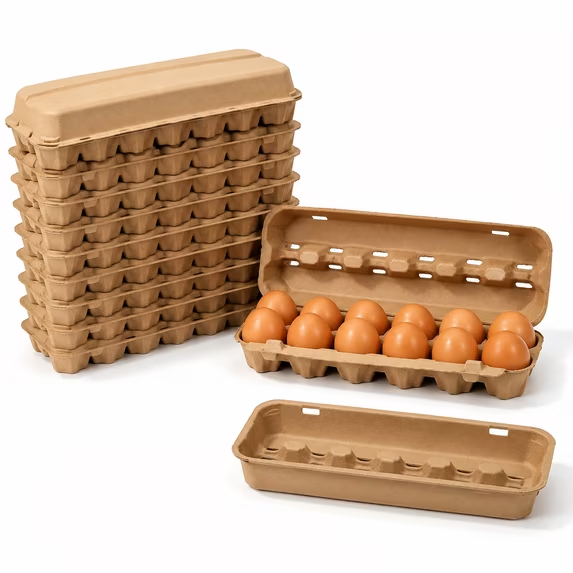
Plain Egg Cartons

  • No printing, no branding, no supplier marks anywhere on the carton
  • Available in every count from 4 through 20 cells
  • Formed from 100% recycled paper pulp, biodegradable and home compostable
  • Lid surface finished for label adhesion, so stickers hold through cold storage
  • Lowest cost per carton in the range, with no plate or tooling charges
  • Natural pulp plus six stock colors, all supplied unprinted
  • Shortest lead time we offer, since printing sits outside the production path

Moule public

Solutions d'emballage

Conception en 3D

Moule personnalisé

Description du produit

Spécifications Détails
Nom de la marque BonitoPak
Numéro de modèle EC-BLK series
Nom du produit Plain Egg Cartons / Blank Pulp Cartons
Matériau Pâte à papier recyclée
Type de papier Post-consumer recycled paper
Technique Molded pulp forming (wet-pressed)
Cell Count 4, 6, 10, 12, 18, or 20 cells
Impression None; supplied completely blank
Supplier Marks None anywhere on the carton
Label Surface Finished for pressure sensitive label adhesion
Couleur Natural pulp; six stock colors, all unprinted
Forme et style Top-fold clamshell; flat top available
Utilisation industrielle Distributors, repackers, private label, farm direct sellers
Application Own-label packing, resale, relabeling, bulk supply
Taille OEM and custom dimensions accepted
Avantages Biodegradable, home compostable, lowest unit cost, shortest lead time
Emballage Bulk nested in export cartons; custom packing accepted
Commande personnalisée Accepté
MOQ Lowest in the range; confirm with sales

Galerie de Plain Egg Cartons pièces

Cette galerie présente la qualité exceptionnelle et l'attention portée aux détails que nous apportons à chaque projet. Des conceptions complexes aux finitions impeccables, chaque image reflète notre engagement en faveur de l'excellence dans les domaines suivants Plain Egg Cartons .

40%

Gain de temps et d'argent

Faites l'expérience de solutions d'emballage de pointe qui optimisent vos coûts et votre temps, en fournissant des processus efficaces et en maximisant votre retour sur investissement.

50%

Plus durable

Réalisez des emballages respectueux de l'environnement avec des matériaux durables, en réduisant les déchets et en promouvant la responsabilité environnementale dans toutes vos gammes de produits.

25%

Augmentation des ventes

Améliorez l'attrait de votre produit en rayon grâce à des designs innovants qui augmentent la visibilité et les ventes sur les marchés de détail et en ligne.

100%

Plus fiable

Faites confiance à l'engagement de BonitoPak en matière de qualité, en vous assurant que chaque produit répond à nos normes élevées avec un service constant et fiable.

Blank is a specification, not an absence

A plain carton sounds like a carton with something missing. In practice it is the format with the most specific requirement attached, because the surface has to accept something else.

If a carton is going to carry a pressure sensitive label, the lid surface has to be consistent enough for adhesive to bond across its full area. Molded pulp varies in surface density depending on how the fiber drained during forming, and a lid with uneven density will hold a label at one end and lift at the other.

We finish blank lids to a controlled surface density for this reason. It is the difference between a label that survives six weeks in a cold case and one that curls at the corner within a week.

Buyers who have had labels lift on pulp cartons before have usually bought a carton that was blank by omission rather than blank by specification.

Who buys blank, and what each group needs

Three groups, with genuinely different requirements.

Distributors and resellers buy blank because they supply many small producers who each want their own identity. The carton has to carry no supplier marks at all, including ours, because the distributor is the supplier as far as their customer is concerned. We do not put our name on these cartons anywhere.

Private label packers buy blank and apply a retailer’s printed label. Their requirement is dimensional consistency, since labels are applied by machine against a fixed registration point, and a carton that varies in height will label crooked.

Small farm sellers buy blank because they cannot reach printing minimums. They label by hand or stamp with a custom rubber stamp. Their requirement is simply low minimum order quantity, which blank cartons give them because there is no plate or mold cost to amortize.

Cost, and why blank is the cheapest route

Blank cartons carry the lowest unit cost in our range, and the reasons compound.

There is no plate charge, since nothing is printed. There is no mold tooling charge, since blanks run on stock molds. There is no print pass, which removes an entire operation from the production path. And blank runs can be scheduled flexibly against other production, because there is no color or artwork changeover to plan around.

That last point also makes blank the shortest lead time we offer. For a buyer whose constraint is timing rather than branding, blank plus a quickly printed label is almost always faster than a printed carton.

Labeling that actually holds

Four practical points from buyers who label blanks.

Paper labels outperform film on pulp. Film has less conformability and lifts at the edges where the lid surface is slightly textured. Uncoated paper labels bond better and look more appropriate on fiber.

Apply at room temperature, not in the cold room. Adhesive needs time to flow into the surface, and cold slows that to the point where the bond never fully forms.

Keep the label away from the hinge and the front tab. Both flex, and a label bridging a flex point peels from that edge first.

And size the label to the flat center panel rather than edge to edge. The lid curves slightly at its margins and a full-width label will tent at the corners.

Stamping as an alternative to labels

Small producers often skip labels entirely and use a custom rubber stamp with food safe ink. On natural pulp it works well, because the absorbent surface takes stamp ink cleanly without smearing, and the slightly irregular result reads as handmade rather than as a printing defect.

It is the cheapest branding route available, it needs no minimum order, and it suits farm stand selling where the handmade impression is an asset. It does not scale, since every carton is a manual operation, and it does not work on darker colored pulp where the ink has nothing to contrast against.

When blank stops being the right answer

Blank is the correct choice up to a point, and past that point it costs more than printing.

Labels have a per unit cost that never falls away, same as printing. Once annual volume is high enough, the accumulated label cost passes what embossing would have cost once in the mold. The crossover is usually lower than buyers expect, because labels also carry an application labor cost that printing does not.

Producers who find themselves hand-labeling thousands of cartons have usually passed that point already. Embossing is covered at boîtes à œufs personnalisées, and it costs nothing per unit once the tool exists.

Across the range

Blank is available in every count. The volume formats are the molded pulp dozen egg carton and the molded pulp 18 egg carton, and both are commonly ordered blank for private label work.

Blank is also available in color, which buyers often miss. A colored blank gives shelf differentiation with no printing at all, and for small producers it is frequently the best value in the catalog. See molded pulp colored egg cartons.

For bulk ordering and pricing tiers, see wholesale egg cartons.

Blank is a specification, not an absence

A plain carton sounds like a carton with something missing. In practice it is the format with the most specific requirement attached, because the surface has to accept something else.

If a carton is going to carry a pressure sensitive label, the lid surface has to be consistent enough for adhesive to bond across its full area. Molded pulp varies in surface density depending on how the fiber drained during forming, and a lid with uneven density will hold a label at one end and lift at the other.

We finish blank lids to a controlled surface density for this reason. It is the difference between a label that survives six weeks in a cold case and one that curls at the corner within a week.

Buyers who have had labels lift on pulp cartons before have usually bought a carton that was blank by omission rather than blank by specification.

Who buys blank, and what each group needs

Three groups, with genuinely different requirements.

Distributors and resellers buy blank because they supply many small producers who each want their own identity. The carton has to carry no supplier marks at all, including ours, because the distributor is the supplier as far as their customer is concerned. We do not put our name on these cartons anywhere.

Private label packers buy blank and apply a retailer’s printed label. Their requirement is dimensional consistency, since labels are applied by machine against a fixed registration point, and a carton that varies in height will label crooked.

Small farm sellers buy blank because they cannot reach printing minimums. They label by hand or stamp with a custom rubber stamp. Their requirement is simply low minimum order quantity, which blank cartons give them because there is no plate or mold cost to amortize.

Cost, and why blank is the cheapest route

Blank cartons carry the lowest unit cost in our range, and the reasons compound.

There is no plate charge, since nothing is printed. There is no mold tooling charge, since blanks run on stock molds. There is no print pass, which removes an entire operation from the production path. And blank runs can be scheduled flexibly against other production, because there is no color or artwork changeover to plan around.

That last point also makes blank the shortest lead time we offer. For a buyer whose constraint is timing rather than branding, blank plus a quickly printed label is almost always faster than a printed carton.

Labeling that actually holds

Four practical points from buyers who label blanks.

Paper labels outperform film on pulp. Film has less conformability and lifts at the edges where the lid surface is slightly textured. Uncoated paper labels bond better and look more appropriate on fiber.

Apply at room temperature, not in the cold room. Adhesive needs time to flow into the surface, and cold slows that to the point where the bond never fully forms.

Keep the label away from the hinge and the front tab. Both flex, and a label bridging a flex point peels from that edge first.

And size the label to the flat center panel rather than edge to edge. The lid curves slightly at its margins and a full-width label will tent at the corners.

Stamping as an alternative to labels

Small producers often skip labels entirely and use a custom rubber stamp with food safe ink. On natural pulp it works well, because the absorbent surface takes stamp ink cleanly without smearing, and the slightly irregular result reads as handmade rather than as a printing defect.

It is the cheapest branding route available, it needs no minimum order, and it suits farm stand selling where the handmade impression is an asset. It does not scale, since every carton is a manual operation, and it does not work on darker colored pulp where the ink has nothing to contrast against.

When blank stops being the right answer

Blank is the correct choice up to a point, and past that point it costs more than printing.

Labels have a per unit cost that never falls away, same as printing. Once annual volume is high enough, the accumulated label cost passes what embossing would have cost once in the mold. The crossover is usually lower than buyers expect, because labels also carry an application labor cost that printing does not.

Producers who find themselves hand-labeling thousands of cartons have usually passed that point already. Embossing is covered at boîtes à œufs personnalisées, and it costs nothing per unit once the tool exists.

Across the range

Blank is available in every count. The volume formats are the molded pulp dozen egg carton and the molded pulp 18 egg carton, and both are commonly ordered blank for private label work.

Blank is also available in color, which buyers often miss. A colored blank gives shelf differentiation with no printing at all, and for small producers it is frequently the best value in the catalog. See molded pulp colored egg cartons.

For bulk ordering and pricing tiers, see wholesale egg cartons.
Matériaux pour Plain Egg Cartons Pièces détachées

Des entreprises et des ingénieurs de premier plan font confiance à BonitoPak pour des itérations rapides et des pièces durables et de haute qualité. Qu'il s'agisse de prototypage ou de production à grande échelle, notre large gamme de matériaux nous permet de répondre aux exigences uniques de n'importe quelle entreprise. Plain Egg Cartons avec précision et rapidité.

Compostable kraft paper is the strongest fiber we form. Made from virgin

Colored pulp is not a separate fiber. It is any of our

Bleached pulp is the material to specify when the part has to

Natural plant fiber covers the non-wood cellulose sources we blend outside the

Corrugated paper as a molded pulp material means recovered cardboard boxes repulped

Straw fiber is made from the stalks left after grain harvest, material

Personnalisé Écologique Fiable

Excellence en matière d'emballage personnalisé et respectueux de l'environnement

Entièrement personnalisable

Personnalisez votre emballage avec des styles, des tailles, des couleurs et des finitions sur mesure pour répondre à des besoins spécifiques.

Soutien des experts

Bonitopak fournit des conseils experts en matière de conception et de logistique afin de maximiser l'efficacité de l'emballage et d'augmenter le retour sur investissement.

Solutions écologiques

Choisissez des emballages durables et écologiques pour réduire l'impact sur l'environnement et soutenir les objectifs écologiques de votre marque.

Assurance qualité

Bonitopak garantit un service de qualité supérieure et l'excellence du produit pour chaque solution d'emballage.

Questions fréquemment posées

Plain Egg Cartons

  • Can I get blank cartons with a flat top for easier labeling?

    Yes, and it is worth specifying if labeling is the plan. A flat top gives a genuinely flat label area rather than a slightly domed one, which improves both application accuracy and adhesion at the label edges. The flat top profile is covered on the molded pulp vintage egg cartons page.

  • Is a blank carton lower quality than a printed one?

    No. It comes off the same mold, at the same fiber density, with the same top load performance. The only difference is that no print pass was applied. Buyers sometimes assume blank means seconds or overruns, and that is a different product category entirely which we do not sell.

  • Can I order blank cartons in small quantities for a trial?

    Blank carries our lowest minimum because there is no tooling or plate cost to recover. It is the right product for a first order while you test a format. We would rather supply a small blank run and have you come back than push a printed minimum onto a buyer who is still deciding.

  • What label adhesive works best on molded pulp?

     General purpose permanent acrylic adhesives on uncoated paper face stock perform well. Avoid removable adhesives, which never develop sufficient bond on a porous surface, and avoid film face stocks, which lift at the edges. Your label supplier will know these as standard options; the substrate to specify is uncoated paper.

  • Will your company name appear anywhere on a blank carton?

     No. Blank means blank, including no supplier identification, no mold numbers visible on the outer faces, and nothing on the base. Distributors reselling under their own name need that to be absolute, and we treat it as such rather than leaving a small mark somewhere.

Biodégradable Résultat

0 jours

7 jours

14 jours

30 jours

Industries spécialisées

Ayant produit des millions de pièces, BonitoPak possède une connaissance approfondie de nombreuses applications. Nous excellons particulièrement dans les industries qui exigent la fabrication de composants précis et complexes. Faites-nous confiance pour vous apporter expertise et qualité, quelle que soit la complexité.

Solutions d'emballage OEM et ODM

Bonitopak propose des solutions d'emballage sur mesure (OEM) et préconçues (ODM). Que vous ayez besoin d'un design entièrement personnalisé ou d'un emballage prêt à l'emploi, nous vous proposons des options de haute qualité, efficaces et flexibles pour répondre aux besoins de votre marque.

Services OEM

Les solutions d'emballage OEM vous permettent de créer des produits entièrement personnalisés, conçus et fabriqués pour répondre à vos besoins spécifiques. Chez Bonitopak, nous offrons un soutien complet tout au long du processus de conception, de prototypage et de fabrication, afin que votre emballage reflète l'identité unique de votre marque. Nos capacités de fabrication de précision garantissent une production de haute qualité et cohérente, quelle que soit la complexité de la conception. Avec un service complet, nous nous occupons de tout, de la conception à la livraison, pour vous aider à rationaliser vos besoins en matière d'emballage.

Services ODM

Les solutions d'emballage ODM offrent des produits préconçus qui peuvent être adaptés aux exigences de votre marque. Grâce à l'expertise de Bonitopak en matière de conception innovante et à son processus de production efficace, vous pouvez choisir parmi une large gamme d'options d'emballage prêtes à l'emploi. Nous offrons une personnalisation flexible, vous permettant d'ajouter votre marque et de choisir parmi différentes finitions, couleurs et tailles. Cette solution permet d'économiser du temps et de l'argent tout en garantissant un emballage de haute qualité qui répond aux normes de votre marque.
Prêt à élever votre projet ?

Donnez vie à vos dessins avec BonitoPak

Faites l'expérience de l'ingénierie de précision avec BonitoPak. Des prototypes détaillés à la production en grande quantité, nous sommes là pour transformer vos concepts en réalité. Contactez-nous dès aujourd'hui pour discuter des besoins de votre projet !

Nos catégories de produits

Découvrez la gamme diversifiée de solutions d'emballage de Bonitopak, y compris les plateaux de pulpe moulée, les emballages alimentaires, les conceptions personnalisées et les options durables. Chaque catégorie est conçue dans un souci de durabilité, de fonctionnalité et de responsabilité environnementale, afin de répondre à vos besoins spécifiques.

Blank is a specification, not an absence

A plain carton sounds like a carton with something missing. In practice it is the format with the most specific requirement attached, because the surface has to accept something else.

If a carton is going to carry a pressure sensitive label, the lid surface has to be consistent enough for adhesive to bond across its full area. Molded pulp varies in surface density depending on how the fiber drained during forming, and a lid with uneven density will hold a label at one end and lift at the other.

We finish blank lids to a controlled surface density for this reason. It is the difference between a label that survives six weeks in a cold case and one that curls at the corner within a week.

Buyers who have had labels lift on pulp cartons before have usually bought a carton that was blank by omission rather than blank by specification.

Who buys blank, and what each group needs

Three groups, with genuinely different requirements.

Distributors and resellers buy blank because they supply many small producers who each want their own identity. The carton has to carry no supplier marks at all, including ours, because the distributor is the supplier as far as their customer is concerned. We do not put our name on these cartons anywhere.

Private label packers buy blank and apply a retailer’s printed label. Their requirement is dimensional consistency, since labels are applied by machine against a fixed registration point, and a carton that varies in height will label crooked.

Small farm sellers buy blank because they cannot reach printing minimums. They label by hand or stamp with a custom rubber stamp. Their requirement is simply low minimum order quantity, which blank cartons give them because there is no plate or mold cost to amortize.

Cost, and why blank is the cheapest route

Blank cartons carry the lowest unit cost in our range, and the reasons compound.

There is no plate charge, since nothing is printed. There is no mold tooling charge, since blanks run on stock molds. There is no print pass, which removes an entire operation from the production path. And blank runs can be scheduled flexibly against other production, because there is no color or artwork changeover to plan around.

That last point also makes blank the shortest lead time we offer. For a buyer whose constraint is timing rather than branding, blank plus a quickly printed label is almost always faster than a printed carton.

Labeling that actually holds

Four practical points from buyers who label blanks.

Paper labels outperform film on pulp. Film has less conformability and lifts at the edges where the lid surface is slightly textured. Uncoated paper labels bond better and look more appropriate on fiber.

Apply at room temperature, not in the cold room. Adhesive needs time to flow into the surface, and cold slows that to the point where the bond never fully forms.

Keep the label away from the hinge and the front tab. Both flex, and a label bridging a flex point peels from that edge first.

And size the label to the flat center panel rather than edge to edge. The lid curves slightly at its margins and a full-width label will tent at the corners.

Stamping as an alternative to labels

Small producers often skip labels entirely and use a custom rubber stamp with food safe ink. On natural pulp it works well, because the absorbent surface takes stamp ink cleanly without smearing, and the slightly irregular result reads as handmade rather than as a printing defect.

It is the cheapest branding route available, it needs no minimum order, and it suits farm stand selling where the handmade impression is an asset. It does not scale, since every carton is a manual operation, and it does not work on darker colored pulp where the ink has nothing to contrast against.

When blank stops being the right answer

Blank is the correct choice up to a point, and past that point it costs more than printing.

Labels have a per unit cost that never falls away, same as printing. Once annual volume is high enough, the accumulated label cost passes what embossing would have cost once in the mold. The crossover is usually lower than buyers expect, because labels also carry an application labor cost that printing does not.

Producers who find themselves hand-labeling thousands of cartons have usually passed that point already. Embossing is covered at boîtes à œufs personnalisées, and it costs nothing per unit once the tool exists.

Across the range

Blank is available in every count. The volume formats are the molded pulp dozen egg carton and the molded pulp 18 egg carton, and both are commonly ordered blank for private label work.

Blank is also available in color, which buyers often miss. A colored blank gives shelf differentiation with no printing at all, and for small producers it is frequently the best value in the catalog. See molded pulp colored egg cartons.

For bulk ordering and pricing tiers, see wholesale egg cartons.

Articles et réflexions connexes

Restez informé des dernières mises à jour sur les tendances en matière d'emballage durable, les perspectives du secteur et les conseils d'experts grâce à notre blog. Explorez des idées et des solutions innovantes pour améliorer vos connaissances en matière d'emballage.

Par Leo Chan | Rédacteur, BonitoPak | Plus de 20 ans d'expérience dans le domaine des emballages en pâte moulée. La vodka, c'est

Par Leo Chan | Rédacteur, BonitoPak | Plus de 20 ans d'expérience dans le domaine des emballages en pâte moulée Presque tous les

Par Leo Chan | Rédacteur, BonitoPak | Plus de 20 ans d'expérience dans le domaine des emballages en pâte moulée Rechercher ceci

Questions fréquemment posées

Plain Egg Cartons

  • Can I get blank cartons with a flat top for easier labeling?

    Yes, and it is worth specifying if labeling is the plan. A flat top gives a genuinely flat label area rather than a slightly domed one, which improves both application accuracy and adhesion at the label edges. The flat top profile is covered on the molded pulp vintage egg cartons page.

  • Is a blank carton lower quality than a printed one?

    No. It comes off the same mold, at the same fiber density, with the same top load performance. The only difference is that no print pass was applied. Buyers sometimes assume blank means seconds or overruns, and that is a different product category entirely which we do not sell.

  • Can I order blank cartons in small quantities for a trial?

    Blank carries our lowest minimum because there is no tooling or plate cost to recover. It is the right product for a first order while you test a format. We would rather supply a small blank run and have you come back than push a printed minimum onto a buyer who is still deciding.

  • What label adhesive works best on molded pulp?

     General purpose permanent acrylic adhesives on uncoated paper face stock perform well. Avoid removable adhesives, which never develop sufficient bond on a porous surface, and avoid film face stocks, which lift at the edges. Your label supplier will know these as standard options; the substrate to specify is uncoated paper.

  • Will your company name appear anywhere on a blank carton?

     No. Blank means blank, including no supplier identification, no mold numbers visible on the outer faces, and nothing on the base. Distributors reselling under their own name need that to be absolute, and we treat it as such rather than leaving a small mark somewhere.

Remplir ce formulaire détaillé