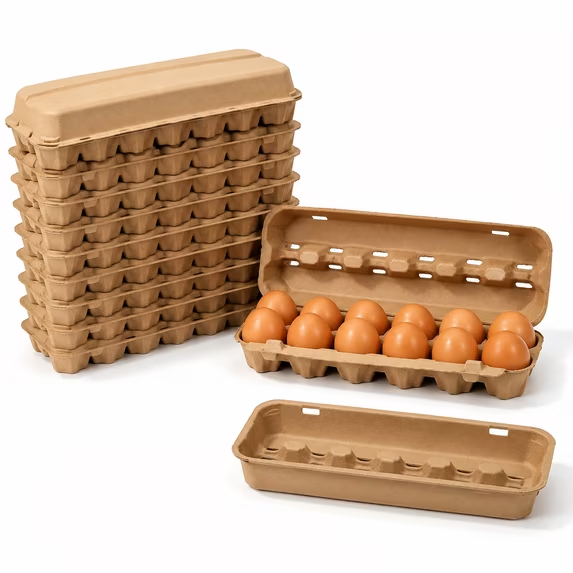
Plain Egg Cartons

  • No printing, no branding, no supplier marks anywhere on the carton
  • Available in every count from 4 through 20 cells
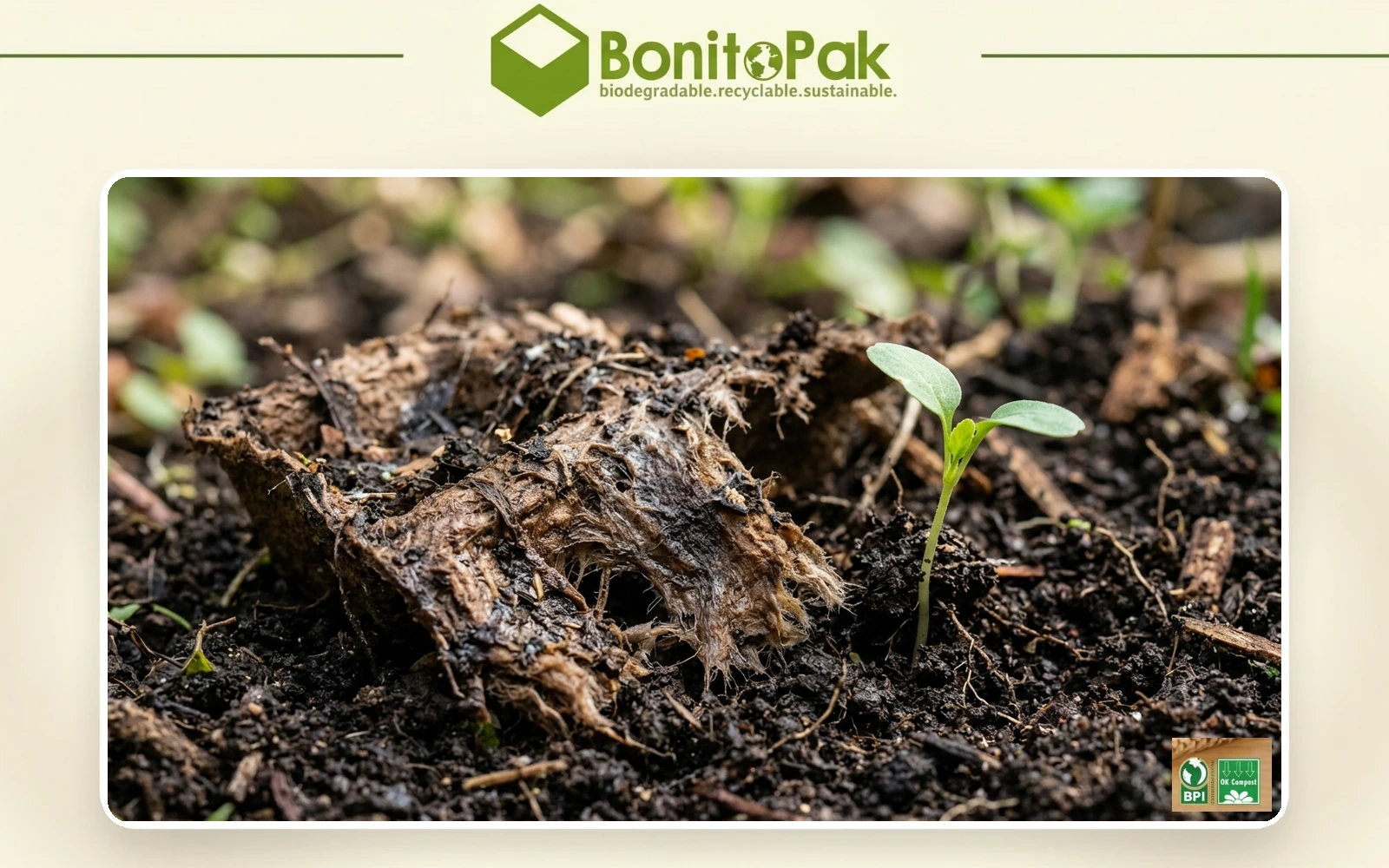
  • Formed from 100% recycled paper pulp, biodegradable and home compostable
  • Lid surface finished for label adhesion, so stickers hold through cold storage
  • Lowest cost per carton in the range, with no plate or tooling charges
  • Natural pulp plus six stock colors, all supplied unprinted
  • Shortest lead time we offer, since printing sits outside the production path

Öffentliche Schimmelpilze

Verpackungslösungen

3D-Entwurf

Kundenspezifische Form

Beschreibung des Produkts

Spezifikation Einzelheiten
Markenname BonitoPak
Modellnummer EC-BLK series
Produktname Plain Egg Cartons / Blank Pulp Cartons
Material Recycelter Papierzellstoff
Papierart Post-consumer recycled paper
Technik Molded pulp forming (wet-pressed)
Cell Count 4, 6, 10, 12, 18, or 20 cells
Drucken None; supplied completely blank
Supplier Marks None anywhere on the carton
Label Surface Finished for pressure sensitive label adhesion
Farbe Natural pulp; six stock colors, all unprinted
Form & Stil Top-fold clamshell; flat top available
Industrielle Nutzung Distributors, repackers, private label, farm direct sellers
Anmeldung Own-label packing, resale, relabeling, bulk supply
Größe OEM and custom dimensions accepted
Vorteile Biodegradable, home compostable, lowest unit cost, shortest lead time
Verpackung Bulk nested in export cartons; custom packing accepted
Individuelle Bestellung Angenommen
MOQ Lowest in the range; confirm with sales

Galerie der Plain Egg Cartons Teile

Diese Galerie zeigt die außergewöhnliche Qualität und die Liebe zum Detail, die wir bei jedem Projekt zeigen. Von komplexen Entwürfen bis hin zu makellosen Oberflächen spiegelt jedes Bild unser Engagement für hervorragende Leistungen in Plain Egg Cartons .

40%

Kosten- und Zeitersparnis

Erleben Sie führende Verpackungslösungen, die Ihre Kosten und Ihren Zeitaufwand optimieren, für effiziente Prozesse sorgen und Ihren ROI maximieren.

50%

Mehr Nachhaltigkeit

Erzielen Sie umweltfreundliche Verpackungen mit nachhaltigen Materialien, reduzieren Sie den Abfall und fördern Sie die Umweltverantwortung für Ihre Produktlinien.

25%

Steigerung des Umsatzes

Steigern Sie die Attraktivität Ihrer Produkte in den Regalen mit innovativen Designs, die die Sichtbarkeit und den Absatz sowohl im Einzelhandel als auch auf dem Online-Markt steigern.

100%

Zuverlässiger

Vertrauen Sie auf das Qualitätsbewusstsein von BonitoPak, das sicherstellt, dass jedes Produkt unseren hohen Standards entspricht und einen beständigen, zuverlässigen Service bietet.

Blank is a specification, not an absence

A plain carton sounds like a carton with something missing. In practice it is the format with the most specific requirement attached, because the surface has to accept something else.

If a carton is going to carry a pressure sensitive label, the lid surface has to be consistent enough for adhesive to bond across its full area. Molded pulp varies in surface density depending on how the fiber drained during forming, and a lid with uneven density will hold a label at one end and lift at the other.

We finish blank lids to a controlled surface density for this reason. It is the difference between a label that survives six weeks in a cold case and one that curls at the corner within a week.

Buyers who have had labels lift on pulp cartons before have usually bought a carton that was blank by omission rather than blank by specification.

Who buys blank, and what each group needs

Three groups, with genuinely different requirements.

Distributors and resellers buy blank because they supply many small producers who each want their own identity. The carton has to carry no supplier marks at all, including ours, because the distributor is the supplier as far as their customer is concerned. We do not put our name on these cartons anywhere.

Private label packers buy blank and apply a retailer’s printed label. Their requirement is dimensional consistency, since labels are applied by machine against a fixed registration point, and a carton that varies in height will label crooked.

Small farm sellers buy blank because they cannot reach printing minimums. They label by hand or stamp with a custom rubber stamp. Their requirement is simply low minimum order quantity, which blank cartons give them because there is no plate or mold cost to amortize.

Cost, and why blank is the cheapest route

Blank cartons carry the lowest unit cost in our range, and the reasons compound.

There is no plate charge, since nothing is printed. There is no mold tooling charge, since blanks run on stock molds. There is no print pass, which removes an entire operation from the production path. And blank runs can be scheduled flexibly against other production, because there is no color or artwork changeover to plan around.

That last point also makes blank the shortest lead time we offer. For a buyer whose constraint is timing rather than branding, blank plus a quickly printed label is almost always faster than a printed carton.

Labeling that actually holds

Four practical points from buyers who label blanks.

Paper labels outperform film on pulp. Film has less conformability and lifts at the edges where the lid surface is slightly textured. Uncoated paper labels bond better and look more appropriate on fiber.

Apply at room temperature, not in the cold room. Adhesive needs time to flow into the surface, and cold slows that to the point where the bond never fully forms.

Keep the label away from the hinge and the front tab. Both flex, and a label bridging a flex point peels from that edge first.

And size the label to the flat center panel rather than edge to edge. The lid curves slightly at its margins and a full-width label will tent at the corners.

Stamping as an alternative to labels

Small producers often skip labels entirely and use a custom rubber stamp with food safe ink. On natural pulp it works well, because the absorbent surface takes stamp ink cleanly without smearing, and the slightly irregular result reads as handmade rather than as a printing defect.

It is the cheapest branding route available, it needs no minimum order, and it suits farm stand selling where the handmade impression is an asset. It does not scale, since every carton is a manual operation, and it does not work on darker colored pulp where the ink has nothing to contrast against.

When blank stops being the right answer

Blank is the correct choice up to a point, and past that point it costs more than printing.

Labels have a per unit cost that never falls away, same as printing. Once annual volume is high enough, the accumulated label cost passes what embossing would have cost once in the mold. The crossover is usually lower than buyers expect, because labels also carry an application labor cost that printing does not.

Producers who find themselves hand-labeling thousands of cartons have usually passed that point already. Embossing is covered at individuell bedruckte Eierkartons, and it costs nothing per unit once the tool exists.

Across the range

Blank is available in every count. The volume formats are the molded pulp dozen egg carton and the molded pulp 18 egg carton, and both are commonly ordered blank for private label work.

Blank is also available in color, which buyers often miss. A colored blank gives shelf differentiation with no printing at all, and for small producers it is frequently the best value in the catalog. See molded pulp colored egg cartons.

For bulk ordering and pricing tiers, see wholesale egg cartons.

Blank is a specification, not an absence

A plain carton sounds like a carton with something missing. In practice it is the format with the most specific requirement attached, because the surface has to accept something else.

If a carton is going to carry a pressure sensitive label, the lid surface has to be consistent enough for adhesive to bond across its full area. Molded pulp varies in surface density depending on how the fiber drained during forming, and a lid with uneven density will hold a label at one end and lift at the other.

We finish blank lids to a controlled surface density for this reason. It is the difference between a label that survives six weeks in a cold case and one that curls at the corner within a week.

Buyers who have had labels lift on pulp cartons before have usually bought a carton that was blank by omission rather than blank by specification.

Who buys blank, and what each group needs

Three groups, with genuinely different requirements.

Distributors and resellers buy blank because they supply many small producers who each want their own identity. The carton has to carry no supplier marks at all, including ours, because the distributor is the supplier as far as their customer is concerned. We do not put our name on these cartons anywhere.

Private label packers buy blank and apply a retailer’s printed label. Their requirement is dimensional consistency, since labels are applied by machine against a fixed registration point, and a carton that varies in height will label crooked.

Small farm sellers buy blank because they cannot reach printing minimums. They label by hand or stamp with a custom rubber stamp. Their requirement is simply low minimum order quantity, which blank cartons give them because there is no plate or mold cost to amortize.

Cost, and why blank is the cheapest route

Blank cartons carry the lowest unit cost in our range, and the reasons compound.

There is no plate charge, since nothing is printed. There is no mold tooling charge, since blanks run on stock molds. There is no print pass, which removes an entire operation from the production path. And blank runs can be scheduled flexibly against other production, because there is no color or artwork changeover to plan around.

That last point also makes blank the shortest lead time we offer. For a buyer whose constraint is timing rather than branding, blank plus a quickly printed label is almost always faster than a printed carton.

Labeling that actually holds

Four practical points from buyers who label blanks.

Paper labels outperform film on pulp. Film has less conformability and lifts at the edges where the lid surface is slightly textured. Uncoated paper labels bond better and look more appropriate on fiber.

Apply at room temperature, not in the cold room. Adhesive needs time to flow into the surface, and cold slows that to the point where the bond never fully forms.

Keep the label away from the hinge and the front tab. Both flex, and a label bridging a flex point peels from that edge first.

And size the label to the flat center panel rather than edge to edge. The lid curves slightly at its margins and a full-width label will tent at the corners.

Stamping as an alternative to labels

Small producers often skip labels entirely and use a custom rubber stamp with food safe ink. On natural pulp it works well, because the absorbent surface takes stamp ink cleanly without smearing, and the slightly irregular result reads as handmade rather than as a printing defect.

It is the cheapest branding route available, it needs no minimum order, and it suits farm stand selling where the handmade impression is an asset. It does not scale, since every carton is a manual operation, and it does not work on darker colored pulp where the ink has nothing to contrast against.

When blank stops being the right answer

Blank is the correct choice up to a point, and past that point it costs more than printing.

Labels have a per unit cost that never falls away, same as printing. Once annual volume is high enough, the accumulated label cost passes what embossing would have cost once in the mold. The crossover is usually lower than buyers expect, because labels also carry an application labor cost that printing does not.

Producers who find themselves hand-labeling thousands of cartons have usually passed that point already. Embossing is covered at individuell bedruckte Eierkartons, and it costs nothing per unit once the tool exists.

Across the range

Blank is available in every count. The volume formats are the molded pulp dozen egg carton and the molded pulp 18 egg carton, and both are commonly ordered blank for private label work.

Blank is also available in color, which buyers often miss. A colored blank gives shelf differentiation with no printing at all, and for small producers it is frequently the best value in the catalog. See molded pulp colored egg cartons.

For bulk ordering and pricing tiers, see wholesale egg cartons.
Materialien für Plain Egg Cartons Teile

Führende Unternehmen und Ingenieure verlassen sich auf BonitoPak, wenn es um schnelle Iterationen und langlebige, hochwertige Teile geht. Ob für die Herstellung von Prototypen oder für die Serienproduktion, unsere breite Palette an Materialien stellt sicher, dass wir die einzigartigen Anforderungen eines jeden Unternehmens erfüllen. Plain Egg Cartons Projekt mit Präzision und Schnelligkeit.

Kompostierbares Kraftpapier ist die festeste Faser, die wir herstellen. Hergestellt aus Frischfaser

Farbiger Zellstoff ist keine eigenständige Faser. Es handelt sich dabei um einen unserer

Gebleichter Zellstoff ist das zu spezifizierende Material, wenn das Bauteil

Der Begriff „natürliche Pflanzenfasern“ umfasst die nicht aus Holz stammenden Zellulosequellen, die wir außerhalb der

Wellpappe als Formmasse bezeichnet wiederverwertete Kartons, die zu Zellstoff zerkleinert wurden

Strohfasern werden aus den nach der Getreideernte übrig gebliebenen Stängeln hergestellt, Material

Individuell Umweltfreundlich Zuverlässig

Maßgeschneiderte, umweltfreundliche Verpackung auf höchstem Niveau

Vollständig anpassbar

Passen Sie Ihre Verpackungen mit maßgeschneiderten Stilen, Größen, Farben und Veredelungen an Ihre spezifischen Bedürfnisse an.

Unterstützung durch Experten

Bonitopak bietet fachkundige Design- und Logistikberatung, um die Verpackungseffizienz zu maximieren und den ROI zu steigern.

Öko-Lösungen

Entscheiden Sie sich für nachhaltige, umweltfreundliche Verpackungen, um die Umweltbelastung zu reduzieren und die grünen Ziele Ihrer Marke zu unterstützen.

Qualitätssicherung

Bonitopak garantiert bei jeder Verpackungslösung einen erstklassigen Service und ein hervorragendes Produkt.

Häufig gestellte Fragen

Plain Egg Cartons

  • Can I get blank cartons with a flat top for easier labeling?

    Yes, and it is worth specifying if labeling is the plan. A flat top gives a genuinely flat label area rather than a slightly domed one, which improves both application accuracy and adhesion at the label edges. The flat top profile is covered on the molded pulp vintage egg cartons Seite.

  • Is a blank carton lower quality than a printed one?

    No. It comes off the same mold, at the same fiber density, with the same top load performance. The only difference is that no print pass was applied. Buyers sometimes assume blank means seconds or overruns, and that is a different product category entirely which we do not sell.

  • Can I order blank cartons in small quantities for a trial?

    Blank carries our lowest minimum because there is no tooling or plate cost to recover. It is the right product for a first order while you test a format. We would rather supply a small blank run and have you come back than push a printed minimum onto a buyer who is still deciding.

  • What label adhesive works best on molded pulp?

     General purpose permanent acrylic adhesives on uncoated paper face stock perform well. Avoid removable adhesives, which never develop sufficient bond on a porous surface, and avoid film face stocks, which lift at the edges. Your label supplier will know these as standard options; the substrate to specify is uncoated paper.

  • Will your company name appear anywhere on a blank carton?

     No. Blank means blank, including no supplier identification, no mold numbers visible on the outer faces, and nothing on the base. Distributors reselling under their own name need that to be absolute, and we treat it as such rather than leaving a small mark somewhere.

Biologisch abbaubar Ergebnis

0 Tage

7 Tage

14 Tage

30 Tage

Spezialisierte Industrien

Durch die Herstellung von Millionen von Teilen verfügt BonitoPak über umfassende Kenntnisse in zahlreichen Anwendungen. Wir zeichnen uns besonders in Branchen aus, die eine präzise und komplizierte Komponentenfertigung erfordern. Vertrauen Sie darauf, dass wir unabhängig von der Komplexität Fachwissen und Qualität liefern.

OEM- und ODM-Verpackungslösungen

Bonitopak bietet sowohl kundenspezifische (OEM) als auch vorgefertigte (ODM) Verpackungslösungen an. Ganz gleich, ob Sie vollständig maßgeschneiderte Designs oder gebrauchsfertige Verpackungen benötigen, wir bieten hochwertige, effiziente und flexible Optionen, um die Anforderungen Ihrer Marke zu erfüllen.

OEM-Dienste

OEM-Verpackungslösungen ermöglichen es Ihnen, vollständig maßgeschneiderte Produkte zu entwerfen und herzustellen, die Ihren spezifischen Anforderungen entsprechen. Wir von Bonitopak bieten umfassende Unterstützung während des gesamten Design-, Prototyping- und Fertigungsprozesses, damit Ihre Verpackung die einzigartige Identität Ihrer Marke widerspiegelt. Unsere Präzisionsfertigungskapazitäten garantieren eine hochwertige und konsistente Produktion, unabhängig von der Komplexität des Designs. Mit unserem End-to-End-Service kümmern wir uns um alles, vom Konzept bis zur Auslieferung, und helfen Ihnen, Ihren Verpackungsbedarf zu optimieren.

ODM-Dienste

ODM-Verpackungslösungen bieten vorgefertigte Produkte, die auf die Anforderungen Ihrer Marke zugeschnitten werden können. Mit dem innovativen Design-Know-how und dem effizienten Produktionsprozess von Bonitopak können Sie aus einer breiten Palette von gebrauchsfertigen Verpackungsoptionen wählen. Wir bieten flexible Anpassungsmöglichkeiten, die es Ihnen ermöglichen, Ihr Markenzeichen hinzuzufügen und aus verschiedenen Veredelungen, Farben und Größen zu wählen. Diese Lösung spart Zeit und Kosten und gewährleistet gleichzeitig eine hochwertige Verpackung, die Ihren Markenstandards entspricht.
Sind Sie bereit, Ihr Projekt aufzuwerten?

Erwecken Sie Ihre Entwürfe mit BonitoPak zum Leben

Erleben Sie Präzisionstechnik mit BonitoPak. Von detaillierten Prototypen bis hin zur Großserienproduktion - wir sind da, um Ihre Konzepte in die Realität umzusetzen. Kontaktieren Sie uns noch heute, um Ihre Projektanforderungen zu besprechen!

Unsere Produktkategorien

Entdecken Sie das vielfältige Angebot an Verpackungslösungen von Bonitopak, darunter geformte Zellstoffschalen, Lebensmittelverpackungen, kundenspezifische Designs und nachhaltige Optionen. Jede Kategorie ist auf Langlebigkeit, Funktionalität und Umweltverträglichkeit ausgelegt und auf Ihre spezifischen Anforderungen zugeschnitten.

Blank is a specification, not an absence

A plain carton sounds like a carton with something missing. In practice it is the format with the most specific requirement attached, because the surface has to accept something else.

If a carton is going to carry a pressure sensitive label, the lid surface has to be consistent enough for adhesive to bond across its full area. Molded pulp varies in surface density depending on how the fiber drained during forming, and a lid with uneven density will hold a label at one end and lift at the other.

We finish blank lids to a controlled surface density for this reason. It is the difference between a label that survives six weeks in a cold case and one that curls at the corner within a week.

Buyers who have had labels lift on pulp cartons before have usually bought a carton that was blank by omission rather than blank by specification.

Who buys blank, and what each group needs

Three groups, with genuinely different requirements.

Distributors and resellers buy blank because they supply many small producers who each want their own identity. The carton has to carry no supplier marks at all, including ours, because the distributor is the supplier as far as their customer is concerned. We do not put our name on these cartons anywhere.

Private label packers buy blank and apply a retailer’s printed label. Their requirement is dimensional consistency, since labels are applied by machine against a fixed registration point, and a carton that varies in height will label crooked.

Small farm sellers buy blank because they cannot reach printing minimums. They label by hand or stamp with a custom rubber stamp. Their requirement is simply low minimum order quantity, which blank cartons give them because there is no plate or mold cost to amortize.

Cost, and why blank is the cheapest route

Blank cartons carry the lowest unit cost in our range, and the reasons compound.

There is no plate charge, since nothing is printed. There is no mold tooling charge, since blanks run on stock molds. There is no print pass, which removes an entire operation from the production path. And blank runs can be scheduled flexibly against other production, because there is no color or artwork changeover to plan around.

That last point also makes blank the shortest lead time we offer. For a buyer whose constraint is timing rather than branding, blank plus a quickly printed label is almost always faster than a printed carton.

Labeling that actually holds

Four practical points from buyers who label blanks.

Paper labels outperform film on pulp. Film has less conformability and lifts at the edges where the lid surface is slightly textured. Uncoated paper labels bond better and look more appropriate on fiber.

Apply at room temperature, not in the cold room. Adhesive needs time to flow into the surface, and cold slows that to the point where the bond never fully forms.

Keep the label away from the hinge and the front tab. Both flex, and a label bridging a flex point peels from that edge first.

And size the label to the flat center panel rather than edge to edge. The lid curves slightly at its margins and a full-width label will tent at the corners.

Stamping as an alternative to labels

Small producers often skip labels entirely and use a custom rubber stamp with food safe ink. On natural pulp it works well, because the absorbent surface takes stamp ink cleanly without smearing, and the slightly irregular result reads as handmade rather than as a printing defect.

It is the cheapest branding route available, it needs no minimum order, and it suits farm stand selling where the handmade impression is an asset. It does not scale, since every carton is a manual operation, and it does not work on darker colored pulp where the ink has nothing to contrast against.

When blank stops being the right answer

Blank is the correct choice up to a point, and past that point it costs more than printing.

Labels have a per unit cost that never falls away, same as printing. Once annual volume is high enough, the accumulated label cost passes what embossing would have cost once in the mold. The crossover is usually lower than buyers expect, because labels also carry an application labor cost that printing does not.

Producers who find themselves hand-labeling thousands of cartons have usually passed that point already. Embossing is covered at individuell bedruckte Eierkartons, and it costs nothing per unit once the tool exists.

Across the range

Blank is available in every count. The volume formats are the molded pulp dozen egg carton and the molded pulp 18 egg carton, and both are commonly ordered blank for private label work.

Blank is also available in color, which buyers often miss. A colored blank gives shelf differentiation with no printing at all, and for small producers it is frequently the best value in the catalog. See molded pulp colored egg cartons.

For bulk ordering and pricing tiers, see wholesale egg cartons.

Verwandte Artikel und Einblicke

Bleiben Sie auf dem Laufenden mit den neuesten Informationen über nachhaltige Verpackungstrends, Einblicke in die Branche und Expertentipps in unserem Blog. Entdecken Sie innovative Ideen und Lösungen, um Ihr Verpackungswissen zu erweitern.

Von Leo Chan | Autor, BonitoPak | Über 20 Jahre Erfahrung im Bereich Verpackungen aus Formzellstoff Wodka ist

Von Leo Chan | Autor, BonitoPak | Über 20 Jahre Erfahrung im Bereich Formzellstoffverpackungen Fast jede

Von Leo Chan | Autor, BonitoPak | Über 20 Jahre Erfahrung im Bereich Verpackungen aus Formzellstoff Hier suchen

Häufig gestellte Fragen

Plain Egg Cartons

  • Can I get blank cartons with a flat top for easier labeling?

    Yes, and it is worth specifying if labeling is the plan. A flat top gives a genuinely flat label area rather than a slightly domed one, which improves both application accuracy and adhesion at the label edges. The flat top profile is covered on the molded pulp vintage egg cartons Seite.

  • Is a blank carton lower quality than a printed one?

    No. It comes off the same mold, at the same fiber density, with the same top load performance. The only difference is that no print pass was applied. Buyers sometimes assume blank means seconds or overruns, and that is a different product category entirely which we do not sell.

  • Can I order blank cartons in small quantities for a trial?

    Blank carries our lowest minimum because there is no tooling or plate cost to recover. It is the right product for a first order while you test a format. We would rather supply a small blank run and have you come back than push a printed minimum onto a buyer who is still deciding.

  • What label adhesive works best on molded pulp?

     General purpose permanent acrylic adhesives on uncoated paper face stock perform well. Avoid removable adhesives, which never develop sufficient bond on a porous surface, and avoid film face stocks, which lift at the edges. Your label supplier will know these as standard options; the substrate to specify is uncoated paper.

  • Will your company name appear anywhere on a blank carton?

     No. Blank means blank, including no supplier identification, no mold numbers visible on the outer faces, and nothing on the base. Distributors reselling under their own name need that to be absolute, and we treat it as such rather than leaving a small mark somewhere.

Füllen Sie dieses detaillierte Formular aus