Blue Egg Cartons

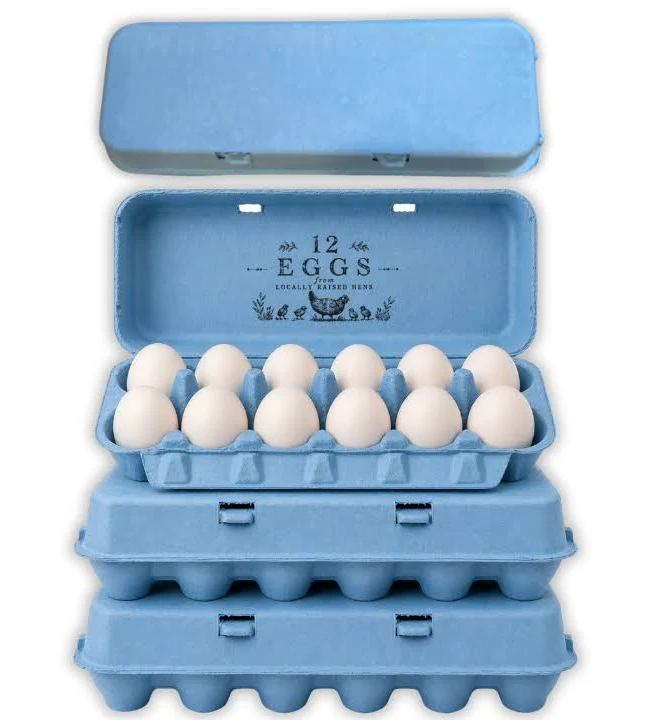
  • Shade range from pale sky through mid blue to deep navy
  • Pigment blended into the slurry, so color survives scuffing and shipping
  • Navy holds embossed detail nearly as sharply as black
  • Pale blue pairs with blue and olive shell eggs for a tonal presentation
  • Compostable and plastic free, with no surface coating
  • Available across every cell count from 4 through 20
  • OEM and ODM sizing accepted; retained shade standards kept for reorders

Öffentliche Schimmelpilze

Verpackungslösungen

3D-Entwurf

Kundenspezifische Form

Blue egg cartons in molded pulp holding pale blue Araucana eggs

Beschreibung des Produkts

Spezifikation Einzelheiten
Markenname BonitoPak
Modellnummer EC-BLU series
Produktname Blue Egg Cartons / Blue Pigmented Pulp Cartons
Material Recycled paper pulp with slurry-blended pigment
Technik Molded pulp forming (wet-pressed), wet end pigmentation
Cell Count 4, 6, 10, 12, 18, or 20 cells
Shade Range Pale sky, mid blue, deep navy; custom shades matched
Color Method Pigment blended into slurry before forming, not surface coated
Lightfastness Lower on pale shades; navy most stable
Print Contrast Strong with white on navy; black on pale sky
Logo-Druck Embossed, debossed, or flexographic print
Industrielle Nutzung Farm brands, specialty retail, seasonal lines, gift packing
Anmeldung Branded egg lines, blue shell egg presentation, spring ranges
Vorteile Biodegradable, home compostable, plastic free, no coating
Individuelle Bestellung Angenommen
MOQ Confirm with sales; stock blue carries a lower minimum than custom shades

Galerie der Blue Egg Cartons Teile

Diese Galerie zeigt die außergewöhnliche Qualität und die Liebe zum Detail, die wir bei jedem Projekt zeigen. Von komplexen Entwürfen bis hin zu makellosen Oberflächen spiegelt jedes Bild unser Engagement für hervorragende Leistungen in Blue Egg Cartons .

40%

Kosten- und Zeitersparnis

Erleben Sie führende Verpackungslösungen, die Ihre Kosten und Ihren Zeitaufwand optimieren, für effiziente Prozesse sorgen und Ihren ROI maximieren.

50%

Mehr Nachhaltigkeit

Erzielen Sie umweltfreundliche Verpackungen mit nachhaltigen Materialien, reduzieren Sie den Abfall und fördern Sie die Umweltverantwortung für Ihre Produktlinien.

25%

Steigerung des Umsatzes

Steigern Sie die Attraktivität Ihrer Produkte in den Regalen mit innovativen Designs, die die Sichtbarkeit und den Absatz sowohl im Einzelhandel als auch auf dem Online-Markt steigern.

100%

Zuverlässiger

Vertrauen Sie auf das Qualitätsbewusstsein von BonitoPak, das sicherstellt, dass jedes Produkt unseren hohen Standards entspricht und einen beständigen, zuverlässigen Service bietet.

The shade that fades fastest

Blue carries a technical limitation worth stating before anything else, because it affects where the carton should be used.

Blue pigments rated for compostable packaging are the least lightfast group in the palette. The chemistries that give strong blue without heavy metals are inherently more vulnerable to ultraviolet exposure than reds, yellows, or blacks.

In a retail cold case, under covered market stalls, or anywhere out of direct sun, this never becomes visible. Cartons held in strong direct sunlight for weeks will lighten noticeably, and pale sky blue will go first because there is less pigment present to lose.

Producers selling at outdoor markets in strong sun should either specify navy, which has far more pigment headroom, or keep stock covered between market days. Producers selling into refrigerated retail can ignore this entirely.

We would rather state it than have a buyer discover it in July.

Three shades and what each is for

Pale sky is the softest blue we run and the one most often ordered for a specific reason: it matches the shell. Producers with Araucana, Ameraucana, or Cream Legbar flocks laying blue-green eggs use pale blue cartons for a tonal presentation where the pack and the product sit in the same color family. It is a considered look and it photographs beautifully.

Mid blue is the general purpose shade. Clearly blue at a distance, strong enough to carry a brand identity, and forgiving to produce because the pigment load reduces base fiber influence.

Deep navy behaves closer to black than to blue in every practical respect. It holds embossed detail sharply, takes white and metallic print well, reads as premium rather than as cheerful, and is the most lightfast blue we make.

Blue against the shell color

Blue differs from every other shade in our range on this point, and it is worth thinking through before ordering.

Most carton colors contrast with the eggs. Pink against brown, black against white, green against cream. Contrast makes the eggs stand out when the lid opens.

Blue is the one shade that can match rather than contrast, because blue shell eggs exist. That opens a presentation option nothing else offers: a tonal pack where pale blue carton and pale blue shell read as a single considered product.

It also creates a risk. A mid or navy blue carton holding blue shell eggs flattens them, since the eggs disappear against a stronger version of their own color. Producers with blue laying flocks should specify pale, or move to a contrasting shade entirely.

Brown and white eggs both contrast well against all three blues.

Print and emboss

Navy behaves much like black. White ink reads strongly, metallic effects work, and embossed detail holds sharply because the tonal depth throws a clean shadow.

Pale sky is the opposite. It is light enough that embossing reads softly, and dark inks are needed for printed contrast. Black on pale blue is a clean combination that several farm brands use.

Mid blue sits awkwardly for both. It is too dark for strong black print contrast and too light for white to read cleanly. Producers specifying mid blue should plan on embossing with the understanding that it will read softly, or choose a shade at one end of the range instead.

Navy as a black alternative

Buyers who want the premium weight of black without its severity frequently land on navy, and it is worth understanding what the swap actually changes.

Navy keeps most of black’s advantages: sharp embossing, strong white and metallic print, high shade consistency, and good lightfastness. What it adds is a visible hue under daylight, so the carton reads as a considered color choice rather than as an absence of color.

What it gives up is maximum contrast. White ink on navy is strong but not as stark as white on black, and metallic effects read slightly softer. For most premium lines that trade is worth making.

Seasonal and market use

Blue runs in spring and Easter ranges alongside pink, yellow, and green, and those orders cluster on a fixed deadline. The approval cycle, not production, is what decides whether a seasonal order lands, and buyers who start late end up accepting a stock shade rather than a matched one.

Blue also has a steady non-seasonal market among producers whose brand identity is blue, where the requirement is consistency across years rather than a single run. Those buyers should approve and retain a physical shade standard at first production, since every reorder is then matched against it.

For the full detail on how shade is controlled between batches and across molds, see molded pulp colored egg cartons.

Pairing with format

Navy on molded pulp octagon egg cartons gives a premium gift presentation close to what black achieves.

Pale blue on a molded pulp 6 egg carton suits specialty blue shell lines, which sell in half dozens more often than in twelves.

For a permanent brand identity across the range, the molded pulp dozen egg carton is the volume format to anchor on. Printing specifications are covered at individuell bedruckte Eierkartons.

The shade that fades fastest

Blue carries a technical limitation worth stating before anything else, because it affects where the carton should be used.

Blue pigments rated for compostable packaging are the least lightfast group in the palette. The chemistries that give strong blue without heavy metals are inherently more vulnerable to ultraviolet exposure than reds, yellows, or blacks.

In a retail cold case, under covered market stalls, or anywhere out of direct sun, this never becomes visible. Cartons held in strong direct sunlight for weeks will lighten noticeably, and pale sky blue will go first because there is less pigment present to lose.

Producers selling at outdoor markets in strong sun should either specify navy, which has far more pigment headroom, or keep stock covered between market days. Producers selling into refrigerated retail can ignore this entirely.

We would rather state it than have a buyer discover it in July.

Three shades and what each is for

Pale sky is the softest blue we run and the one most often ordered for a specific reason: it matches the shell. Producers with Araucana, Ameraucana, or Cream Legbar flocks laying blue-green eggs use pale blue cartons for a tonal presentation where the pack and the product sit in the same color family. It is a considered look and it photographs beautifully.

Mid blue is the general purpose shade. Clearly blue at a distance, strong enough to carry a brand identity, and forgiving to produce because the pigment load reduces base fiber influence.

Deep navy behaves closer to black than to blue in every practical respect. It holds embossed detail sharply, takes white and metallic print well, reads as premium rather than as cheerful, and is the most lightfast blue we make.

Blue against the shell color

Blue differs from every other shade in our range on this point, and it is worth thinking through before ordering.

Most carton colors contrast with the eggs. Pink against brown, black against white, green against cream. Contrast makes the eggs stand out when the lid opens.

Blue is the one shade that can match rather than contrast, because blue shell eggs exist. That opens a presentation option nothing else offers: a tonal pack where pale blue carton and pale blue shell read as a single considered product.

It also creates a risk. A mid or navy blue carton holding blue shell eggs flattens them, since the eggs disappear against a stronger version of their own color. Producers with blue laying flocks should specify pale, or move to a contrasting shade entirely.

Brown and white eggs both contrast well against all three blues.

Print and emboss

Navy behaves much like black. White ink reads strongly, metallic effects work, and embossed detail holds sharply because the tonal depth throws a clean shadow.

Pale sky is the opposite. It is light enough that embossing reads softly, and dark inks are needed for printed contrast. Black on pale blue is a clean combination that several farm brands use.

Mid blue sits awkwardly for both. It is too dark for strong black print contrast and too light for white to read cleanly. Producers specifying mid blue should plan on embossing with the understanding that it will read softly, or choose a shade at one end of the range instead.

Navy as a black alternative

Buyers who want the premium weight of black without its severity frequently land on navy, and it is worth understanding what the swap actually changes.

Navy keeps most of black’s advantages: sharp embossing, strong white and metallic print, high shade consistency, and good lightfastness. What it adds is a visible hue under daylight, so the carton reads as a considered color choice rather than as an absence of color.

What it gives up is maximum contrast. White ink on navy is strong but not as stark as white on black, and metallic effects read slightly softer. For most premium lines that trade is worth making.

Seasonal and market use

Blue runs in spring and Easter ranges alongside pink, yellow, and green, and those orders cluster on a fixed deadline. The approval cycle, not production, is what decides whether a seasonal order lands, and buyers who start late end up accepting a stock shade rather than a matched one.

Blue also has a steady non-seasonal market among producers whose brand identity is blue, where the requirement is consistency across years rather than a single run. Those buyers should approve and retain a physical shade standard at first production, since every reorder is then matched against it.

For the full detail on how shade is controlled between batches and across molds, see molded pulp colored egg cartons.

Pairing with format

Navy on molded pulp octagon egg cartons gives a premium gift presentation close to what black achieves.

Pale blue on a molded pulp 6 egg carton suits specialty blue shell lines, which sell in half dozens more often than in twelves.

For a permanent brand identity across the range, the molded pulp dozen egg carton is the volume format to anchor on. Printing specifications are covered at individuell bedruckte Eierkartons.

Materialien für Blue Egg Cartons Teile

Führende Unternehmen und Ingenieure verlassen sich auf BonitoPak, wenn es um schnelle Iterationen und langlebige, hochwertige Teile geht. Ob für die Herstellung von Prototypen oder für die Serienproduktion, unsere breite Palette an Materialien stellt sicher, dass wir die einzigartigen Anforderungen eines jeden Unternehmens erfüllen. Blue Egg Cartons Projekt mit Präzision und Schnelligkeit.

Kompostierbares Kraftpapier ist die festeste Faser, die wir herstellen. Hergestellt aus Frischfaser

Farbiger Zellstoff ist keine eigenständige Faser. Es handelt sich dabei um einen unserer

Gebleichter Zellstoff ist das zu spezifizierende Material, wenn das Bauteil

Der Begriff „natürliche Pflanzenfasern“ umfasst die nicht aus Holz stammenden Zellulosequellen, die wir außerhalb der

Wellpappe als Formmasse bezeichnet wiederverwertete Kartons, die zu Zellstoff zerkleinert wurden

Strohfasern werden aus den nach der Getreideernte übrig gebliebenen Stängeln hergestellt, Material

Individuell Umweltfreundlich Zuverlässig

Maßgeschneiderte, umweltfreundliche Verpackung auf höchstem Niveau

Vollständig anpassbar

Passen Sie Ihre Verpackungen mit maßgeschneiderten Stilen, Größen, Farben und Veredelungen an Ihre spezifischen Bedürfnisse an.

Unterstützung durch Experten

Bonitopak bietet fachkundige Design- und Logistikberatung, um die Verpackungseffizienz zu maximieren und den ROI zu steigern.

Öko-Lösungen

Entscheiden Sie sich für nachhaltige, umweltfreundliche Verpackungen, um die Umweltbelastung zu reduzieren und die grünen Ziele Ihrer Marke zu unterstützen.

Qualitätssicherung

Bonitopak garantiert bei jeder Verpackungslösung einen erstklassigen Service und ein hervorragendes Produkt.

Häufig gestellte Fragen

Blue Egg Cartons

  • Does blue cost more than natural pulp?

    Yes, as all pigmented shades do, and the difference comes from pigment cost plus the line flush required when changing color. Blue sits in the middle of our color range on price, above black on pigment cost per unit of coverage and below custom matched shades.

  • Is navy just black with less pigment?

    No, they use different pigment systems entirely. Navy reads as a dark blue under daylight and shows its blue cast clearly against a true black carton placed beside it. Buyers who want near-black performance with a hint of color choose navy deliberately rather than as a compromise.

  • Can you match a specific Pantone blue?

    We produce a close match and supply a formed physical sample for approval. Exact matching to a printed Pantone reference is not physically achievable in pigmented fiber, since pulp scatters light differently from coated paper. Brands with a strict standard approve a designated pulp equivalent rather than insisting on the ink reference.

  • How much fading should I expect at an outdoor market?

    Visible lightening after sustained direct sun across weeks, with pale sky showing it first and navy showing it last. Cartons used and sold within days never see enough exposure to matter. The problem is stock sitting in sun between market days, which is solved by covering the pile rather than by changing shade.

  • Which blue should I choose if my hens lay blue eggs?

    Pale sky, for a tonal match, or move away from blue entirely for contrast. Avoid mid blue and navy, which are strong enough to flatten a pale blue shell so the eggs stop registering as the distinctive thing they are. Order a sample and seat your actual eggs in it before committing.

Biologisch abbaubar Ergebnis

0 Tage

7 Tage

14 Tage

30 Tage

Spezialisierte Industrien

Durch die Herstellung von Millionen von Teilen verfügt BonitoPak über umfassende Kenntnisse in zahlreichen Anwendungen. Wir zeichnen uns besonders in Branchen aus, die eine präzise und komplizierte Komponentenfertigung erfordern. Vertrauen Sie darauf, dass wir unabhängig von der Komplexität Fachwissen und Qualität liefern.

OEM- und ODM-Verpackungslösungen

Bonitopak bietet sowohl kundenspezifische (OEM) als auch vorgefertigte (ODM) Verpackungslösungen an. Ganz gleich, ob Sie vollständig maßgeschneiderte Designs oder gebrauchsfertige Verpackungen benötigen, wir bieten hochwertige, effiziente und flexible Optionen, um die Anforderungen Ihrer Marke zu erfüllen.

OEM-Dienste

OEM-Verpackungslösungen ermöglichen es Ihnen, vollständig maßgeschneiderte Produkte zu entwerfen und herzustellen, die Ihren spezifischen Anforderungen entsprechen. Wir von Bonitopak bieten umfassende Unterstützung während des gesamten Design-, Prototyping- und Fertigungsprozesses, damit Ihre Verpackung die einzigartige Identität Ihrer Marke widerspiegelt. Unsere Präzisionsfertigungskapazitäten garantieren eine hochwertige und konsistente Produktion, unabhängig von der Komplexität des Designs. Mit unserem End-to-End-Service kümmern wir uns um alles, vom Konzept bis zur Auslieferung, und helfen Ihnen, Ihren Verpackungsbedarf zu optimieren.

ODM-Dienste

ODM-Verpackungslösungen bieten vorgefertigte Produkte, die auf die Anforderungen Ihrer Marke zugeschnitten werden können. Mit dem innovativen Design-Know-how und dem effizienten Produktionsprozess von Bonitopak können Sie aus einer breiten Palette von gebrauchsfertigen Verpackungsoptionen wählen. Wir bieten flexible Anpassungsmöglichkeiten, die es Ihnen ermöglichen, Ihr Markenzeichen hinzuzufügen und aus verschiedenen Veredelungen, Farben und Größen zu wählen. Diese Lösung spart Zeit und Kosten und gewährleistet gleichzeitig eine hochwertige Verpackung, die Ihren Markenstandards entspricht.
Sind Sie bereit, Ihr Projekt aufzuwerten?

Erwecken Sie Ihre Entwürfe mit BonitoPak zum Leben

Erleben Sie Präzisionstechnik mit BonitoPak. Von detaillierten Prototypen bis hin zur Großserienproduktion - wir sind da, um Ihre Konzepte in die Realität umzusetzen. Kontaktieren Sie uns noch heute, um Ihre Projektanforderungen zu besprechen!

Unsere Produktkategorien

Entdecken Sie das vielfältige Angebot an Verpackungslösungen von Bonitopak, darunter geformte Zellstoffschalen, Lebensmittelverpackungen, kundenspezifische Designs und nachhaltige Optionen. Jede Kategorie ist auf Langlebigkeit, Funktionalität und Umweltverträglichkeit ausgelegt und auf Ihre spezifischen Anforderungen zugeschnitten.

The shade that fades fastest

Blue carries a technical limitation worth stating before anything else, because it affects where the carton should be used.

Blue pigments rated for compostable packaging are the least lightfast group in the palette. The chemistries that give strong blue without heavy metals are inherently more vulnerable to ultraviolet exposure than reds, yellows, or blacks.

In a retail cold case, under covered market stalls, or anywhere out of direct sun, this never becomes visible. Cartons held in strong direct sunlight for weeks will lighten noticeably, and pale sky blue will go first because there is less pigment present to lose.

Producers selling at outdoor markets in strong sun should either specify navy, which has far more pigment headroom, or keep stock covered between market days. Producers selling into refrigerated retail can ignore this entirely.

We would rather state it than have a buyer discover it in July.

Three shades and what each is for

Pale sky is the softest blue we run and the one most often ordered for a specific reason: it matches the shell. Producers with Araucana, Ameraucana, or Cream Legbar flocks laying blue-green eggs use pale blue cartons for a tonal presentation where the pack and the product sit in the same color family. It is a considered look and it photographs beautifully.

Mid blue is the general purpose shade. Clearly blue at a distance, strong enough to carry a brand identity, and forgiving to produce because the pigment load reduces base fiber influence.

Deep navy behaves closer to black than to blue in every practical respect. It holds embossed detail sharply, takes white and metallic print well, reads as premium rather than as cheerful, and is the most lightfast blue we make.

Blue against the shell color

Blue differs from every other shade in our range on this point, and it is worth thinking through before ordering.

Most carton colors contrast with the eggs. Pink against brown, black against white, green against cream. Contrast makes the eggs stand out when the lid opens.

Blue is the one shade that can match rather than contrast, because blue shell eggs exist. That opens a presentation option nothing else offers: a tonal pack where pale blue carton and pale blue shell read as a single considered product.

It also creates a risk. A mid or navy blue carton holding blue shell eggs flattens them, since the eggs disappear against a stronger version of their own color. Producers with blue laying flocks should specify pale, or move to a contrasting shade entirely.

Brown and white eggs both contrast well against all three blues.

Print and emboss

Navy behaves much like black. White ink reads strongly, metallic effects work, and embossed detail holds sharply because the tonal depth throws a clean shadow.

Pale sky is the opposite. It is light enough that embossing reads softly, and dark inks are needed for printed contrast. Black on pale blue is a clean combination that several farm brands use.

Mid blue sits awkwardly for both. It is too dark for strong black print contrast and too light for white to read cleanly. Producers specifying mid blue should plan on embossing with the understanding that it will read softly, or choose a shade at one end of the range instead.

Navy as a black alternative

Buyers who want the premium weight of black without its severity frequently land on navy, and it is worth understanding what the swap actually changes.

Navy keeps most of black’s advantages: sharp embossing, strong white and metallic print, high shade consistency, and good lightfastness. What it adds is a visible hue under daylight, so the carton reads as a considered color choice rather than as an absence of color.

What it gives up is maximum contrast. White ink on navy is strong but not as stark as white on black, and metallic effects read slightly softer. For most premium lines that trade is worth making.

Seasonal and market use

Blue runs in spring and Easter ranges alongside pink, yellow, and green, and those orders cluster on a fixed deadline. The approval cycle, not production, is what decides whether a seasonal order lands, and buyers who start late end up accepting a stock shade rather than a matched one.

Blue also has a steady non-seasonal market among producers whose brand identity is blue, where the requirement is consistency across years rather than a single run. Those buyers should approve and retain a physical shade standard at first production, since every reorder is then matched against it.

For the full detail on how shade is controlled between batches and across molds, see molded pulp colored egg cartons.

Pairing with format

Navy on molded pulp octagon egg cartons gives a premium gift presentation close to what black achieves.

Pale blue on a molded pulp 6 egg carton suits specialty blue shell lines, which sell in half dozens more often than in twelves.

For a permanent brand identity across the range, the molded pulp dozen egg carton is the volume format to anchor on. Printing specifications are covered at individuell bedruckte Eierkartons.

Verwandte Artikel und Einblicke

Bleiben Sie auf dem Laufenden mit den neuesten Informationen über nachhaltige Verpackungstrends, Einblicke in die Branche und Expertentipps in unserem Blog. Entdecken Sie innovative Ideen und Lösungen, um Ihr Verpackungswissen zu erweitern.

Von Leo Chan | Autor, BonitoPak | Über 20 Jahre Erfahrung im Bereich Verpackungen aus Formzellstoff Wodka ist

Von Leo Chan | Autor, BonitoPak | Über 20 Jahre Erfahrung im Bereich Formzellstoffverpackungen Fast jede

Von Leo Chan | Autor, BonitoPak | Über 20 Jahre Erfahrung im Bereich Verpackungen aus Formzellstoff Hier suchen

Häufig gestellte Fragen

Blue Egg Cartons

  • Does blue cost more than natural pulp?

    Yes, as all pigmented shades do, and the difference comes from pigment cost plus the line flush required when changing color. Blue sits in the middle of our color range on price, above black on pigment cost per unit of coverage and below custom matched shades.

  • Is navy just black with less pigment?

    No, they use different pigment systems entirely. Navy reads as a dark blue under daylight and shows its blue cast clearly against a true black carton placed beside it. Buyers who want near-black performance with a hint of color choose navy deliberately rather than as a compromise.

  • Can you match a specific Pantone blue?

    We produce a close match and supply a formed physical sample for approval. Exact matching to a printed Pantone reference is not physically achievable in pigmented fiber, since pulp scatters light differently from coated paper. Brands with a strict standard approve a designated pulp equivalent rather than insisting on the ink reference.

  • How much fading should I expect at an outdoor market?

    Visible lightening after sustained direct sun across weeks, with pale sky showing it first and navy showing it last. Cartons used and sold within days never see enough exposure to matter. The problem is stock sitting in sun between market days, which is solved by covering the pile rather than by changing shade.

  • Which blue should I choose if my hens lay blue eggs?

    Pale sky, for a tonal match, or move away from blue entirely for contrast. Avoid mid blue and navy, which are strong enough to flatten a pale blue shell so the eggs stop registering as the distinctive thing they are. Order a sample and seat your actual eggs in it before committing.

Füllen Sie dieses detaillierte Formular aus