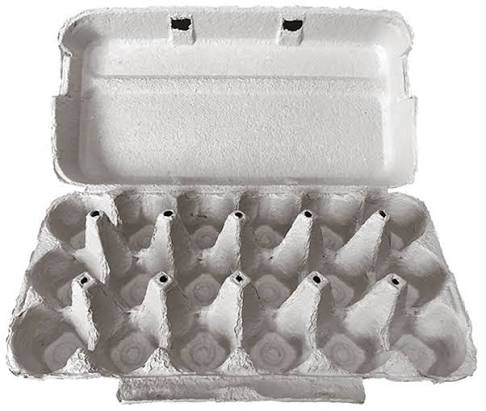
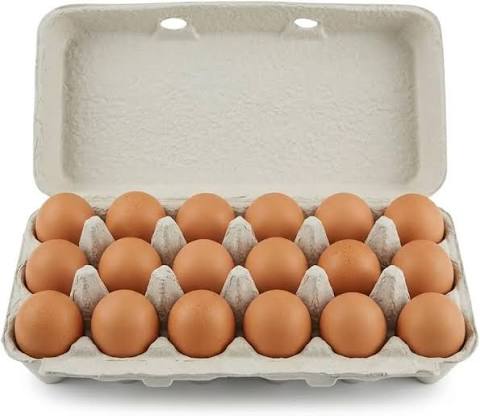
Add six cells to a twelve count and something has to change structurally. That is the part buyers miss when they assume an 18 egg carton is simply a longer version of the standard.
The issue is span. A twelve count lid bridges roughly 105 mm across its short axis. An eighteen count bridges 155 mm. Half again as much unsupported width, carrying the same or greater stacking load, on the same fiber thickness. Without a change to the geometry, the lid bows in the middle and the load transfers onto the center row of eggs.
Our eighteen count solves this with a reinforced rib running the length of the lid center, plus deeper cone geometry on the middle row. The rib turns a wide flat panel into two narrower spans, which is the same principle a floor joist uses. It is invisible once the carton is filled and it is the reason the format survives deep pallet stacks.
Why eighteen counts grew
The eighteen count exists because of how American households actually buy eggs.
Value pack formats sit in a specific gap. A dozen runs out quickly in a family of four. A thirty count flat is more than most home refrigerators can shelve and does not reclose properly once opened. Eighteen fits the door shelf on most US refrigerators, reclosd cleanly, and prices below two dozens bought separately.
Warehouse clubs pushed the format first, and mainstream grocery followed. For a producer, it means one more SKU that sells on price per egg rather than on brand, which changes the packaging brief. Value pack buyers are less responsive to premium finishes and more responsive to a carton that arrives intact.
Twin tabs and why a single closure fails
A wider lid needs two closure points.
Single tab closures work up to roughly 120 mm of lid width. Past that, the lid corners lift because the tab holds the center while the ends stay free. Once a corner lifts, the carton no longer stacks square, and a leaning stack is how pallets collapse.
The twin tab arrangement on our eighteen count places closures inboard of each end, so the lid is held at two points that divide the free span into thirds. The carton sits flat, stacks square, and the closure force per tab drops, which also makes it easier to open by hand.
Stacking and pallet math
Filled, this format runs close to 1.1 kilograms. A standard export pallet configuration puts real compressive load on the bottom layer, and the arithmetic gets serious fast in a deep stack.
Pulp cartons handle this better than most buyers expect because the load path is internal. The cone columns between cells engage as soon as the lid closes, so the carton behaves like a small frame structure rather than a box. Testing on molded pulp egg cartons routinely shows top load figures well above what the same weight of folded board achieves.
That said, top load performance is a function of forming pressure and fiber density, not of the format itself. If you are comparing suppliers on an eighteen count, ask for the top load figure and the test method rather than accepting a general durability claim.
Where the format struggles
Two honest limitations are worth stating.
Printing an eighteen count costs more per unit than a twelve, simply because the panel is larger and the print area scales with it. Value pack economics are tight, so many producers run these blank or embossed only and put the branding on a wrap or a label instead.
Second, eighteen counts do not nest quite as efficiently as smaller formats, because the reinforcing rib interrupts the nesting profile. The difference is small, in the range of a millimeter or two per carton, but on a full container it is real. We factor it into loading calculations at quotation rather than quoting a generic figure.
Case fit and how retailers order it
Eighteen counts are almost always sold by the case rather than by the carton, and case configuration is worth settling before tooling. Most US distributors work in cases of eight or twelve, since those numbers divide cleanly onto a standard pallet footprint without overhang. A configuration that leaves cartons hanging past the pallet edge will be rejected at receiving regardless of how well the packaging performs, so we confirm case dimensions against your pallet standard at quotation.
Building the range around it
Producers rarely run an eighteen count alone. It works as the value anchor beneath a dozen egg carton doing the volume, with a 6 egg carton carrying the premium line above both.
Buyers packing across grades should read the chicken egg carton page, since the size class question decides cell depth for all three formats at once. Anyone specifying color across a full range should start at farbige Eierkartons, where shade consistency between molds is covered in detail.
 Zum Inhalt wechseln




















 German
  English
  Spanish
  French
  Russian
  Japanese
  Portuguese
  Arabic