 Ir para o conteúdo
Por Leo Chan | Redator, BonitoPak | Mais de 20 anos na área de embalagens de polpa moldada
Published: 13 August 2026 | Last reviewed: 13 August 2026
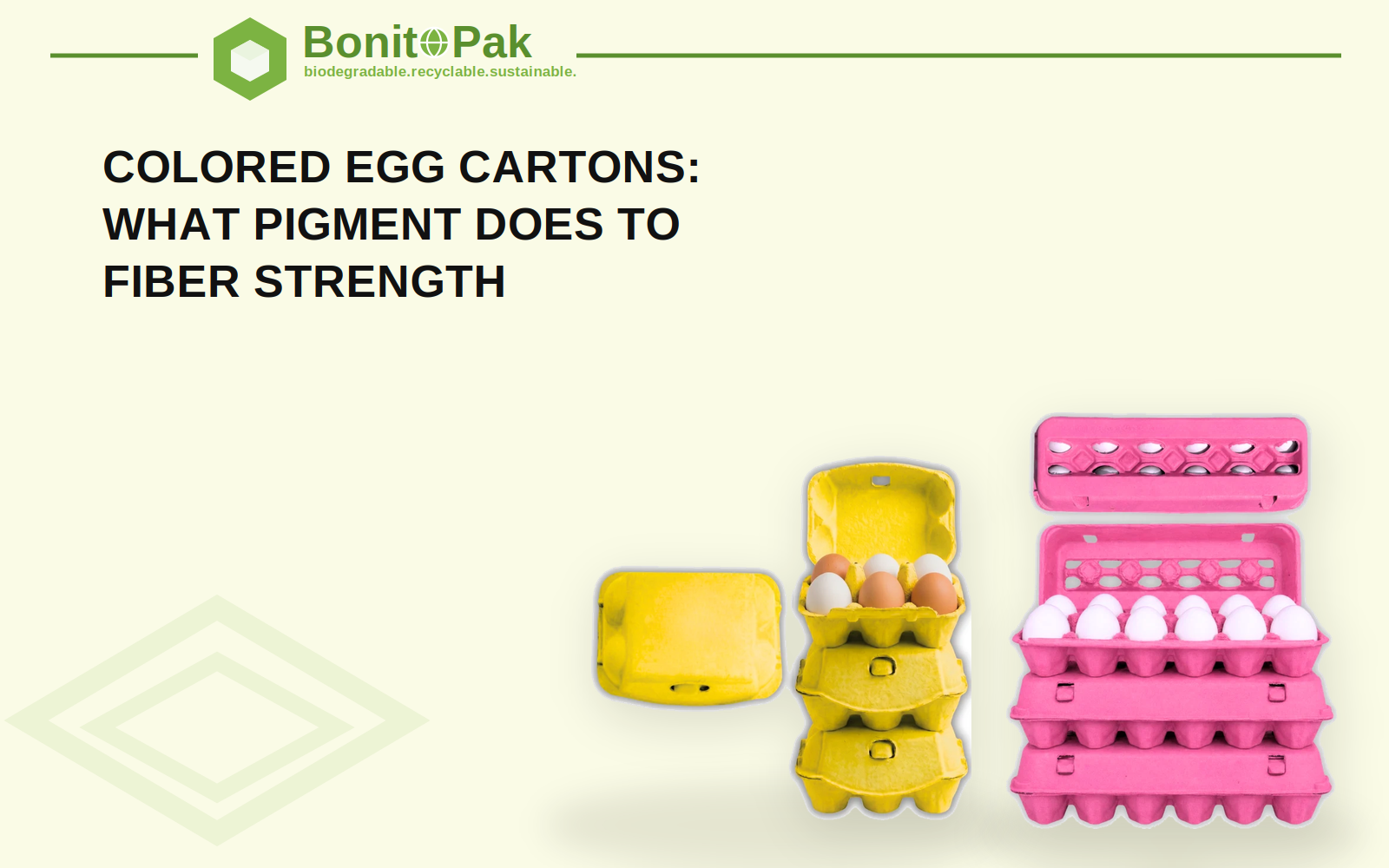
Pigment does not weaken molded pulp by itself. Pigment load does. Color is added into the pulp slurry rather than onto the surface, and at normal levels strength is unaffected. Push toward deep saturated shades and fiber bonding starts to suffer.
Buyers of colored egg cartons ask this question in two very different ways. Some assume color is purely cosmetic and cannot possibly affect performance. Others assume any additive must compromise a natural material. Both are wrong, and the real answer is more useful than either.
Color in molded fiber is a formulation decision that interacts with strength, cost, lead time and environmental claims. Understanding where the limits sit lets you choose a shade that actually runs well rather than one that looks good on a swatch and disappoints in production.
How Color Gets Into Colored Egg Cartons
This is the part that determines everything else. Colored molded pulp is not painted. The color is introduced into the pulp slurry before forming, so pigment is distributed through the entire wall rather than sitting on one face.
In practical terms, if you tore a colored carton in half, the torn edge would be the same color as the outside. That is the defining difference between in-pulp dyeing and surface coating, and it is why a scuffed colored carton does not show a pale patch the way a printed one does.
The chemistry matters. Fiber reactive dyes bond with cellulose at a molecular level rather than simply coating it, and additives such as salt or soda ash along with elevated pulp temperature help lock the dye into the fiber, which prevents bleeding and deepens the shade. That approach is described in some detail in published patent literature on fiber based food container manufacture. It explains why a properly fixed color will not transfer onto the eggs, and why an improperly fixed one will.
The Strength Question, Answered Honestly
Molded fiber gets its strength from bonding between fibers. As the slurry dewaters and dries, hydrogen bonding and mechanical entanglement between adjacent fibers hold the structure together. Anything that sits between fibers and interferes with that contact reduces bond strength.
At the pigment levels used for pale and mid tone colors, that interference is negligible. The fiber to fiber contact area barely changes and the finished carton performs the same as a natural one. This is the answer that applies to most orders.
The problem appears at the deep end of the range. To reach a genuinely saturated shade, particularly black or a strong red, the pigment load has to increase substantially. At that point there is measurably more non fibrous material distributed through the wall, and fiber bonding suffers. Manufacturers working in this space report exactly this outcome, with deep color requests producing noticeably more fragile parts.
So the accurate framing is not that color weakens fiber. It is that saturation weakens fiber, and saturation is what you are actually buying when you specify a deep shade.
Why some fiber is stronger before you add anything
It is worth knowing that the base fiber sets the ceiling. Research on high strength molded fiber materials found that reducing lignin content from around 24.9 percent to 11.45 percent increased tensile strength by 22 percent and bending strength by 23.9 percent, alongside a density increase. That study on molded fiber mechanical properties is a useful reminder that furnish and process contribute far more to strength than pigment does. If a colored carton is underperforming, the color is not always the culprit.
What Different Shades Actually Cost You
Price differences between colors are not arbitrary. They track pigment load and production time, which is why quotes for custom color egg cartons vary so widely between shades.
| Shade family | Relative pigment load | Practical notes |
|---|---|---|
| Natural or kraft | Nenhum | Baseline strength and cost, no color changeover |
| White or bleached | Bleaching rather than pigment | Depends on the bleaching route used |
| Pale tones | Baixa | Minimal strength effect, easiest to match consistently |
| Mid tones | Moderado | Reliable in production, small cost premium |
| Deep saturated | Alta | Strength effect appears here, longest cleaning downtime |
| Preto | Mais alto | Black egg cartons are the most demanding shade to run and match |
Black egg cartons sit at the demanding end of that table, which is why they carry a premium that surprises buyers who assume one pigment costs the same as another. Pink egg cartons and similar pastel shades sit at the easy end, which is part of why they are so common in farm gate and specialty retail packs. If you are testing color for the first time, starting where pink egg cartons and other pale tones sit gives you the branding benefit without the production risk.
Batch to Batch Consistency Is the Real Risk
Strength is rarely what goes wrong on a colored order. Consistency is.
Small variations in pigment ratio or in processing conditions produce shade differences that are obvious once cartons from two runs sit side by side on a shelf. Surface texture compounds it, because a smooth wet pressed surface reflects light differently from a rougher dry pressed one, so the same pigment can read as two different colors depending on the mold and the finish.
Low quality pigment is a frequent cause. It is tempting to accept a cheaper pigment on a first order, then discover the second run does not match. If color is doing real branding work for you, the pigment specification deserves as much attention as the fiber specification.
- Ask for a physical sample rather than approving from a screen or a printed swatch.
- Confirm the tolerance the supplier will hold, expressed against a Pantone reference.
- Approve the sample on the same process and surface finish as the production run.
- Order colored stock in fewer, larger batches to reduce the number of changeovers.
Colored Pulp Cannot Simply Be Switched On and Off
This is the production constraint that explains most of the commercial differences between colored and natural cartons, and it is rarely explained to buyers.
A colored run means the pulp system holds pigmented slurry. Moving to a different color, or back to natural, requires flushing and cleaning that system thoroughly. That takes time, produces additional rinse water and creates unavoidable downtime between runs.
Three consequences follow. Colored formats generally carry higher minimum order quantities than natural ones, because the changeover has to be justified by run length. Lead times are longer, since colored orders are batched rather than run on demand. And the additional water use and wastewater from the dyeing and cleaning process is a genuine environmental cost that a natural carton does not carry, which is worth acknowledging if sustainability is central to your positioning.
Color and End of Life Claims
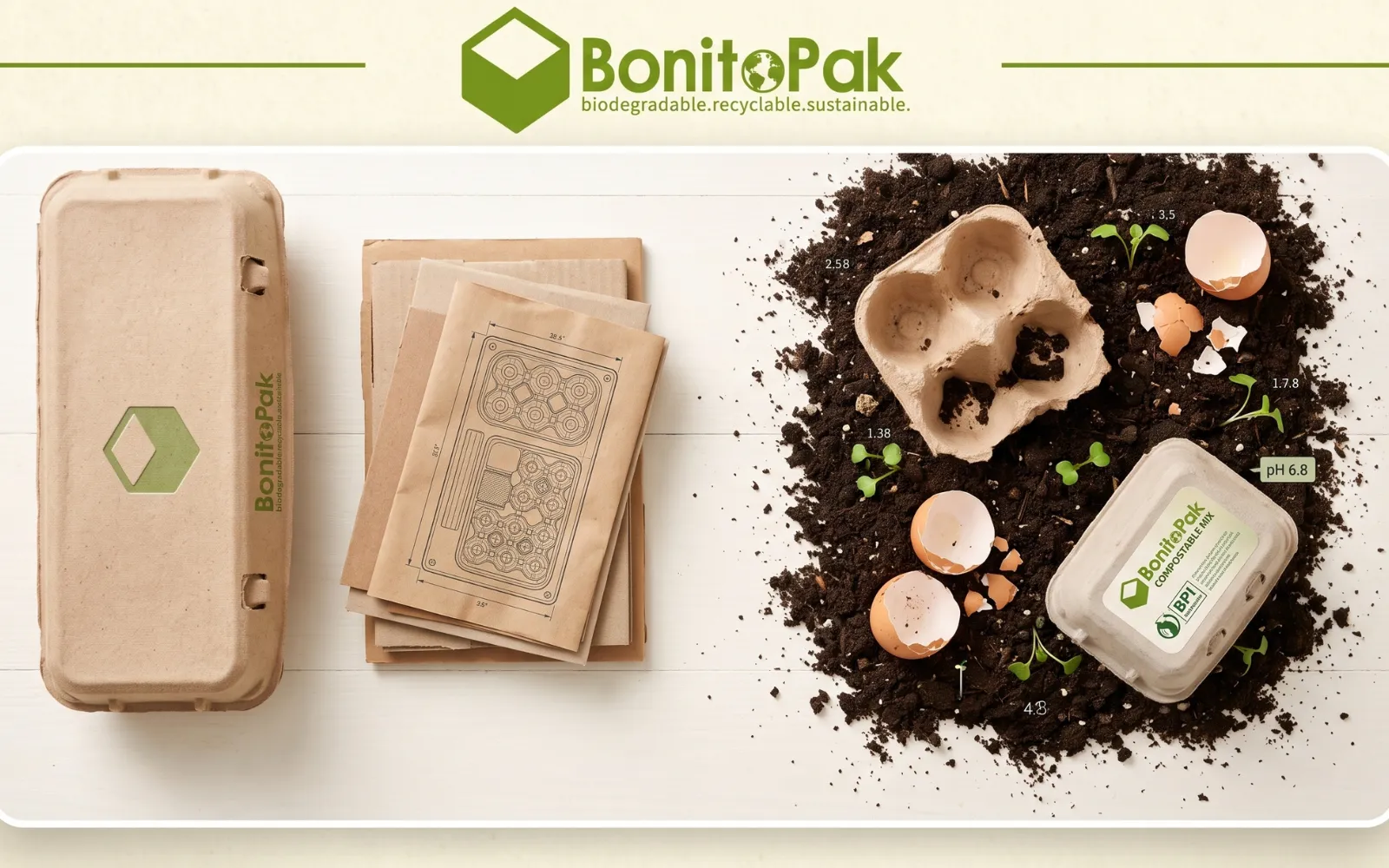
Pigment does not automatically prevent a carton being recycled or composted, but it does change what you can safely claim. Compostability certification tests the finished article rather than the base material, so the specific pigment has to be included in whatever certification you intend to reference. We cover the broader disposal picture in our article on whether egg cartons are recyclable.
One genuine advantage of in-pulp coloring over heavy surface printing is that pigment is spread thinly through the whole wall instead of concentrated as dense ink on one face. That tends to be the easier route when a brand wants strong shelf presence and also wants a defensible environmental claim, although the pigment itself still has to clear the certification you are pursuing.
O que vemos em nossa própria linha de produção
We run six pulp systems at our facility in Chashan Town, Dongguan, with color matched to better than 95 percent Pantone accuracy. A few things come up often enough to be worth stating plainly.
Not every color suits every application
We recommend natural and white fiber for direct food contact applications, with pigmented systems better suited to tray and presentation packaging. A shell egg sits in its cell with limited contact, which is why colored cartons are viable in this category at all, but the distinction is real and we would rather set the expectation than let a customer assume every color is equivalent for every use.
Bleaching route matters as much as pigment
For white cartons we use hydrogen peroxide rather than chlorine based bleaching, which matters for food safety approval and keeps the fiber cleaner going into a compost or recycling stream. Details are on our bleached pulp material page. If you are sourcing white and the supplier cannot tell you the bleaching route, that is a question to ask before printing any environmental claim.
Surface finish changes how a color reads
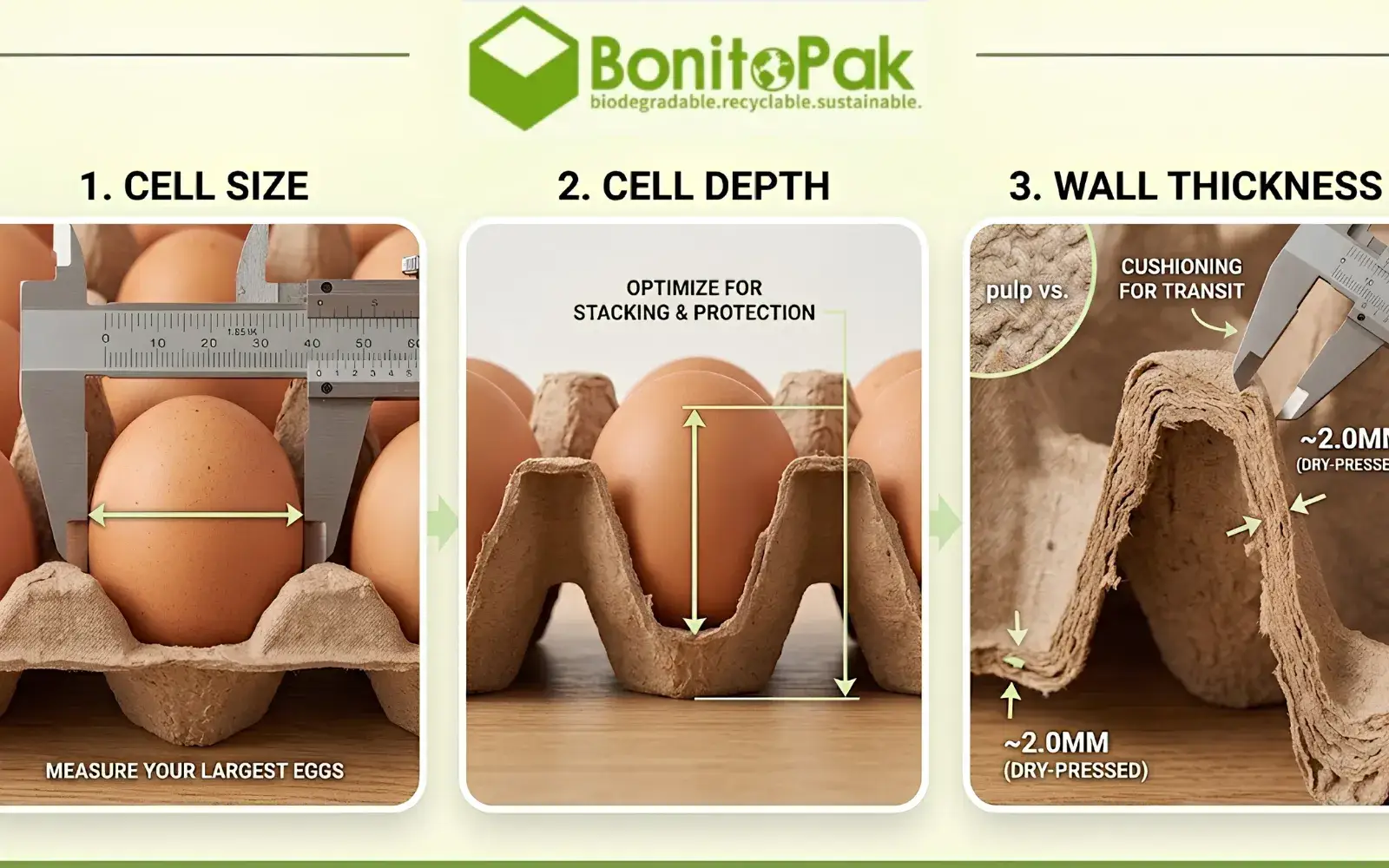
The same pigment looks different on different processes. Wet pressed cartons finish at roughly 0.7 to 1.2mm with a smooth, dense surface that renders color cleanly and holds emboss detail. Dry pressed trays finish at roughly 2.5 to 3.0mm with a rougher surface that scatters light and reads as a softer, less saturated version of the same shade. Approve your sample on the process you will actually run.
Push for depth and something has to give
When a customer asks for a shade at the deep end of the range, the honest conversation is about trade offs rather than feasibility. We can usually hit the color. The question is whether the resulting wall meets the load requirement, and on a carton carrying eggs that is not a question to leave until after tooling. Where depth and strength conflict, moving one step lighter on the shade usually resolves it without any visible loss on shelf.
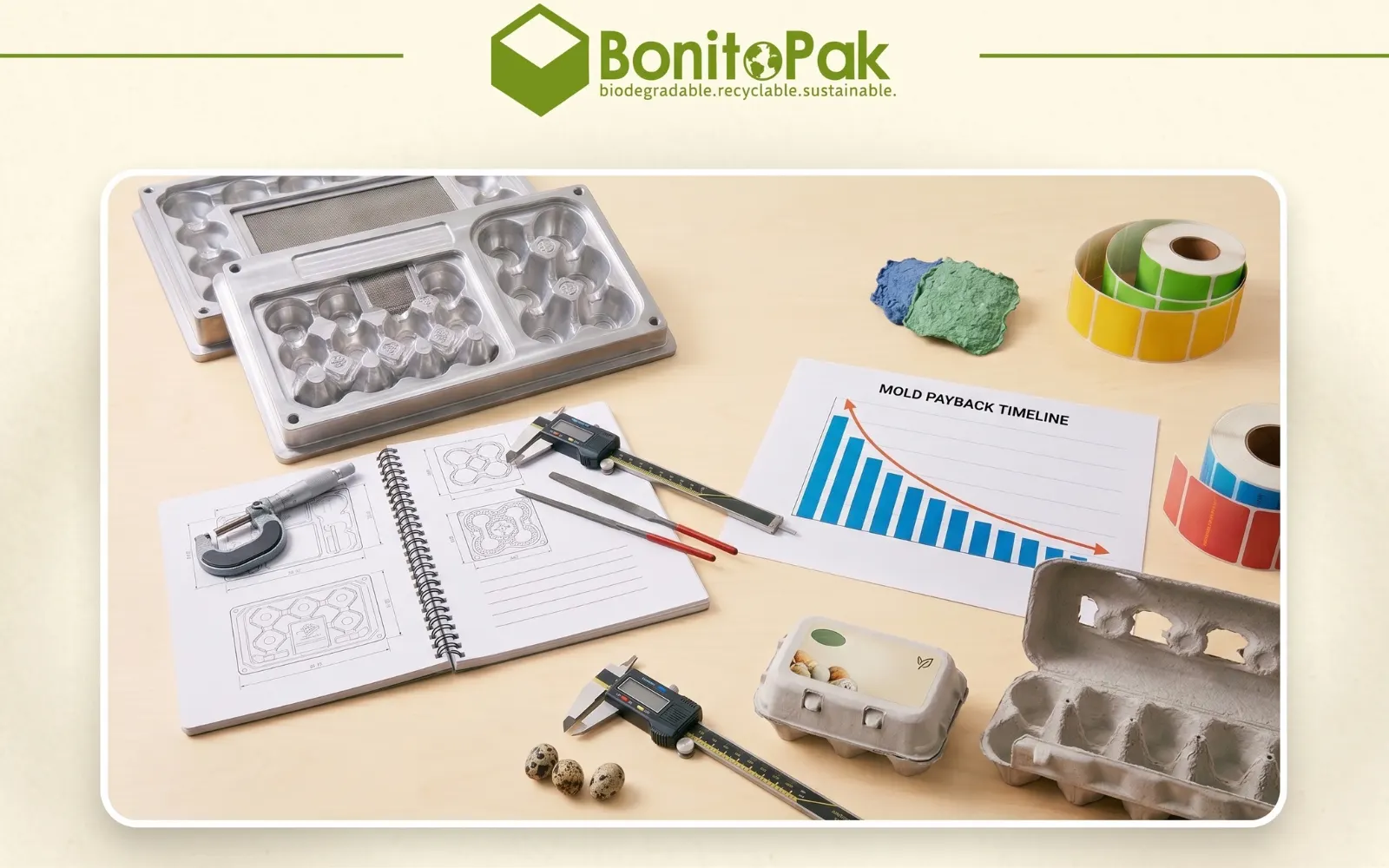
On lead times, sample molds run in about seven days and production molds follow around eight days after geometry approval. Color changeover sits on top of that, which is the practical reason colored formats price and schedule differently from natural. Our colored molded pulp egg box page sets out the available systems for custom color egg cartons, and volume pricing behaviour is covered in our guide to bulk and wholesale egg carton pricing.
Colocando isso em prática
Choose the lightest shade that achieves your shelf goal. Every step toward saturation costs pigment, production time and a little structural margin, and the visual difference between a deep tone and a slightly lighter one is smaller on a shelf than it is on a swatch card.
Approve a physical sample made on your actual process, agree a color tolerance in writing, and order in fewer larger batches to limit changeovers. If you are pursuing a compostability claim, confirm the pigment is covered by the certification before tooling rather than after.
Em BonitoPak we set fiber, color and cell geometry together at the tooling stage rather than treating color as a finishing step, which is what keeps a pigmented carton performing like a natural one. If you are weighing a specific shade, sending the Pantone reference alongside your load requirement is the fastest way to find out whether the two are compatible.
Sobre o autor
Leo Chan is the founder of BonitoPak and has spent more than 20 years in molded pulp packaging, working with over 500 brands moving from plastic and foam to fiber based formats. BonitoPak manufactures molded pulp packaging at its facility in Chashan Town, Dongguan, Guangdong, running both wet pressing and dry pressing lines across six pulp systems, with in house mold design and tooling. The formulation and production observations here reflect work on that line alongside published research on molded fiber mechanical properties and fiber dyeing chemistry.
Perguntas frequentes
Q: Do colored egg cartons protect eggs less than natural ones?
A: At normal pigment levels, no. Strength loss only appears when pigment load is pushed high to reach a deep shade. A pale or mid tone color performs the same as natural fiber in practice.
Q: Why are black egg cartons more expensive than light gray?
A: Black needs the highest pigment load of any shade, which raises material cost, extends tank cleaning between runs and narrows the processing window. The premium reflects production time as much as pigment price.
Q: Can I order custom color egg cartons in a small quantity?
A: Not easily. Every color change requires flushing and cleaning the pulp system, so runs are batched. That downtime is why colored formats usually carry higher minimums than natural ones.
Q: Will the color rub off onto the eggs?
A: Not with properly fixed in-pulp dyeing, because the dye bonds to the fiber rather than sitting on the surface. Bleeding indicates unfixed dye or an unsuitable pigment, which is worth testing for before a full run.
Q: Is a colored carton still compostable?
A: It can be, but the claim depends on the specific pigment rather than on the fiber. Certification testing covers the finished article, so the color has to be included in whatever certification you intend to reference.

 Portuguese
  English
  German
  Spanish
  French
  Russian
  Japanese
  Arabic