竹繊維

Bamboo fiber comes from a grass rather than a tree, and that single fact is why it sits apart in our range. It reaches harvest maturity in three to five years against 25 to 40 for a softwood plantation, regrows from the existing root system without replanting, and yields fibers at 1.5 to 3.0 mm that approach softwood strength. It is the one material that does not force a trade between structural performance and a fast renewal cycle.

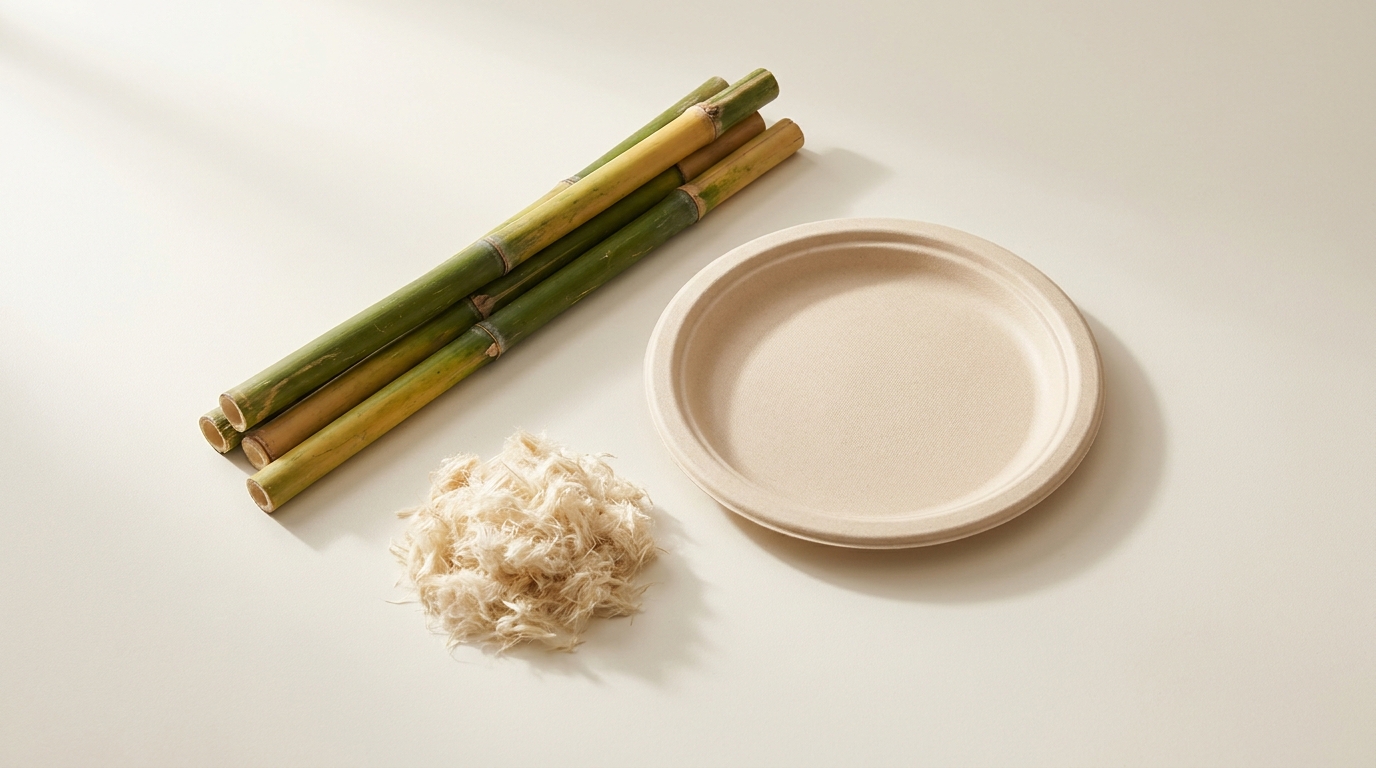
Why bamboo fiber resolves the usual trade-off

  • Near-softwood fiber length. At 1.5 to 3.0 mm, bamboo fiber builds a bonded network close to what softwood kraft achieves, and well above any agricultural residue.
  • Three to five year harvest cycle. A managed grove is cut on rotation and regrows from the same rhizome system. No replanting, no soil disturbance between harvests.
  • Regrows from the root, not from seed. Harvesting a culm does not kill the plant. The root network stays intact and continues sequestering carbon between cuts.
  • Naturally pale. Forms lighter than wood and considerably lighter than recycled fiber, so a clean-looking part is achievable without a bleaching stage.
  • High tensile strength per unit weight. The same property that makes bamboo a structural material in construction carries through into formed fiber parts.
  • No competition with food crops. Bamboo grows on land often unsuitable for agriculture, including degraded slopes where it also stabilizes soil.

The processing consideration is that bamboo is dense and silica-bearing, so it needs more energy to pulp than wood and more process control than a soft agricultural residue. Suppliers who treat it as a drop-in wood substitute get inconsistent fiber separation and variable part strength.

The second consideration is honest sourcing. Bamboo’s environmental credentials depend on the grove being managed rather than wild-cut, and on processing chemistry being controlled. Bamboo is not automatically sustainable because it grows quickly. The management practice is what makes the claim true.

仕様表

仕様 詳細
材料名 竹繊維
素材タイプ Bamboo culm cellulose
繊維源 Managed bamboo groves
平均繊維長 1.5 to 3.0 mm
Harvest Cycle 3 to 5 years
Regeneration From existing rhizome; no replanting required
ナチュラルカラー Pale natural
表面仕上げ Fine, smooth
相対力 Very high; second only to softwood kraft
代表的な壁厚 0.8 to 4.0 mm
プロセスの互換性 Wet pressing, dry pressing, thermoformed fiber
成形パルプの種類 Type 2, Type 3, Type 4
堆肥化可能性 EN 13432 および ASTM D6400(コーティングなし)の化学的要件を満たしています
リサイクル性 Accepted in paper streams uncoated
食品との接触 Use bleached variant; confirm for your market
カラーオプション Natural pale; takes pigment cleanly
Processing Energy Higher than wood; dense and silica-bearing
相対コスト Medium-high

Where bamboo fiber is the right specification

Parts needing strength and a sustainability narrative. This is the combination bamboo exists to serve. Where kraft delivers strength but reads as conventional virgin wood, and where straw delivers the story but not the structural performance, bamboo does both.

Premium retail packaging. The naturally pale finish and fine surface suit parts that a customer sees and handles, without the processing cost of bleaching.

Brands with explicit deforestation policies. Procurement policies that restrict or exclude wood fiber can usually accommodate bamboo, because it is a grass harvested on rotation rather than a felled tree.

Type 3 thermoformed parts. Bamboo supports the smooth, densified finish that cure-in-the-mold tooling produces, alongside 木材パルプ そして 晒しパルプ.

Where bamboo is the wrong call: cost-driven volume parts, where 再生紙パルプ または 藁繊維 do the job for considerably less, and parts where absolute maximum tear strength governs, where 堆肥化クラフト紙 still leads.

Buyers comparing bamboo against virgin wood are usually weighing a slightly lower strength ceiling against a renewal cycle roughly eight times faster. Which matters more depends on whether the binding constraint is the part’s performance or the customer’s reporting.

よくある質問 (FAQ)

Is bamboo actually more sustainable than wood for packaging?
On renewal rate, clearly: three to five years against 25 to 40, with regrowth from the existing root system and no replanting. On the full picture it depends on management and processing. Bamboo needs more energy to pulp than wood, and wild-cut bamboo from unmanaged stands carries real ecological cost. The material has a strong case when the grove is managed and the processing is controlled, and a weak one when neither is verified.
Close, and below it. Bamboo fibers run 1.5 to 3.0 mm against 2.5 to 4.5 mm for softwood kraft, so the bonded network is slightly less interconnected and tear resistance is correspondingly lower. For most packaging the gap does not govern the design. For edge protectors and heavy cradles carrying serious compression, kraft is still the specification.
This claim circulates widely and does not survive the pulping process. Bamboo plants contain a compound sometimes described as antibacterial, but chemical pulping removes it along with the lignin. A finished molded bamboo part should not be marketed as antimicrobial. We would rather tell you that than let the claim go on a pack and fail a substantiation challenge.
Collection and processing. Straw is a residue already aggregated at harvest, so it arrives cheaply. Bamboo is a primary crop that has to be cut, transported, and pulped, and it is dense enough to need more energy to separate into fibers. You are paying for the strength advantage, which straw cannot match.
Yes, through bleaching, which produces the material described on our bleached pulp page using bamboo as the fiber source. Bamboo bleaches to a clean white and retains more strength through the process than many wood pulps do. Unbleached bamboo is already pale enough for most applications, so bleaching is usually specified for food contact rather than for appearance alone.
材料名

竹繊維

素材タイプ

持続可能な植物性繊維

プロセスの互換性

ボニトパック包装資材

当社のパッケージング・ソリューションは、サトウキビ繊維、竹、再生紙パルプなどの持続可能な素材から作られており、さまざまな製品に環境に優しく生分解性のオプションを提供しています。

生分解性クラフト紙は、当社が製造する繊維製品の中で最も強度が高いものです。バージン

着色パルプは、独立した繊維ではありません。これは、当社の

部品が以下の条件を満たす必要がある場合は、漂白パルプを指定する必要があります。

天然植物繊維とは、当社がブレンドに用いる、木材以外のセルロース源を指します。

成形パルプ材料としての段ボール紙とは、回収された段ボール箱を再パルプ化したものを指す。

わら繊維は、穀物の収穫後に残る茎から作られる素材です。

製品カテゴリー

成型パルプトレイ、食品包装、カスタムデザイン、持続可能なオプションなど、Bonitopakの多様なパッケージングソリューションをご覧ください。各カテゴリーは、耐久性、機能性、環境への責任を考慮し、お客様の特定のニーズに合わせて作られています。
あなたのプロジェクトを向上させる準備はできていますか?

BonitoPakでデザインに命を吹き込もう

BonitoPakで精密なエンジニアリングを体験してください。詳細なプロトタイプから大量生産まで、お客様のコンセプトを現実にします。今すぐお問い合わせください!

関連記事と洞察

持続可能なパッケージングのトレンド、業界の洞察、専門家のヒントに関する最新情報をブログでお届けします。革新的なアイデアやソリューションを探求し、パッケージングの知識を深めましょう。

By Leo Chan, Senior Packaging Consultant · November 14, 2026 Molded fiber food containers are

By Leo Chan, Senior Packaging Consultant · November 14, 2026 Egg cartons are easy to

By Leo Chan, Senior Packaging Consultant · November 14, 2026 The molded pulp packaging market

詳細フォーム