By Leo Chan, Senior Packaging Consultant · November 14, 2026
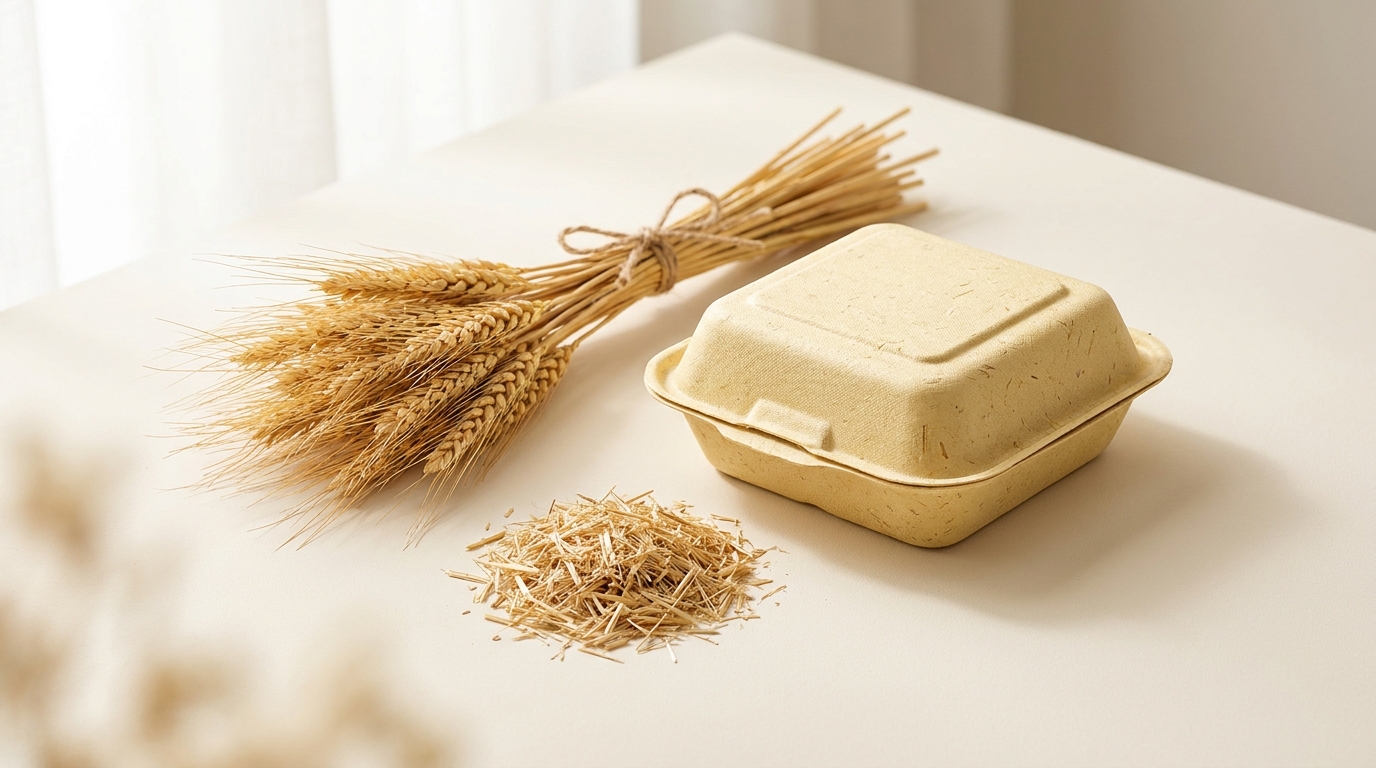
Molded pulp trays are inner packaging trays formed from plant fiber or recycled paper in a mold, then pressed or dried into a rigid shape. Each pocket matches the product, so nothing slides in the box. A pulp tray replaces foam, EVA and plastic blister trays in electronics, cosmetics, wine, appliance and food packaging, which makes it one of the most practical eco-friendly packaging solutions for brands with sustainability targets.
We make these trays every day at our plant in Chashan Town, Dongguan. This guide explains the molded pulp tray types buyers order most, the two main tray processes and the fibers behind them. It also covers how a custom tray is designed and tooled, and what drives price and lead time. It is written for packaging buyers and product teams who need a tray that fits the first time.
If you want the wider picture of sustainable packaging materials and processes first, start with our guide to emballage de pâte à papier moulée, then come back here for the tray details.
What Is a Molded Pulp Tray?
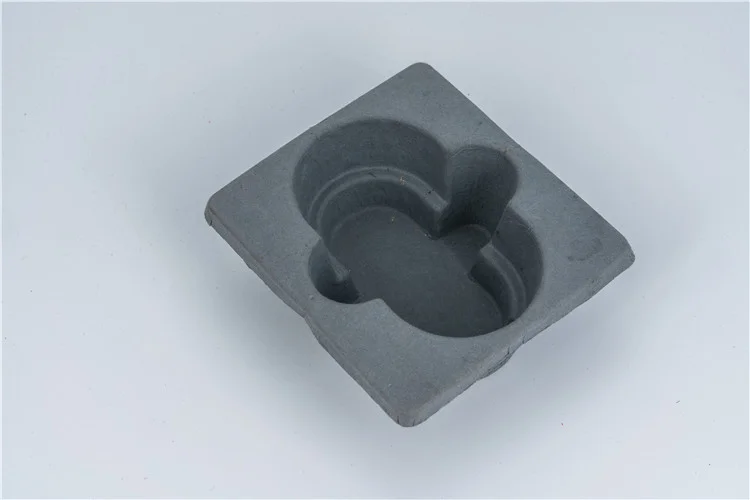
A molded pulp tray is a shaped fiber insert that sits inside an outer box and holds one or more products in fitted pockets. It is formed from a water and fiber slurry on a mesh mold, then hot pressed or oven dried. Trays protect against drops and vibration and present the product when the box opens.
The tray does two jobs. It protects the product in transit, and it presents the product when the customer opens the box. Which job matters more decides almost every other choice: the process, the fiber, the color and the cost.
A paper pulp tray made for display needs a smooth face, crisp edges and an exact fit. A tray made only for shipping protection needs strength and cushioning, and nobody cares how it looks. Mixing up those two goals is the most expensive mistake we see, whether the tray goes into luxury packaging or a plain shipping carton.
Buyers use several names for the same part. Pulp tray, paper pulp tray, molded fiber tray and moulded pulp tray all describe it. Our plateaux moulés en pâte à papier product page uses the British spelling, and the parts are identical.
Wet Pressed vs Dry Pressed Molded Pulp Trays
Wet pressed trays are thin (0.7 to 1.2 mm), smooth on the face side and dense, so they suit retail display. Dry pressed trays are thicker (1.5 to 3.0 mm) with a rough surface and lower tooling cost, so they suit hidden inner trays and shipping protection. Both cushion well and both are static neutral.
The table uses the specifications we publish for our own tray lines.
| Fonctionnalité | Wet pressed tray | Dry pressed tray |
|---|---|---|
| Typical fiber | Sugarcane bagasse, bamboo fiber | Recycled corrugated, wood pulp |
| Épaisseur de la paroi | 0.7 to 1.2 mm | 1.5 to 3.0 mm |
| Surface | One side smooth, the other with a net texture | Rough on both sides |
| Couleurs | White, natural, black, Pantone custom colors | Natural, black, white |
| Amortissement | Very good against vibration and shock | Good, passes drop testing |
| Statique | Neutre statique | Neutre statique |
| Climate | Holds shape through heat and cold | L'humidité affecte les performances |
| Storage and shipping | Nests tightly, lower freight cost | Nests, but thicker walls take more space |
| Idéal pour | Retail display, electronics, cosmetics, gift sets | Inner shipping trays, industrial parts |
When to choose a wet pressed pulp tray
Choose wet pressing when the customer sees the tray.
Phone boxes, earbud cases, skincare kits and premium gift sets use it because the face looks clean and the edges hold fine detail. Debossed logos and thin ribs come out sharp. The trade off is cost: heated tools and longer press time make both tooling and unit price higher. Our plateaux à pulpe moulés par pressage humide come in bagasse and bamboo.
When to choose a dry pressed pulp tray
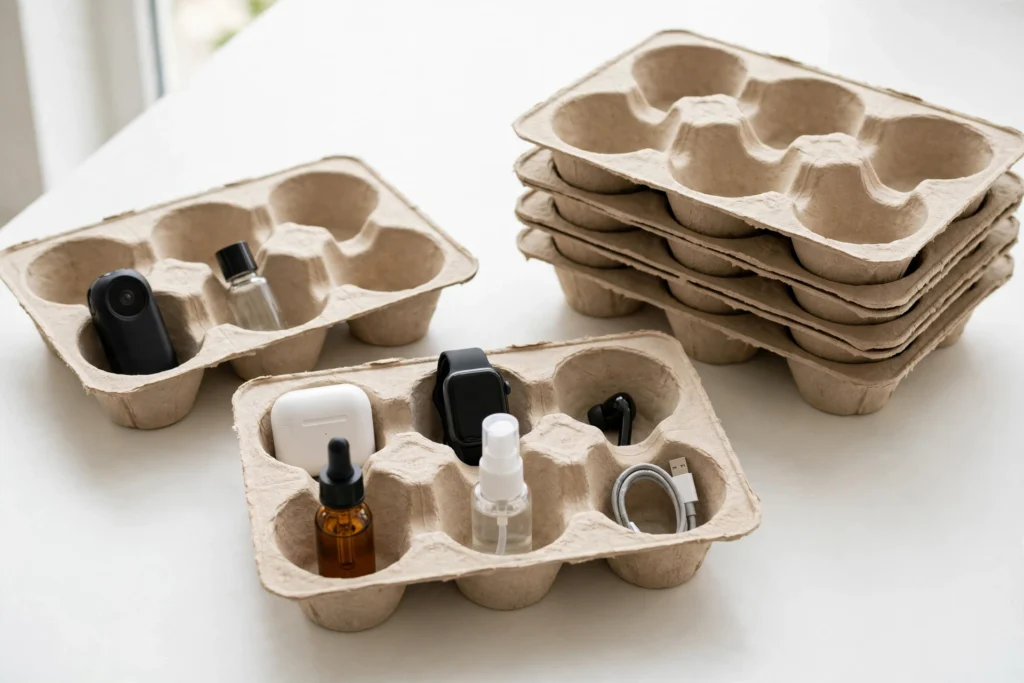
Choose dry pressing when the tray sits under a lid or a printed sleeve and only has to protect. Recycled fiber keeps material cost low, and the thicker wall absorbs knocks well. Our plateaux à pulpe moulés par pressage à sec also suit heavier items where a thin wet pressed wall would flex.
A simple rule settles most projects. If the tray is part of the unboxing, pay for wet pressing. If it is hidden, put the money into the outer box instead.
Which Fiber Works Best for Each Tray?
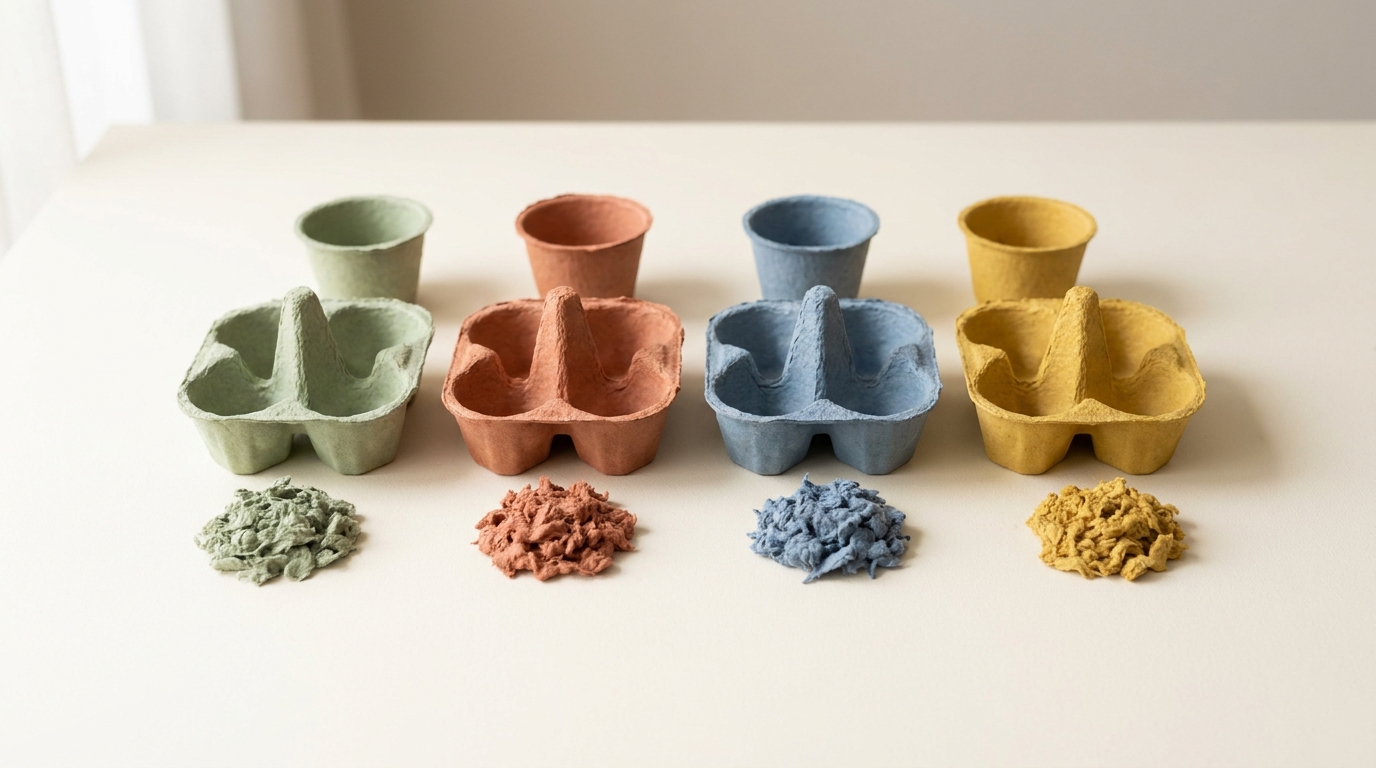
Bagasse and bamboo make the smoothest, strongest wet pressed trays. Recycled corrugated and paper make the lowest cost dry pressed trays. Wood pulp gives the cleanest white. Colored pulp is any of these fibers with pigment mixed in before forming, so the color runs through the whole wall.
Sugarcane bagasse. Sugarcane fiber (bagasse), the leftover fiber from sugar production, forms a fine, even surface and takes color well. It is our first choice for cosmetic and electronics trays.
Bamboo fiber. Long fibers make a stiff tray for its weight. Bamboo suits deep pockets that hold heavier devices without bending.
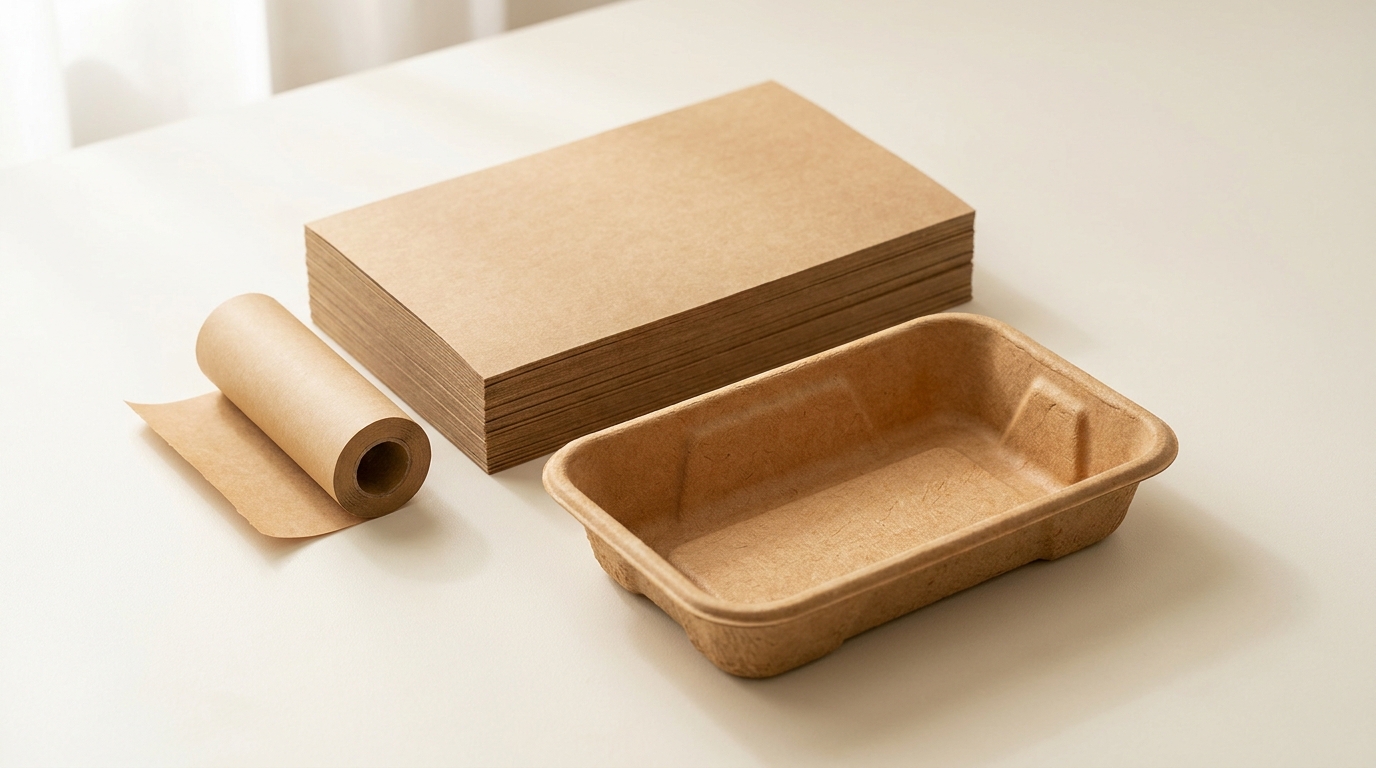
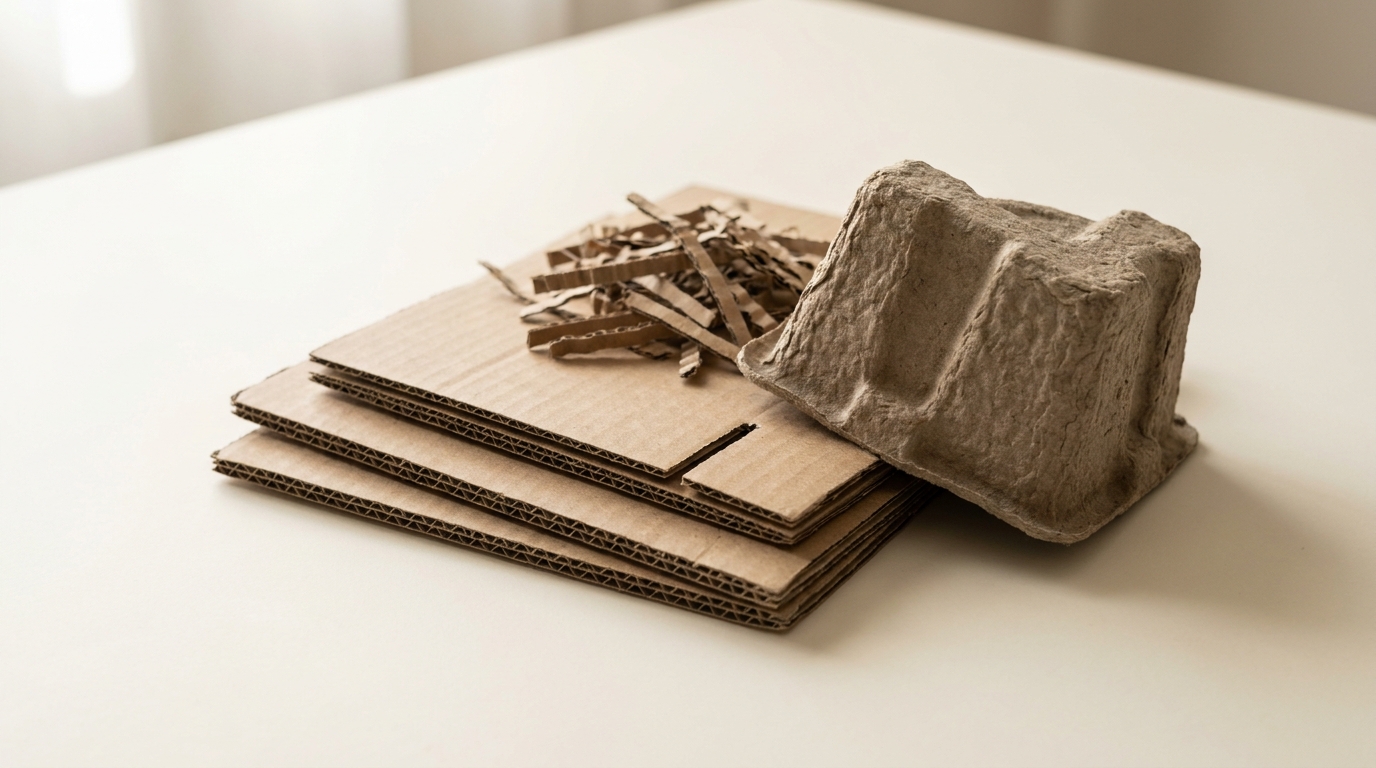
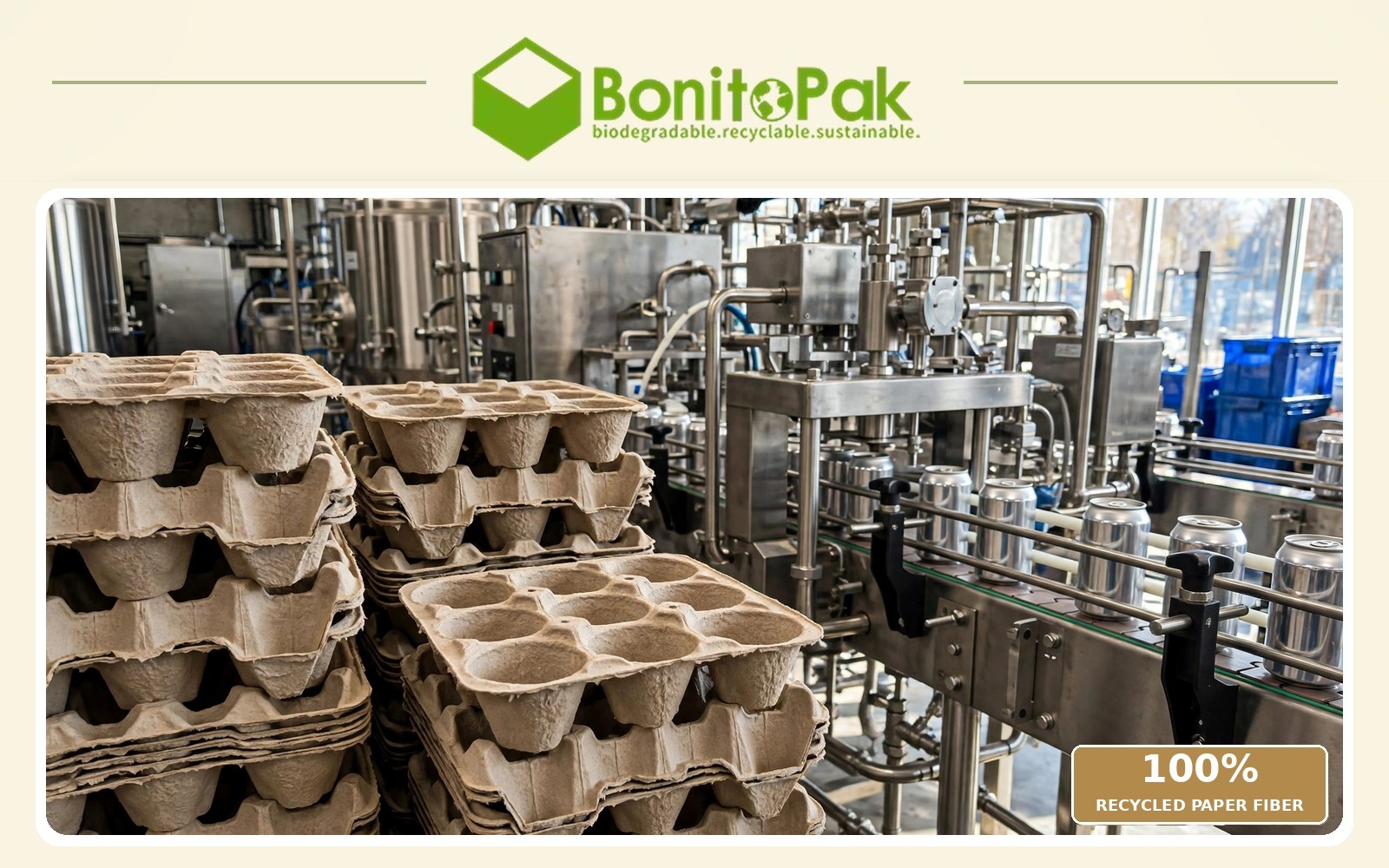
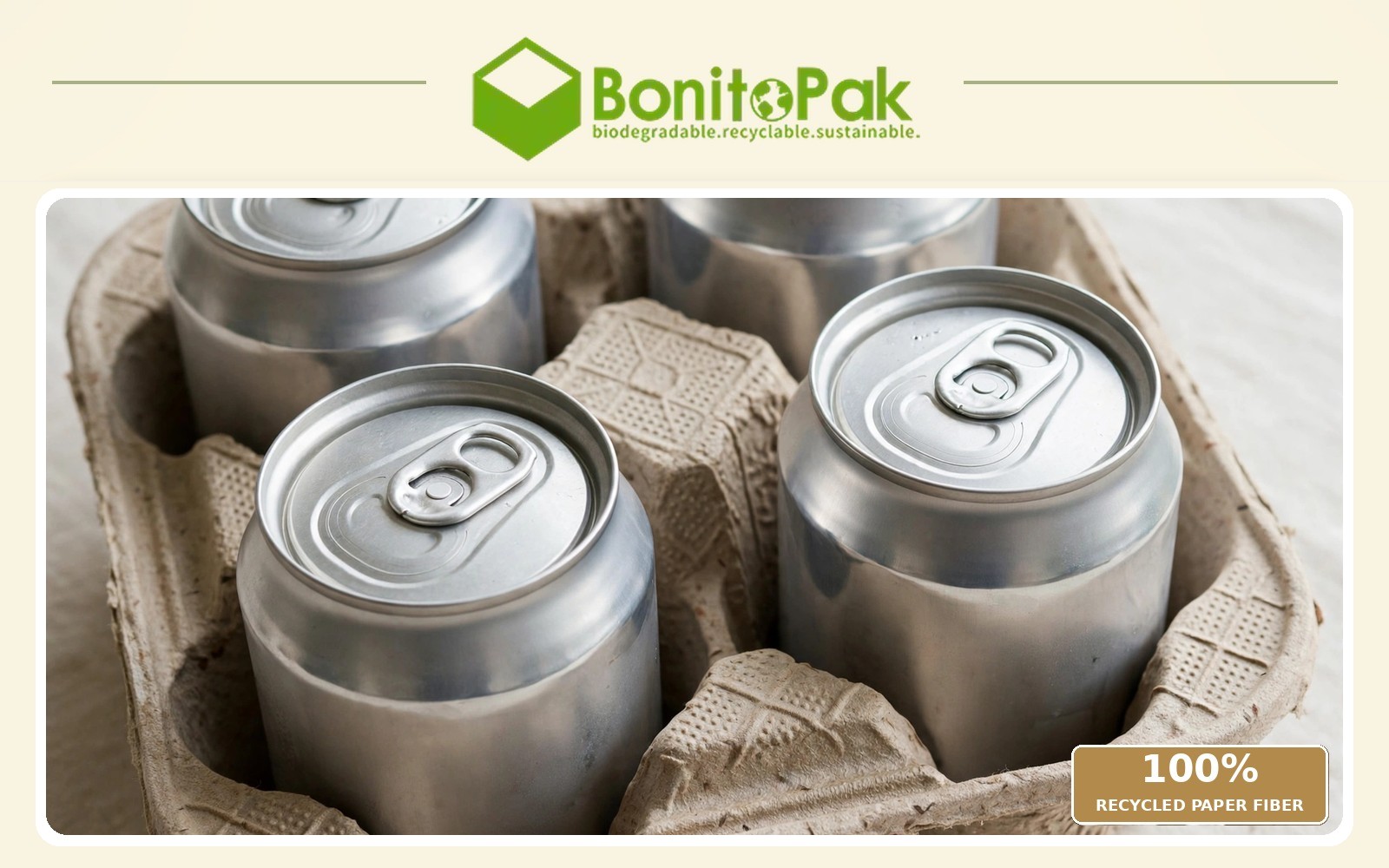
Recycled corrugated and paper. Recycled cardboard boxes and paper, the same stock you recycle at home, are repulped into a gray or brown pâte à papier recyclée. Small specks are normal. Turning waste paper and natural fibers into a packing tray is the core idea of molded pulp products, and this is the standard fiber for dry pressed inner trays.
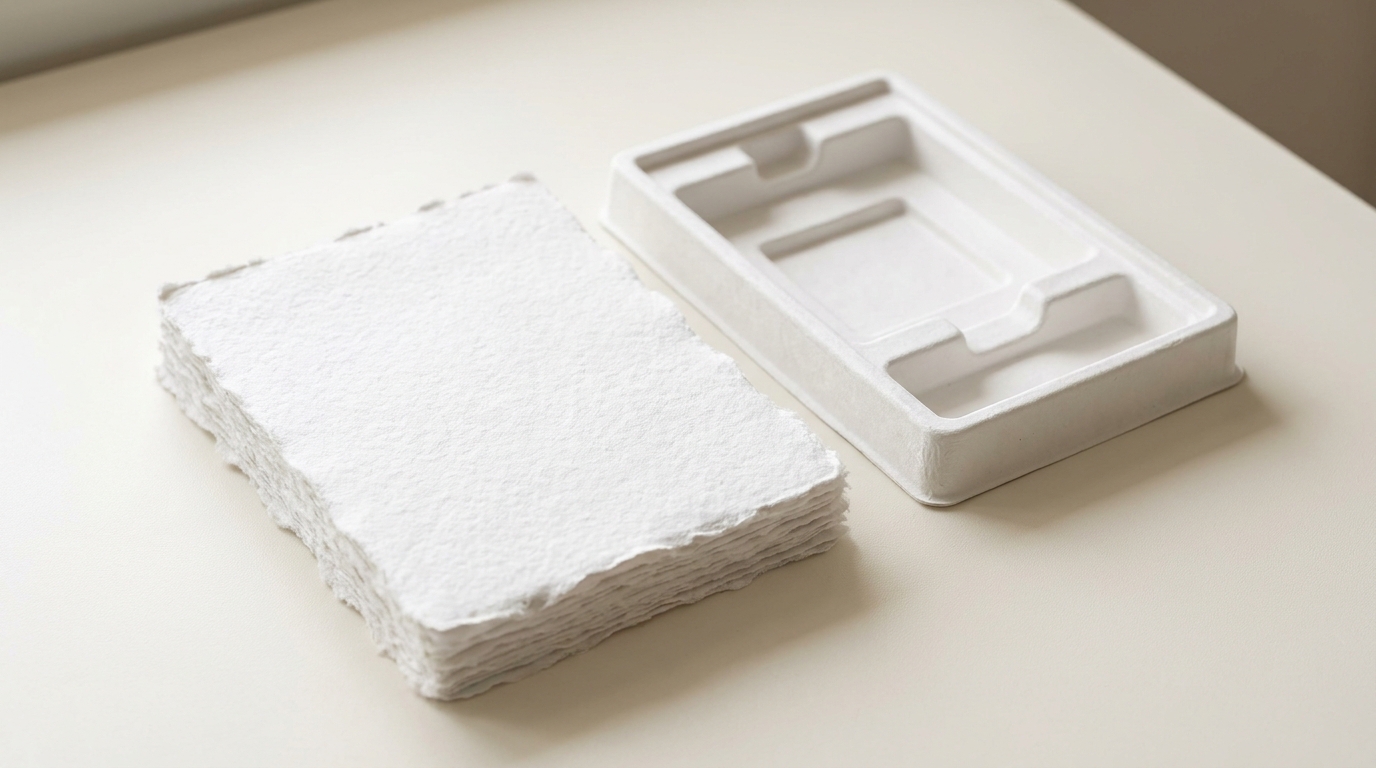
Wood pulp. Virgin pulp gives the most consistent color and the brightest white after bleaching.
Colored pulp. We run six pulp systems (white, natural, black, orange, gray and blue) and match custom Pantone colors to within about 95%. Black trays are the most common choice for premium electronics. White and natural are the safe choices for food contact.
Molded Pulp Tray Types Buyers Order Most
The tray formats buyers order most are single product inserts, multi cavity trays for kits, lid and base sets, bottle trays, nesting shipping trays and end caps. The format follows the product count, the box style and whether the tray is visible. Most projects start from one of these and then get a custom pocket.
Single product insert. One pocket for one item, such as a phone, a perfume bottle or a watch. The tray sits inside a rigid box or a folding carton.
Multi cavity kit tray. Several pockets of different shapes in one tray, for skincare sets, tool kits or device bundles with a charger and cable. Pocket spacing and finger cutouts matter more here than in any other format.
Lid and base set. A molded base and a molded lid that close together, sometimes with an elastic band or a paper sleeve. This replaces plastic trays, a plastic clamshell or a rigid box insert for small gifts, and it can serve as the whole packaging box for small items.
Bottle tray. Deep pockets that grip a bottle neck and base. Spirits and cosmetic bottles use it, and our plateaux en pulpe moulée pour bouteilles de vin are the most common version.
Nesting shipping tray. A flat tray with a grid of pockets for small parts or components moving between factories. These stack tightly empty and stack on each other full.
End caps and corner trays. Partial trays that fit the ends or corners of a large product. These are the bridge between trays and the heavy industrial parts on our emballage protecteur industriel pour la pâte à papier page.
Which Industries Use Fiber Trays?
Electronics, cosmetics and beauty, wine and spirits, home appliances, food service and industrial parts use these trays most. Electronics and cosmetics lead for wet pressed display trays. Appliances and industrial goods lead for dry pressed protective trays. Food service uses food grade bagasse trays and containers.
Electronics. Phones, earbuds, chargers, smart home devices and cables sit in tight wet pressed pockets. Static neutral fiber matters in electronics tray packaging, which is why our plateaux à pulpe pour produits électroniques use it.
Cosmetics and beauty. In cosmetic packaging, bottles, jars, lipsticks and refill pods sit in smooth pulp trays for cosmetic and beauty products, mostly bagasse in black or white to match the brand.
Home appliances. Hair dryers, shavers, kettles and small kitchen appliances use plateaux en fibre moulée pour appareils électroménagers or end caps in place of EPS foam.
Food service. A food tray, plate or compartment container uses food grade bagasse. Fibre moulée pour emballage alimentaire needs grease resistance, food contact paperwork and, for most US buyers, PFAS-free fiber.
Industrial and logistics. Component trays, roll cradles and protective trays move parts between plants. Our custom molded fiber roll cradles are one example, made by dry pressing with custom diameters and groove patterns.
How Do You Design a Tray for Fit and Protection?
A good tray design starts from the real product. Each pocket gets a small clearance, and every wall gets a draft angle so the part releases from the mold. Ribs go where the load lands, and finger cutouts let the customer lift the product out. Then the sample is drop tested inside the real outer box.
These are the design points we check on every tray drawing.
Pocket clearance. Too tight and the product sticks or the tray tears. Too loose and the product rattles. The right clearance depends on the product surface and the process, so we confirm it on the sample, not on paper.
Draft angles. Pocket walls must taper slightly. A straight wall locks onto the mold and tears during forming. Draft also lets empty trays nest.
Wall thickness and ribs. Wet pressed walls run 0.7 to 1.2 mm and dry pressed walls 1.5 to 3.0 mm. Rather than making the whole tray thicker, add ribs or bumpers where the product presses. That keeps fiber use and cost down.
Finger cutouts. A device in a snug pocket needs a notch beside it. Brands forget this more than any other detail, and customers notice.
Fit in the outer box. The tray’s outer edge must match the box with a small gap. Measure the inside of the box, not the outside, and allow for the board thickness.
Branding. A debossed or embossed logo is cut into the tool once and adds nothing to the unit price. Printing adds a step on every run. Either way, the tray becomes part of your brand image, not just insert packaging.
If a product is heavy or fragile, we test the sample at the drop height your carrier uses. When a tray fails, we change the rib layout, the fiber or the wall thickness before cutting production tooling. That costs far less than changing a production mold.
Public Molds vs Custom Molds
A public mold is a pulp mold the factory already owns, so you skip the tooling charge and get samples faster. A custom mold is cut for your product, so the fit is exact but you pay for tooling and wait for it. Use a public mold when a standard shape fits. Pay for a custom mold when the pocket must match your product.
We keep 65+ molds in house. For common shapes, such as standard bottle trays or simple rectangular inserts, an existing tool can fit with a small change to the outer box. That saves the tooling cost and a week or more of sampling.
Custom mold design makes sense for unusual product shapes and molded logos, where full customization pays back. Custom molds also pay off when volume is high enough that tooling spreads thin across the run. Our emballage de pâte à papier moulé sur mesure service covers the full custom route.
How Long Does a Custom Tray Take to Make?
A custom molded pulp tray runs through five steps: brief, 3D drawing, sample, production tooling and mass production. Our published timings are about 2 days for the drawing, 7 to 10 days for samples and 8 to 12 days for production molds. Exact time depends on tray size and cavity count. Mass production time depends on volume.
- Send the brief. Share the product or an accurate 3D file and the inside size of the outer box. Add the target fiber, color, annual volume and the market you ship to. We reply within 24 hours.
- Approve the 3D drawing. Our design team returns a drawing in about 2 days. Check pocket depth, clearance, finger cutouts and how the tray sits in the box.
- Test the sample. We cut a single cavity sample mold and make a small run, usually about 10 pieces, in 7 to 10 days. The sample mold cost is not refundable because the tool cannot run production.
- Build production tooling. After sample approval, our in-house tooling team builds the multi cavity production mold in 8 to 12 days.
- Run production and inspection. Trays are formed, pressed or dried, trimmed to plus or minus 0.5 mm on flat parts, inspected and packed.
Most delays come from approving a drawing without testing the real product in the sample, then finding a fit problem in production. A week spent on the sample saves a month on rework.
What Does a Molded Pulp Tray Cost?
Molded pulp tray cost has two parts: one-time tooling and a unit price. Tooling depends on tray size, complexity and cavity count, and wet press tools cost more than dry press tools. Unit price depends on size, depth, fiber, color, wall thickness, finish and volume. Our MOQ starts at 1,000 pieces on most lines.
Tooling. A sample mold is a small charge. The production mold is the main one-time cost. Wet pressing needs heated matched tools, so it costs more than a dry press forming tool. A public mold removes most of this cost.
Unit price. Bigger and deeper trays use more fiber and take longer to dry. Colored and white fiber cost more than natural. Wet pressed trays cost more per piece than dry pressed trays of the same size. Print adds cost on every run, while a molded logo does not.
MOQ. Most lines start at 1,000 pieces. Larger trays and a few specific items start higher, at 5,000 or 10,000 pieces, because of how many fit in each mold and how long each cycle runs.
For a full breakdown, read our guide to molded pulp packaging cost, tooling and MOQ. For a real quote, send the product size, a photo and your annual volume.
Are Paper Pulp Trays Recyclable and Compostable?
Plain paper pulp trays with no plastic film or heavy coating can go into paper recycling in most US curbside programs, so customers can recycle them with paper. The fiber is biodegradable and breaks down in compost. Colored trays, coatings and additives can change that. Any compostable claim on your box needs third party certification, such as BPI in North America or OK compost in Europe.
Uncoated trays are the easy case. Trouble starts when a tray gets a plastic window, a foil stamp or a water resistant additive, because each one changes how recyclers and composters treat it. If an end-of-life claim matters to your brand, decide it before the tray is designed, not after. Recyclable packaging, biodegradable packaging and certified compostability are three different claims, each with its own proof.
In the US, environmental claims on packaging fall under the Federal Trade Commission’s Green Guides. Ask your supplier for the certificate that covers your exact tray, fiber and thickness before you print a logo.
Ordering Molded Pulp Trays From BonitoPak
The fastest route to a working tray is a real product sample and a clear brief. Send us the product or its 3D file, the inside size of your outer box, the look you want, your annual volume and your target market. We reply within 24 hours with a process recommendation, fiber and packaging options, and a tooling plan. As custom packaging manufacturers with our own tool shop, we handle the drawing, the paper tray sample and production in one place.
If a standard shape could fit, ask about our public molds first, because they cut tooling cost and time. If your product needs an exact pocket, we will draw a custom tray and send it for approval in about 2 days.
You can see our full range of packaging products on the BonitoPak homepageou request a quote for your molded pulp trays today.
Questions fréquemment posées
What is the difference between a pulp tray and a molded pulp tray?
A: There is no difference. Pulp tray, molded pulp tray, paper pulp tray and molded fiber tray all describe the same part, a fiber insert formed in a mold. Moulded pulp tray is the British spelling. Suppliers use the terms interchangeably, so compare specifications such as process, fiber and wall thickness, not the name.
How thick is a molded pulp tray?
A: On our lines, wet pressed trays run 0.7 to 1.2 mm thick and dry pressed trays run 1.5 to 3.0 mm. Thicker walls give more cushioning but use more fiber and cost more. Ribs and bumpers in the right places usually protect better than a thicker wall everywhere.
Are molded pulp trays strong enough for electronics?
A: Yes, for most consumer electronics. Wet pressed bamboo and bagasse trays hold phones, earbuds, chargers and small devices securely, and the fiber is static neutral. For heavier devices we add ribs or deepen the pocket. A drop test of the sample inside the real outer box is the only reliable proof.
Can molded pulp trays be made in black or brand colors?
A: Yes. We run six pulp systems, white, natural, black, orange, gray and blue, and match custom Pantone colors to within about 95%. The color is mixed into the pulp, so it runs through the whole wall instead of sitting on top, and scratches do not show a different color underneath.
What is the minimum order for custom molded pulp trays?
A: Our MOQ starts at 1,000 pieces on most lines. A few larger trays and specific items start at 5,000 or 10,000 pieces because of cavity count and cycle time. A public mold that already exists can lower both the minimum and the tooling cost, so ask whether one fits.
Do molded pulp trays work in humid climates?
A: Wet pressed trays hold their shape well through heat and cold because they are dense and fully dried under pressure. They also handle damp air better than dry pressed trays. Our specifications list humidity as a factor for dry pressed trays. For humid shipping routes or cold storage, choose wet pressing or ask about water resistant additives, and check how the additive affects compost claims.