By Leo Chan | Writer, BonitoPak | 20+ years in molded pulp packaging
The three-word answer is pulp, plastic or foam. That is accurate and almost useless, because it tells you nothing about what the pulp actually is, where the fiber comes from, why one grey carton feels stiffer than another, or which material is in your hand right now.
This article gives the full answer to what are egg cartons made of. Every material used in commercial egg packaging, the specific fiber sources behind molded pulp, how each is formed, what each costs and performs like, and a physical test to identify any carton without a label.
A note on the fourth material. Most articles list three. There is a fourth category in regular commercial use, and it is covered below.
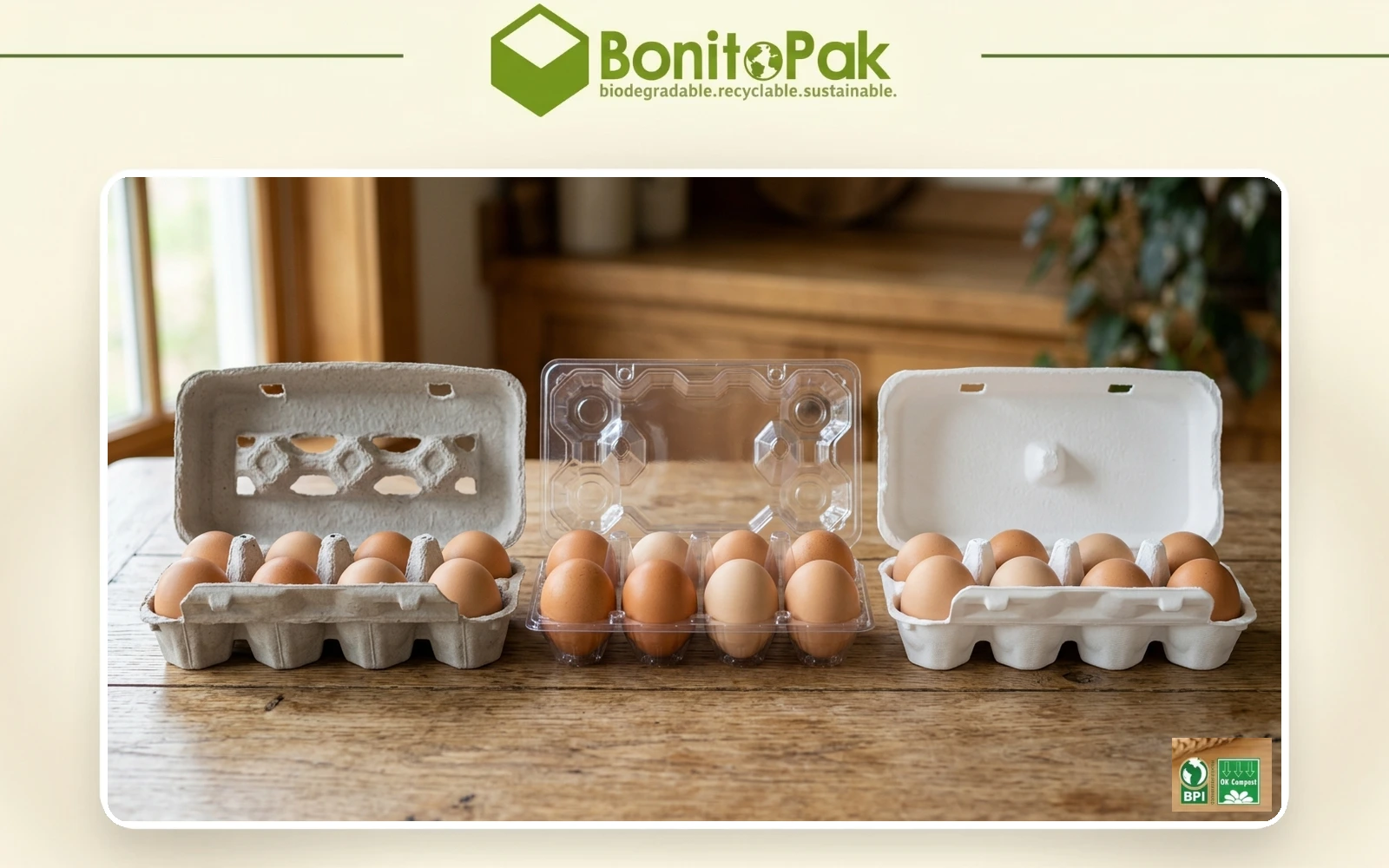
The Four Egg Carton Materials
|
Material |
What it is |
Share of market |
How to spot it |
|---|---|---|---|
|
Molded pulp |
Cellulose fiber formed wet and dried |
Dominant |
Dull, fibrous, tears like paper |
|
PET plastic |
Thermoformed polyethylene terephthalate |
Common in retail |
Clear, crinkles loudly, resin code 1 |
|
Polystyrene foam |
Expanded polystyrene |
Declining |
Bright white, squeaks, very light |
|
Paperboard |
Folded printed board |
Niche, gift and specialty |
Creased folds, not molded |
That last row is the one usually missed. Folded paperboard egg packaging exists, mostly in gift and premium formats, and it is a genuinely different product from molded pulp. It is printed flat and folded rather than formed in a mold, which means better print quality and generally less protection.
Molded Pulp: What the Fiber Actually Is
This is the material in most egg cartons worldwide, and “paper pulp” covers at least four distinct inputs that behave differently.
Recycled Paper
The most common input. Recovered newsprint, cardboard and office waste, pulped with water. Used egg cartons go back in too, which is one reason this product recycles into itself cleanly.
Colour: grey, from mixed inks and varied fiber. Cost: lowest. Performance: good cushioning, slightly rough surface. Limitation: fiber shortens with each recycling cycle, so producers blend recovered material with other grades to hold strength. The grey base also makes clean white or saturated colour expensive to achieve.
Sugarcane Bagasse
Bagasse is the fibrous residue left after sugarcane is crushed for juice. It is an agricultural by-product, so it does not compete with food production or require tree harvesting.
Colour: light tan or straw. Cost: higher than recycled. Performance: behaves like virgin fiber, cleaner surface, takes colour better. Why it matters: if you want a light or coloured carton, starting from bagasse costs less in processing than bleaching grey recycled fiber to the same result.
Bamboo
Fast-growing and renewable, generally pale, sitting between recycled grey and bagasse tan.
Cost: higher than recycled. Performance: strong fiber, good surface.
Virgin Wood Pulp
The lightest and most expensive starting point. Used where appearance matters most and rarely for commodity egg cartons.
At BonitoPak we run recycled paper, bagasse and bamboo across six pulp colour systems. Our materials page sets out the options.
What Is Not in Plain Molded Pulp
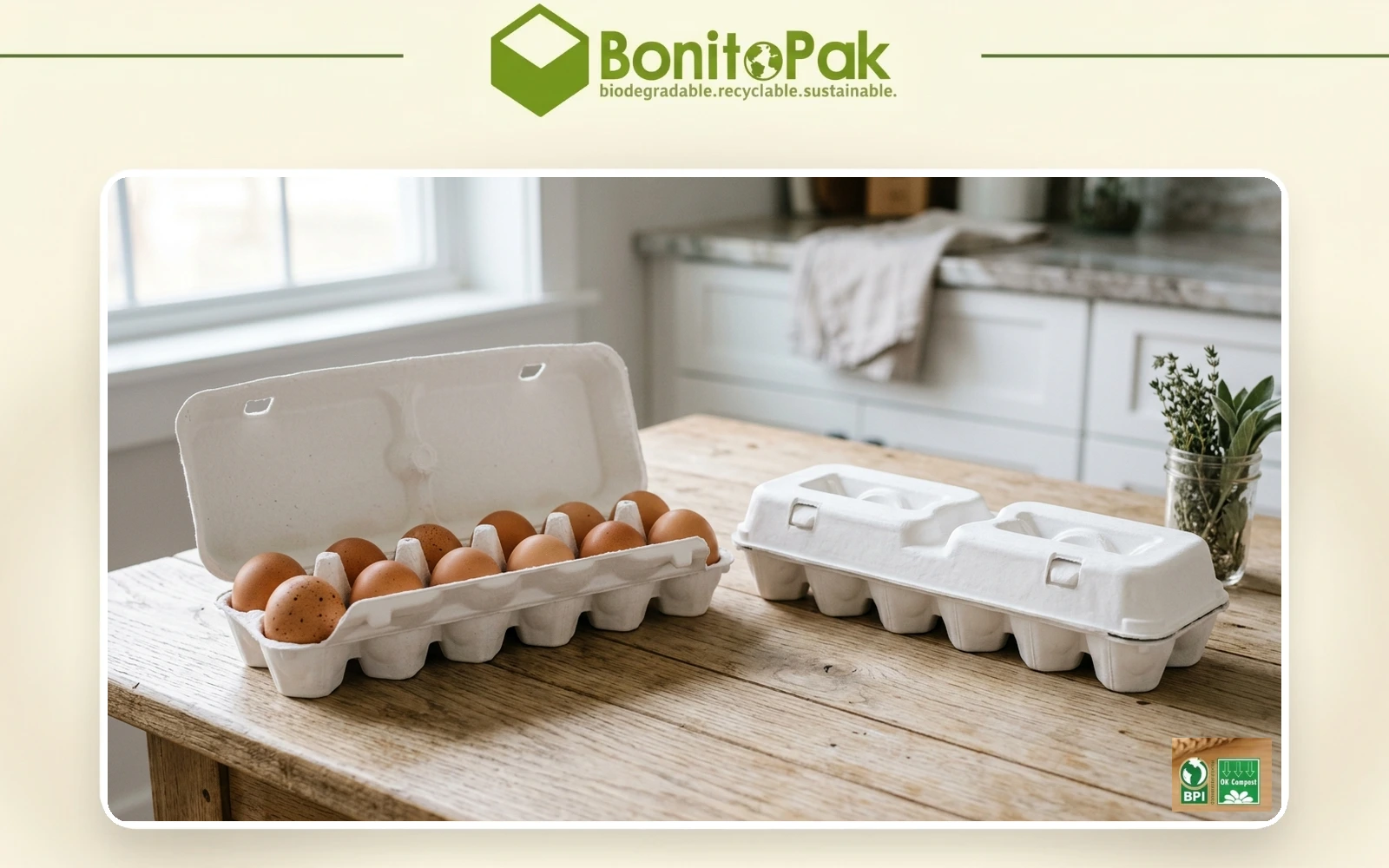
This is worth stating because buyers often assume otherwise. A plain molded fiber carton contains no glue, no binder and no plastic layer. The fibers interlock mechanically as the part dries. That is why it recycles with paper and composts without residue.
Additives enter only when a job calls for them: pigment for coloured pulp, which goes into the slurry rather than onto the surface, and water-resistance additives where required. Egg cartons rarely need grease resistance, which is relevant because some fiber food packaging has historically used fluorinated chemicals for that purpose. BPI certification requires no intentionally added fluorinated chemicals and a lab result below 100 ppm total organic fluorine.
How Molded Pulp Is Formed
Knowing the process explains why two grey cartons can feel completely different.
Fiber is pulped with water into a slurry. A mesh-covered mold dips into it while vacuum draws water through, depositing fiber on the mold surface. The wet part is transferred off and dried.
Where it diverges: in dry pressing the part is released and dried afterward, which leaves thicker, springier walls and a visibly fibrous surface. In wet pressing, also called thermoforming, the part dries between heated tools under pressure, producing thin, dense walls and two smooth faces.
Wall thickness follows directly. The International Molded Fiber Association classifies molded fiber into four types, with thick wall around 5 to 10 mm, transfer molded around 3 to 5 mm, and thermoformed around 2 to 4 mm. Egg cartons are typically transfer molded, which is why they cushion well and do not look polished.
Our articles on the four types of molded pulp and how pulp egg trays are made go deeper on both points.
PET Plastic
Thermoformed from polyethylene terephthalate, the same resin family as drinks bottles, usually marked with resin code 1. Frequently made with recycled content, labelled RPET.
Strengths: complete visibility of the eggs, no moisture absorption, crisp shape retention. Weaknesses: thinner and stiffer, so it relies on ribs and cell shape rather than material bulk for protection. It does not breathe, so condensation can sit against the shells. Disposal: technically recyclable, practically harder. Egg cartons are thermoforms rather than bottles, and sorting equipment detects bottles more reliably. NAPCOR reported US PET thermoform recycling more than tripling between 2011 and 2023 to 130 million pounds, but The Recycling Partnership has noted only around 30% of North American reclaimers can process thermoforms mixed into bottle bales.
Polystyrene Foam
Expanded polystyrene, resin code 6. Light, insulating and cheap, and in clear decline.
Why it is declining: foam is roughly 95% air, which makes it expensive to collect and transport and uneconomic for most facilities to process. Regulatory pressure has added to this. California prohibited expanded polystyrene food service ware from January 1, 2025 after the sector failed to demonstrate a 25% recycling rate under SB 54.
Disposal: rarely accepted kerbside. Some communities run drop-off programs.
Paperboard
Printed flat and folded into shape rather than molded. Found mostly in gift packs, specialty formats and some European retail.
Strengths: the best print surface of any option, and the largest branding area. Weaknesses: generally less protective than molded fiber of equivalent weight, and more vulnerable to moisture. Identification: look for straight creased folds and uniform wall thickness, rather than the formed curves and varying thickness of molded pulp.
How to Identify Any Carton
Three tests, no equipment needed.
Look. Molded pulp is dull with visible fiber texture and one smoother face. Bagasse pulp is tan rather than grey. PET is glossy and transparent. Foam is bright white and uniform. Paperboard shows printed flat stock with creased folds.
Squeeze. Pulp gives and stays bent. PET crinkles loudly and springs back. Foam compresses with a faint squeak. Paperboard creases.
Tear a corner. Pulp and paperboard tear like paper. PET and foam do not.
Check for a resin code. A 1 means PET, a 6 means polystyrene. Molded pulp has none. Note that a recycling symbol is not a promise your local program accepts the item.
Egg Carton Materials Compared
|
Factor |
Molded pulp |
PET |
Foam |
Paperboard |
|---|---|---|---|---|
|
Cushioning |
Best |
Good with design |
Good |
Moderate |
|
Breathability |
Yes |
No |
No |
Yes |
|
Visibility |
Open styles only |
Full |
None |
None |
|
Print quality |
Limited by texture |
Via label |
Poor |
Best |
|
Kerbside recycling |
Widely, with paper |
Patchy |
Rare |
Widely, with paper |
|
Composting |
Yes, if plain |
No |
No |
Yes, if uncoated |
|
Moisture tolerance |
Absorbs |
None |
None |
Low |
|
Regulatory exposure |
Low |
Rising |
High |
Low |
Our comparison of pulp versus plastic egg cartons covers the first two columns in more depth for buyers choosing between them.
Which Material to Choose
For most egg sellers, molded pulp. It cushions well, breathes, recycles through a stream most households can reach, composts if plain, and sits in the lowest regulatory risk band as plastic rules tighten.
Choose PET when shoppers need to see unusual shells, or when your storage is genuinely wet. Choose paperboard when the pack is a gift item and print quality outranks protection. Foam is a shrinking option facing active prohibition in some markets.
The fiber choice within molded pulp then follows your appearance needs: recycled paper for cost, bagasse for a lighter base and better colour, bamboo for strength with a pale surface.
At BonitoPak we make molded pulp egg cartons and custom egg trays from all three fiber types, BPI and OK Compost certified, with molds cut per project from 1,000 pieces. Send us your eggs and we will tell you which fiber and format fits.
FAQs
Q: What are egg cartons made of most commonly? A: Molded pulp, formed from recycled paper, sugarcane bagasse, bamboo or wood pulp mixed with water and vacuum-formed in a mold. PET plastic and polystyrene foam make up most of the rest, with folded paperboard in niche formats.
Q: What are egg trays made of compared with cartons? A: What are egg trays made of is the same answer: the same materials, most often molded pulp. Trays and flats are open 30-cell formats for handling and wholesale, while cartons have hinged lids for retail. Material choice does not change between the two.
Q: Do molded pulp egg cartons contain glue or plastic? A: Plain ones contain neither. The fibers interlock mechanically as the part dries, which is why they recycle with paper and compost without residue. Pigment for coloured pulp and any water-resistance additive go into the slurry.
Q: Is bagasse better than recycled paper for egg cartons? A: Better for appearance, not for cushioning. Bagasse is an agricultural by-product with a lighter tan base that takes colour more cleanly, so it suits white or coloured cartons. Recycled paper is cheaper and performs well.
Q: How can I tell if my egg carton is pulp or plastic? A: Tear a corner. Pulp tears like paper; PET and foam do not. Pulp is also dull with visible fiber, while PET is glossy and transparent and foam is bright white and squeaks under a fingernail.