 Aller au contenu
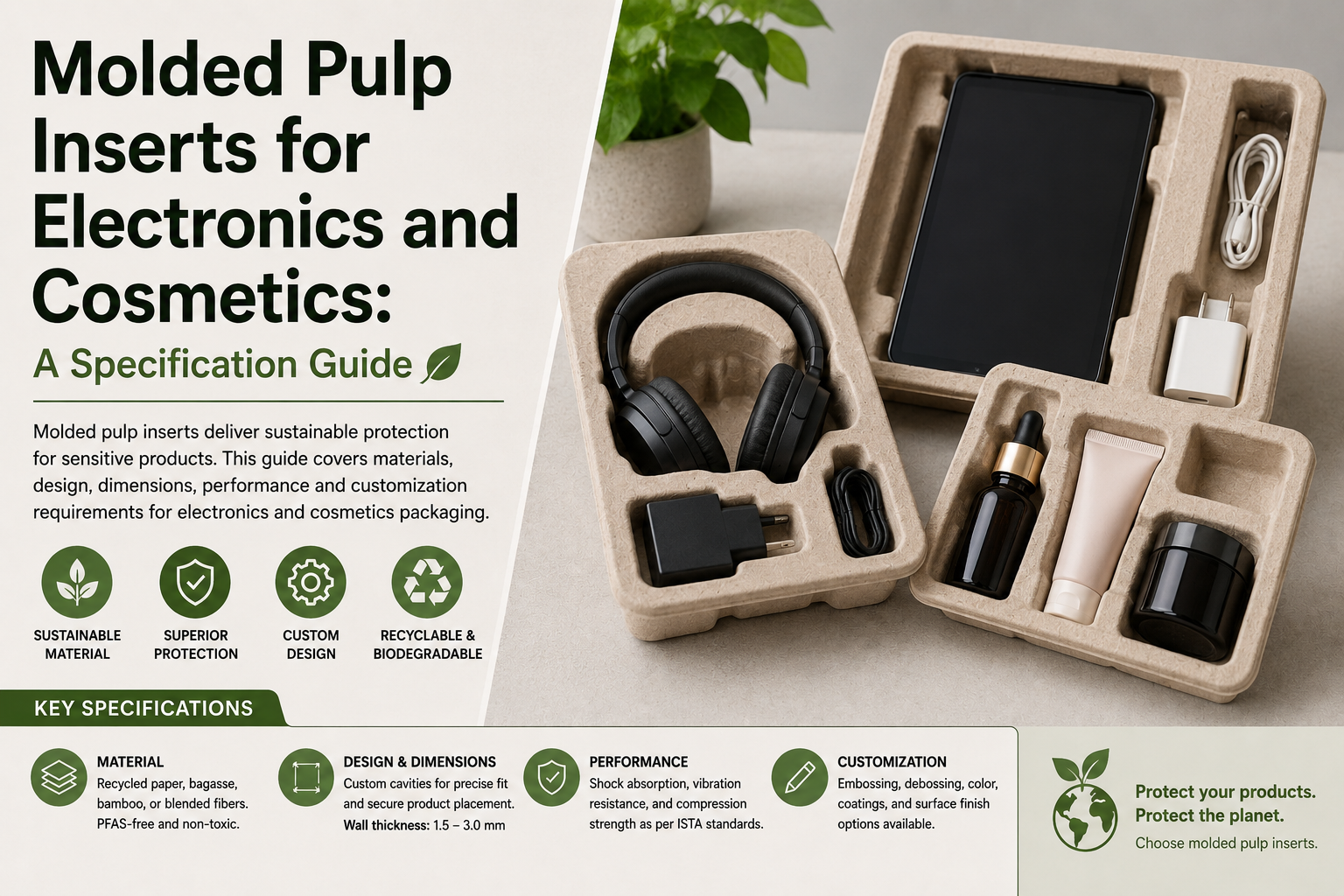
En bref : Molded pulp inserts hold a product in fixed position inside its outer box, replacing EVA foam, blister and vacuum-formed PET. Electronics and cosmetics are the two largest custom insert markets, and they need opposite things from the same process. This guide covers the design rules, the tolerance reality, when wet press is worth the premium, and what to send for a tooling quote.
The first molded pulp insert most brands commission fails on the same detail: the product does not sit level in the tray.
It happens because the designer scaled the cavity directly from the product’s CAD outline with a uniform offset. Fiber does not behave that way. It draws down over the mold under vacuum, thins slightly at deep corners, and springs back a fraction as it dries. A cavity cut to nominal dimensions holds the product loose on one axis and tight on another.
That is fixable at the sample mold stage for a few hundred dollars. Caught after production tooling is cut, it is a scrapped mold.
Electronics and cosmetics are the two sectors buying the most custom molded pulp inserts right now, and they want opposite things from the same process. Electronics needs cushioning and drop survival. Cosmetics needs a surface that photographs well. This guide covers both.
What Is a Molded Pulp Insert?
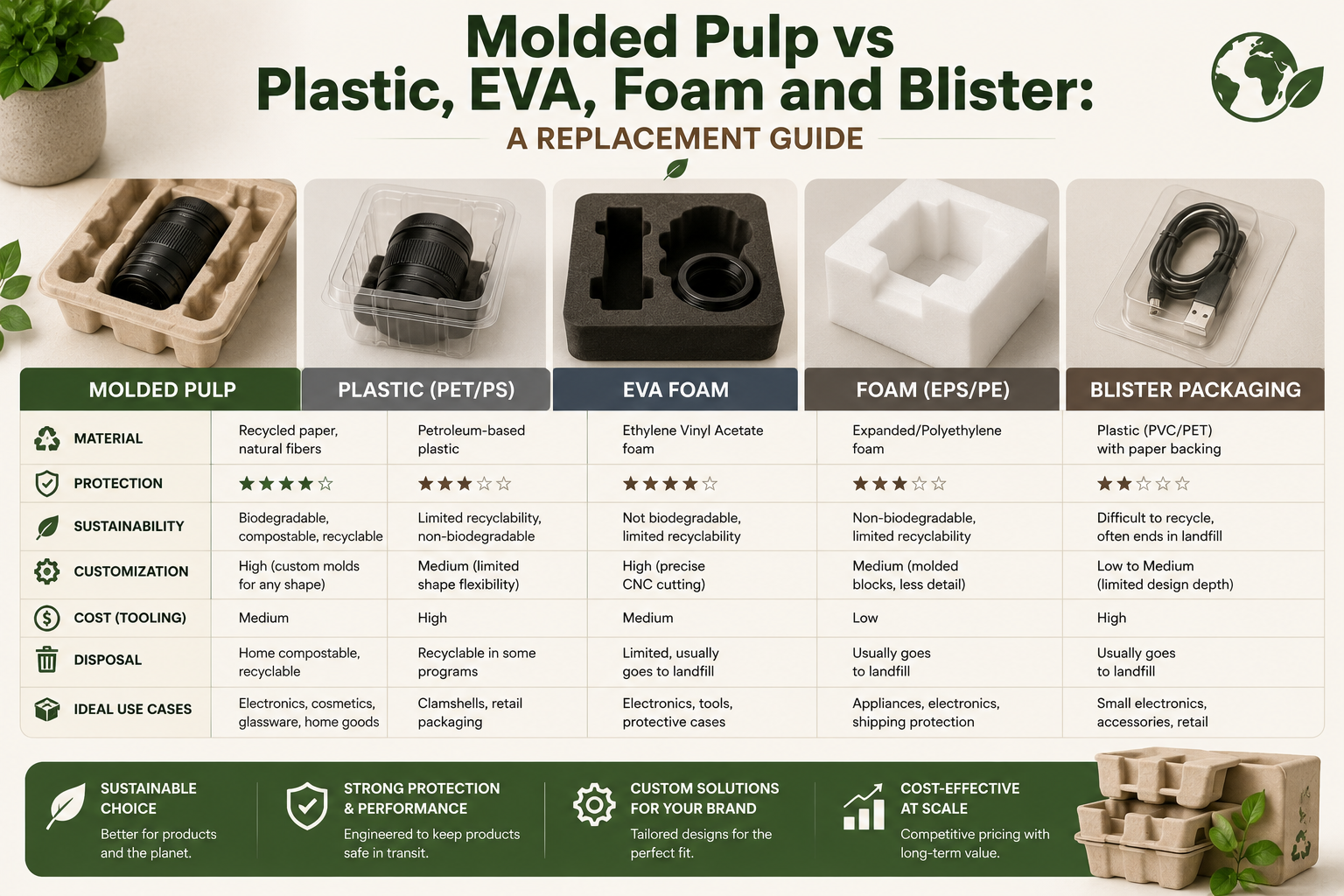
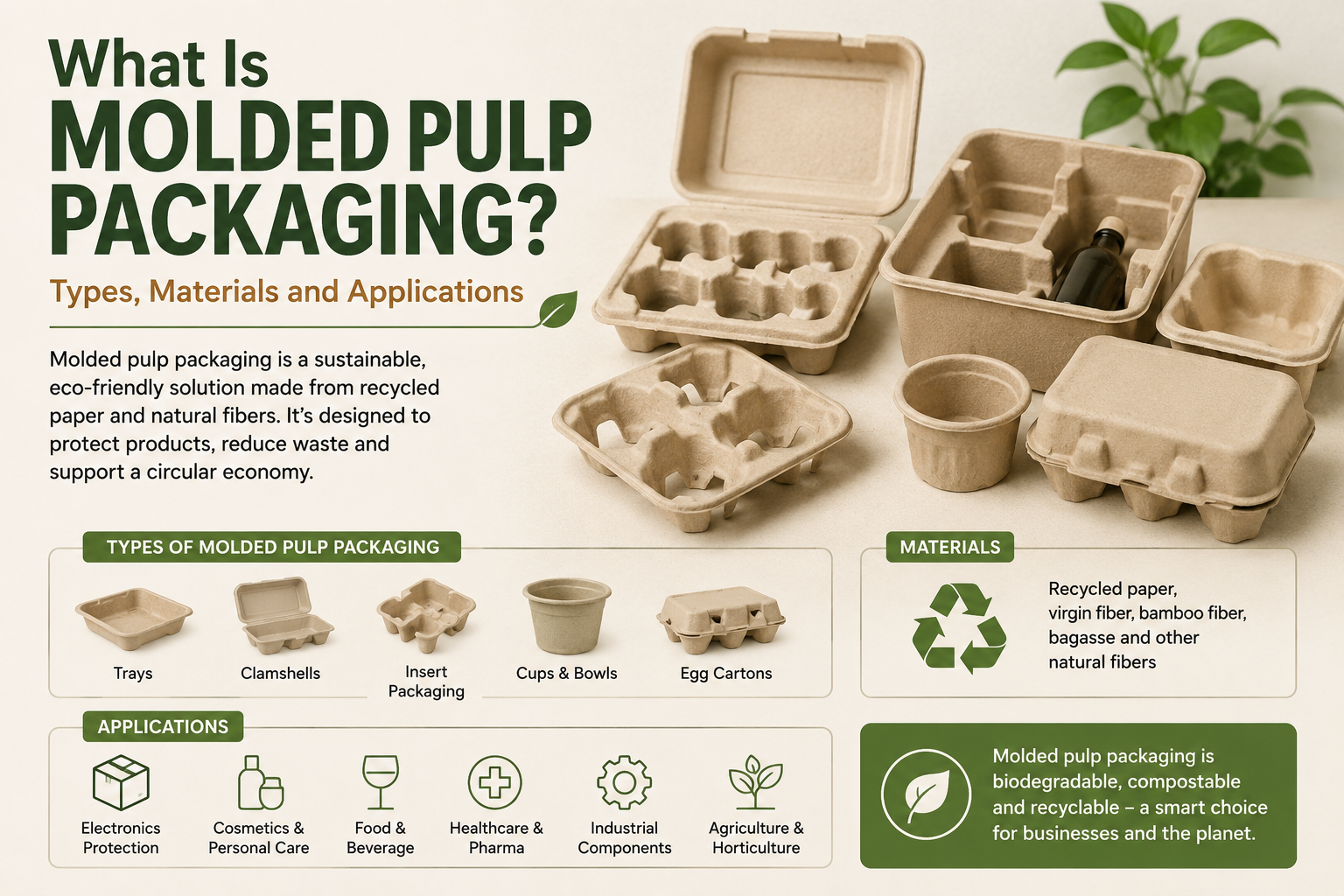
A molded pulp insert is a fiber tray with recessed cavities shaped to hold a specific product in a fixed position inside its outer packaging. It performs the job EVA foam, blister packs and vacuum-formed PET trays traditionally did, using plant fiber that recycles and composts instead of petroleum-based plastic. If you are new to the material itself, start with Qu'est-ce qu'un emballage en pâte moulée ?.
The insert is not the box. It sits inside a carton, rigid box or sleeve, and its job is positional: hold the product still, absorb shock, and present the contents in a defined arrangement when the box opens.
Two forming routes produce them:
Wet pressed inserts go through a hot press stage after vacuum forming, where heated tooling compresses the wet part and drives out moisture simultaneously. Result is a smooth surface on both faces, tight tolerance, sharp detail. Wall sections of 0.7 to 1.2mm, produced by a cure-in-the-mold technique where the part dries inside the tool rather than in a separate oven.
Dry pressed inserts are oven dried without compression. Rougher texture, thicker wall, lower cost. BonitoPak’s dry press line reaches 2.5 to 3.0mm and passes drop testing, sitting in the transfer molded range that the International Molded Fiber Association classifies as Type 2.
Which one you need depends almost entirely on whether the customer sees the insert.
How Do Electronics and Cosmetics Inserts Differ?
Electronics inserts are engineered for drop survival and are usually never seen by the end user, so dry press and a rough finish are acceptable. Cosmetics inserts are part of the unboxing experience and get photographed, so wet press and a smooth, evenly colored surface justify the premium.
Electronics requirements:
Shock absorption is the primary function. The insert must decelerate the product over a controlled distance during a drop, which means the fiber needs room to deform. Cavities cut tight against the product transmit shock straight through.
Cable and accessory management matters. Most electronics packaging holds a main unit plus chargers, cables and documentation, each needing its own defined position.
Static is not a concern with plain fiber, unlike some plastic alternatives.
Stacking and nesting for inbound logistics, since inserts ship to the assembly line in volume before they ship out with product.
Cosmetics requirements:
Surface quality is the primary function. The insert appears in product photography, unboxing videos and on retail shelves in open display formats.
Color fidelity matters more than in any other sector. A black insert that reads slightly brown under retail lighting undermines a premium positioning.
Cavity precision is tighter because product sizes are small and a 2mm gap around a lipstick looks like a defect in a way the same gap around a laptop does not.
Multi-cavity layouts holding sets: serum plus dropper plus cream plus sample sachet, each in position, is a common brief.
| Requirement | Electronics inserts | Cosmetics inserts |
| Primary function | Shock absorption, drop survival | Surface appearance, brand presentation |
| Typical process | Dry press | Presse humide |
| Épaisseur de la paroi | 1.5 to 3.0mm | 0.7 to 1.2mm |
| Surface priority | Low, insert rarely seen | High, appears in photography |
| Color fidelity | Low priority | Critical, especially black |
| Cavity precision | Moderate, clearance aids cushioning | Tight, gaps read as defects |
| Common layout | Main unit plus cables and accessories | Multi-cavity product sets |
The specification consequence is straightforward. Electronics can usually run dry press and save meaningfully on unit cost. Cosmetics almost always needs wet press, and buyers who try to save there generally end up re-tooling.
What Tolerances Can Molded Pulp Inserts Hold?
Molded pulp does not hold injection molding tolerances and should not be specified as though it does. Wet pressed parts hold tighter tolerances than dry pressed, but both need design allowance for fiber springback during drying and slight variation across a production run.
This is the single most common source of disappointment for designers arriving from a plastics background.
Practical implications for cavity design:
Build in clearance. Cavities should be designed with deliberate clearance around the product rather than to nominal product dimensions. The exact allowance depends on part size and geometry, and your manufacturer should specify it during design review.
Use the fiber’s compliance. Pulp deforms slightly under load, which means a cavity with a small interference fit will grip a product securely where a rigid plastic tray of the same dimensions would not close. This is an advantage if you design for it.
Expect variation across cavities. In a multi-cavity mold, small differences between cavities are normal.
Deep draws thin the wall. Fiber drawn into a deep narrow cavity thins at the base. Deep cavities need either a larger radius at the base or an accepted thinner section.
The design review with your manufacturer is where these numbers get set for your specific part. Any supplier who quotes tooling without discussing tolerance is not paying attention.
What Design Rules Apply to Molded Pulp Inserts?
Four rules govern whether an insert can be produced at all: generous draft on vertical walls, no undercuts, consistent wall thickness, and radiused internal corners. These come from the physics of vacuum forming fiber from a slurry, not from convention.
Draft angle. Vertical walls need roughly 3 to 5 degrees of draft, considerably more than injection molding requires. Insufficient draft means the part grips the tool and tears on release.
No undercuts. The mold is a single-direction tool. Any geometry that would trap the part is impossible without secondary operations, which add cost and usually are not worth it. Redesign the cavity instead.
Consistent wall thickness. Thick sections hold water longer, dry slower, and warp as the surrounding thin sections finish drying and shrink. Uniform thickness is the single biggest determinant of dimensional stability.
Radiused corners. Sharp internal corners cause fiber to thin as it draws around them, creating the weak point that fails first under drop testing. Generous radii are both a manufacturing and a performance requirement.
| Design rule | Requirement | Consequence if ignored |
| Angle de tirage | 3 to 5 degrees on vertical walls | Part grips tool, tears on release |
| Contre-dépouilles | None without secondary operations | Part cannot be demolded |
| Épaisseur de la paroi | Consistent throughout | Thick sections dry slowly and warp |
| Internal corners | Generous radii | Fiber thins, fails first in drop test |
| Deep cavities | Larger base radius | Wall thins at cavity base |
Two more worth knowing:
Ribs and features add stiffness cheaply. A shallow rib pressed into a flat span stiffens it substantially at no material cost, which is often better than increasing wall thickness across the whole part.
Emboss and deboss are free branding. Logo detail cut into the tool costs nothing per unit, adds no material, and survives moisture and handling that would smear printed ink. On molded pulp this is the cleanest branding route available.
Can Molded Pulp Inserts Be Colored?
Yes, and the method decides whether the insert stays recyclable. Pigment mixed into the pulp slurry colors the fiber throughout and keeps the part fully recyclable and compostable. Surface coating or lamination achieves color too but converts a single-material part into a composite that fails both disposal routes.
BonitoPak runs six separate pulp color systems: white, natural, black, orange, gray and blue, all Pantone referenced with matching accurate to better than 95%. Running six is unusual, since each color system needs its own pulping line to prevent cross-contamination between batches.
Black is worth a specific note because it dominates premium electronics and cosmetics packaging. Achieving a genuinely neutral black in fiber is harder than it sounds, since the natural fiber tone pulls toward brown and an under-pigmented black reads as very dark brown under warm retail lighting. A dedicated black pulp system rather than an ad-hoc additive run makes the difference.
For food contact applications, specify white or natural. Additive colored systems are intended for insert and tray packaging rather than direct food contact.
The gloss question comes up constantly in cosmetics briefs. If a supplier offers a glossy pulp insert, ask what produces the gloss. A film or laminate finish means the sustainability claim on that part is gone, whatever the fiber underneath is made from. In-pulp color plus water-based printing keeps the claim intact.
What Do You Need to Send for an Insert Tooling Quote?
Send a 3D file of the product being packaged, not a drawing of the packaging you have in mind. The insert geometry derives from the product, and manufacturers with in-house design teams will produce the packaging concept from the product model.
The full quote package:
3D product file. SolidWorks, Creo, IGS or STEP are all accepted. If you have physical samples, send those instead or as well.
Annual volume and order frequency. Cavity count is decided by volume, and a tool cut for 20,000 units a year looks different from one cut for 500,000.
Outer packaging dimensions. The insert has to fit inside something. Send the carton internal dimensions.
Orientation requirement. Whether the product must present a particular face upward when the box opens changes the entire cavity strategy.
Finish and color. Wet press or dry press, and Pantone reference if you have one.
Drop test requirement. If the packaging must pass a specific drop test standard, state it upfront. It changes wall thickness and cushioning geometry.
Emboss, deboss or print requirement. These are cut into the tool, not added afterward.
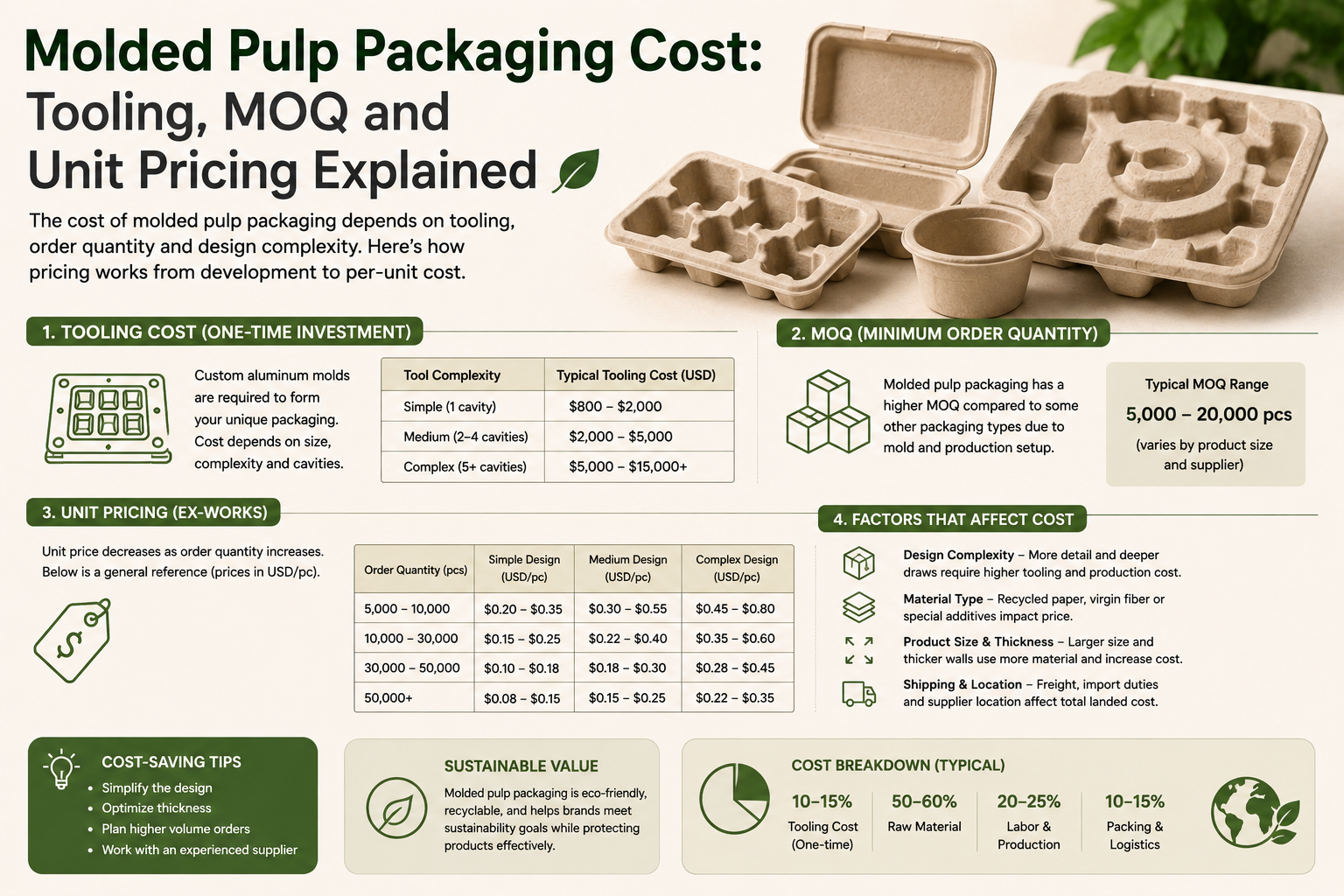
BonitoPak returns 3D drawings within 2 days of receiving a specification. Tooling then runs in two stages: sample mold in 7 days for approval, production mold in 8 days once geometry is signed off. What each of those stages adds to the quote is broken down in molded pulp packaging cost.
That two-stage sequence is not bureaucracy. A production mold that needs geometry changes gets scrapped rather than modified, so every revision absorbed at the sample stage costs a fraction of one caught later. Buyers who push to skip straight to production tooling are the ones who end up paying for two molds.
Conclusion
Trois points à retenir.
Match the process to who sees the part. Electronics inserts hidden inside a box can run dry press and save real money per unit. Cosmetics inserts that appear in product photography need wet press, and trying to economize there usually ends in re-tooling.
Design for fiber, not for plastic. Generous draft, no undercuts, uniform wall thickness, radiused corners. Designers arriving from injection molding underestimate all four, and the resulting geometry will not release from the tool.
Color method decides the sustainability claim. Pigment in the pulp keeps the insert recyclable and compostable. Surface film does not, regardless of the fiber underneath.
To start a quote, send the 3D file of your product along with annual volume, carton internal dimensions and finish requirement. BonitoPak will return a design concept, tooling estimate and unit pricing.
Questions fréquemment posées
What is a molded pulp insert and what does it replace?
A molded pulp insert is a fiber tray with recessed cavities shaped to hold a specific product in fixed position inside its outer carton, box or sleeve. It performs the job that EVA foam, blister packs, expanded polystyrene and vacuum-formed PET trays traditionally did, using plant fiber that recycles in paper streams and composts, instead of petroleum-based plastic. Its function is positional as well as protective: hold the product still, absorb shock during transit and drops, and present the contents in a defined arrangement when the box is opened. Electronics and cosmetics are currently the two largest custom insert markets, though the same process serves medical, food, wine and industrial applications.
Should I choose wet press or dry press for my insert?
The deciding question is whether the end customer sees the insert. Wet press adds a hot press stage after vacuum forming, where heated tooling compresses the part and drives out moisture at once, producing smooth faces, tighter tolerances and sharp detail definition at wall sections down to around 2mm. Dry press dries the part in an oven without compression, leaving a rougher texture and thicker wall at 2.5 to 3.0mm, which still passes drop testing at meaningfully lower unit cost. Electronics inserts hidden inside a sealed carton usually run dry press economically, while cosmetics inserts that appear in unboxing photography almost always need wet press.
What tolerances can molded pulp inserts hold?
Molded pulp does not hold injection molding tolerances and should not be specified as though it does, since fiber springs back slightly as it dries and varies marginally across a production run and between cavities in a multi-cavity tool. Wet pressed parts hold tighter tolerances than dry pressed, but both need deliberate clearance designed into the cavity rather than cutting to nominal product dimensions. The compensating advantage is that fiber deforms slightly under load, so a cavity with a small interference fit grips a product securely where a rigid plastic tray of identical dimensions would not. Your manufacturer should specify the exact allowance for your part during design review, and any supplier quoting tooling without discussing tolerance is not paying attention.
What design rules apply to molded pulp insert geometry?
Four rules decide whether a part can be produced at all: draft angles of roughly 3 to 5 degrees on vertical walls, no undercuts, consistent wall thickness throughout, and radiused rather than sharp internal corners. Insufficient draft means the part grips the tool and tears on release, while undercuts are impossible in a single-direction mold without secondary operations that rarely justify their cost. Thick sections hold water longer and warp as surrounding thin sections finish drying and shrink, making uniform thickness the biggest single determinant of dimensional stability. Sharp internal corners thin the fiber as it draws around them and become the first failure point under drop testing.
Can molded pulp inserts be made in custom colors, including black?
Yes, provided pigment is mixed into the pulp slurry rather than coated onto the surface, which colors the fiber throughout and keeps the insert fully recyclable and compostable. BonitoPak runs six separate pulp color systems covering white, natural, black, orange, gray and blue, all Pantone referenced with matching accurate to better than 95%, with each system on its own line to prevent cross-contamination. Black deserves particular attention because natural fiber tone pulls toward brown, so an under-pigmented black reads as very dark brown under warm retail lighting, and a dedicated black pulp system rather than an ad-hoc additive run is what produces a genuinely neutral result. Surface coating and lamination achieve color too but convert a compostable part into a composite that fails both recycling and composting.
What do I need to send to get an insert tooling quote?
Send a 3D file of the product being packaged rather than a drawing of the packaging you envisage, since the insert geometry derives from the product and manufacturers with in-house design teams will produce the concept from your product model. Accepted formats are SolidWorks, Creo, IGS and STEP, and physical samples work as an alternative or supplement. You should also supply annual volume and order frequency because cavity count is decided by volume, the internal dimensions of the outer carton, any orientation requirement for how the product presents when the box opens, your finish and color preference, and any drop test standard the packaging must pass. Emboss, deboss and print requirements need stating upfront because they are cut into the tool rather than added afterward.

 French
  English
  German
  Spanish
  Russian
  Japanese
  Portuguese
  Arabic