By Leo Chan | Founder, BonitoPak | 20+ years in fiber packaging manufacturing Last Updated: October 2026
Molded pulp packaging is protective packaging formed from cellulose fiber suspended in water, pulled onto a mesh mold under vacuum, then dried into a rigid three dimensional part. The global market reached USD 7.85 billion in 2025 and is forecast to hit USD 14.65 billion by 2035 at a 6.44% compound annual growth rate (Spherical Insights, 2025). Trays accounted for roughly 35.0% of that market in 2025, and electronics was the largest end use segment. It recycles through the paper stream, which the American Forest and Paper Association put at a 61% to 65% US recovery rate for paper and 70% to 75% for cardboard in 2025.
In This Guide
- What is it made of?
- The four production types
- How it is manufactured
- Wet pressing or dry pressing
- What it costs
- Recycling and composting
- Which industries use it
- How to specify a custom project
Key Takeaways
- Four production types exist, and they are distinguished by wall thickness and surface finish rather than by pulp material. Transfer molding is the most prevalent process in commercial use today.
- Published wall thickness ranges differ between sources. Treat any single set of figures as indicative and confirm your supplier’s actual production range.
- Tooling, not unit price, usually decides whether a project makes sense. Molds are cut per part and amortize across volume.
- Plain uncoated fiber contains no glue, binder or plastic layer, which is why it recycles with paper and needs no barrier chemistry for dry goods.
- Fiber sits in the lowest fee bands under extended producer responsibility programs, while plastic categories are being charged more as those programs take effect.
What Is Molded Pulp Made Of?
It is made from cellulose fiber and water, with nothing else required. The fiber comes from one of four inputs: recovered paper, sugarcane bagasse, bamboo or virgin wood. The finished part holds its shape because the fibers physically interlock as the water leaves, not because an adhesive binds them.
That last point surprises buyers more than anything else in this guide. A plain fiber part has no glue, no resin and no plastic lining. You will also see the material written as moulded paper pulp, which is the same thing under British spelling.
Recovered paper pulp is the most common and least expensive input. Newsprint, cardboard and office waste are broken down in water into a slurry. Used parts can go back in, so the product recycles into itself. It produces a grey part, because mixed inks and varied fiber average out to grey.
Bagaço de cana-de-açúcar is the fibrous residue left after cane is crushed for juice. It is an agricultural by-product, so it competes with neither food production nor forestry. It gives a light tan part with a cleaner surface, and it takes color far more cheaply than grey fiber does.
Bambu is fast growing and renewable, with strong fiber and a pale surface, priced above recovered paper.
Polpa de madeira virgem is the lightest and costliest starting point, used where appearance outranks cost.
Each pulp material is bought by grade, and the grade drives color, surface quality and price before any tooling decision gets made. Our página de materiais sets out what each input suits.
What Are the Four Types of Molded Fiber?
The industry sorts fiber parts into four categories by how each is formed and finished, and the practical difference between them is wall thickness and surface quality. Thick wall is rough and strong, transfer molded is the commercial workhorse, cure-in-the-mold is thin and smooth, and the fourth category covers any of the first three after secondary processing.
|
Tipo |
Wall thickness |
Surfaces |
Typical uses |
|---|---|---|---|
|
Thick wall, also called slush molded |
1.5 to 6 mm |
Rough one side, moderately smooth the other |
Edge protectors, heavy items, auto parts, pallet trays |
|
Transfer molded |
Roughly 1.6 to 4.8 mm |
Relatively smooth one side, fairly smooth the other |
Electronics, phones, hardware, drink trays, cup carriers, egg cartons, fruit trays |
|
Cure-in-the-mold, also called thermoformed |
Thin wall |
Smooth both faces, near plastic appearance |
Point of purchase packaging, high definition cosmetic parts |
|
Secondary processed |
Varies by base type |
Varia |
Coated, printed, hot pressed, die cut or colored versions of the above |
Thickness ranges above follow published industry descriptions of each category. One honest caveat: those ranges vary noticeably between sources, and plenty of suppliers run well outside the quoted bands. Ask for a supplier’s measured production range rather than assuming a classification figure applies to their line.
Transfer molding is described as the most prevalent process in commercial use, which matches what we see day to day. Our detailed breakdown of the four production types covers the selection logic in more depth.
How Is Molded Pulp Manufactured?
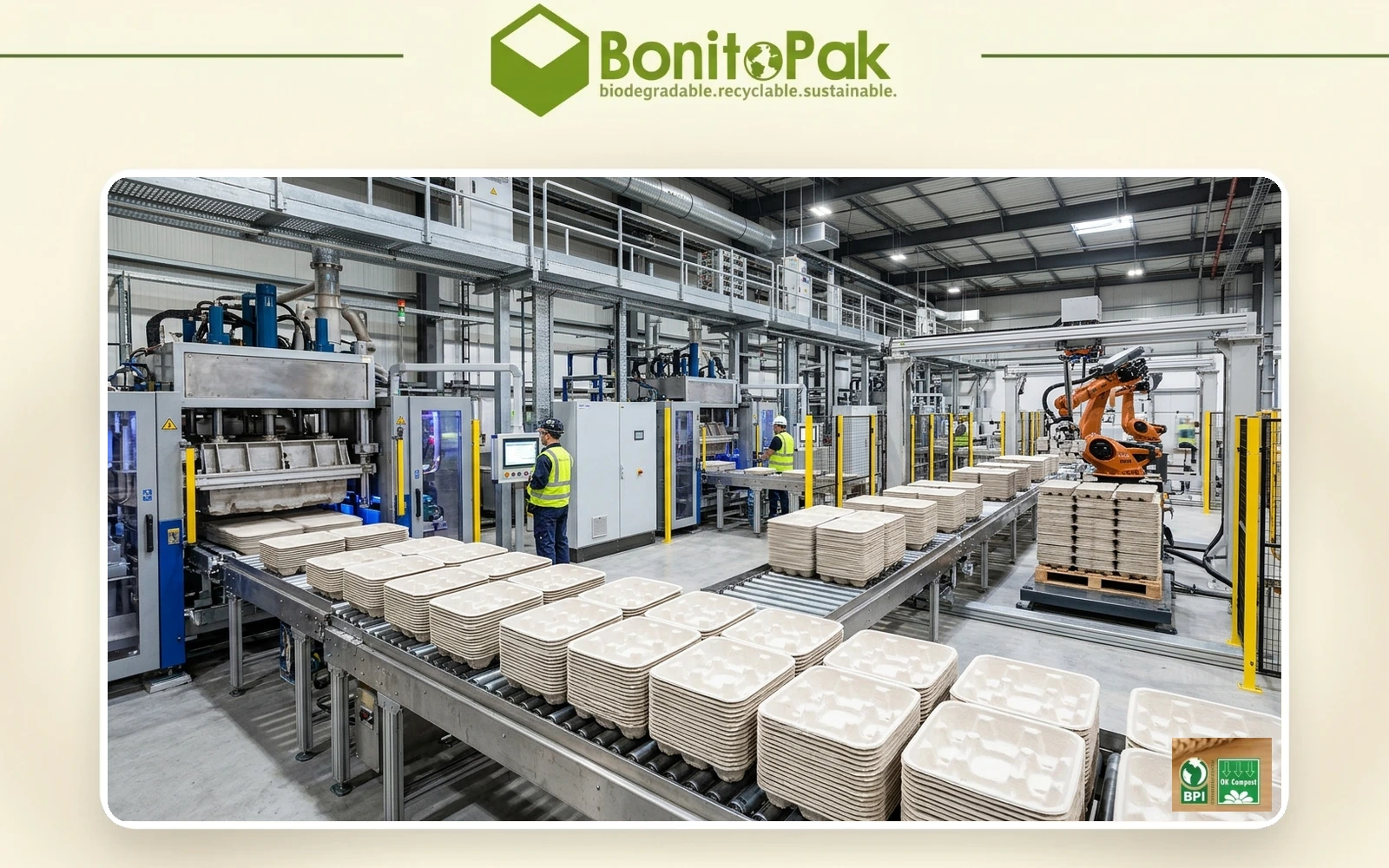
Production runs in four stages: pulping, forming, drying and finishing. Fiber is mixed with water into a dilute slurry, a mesh covered mold draws that slurry against its surface under vacuum, water is pulled through leaving a fiber layer, and the wet part is then dried into a rigid shape.
Pulping. Fiber is broken down in water, screened for contaminants and brought to a working consistency. Pigment goes in at this stage for colored parts, which is why fiber color runs all the way through rather than sitting on the surface.
Forming. A fine wire mesh mold mates with a vacuum chamber. Slurry is sprayed or dipped, vacuum pulls it onto the mesh, and excess returns to the pool for reuse. That mesh pattern is why one face of most fiber parts is slightly textured.
Drying. This is where the processes diverge, and it decides the finished part more than anything else does.
Finishing. Trimming, die cutting, printing, hot pressing or coating, depending on specification.
Nosso step by step guide to the mold process walks through each stage with the equipment involved.
Wet Pressing or Dry Pressing: Which Do You Need?
Dry pressing releases the part from the mold and dries it in an oven, producing thicker, springier walls with a visibly fibrous surface. Wet pressing dries the part between heated tools under pressure, producing thinner, denser walls with two smooth faces. Dry pressing costs less and cushions better. Wet pressing looks better and holds tighter tolerances.
The decision usually comes down to whether the part will be seen.
|
Fator |
Dry pressing |
Prensagem úmida |
|---|---|---|
|
Superfície |
One textured face, fibrous |
Two smooth faces |
|
Wall |
Thicker, more springy |
Thinner, denser |
|
Amortecimento |
Better |
Adequate |
|
Dimensional precision |
Looser |
Tighter |
|
Tooling cost |
Inferior |
Mais alto |
|
Custo unitário |
Inferior |
Mais alto |
|
Melhor para |
Egg cartons, trays, industrial protection |
Retail inserts, cosmetics, visible presentation |
A tray hidden inside a shipping carton has no reason to be wet pressed. An insert a customer lifts out of a gift box usually does. We run both lines, and the honest answer in a quoting conversation is often that the cheaper process is the right one. Compare our wet pressing trays e dry pressing trays to see the surface difference.
What Does Molded Pulp Packaging Cost?
Unit price depends on part size, wall thickness, fiber, color and volume, but it is rarely what decides a project. Tooling does. Molds are cut for one specific part, that cost is paid once, and it amortizes across the quantity ordered. A project that looks expensive at 1,000 pieces often looks obvious at 50,000.
Five variables move the number:
- Part geometry. Deep draws, tight radii and undercuts need more complex tooling and slow the line.
- Wall thickness and fiber weight. More material per part costs more per part.
- Process. Wet pressing carries higher tooling and unit cost than dry pressing.
- Fiber and color. Recovered grey paper pulp is the floor. Bagasse, bamboo and pigmented stock all cost more.
- Volume. The single biggest lever, because it decides how thinly tooling spreads.
The mistake we see most often is comparing a fiber quote against an existing plastic quote without including tooling amortization, freight and nesting. Fiber parts nest, so more units fit a container than rigid plastic equivalents, and that freight difference sometimes outweighs a higher unit price.
Is Molded Fiber Recyclable and Compostable?
Plain uncoated fiber recycles through the paper stream, which is the most accessible recycling route in the United States. AF&PA reported US paper recovery at 61% to 65% and cardboard at 70% to 75% in 2025, with mills consuming 31.4 million tons of recovered paper. Uncoated fiber also composts, and certified products are tested against defined standards rather than simply labelled.
Two qualifications matter commercially.
Coatings change the answer. A wax or plastic barrier layer can push a part out of both the recycling and composting streams. Dry goods packaging usually needs no barrier at all, which is a real advantage as PFAS restrictions tighten on coated fiber food packaging. BPI certification requires no intentionally added fluorinated chemicals and a laboratory result below 100 parts per million total organic fluorine.
Composting access is narrower than recycling access. Certification says a product can compost. It does not say a facility near your customer accepts it. For most packaging in most US markets, recycling is the route with real infrastructure behind it.
AF&PA moved from precise recovery figures to ranges after critics questioned whether its stated rates were inflated, so quoting ranges rather than a single number is the accurate presentation.
Which Industries Use Molded Fiber Packaging?
Electronics was the largest end use segment for molded fiber packaging in 2025, with trays the largest format at roughly 35.0% of the market (Spherical Insights, 2025). Food and agriculture, consumer goods, cosmetics, beverages and industrial shipping make up most of the remainder. North America held about 30.0% of global demand, while Asia Pacific is forecast to grow fastest at around 7.1% annually.
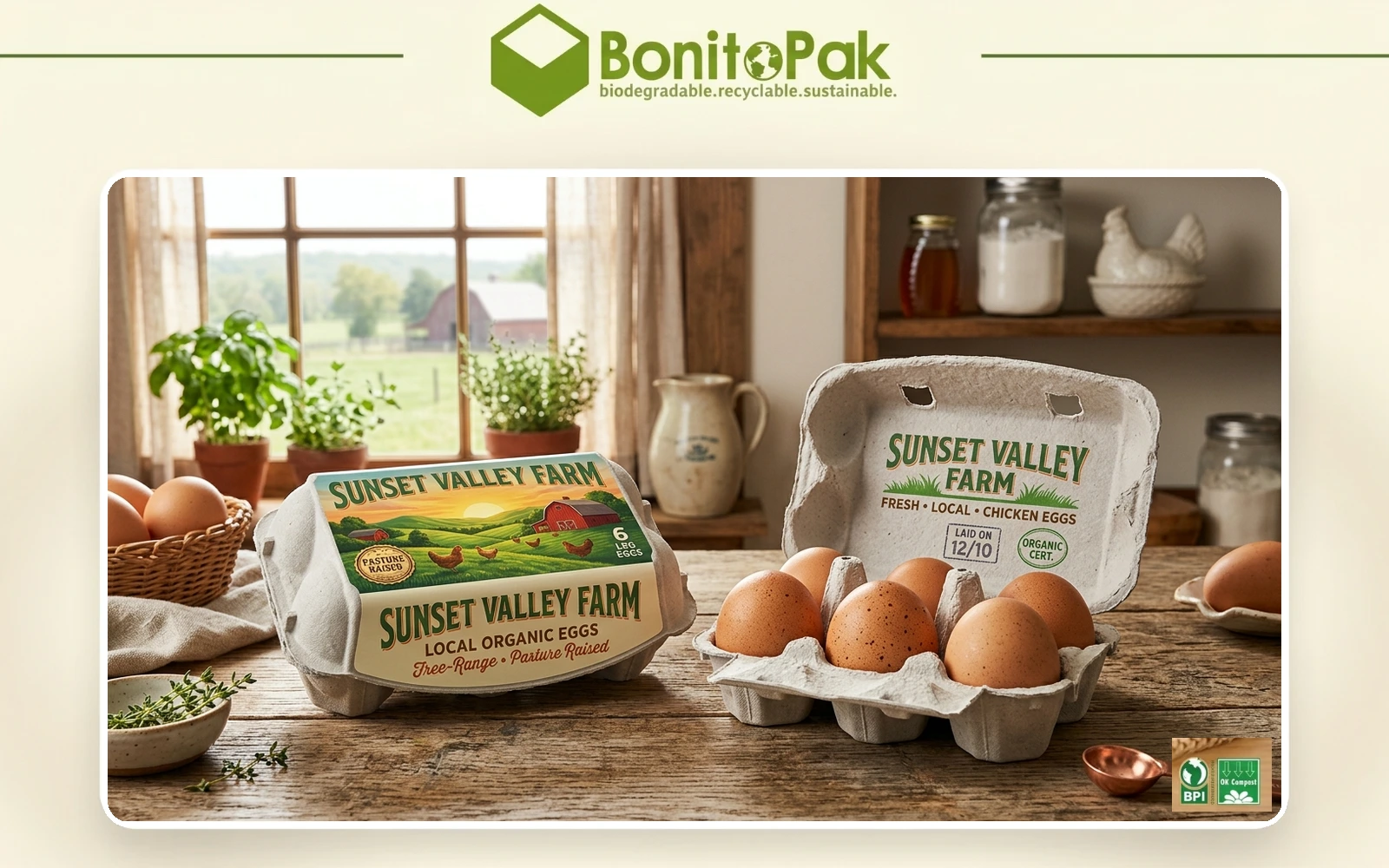
- Eggs and produce. The original high volume application, and still the most recognizable.
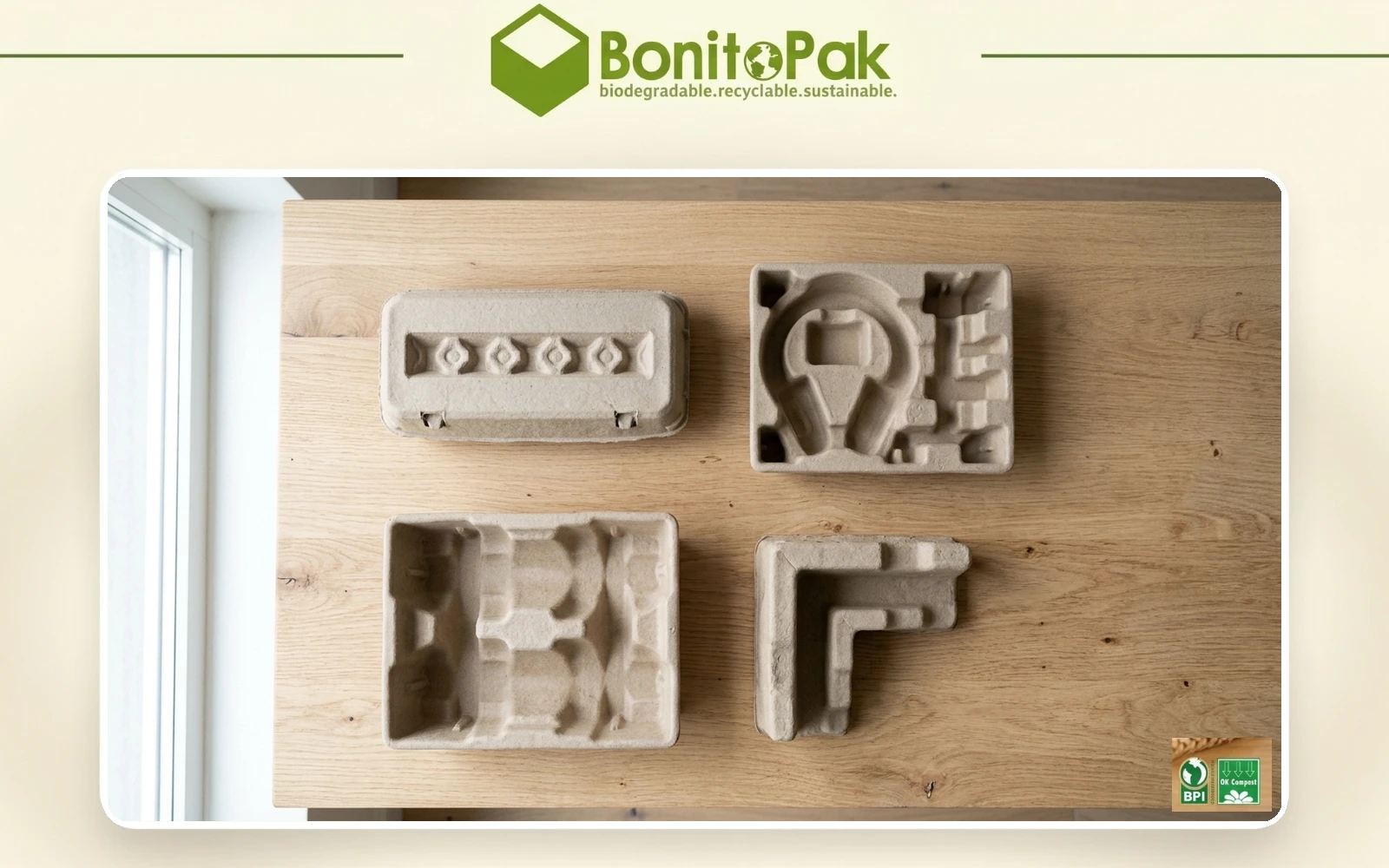
- Electronics and accessories. Fitted inserts replacing vacuum formed plastic trays.
- Beverages. Bottle trays, dividers and can carriers replacing plastic rings and shrink film.
- Cosmetics and personal care. Wet pressed inserts where surface quality is visible to the customer.
- Industrial. Edge protectors, corner blocks and pallet trays in thick wall formats.
Nosso insert guide covers the protective applications in detail.
How to Specify a Custom Project
If you are scoping a project this quarter, work in this order. It saves a round of requoting.
This week: send your supplier the product itself, or accurate dimensions and weight. Fiber geometry is designed around the object, and a drawing rarely captures what a sample does.
Before you brief tooling: settle annual volume, because it decides whether a custom mold amortizes. Settle whether the part will be visible to the end customer, because that decides wet or dry pressing. Settle your markets, because recycling access and producer fees vary by state.
Then ask for: a quote that separates tooling from unit price, the supplier’s measured wall thickness range rather than a classification figure, sample parts in your chosen fiber before approval, and a written batch tolerance if color consistency matters.
Em BonitoPak we manufacture across recovered paper, bagasse and bamboo on both wet and dry pressing lines, with molds cut per project and in house tooling design. Our custom service page sets out the development process. Send us the product and we will tell you which process and fiber fit, including when the cheaper option is the right one.
Perguntas frequentes
Q: What is molded fiber used for? A: Protective and retail packaging across electronics, food, beverages, cosmetics and industrial shipping. Electronics was the largest end use segment in 2025 and trays the largest format at around 35.0% of the market (Spherical Insights, 2025). Common formats include egg cartons, bottle trays, fitted inserts, cup carriers, fruit trays and edge protectors.
Q: Is molded pulp the same as molded fiber? A: Yes. Those terms, together with moulded paper pulp, describe the same product category, formed from cellulose fiber and water on a mesh mold under vacuum. The terminology varies by region and by company rather than by product. British spelling uses moulded, American spelling uses molded, and both appear in industry literature and standards documentation.
Q: How strong is fiber packaging compared with plastic? A: It protects differently rather than less well. Fiber cushions by compressing and recovering, absorbing impact energy through wall deformation, with thick wall formats running 1.5 to 6 mm and transfer molded parts roughly 1.6 to 4.8 mm. Rigid plastic resists deformation but transmits shock through to the product. Plastic wins on moisture resistance and transparency, which fiber cannot match.
Q: Does fiber packaging absorb moisture? A: Yes, and it is the material’s main limitation. Uncoated fiber takes up ambient humidity and softens in genuinely wet conditions. For dry goods, retail and ambient shipping that is not a problem. For wet or refrigerated applications, discuss barrier options, keeping in mind that BPI certification caps total organic fluorine below 100 parts per million.
Q: What is the minimum order for a custom fiber project? A: It depends on the supplier and on whether a new mold is required, since tooling is cut per part and amortizes across volume. Ask any supplier to quote tooling separately from unit price so you can calculate the breakeven yourself. A project that looks expensive at low volume frequently becomes competitive once annual quantities are included.
Q: Is molded fiber packaging cheaper than plastic? A: Sometimes, and the comparison is often made wrongly. Compare total landed cost rather than unit price: tooling amortized over annual volume, freight, and nesting efficiency. Fiber parts nest, so more units fit a container than rigid plastic equivalents. Add producer fees, where fiber generally sits in lower bands than plastic categories.
Sources
- Spherical Insights, Molded Fibre Pulp Packaging Market, 2025. Market size, CAGR, format and end use segmentation. https://www.sphericalinsights.com
- American Forest and Paper Association, 2025 recovery figures. https://www.afandpa.org
- Biodegradable Products Institute, certification requirements including the fluorinated chemicals threshold. https://bpiworld.org
- International Molded Fiber Association, industry classification of fiber production types. https://www.imfa.org
- Molded pulp, reference entry on production categories, wall thickness ranges and manufacturing processes. https://en.wikipedia.org/wiki/Molded_pulp