 Ir para o conteúdo
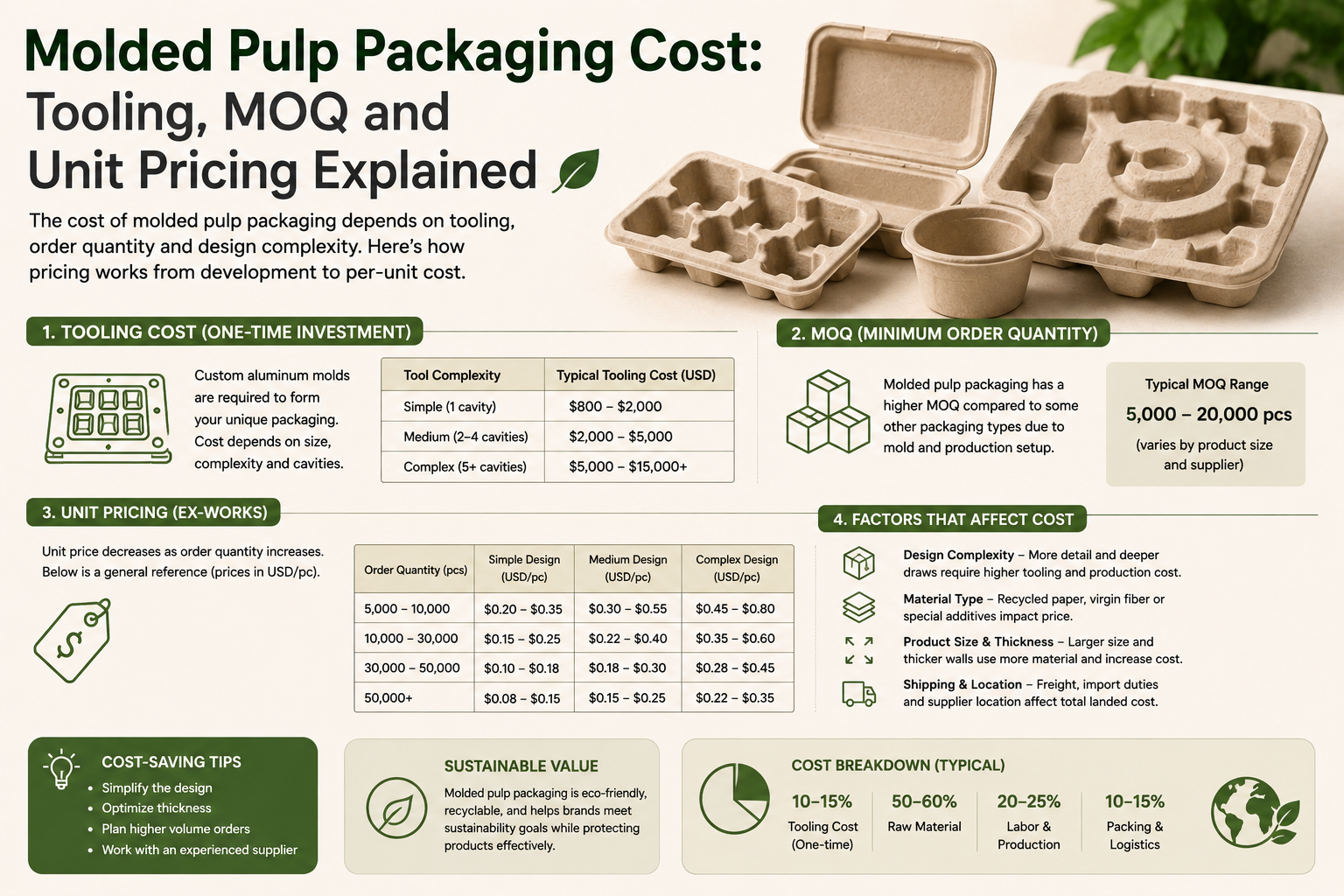
Resumo: Molded pulp cost splits into two parts: one-time tooling and per-unit price. Tooling scales with part complexity and cavity count. Unit price is driven by part size, forming process, fiber choice, color and volume. This guide explains what moves each number, where buyers overspend, and what to send for a quote that is not a guess.
The most expensive decision in a molded pulp project usually happens before anyone discusses price.
It is the decision to skip the sample mold and go straight to production tooling, because the timeline is tight and the geometry “looks fine.” Then the first production parts come out and the product sits crooked in the cavity, or the tray will not release cleanly, and the mold that was supposed to save two weeks gets scrapped.
A production mold that needs geometry changes is not modified. It is replaced. That is the single largest avoidable cost in this category, and it has nothing to do with the unit price anybody negotiated.
This guide covers what actually drives molded pulp cost, in the order the money gets spent.
How Is Molded Pulp Packaging Priced?
Molded pulp pricing has two components: a one-time tooling charge and a per-unit price. Tooling scales with part complexity and cavity count. Unit price scales inversely with volume and depends on part size, forming process, fiber, color and wall thickness.
| Cost component | Tipo | Scales with | Paid |
| Sample mold | One-time | Part complexity | Before prototyping |
| Production mold | One-time | Complexity, cavity count | Before production |
| Unit price | Per piece | Size, process, fiber, color, volume | Per order |
| Setup | Per order | Line changeover | Per production run |
The relationship between the two matters more than either number alone. Tooling is amortized across the units it produces, so a project running 500,000 units a year absorbs tooling almost invisibly. A project running 5,000 units a year does not, and for those the tooling charge can exceed the total unit cost.
That is why MOQ exists at all. It is not a capacity constraint, it is tooling economics. A mold has to be cut whether you order a thousand parts or a hundred thousand.
What Drives Molded Pulp Tooling Cost?
Tooling cost is driven by part complexity, cavity count and the number of tool stages required. A simple shallow tray with one cavity costs a fraction of a deep multi-cavity insert with fine emboss detail.
| Tooling variable | Lower cost | Higher cost |
| Part geometry | Shallow, simple, few features | Deep draws, undercut-adjacent, complex |
| Cavity count | Fewer cavities per tool | More cavities, higher tool cost |
| Emboss and deboss | Nenhum | Fine logo detail cut into tool |
| Processo | Dry press, unheated tooling | Wet press, heated matching tools |
| Revisions | Approved at first sample | Multiple sample cycles |
Two points buyers frequently misread:
More cavities means higher tooling cost and lower unit cost. These pull against each other, and the crossover depends on your annual volume. Cavity count is a decision that should be made from your volume forecast, not from a preference for either number.
Emboss is nearly free per unit but costs at tooling. Logo detail cut into the tool adds nothing to the per-piece price, adds no material, and survives handling that would smear print. If you want branding on molded pulp, emboss is the cheapest route in the long run and the more expensive one on day one.
Wet press tooling costs more than dry press tooling because it requires heated matching tools rather than a single forming screen. That difference carries into unit price too.
What Drives Molded Pulp Unit Price?
Unit price is driven by six variables: part size, forming process, fiber choice, color, wall thickness and order volume. Part size and process usually dominate.
| Variável | Lower unit cost | Higher unit cost | Why |
| Part size | Small insert | Large tray | Fiber consumption scales with area |
| Processo | Dry press | Prensa úmida | Heated tooling, longer cycle, more energy |
| Fiber | Papel reciclado | Bagasse, bamboo, wood pulp | Input material cost |
| Cor | Natural, unbleached | White bleached, additive colors | Bleaching and pigment cost |
| Wall thickness | Thinner | Thicker | More fiber, longer form and dry time |
| Volume | Mais alto | Inferior | Tooling amortization, setup spread |
Part size is the biggest single lever. Fiber consumption is roughly proportional to surface area multiplied by wall thickness, so a large tray costs meaningfully more than a small insert before any other variable is considered.
Processo is the second. Wet press adds heated tooling, a longer cycle and more energy per part. The premium is real and it buys surface quality, not protection.
Fiber is smaller than most buyers expect. Recycled paper is the cheapest input, bagasse and bamboo sit above it, and wood pulp is highest. The gap matters at volume but rarely dominates the quote.
Cor is often underestimated. Natural is cheapest because it skips both bleaching and pigmenting. White adds a peroxide bleaching stage. Additive colors add pigment cost, and black is the most expensive pigment of the common range.
Wall thickness cuts both ways. Thicker uses more fiber and takes longer to form and dry. Thinner needs geometric stiffening, which can mean a more complex tool.
Ranked by how much each typically moves the unit price, largest lever first:
- Part size — fiber consumption scales with surface area, so this dominates before anything else.
- Forming process — wet press carries a real premium over dry press for surface quality, not protection.
- Wall thickness — more fiber and longer cycle time on thicker walls.
- Cor — natural is cheapest, white adds bleaching, black is the most expensive pigment.
- Fiber — recycled paper cheapest, wood pulp highest, but the gap rarely dominates a quote.
- Volume — spreads tooling and setup, decisive at low quantities and marginal at high.
We do not publish flat per-unit prices because size, process and volume swing the number too far for a headline figure to mean anything. A small dry press insert at high volume and a large wet press tray at low volume are not in the same universe, and any supplier quoting a single price before seeing geometry is guessing.
Where Do Buyers Overspend on Molded Pulp?
The four most common overspends are choosing wet press for packaging nobody sees, pairing a premium process with a cheap fiber, ordering below the volume that justifies the tooling, and skipping the sample mold.
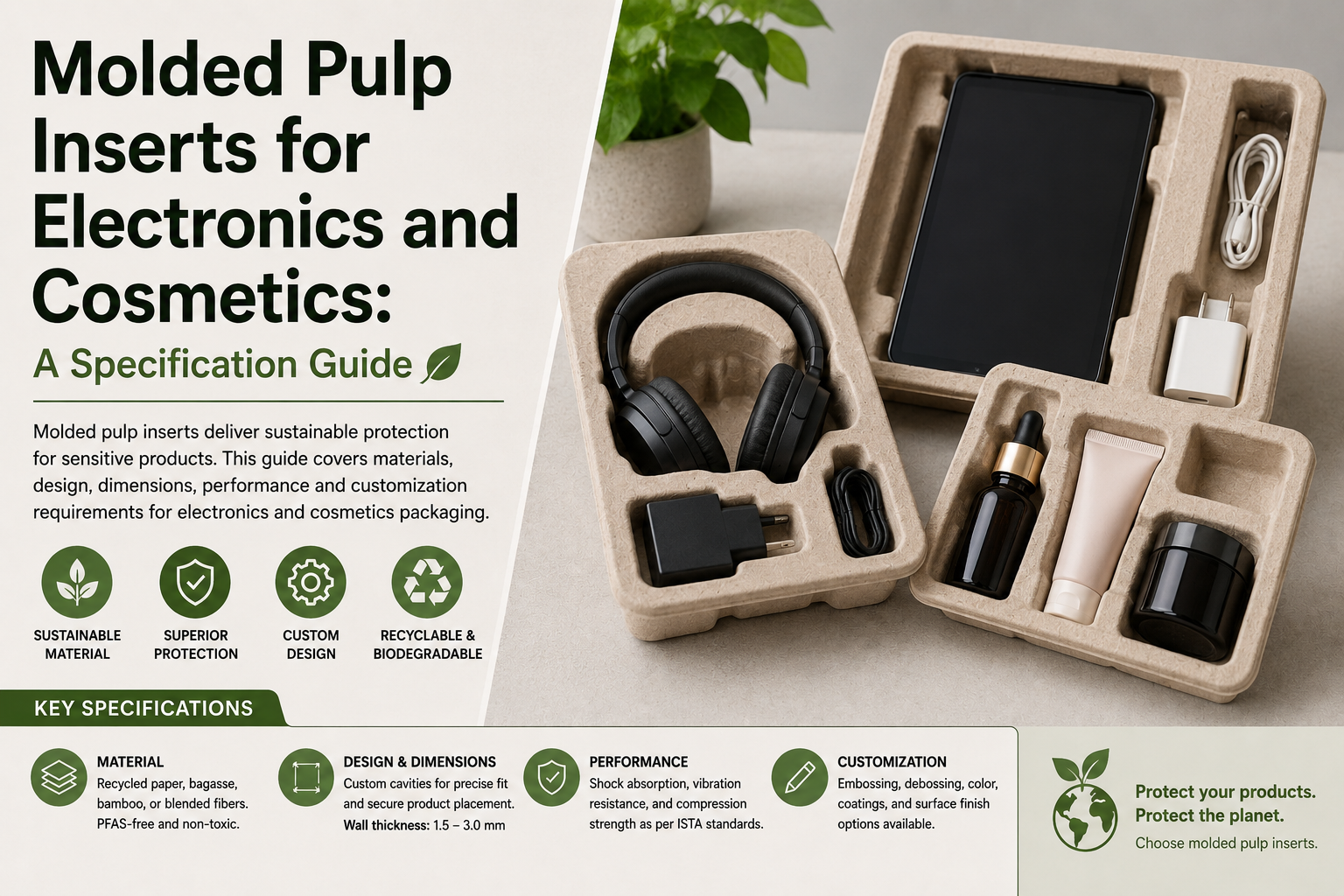
Wet press on invisible packaging. A transit tray inside a sealed outer carton gets opened by a warehouse operator and discarded. Paying a wet press premium for surface quality on that part is money spent on something no customer will ever see. The test: if the end customer opens the box and forms an impression from what they see, wet press earns its cost. Otherwise it does not. The distinction plays out clearly in molded pulp inserts for electronics and cosmetics, where hidden electronics parts run dry press and shelf-facing cosmetics parts need wet press.
Premium process, cheap fiber. Wet pressing recycled paper is a common false economy. Recycled fiber carries a gray base tone, so achieving a clean white or a saturated color over it needs more pigment and more bleaching than the same result over bagasse. The extra processing erodes the fiber saving, and the finished surface is still inferior. If you are paying for wet press, do not undercut it at the input.
Volume below the tooling breakeven. Custom molded pulp needs enough annual volume to amortize the mold. Below that threshold, the tooling charge dominates and standard formats or a shared tool may serve better. Ask about this directly rather than discovering it in the quote.
Skipping the sample mold. Covered above and worth repeating, because it is the biggest single avoidable cost in the category. Sample tooling exists to absorb revisions at a fraction of production tooling cost.
How Does Volume Affect Molded Pulp Pricing?
Volume affects pricing through two mechanisms: tooling amortization across more units, and setup cost spread across a longer production run. The effect is significant at the low end and flattens as volumes rise.
| Order profile | Tooling impact per unit | Practical implication |
| Low volume, one-off | Dominant | Tooling may exceed total unit cost |
| Moderate, repeating | Significativo | Worth optimizing cavity count |
| High volume, ongoing | Marginal | Unit price variables dominate |
Order frequency matters as much as annual quantity. A single annual order of 100,000 units incurs one setup. Twelve monthly orders of 8,300 incur twelve, and each changeover has a cost. If your warehousing can absorb it, consolidating orders reduces cost.
BonitoPak’s MOQ starts at 1,000 pieces on most lines, with some products at 5,000. That is worth checking against your project size early, because MOQ varies across the industry and some suppliers quote from 500 pieces on simpler geometry.
What Do You Need to Send for an Accurate Quote?
Send the 3D file of the product being packaged, annual volume, order frequency and finish requirement. A quote given without geometry is a guess, and guesses in this category are usually wrong in the direction that suits the quoter.
| Information | Why it is needed |
| 3D file or physical samples | Insert geometry derives from the product |
| Outer carton internal dimensions | The insert has to fit inside something |
| Annual volume and order frequency | Sets cavity count and tooling amortization |
| Wet press or dry press | Largest single unit price variable after size |
| Color, with Pantone reference | Bleaching and pigment cost |
| Orientation requirement | Changes cavity strategy and draft |
| Drop test standard, if any | Changes wall thickness and geometry |
| Emboss, deboss or print | Cut into tooling, not added after |
| Destination market | Certification requirements differ |
Accepted 3D formats are SolidWorks, Creo, IGS and STEP. If you do not have a 3D file, physical samples work and we produce the drawing within 2 days.
The tooling timeline once specification is confirmed:
| Estágio | Turnaround |
| 3D drawing | 2 days |
| Sample mold and prototype parts | 7 dias |
| Production mold after approval | 8 dias |
Conclusão
Three takeaways.
Tooling and unit price are separate decisions that interact. Cavity count trades tooling cost against unit cost, and the right answer comes from your volume forecast rather than from a preference.
Process choice is the biggest controllable lever after part size. Wet press buys surface quality, not protection. Specify it where a customer sees the part and skip it where they do not.
The sample mold is not optional overhead. It is the cheapest insurance available in this category, because a production mold that needs geometry changes gets scrapped rather than modified.
For a quote that reflects reality rather than a range, send the 3D file of your product with annual volume, order frequency and finish requirement. BonitoPak returns a process recommendation, tooling estimate and unit pricing.
Perguntas frequentes
How is molded pulp packaging priced?
Molded pulp pricing has two separate components: a one-time tooling charge and a per-unit price paid on each order. Tooling scales with part complexity, cavity count and the number of tool stages required, while unit price depends on part size, forming process, fiber choice, color, wall thickness and order volume. The relationship between them matters more than either number in isolation, because tooling is amortized across the units it produces, so a project running 500,000 units annually absorbs the mold cost almost invisibly while a project running 5,000 units does not. This is also why minimum order quantities exist at all: they reflect tooling economics rather than production capacity, since a mold must be cut whether you order a thousand parts or a hundred thousand.
What makes molded pulp tooling more or less expensive?
Tooling cost is driven by part complexity, cavity count and process type, so a shallow simple tray with few cavities costs a fraction of a deep multi-cavity insert carrying fine emboss detail. Wet press tooling costs more than dry press because it requires heated matching tools rather than a single forming screen, and that difference carries through into unit price as well. Two things buyers commonly misread: more cavities raises tooling cost while lowering unit cost, so cavity count should be decided from your annual volume forecast rather than from a preference for either figure. Emboss detail is nearly free per unit but adds to tooling, making it the cheapest branding route over a production run and the more expensive one on day one.
Which factors have the biggest effect on unit price?
Part size and forming process dominate, with the other four variables of fiber, color, wall thickness and volume mattering less individually. Fiber consumption is roughly proportional to surface area multiplied by wall thickness, so a large tray costs meaningfully more than a small insert before anything else is considered. Wet press adds heated tooling, longer cycle time and more energy per part than dry press, and that premium buys surface quality rather than additional protection. Fiber choice is smaller than most buyers expect, with recycled paper cheapest and wood pulp highest, while color is often underestimated since natural skips both bleaching and pigmenting, white adds a peroxide bleaching stage, and black is the most expensive pigment in the common range.
Where do buyers most often overspend on molded pulp?
Four overspends account for most wasted budget in this category. Choosing wet press for packaging nobody sees is the largest, since a transit tray inside a sealed outer carton is opened by a warehouse operator and discarded, making the surface premium money spent on something no customer will encounter. Pairing a premium process with the cheapest fiber is a false economy, because recycled fiber carries a gray base tone and achieving a clean white or saturated color over it needs enough extra pigment and bleaching to erode the saving while still finishing inferior to bagasse. The other two are ordering below the volume that justifies custom tooling, and skipping the sample mold, which is the single biggest avoidable cost since a production mold needing geometry changes is scrapped rather than modified.
How much does order volume change the price?
Volume affects pricing through tooling amortization across more units and setup cost spread across longer production runs, with the effect being significant at low volumes and flattening as quantities rise. At low one-off volumes the tooling charge can exceed the total unit cost of the order, which is the point at which standard formats or a shared tool may serve better than custom tooling. Order frequency matters as much as annual quantity, since a single annual order of 100,000 units incurs one setup while twelve monthly orders of 8,300 incur twelve changeovers, each carrying a cost. If your warehousing can absorb the inventory, consolidating orders reduces total cost.
What information do I need to send to get an accurate quote?
Send a 3D file of the product being packaged in SolidWorks, Creo, IGS or STEP format, or physical samples if you have no file, along with annual volume, order frequency and your finish requirement. You should also supply the internal dimensions of the outer carton since the insert has to fit inside it, any orientation requirement for how the product presents when the box opens, and any drop test standard the packaging must pass, since that changes wall thickness and cushioning geometry. Emboss, deboss and print requirements need stating upfront because they are cut into the tool rather than added afterward, and destination market matters because compostability certification requirements differ between North America and Europe, with Certificação BPI covering ASTM D6400 in the US and TUV Austria covering EN 13432 in the EU. A quote given without geometry is a guess, and guesses in this category tend to be wrong in whichever direction suits the quoter.

 Portuguese
  English
  German
  Spanish
  French
  Russian
  Japanese
  Arabic