By Leo Chan, Senior Packaging Consultant · November 2026
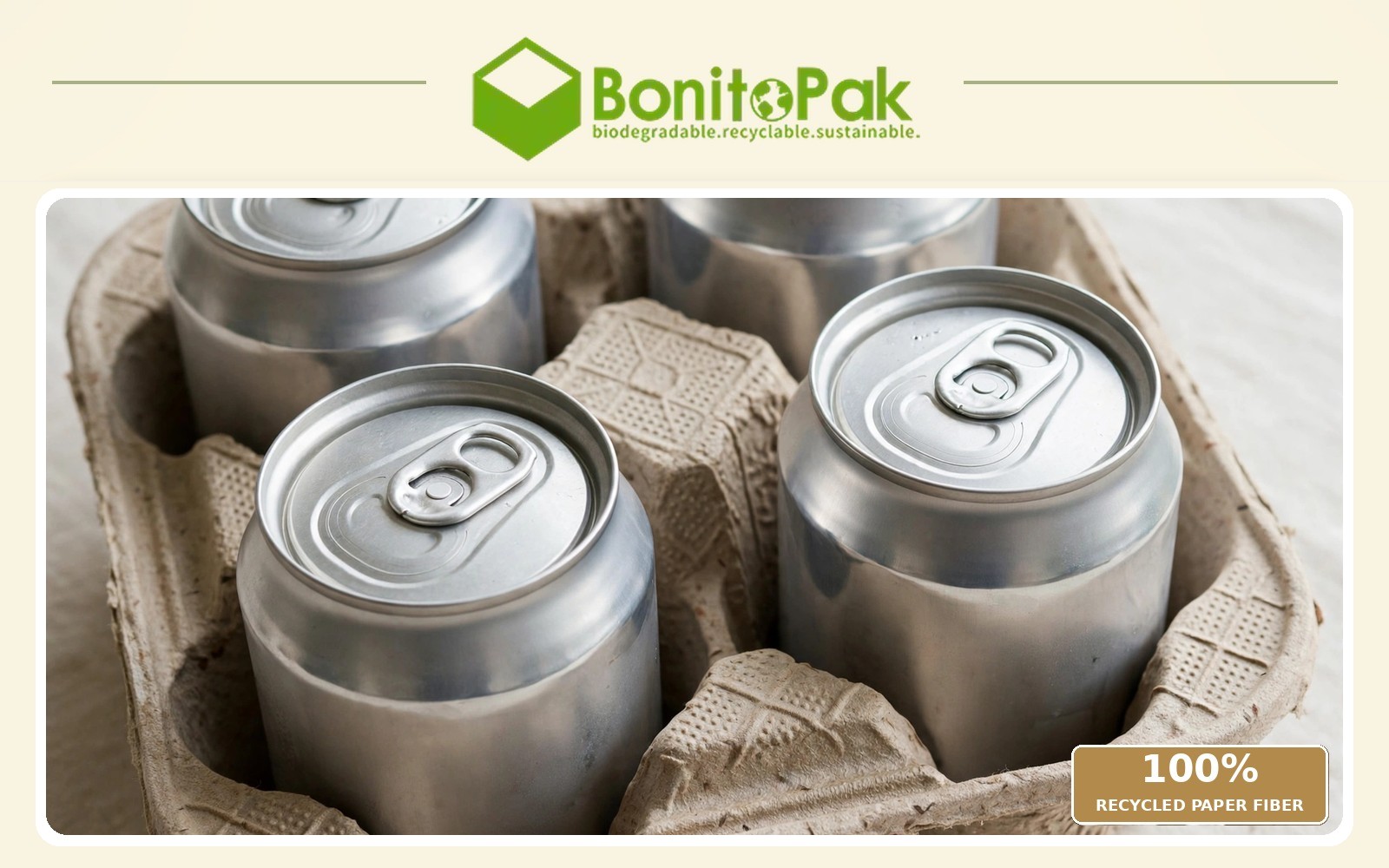
A can carrier for breweries has to do more than hold cans. It has to fit the canning line, be applied at the pace of the filler, stack without crushing, and sit in storage without absorbing moisture. A molded pulp carrier suits small and mid size craft lines that apply packs by hand or with simple tooling. It is not the best choice for a fast line with a clip applicator.
Breweries choose a carrier by price and look, then find the problems on the packing table. The cans arrive wet. The carrier is too loose or too tight on the widest can. The pallet leans. The back room is damp. This guide walks through each step from the seamer to the warehouse, with the numbers a brewer needs, and says where the fiber format is a poor match, based on what we see at BonitoPak in Dongguan, China.
Where Does a Can Carrier Enter a Brewery Canning Line?
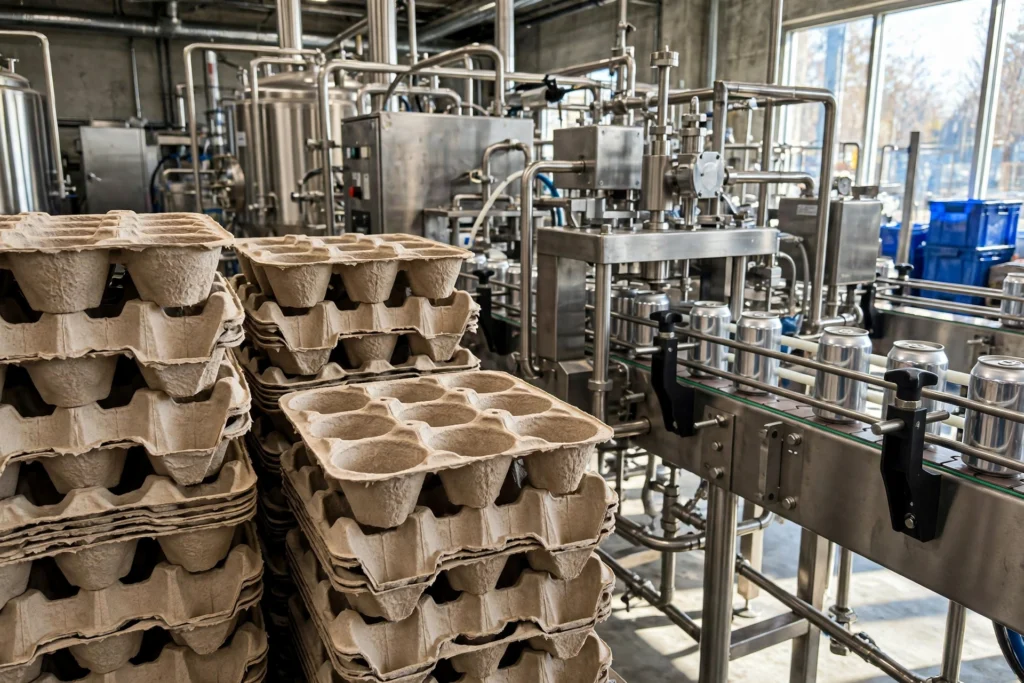
The carrier goes on after the cans are filled, seamed, rinsed and dried. In a typical small line the steps run in this order: filler, seamer, can rejector, air dryer, checkweigher, then packing. A craft brewery in Ontario described such a line in a trade article. It ran six filling heads and a single head seamer at 40 cans per minute, rated up to 50, with a can rejector, an air dryer, a checkweigher and a tray packer at the end, as reported in this Packworld report on a craft canning line. That article does not mention carriers, so the carrier step is a decision you add after the dryer.
Fit the carrier onto dry cans, ahead of the case or tray. Two places are common. Some breweries fit carriers at a table beside the line by hand. Others add a simple fixture that holds the carrier while a person drops cans in. A formed fiber carrier can be placed by hand or with simple tooling, which is why it lowers the equipment barrier for small lines.
How Fast Can You Apply Carriers at Your Line Speed?
Work out the number of packs per minute first. Divide the line speed by the pack count. At 40 cans per minute, a six pack line needs 6.7 carriers per minute, which is about 400 packs an hour. A four pack line needs 10 per minute, or 600 an hour. At 50 cans per minute the six pack rate rises to about 500 packs an hour.
| Liniengeschwindigkeit | Six pack rate | Four pack rate |
|---|---|---|
| 40 cans per minute | 6.7 per minute (400 per hour) | 10 per minute (600 per hour) |
| 50 cans per minute | 8.3 per minute (500 per hour) | 12.5 per minute (750 per hour) |
A person can usually keep up with these rates, but you should time it, because a hand fit step has a ceiling. Use a stopwatch on a trial run with your own cans and a sample carrier. Time ten packs, then work out the pace. If your fastest line runs at several hundred cans a minute, paperboard clip systems are the proven answer, and molded fiber application at those speeds is far less established. We say so plainly, and we turn down a project when the line speed points to paperboard.
How Do You Check Can Fit Before You Order Carriers?
Measure your cans with calipers, ten cans from different production dates, and record the widest and narrowest. A carrier has to accept the widest can in the batch and still hold the narrowest. That spread is the tolerance we design around. Standard 12 oz and 16 oz cans share a 66 mm body, sleek cans run about 57 mm and slim cans about 53 mm, and each family needs its own tooling. Our Größenübersicht für Dosenhalter lists the dimensions.
A fiber carrier grips the can body and not the rim, which spreads the load over a larger contact area and tolerates more variation in can shape. Measure filled and sealed cans if you can, since internal pressure in a carbonated pack changes the body profile slightly. Then run three checks on a sample carrier:
- The cans seat fully without force from a tool.
- A pack lifted by one hand does not shift or let a can slip.
- A pack set down on the table sits level.
If you run two can sizes, such as 12 oz regular and 12 oz sleek, you need two carrier tooling families. Price that before you decide.
Why Must Cans Be Dry Before the Carrier Goes On?
A wet can is the main risk to a fiber carrier. Pulp takes up water, and wet fiber loses stiffness. Cans come off a cold fill wet with rinse water or condensation, so the air dryer step matters more with a fiber carrier than with a plastic ring. If cans arrive at the packing table damp, the carrier absorbs that water at every contact point.
Check three things. Is the dryer clearing the can base and the shoulder? Are cans reaching the table at room temperature or cold? Does the pack go straight into a cold room? Our can carrier wet strength post explains how fiber behaves in ice and humidity, and why wall design and sizing treatment are separate decisions.
How Do You Stack and Case Pack Branded Carriers?
Plan the pack weight first. A filled 12 oz can weighs roughly 368 g, so a six pack weighs about 2.2 kg and a four pack about 1.5 kg. A 24 can case holds four six packs or six four packs. The carrier holds the pack in tension while it is carried, but in a case the cans take the stacked load, so test the full case under a pallet weight and not only the carrier by hand.
Pack the carriers into the case in one orientation, with cans upright and no gaps that let a pack tip. If your case is sized for loose cans, check that a carrier does not add height or width that jams the flaps. Our 4 pack or 6 pack guide shows the footprints: a four count is about 132 x 132 mm for 66 mm cans, and a six count about 198 x 132 mm.
For a pallet, stack the cases in a pattern that locks, and use corner boards or stretch film. Run a vibration check on the first pallet. Ask us for the packed carton size and the count per carton for the empty carriers, so you can plan the receiving area.
How Do You Store Empty Carriers in a Brewery?
Store them dry, nested and off the floor. A formed carrier occupies its finished volume from the factory onward, so it takes more room than flat paperboard. Nesting recovers some of that, and how well the carriers nest is set by the draft angle at the tooling stage. Plan the space before you order and not after the pallet arrives.
Keep these rules for storage:
- Keep cartons off concrete, on a pallet or a shelf.
- Keep them out of the cold room and away from a wash area, since fiber takes up moisture.
- Close opened cartons or cover them, so dust and spray stay out.
- Rotate stock so the oldest carton is used first.
A damp carton can soften the bottom row of a stack. Bring only the day’s carriers to the packing table. If your brewery runs a cold packing room, let the cartons acclimate in a dry space first, so they do not draw condensation when they move into warm air.
How Many Carriers Does a Brew Need?
Count cans first and divide by the pack count. A 25 hectoliter batch, which is the batch size of the Ontario brewery in the report above, holds 2,500 liters. At 355 ml per can that is about 7,000 cans before losses, which makes about 1,170 six packs or 1,760 four packs. A tooling minimum of 1,000 pieces is therefore close to one batch of six packs.
Use that math to set your order size and your safety stock. Add a margin for rejected cans and damaged carriers, then track the actual loss for a few runs. Lead time matters too. Sample molds run in about seven days and production molds around eight days after geometry approval, and shipping from China adds transit time that you should confirm with your quote. Reorder when stock reaches your next two brews, not when the last carton is open. Our cost per unit guide shows how volume changes the unit price.
When Is a Fiber Carrier the Wrong Choice for a Brewery?
A fiber carrier is the wrong choice when the line is fast, the storage is damp or the shelf needs a large printed surface. Paperboard clip systems keep pace with high speed fillers, flat blanks ship and store at a fraction of the volume, and a printed collar makes a billboard that fiber cannot match. A fiber carrier also leaves the can tops open, while a clip or collar can cover them.
Choose fiber when your line is small, you pack by hand or with simple tooling, your cans are sized to one or two diameter families and you want a single material that keeps recycling open. Our molded fiber against paperboard comparison lays out both sides.
How Do You Trial a Carrier on Your Own Line?
Run a trial before you commit to tooling. Take a sample carrier, your cans and a normal shift crew, and work through this list in order.
- Measure ten cans and record the widest and narrowest body diameter.
- Fit carriers by hand at line pace and time ten packs.
- Check that cans are dry and cold when they reach the table.
- Lift each pack by one hand and check for shift or slip.
- Case pack, then load a test pallet and check lean and crush.
- Leave packs in the cold room overnight and recheck the pockets.
- Store a carton of empties for a week in your real storage room and check for softening.
Write the result of each step, with photos. If a step fails, tell us which one, and we adjust the cavity, the wall or the can fit before the production mold is cut.
How Do You Order Brewery Can Carriers From BonitoPak?
Email leo@bonitopak.com with your can size and diameter, pack count, line speed, how you apply packs and where you store them. A few of your own cans help us size the cavity. We form a sample, you test it on your line, and we quote the order with the mold cost shown separately.
See our range for brewers on the beer and liquor packaging page, or start from the BonitoPak homepage. Price and lead time are confirmed with each quote.
Häufig gestellte Fragen
Can a small brewery apply molded pulp can carriers by hand?
A: Yes. A formed fiber carrier can be placed by hand or with simple tooling, which suits small lines. Time ten packs on your own cans first, since the pace depends on the crew and the pack count.
Will a fiber carrier work on a high speed canning line?
A: Not usually. At several hundred cans a minute, paperboard clip systems are the proven answer, and fiber application at that speed is far less established. We advise paperboard for those lines.
How many carriers do I need per batch?
A: Divide your cans by the pack count. A 25 hl batch of 355 ml cans is about 7,000 cans, which is about 1,170 six packs. Add a margin for rejected cans and damaged carriers.
Can I store carriers in my cold room?
A: Avoid it. Fiber takes up moisture, and a cold room is damp. Store cartons dry, off the floor, and bring only the day’s carriers to the packing table.
Do I need separate carriers for 12 oz and 16 oz cans?
A: Usually not. Both share a 66 mm body, so one carrier cell fits both. Sleek cans at about 57 mm and slim cans at about 53 mm need their own tooling.
How long does it take to get a sample carrier?
A: Sample molds run in about seven days after geometry approval, and production molds in about eight days. Shipping time is extra, so confirm the full schedule with your quote.
About the author: Leo Chan is a Senior Packaging Consultant at BonitoPak, a molded pulp packaging manufacturer in Dongguan, China.