Entenei-Kartons

  • Cell bed cut to duck egg proportions, roughly 5 mm deeper and wider than a chicken cell
  • Available in 4, 6, and 12 cell layouts on a correspondingly larger footprint
  • Formed from 100% recycled paper pulp, biodegradable and home compostable
  • Lid clears the shell on Pekin, Khaki Campbell, Runner, and most Muscovy eggs
  • Taller clamshell profile stops the lid pressing on the pointed end
  • Natural pulp plus six stock colors; custom shade matching available
  • OEM and ODM sizing accepted; stock molds available without tooling charge

Öffentliche Schimmelpilze

Verpackungslösungen

3D-Entwurf

Kundenspezifische Form

Beschreibung des Produkts

Spezifikation Einzelheiten
Markenname BonitoPak
Modellnummer EC-D04 / EC-D06 / EC-D12
Produktname Duck Egg Cartons / Deep Cell Pulp Carton
Material Recycelter Papierzellstoff
Papierart Post-consumer recycled paper
Technik Molded pulp forming (wet-pressed)
Cell Count 4, 6, or 12 cells
Egg Size Range Pekin, Khaki Campbell, Runner, most Muscovy
Cell Depth Approximately 50 mm, deeper than the chicken standard
Outer Dimensions 6 cell: 195 x 118 x 85 mm; 12 cell: 330 x 118 x 85 mm
Unit Weight 24 to 66 g depending on cell count
Farbe Natural pulp; six stock colors; custom color matching
Form & Stil Top-fold clamshell with front locking tab
Logo-Druck Embossed, debossed, or flexographic print
Industrielle Nutzung Duck farms, specialty poultry, gourmet retail, farm direct
Anmeldung Retail duck egg packs, farm stand sales, hatching egg transport
Größe OEM and custom dimensions accepted
Vorteile Biodegradable, home compostable, nestable, plastic free
Verpackung Bulk nested in export cartons; custom packing accepted
Individuelle Bestellung Angenommen
MOQ Confirm with sales; stock molds carry a lower minimum than custom tooling

Galerie der Entenei-Kartons Teile

Diese Galerie zeigt die außergewöhnliche Qualität und die Liebe zum Detail, die wir bei jedem Projekt zeigen. Von komplexen Entwürfen bis hin zu makellosen Oberflächen spiegelt jedes Bild unser Engagement für hervorragende Leistungen in Entenei-Kartons .

40%

Kosten- und Zeitersparnis

Erleben Sie führende Verpackungslösungen, die Ihre Kosten und Ihren Zeitaufwand optimieren, für effiziente Prozesse sorgen und Ihren ROI maximieren.

50%

Mehr Nachhaltigkeit

Erzielen Sie umweltfreundliche Verpackungen mit nachhaltigen Materialien, reduzieren Sie den Abfall und fördern Sie die Umweltverantwortung für Ihre Produktlinien.

25%

Steigerung des Umsatzes

Steigern Sie die Attraktivität Ihrer Produkte in den Regalen mit innovativen Designs, die die Sichtbarkeit und den Absatz sowohl im Einzelhandel als auch auf dem Online-Markt steigern.

100%

Zuverlässiger

Vertrauen Sie auf das Qualitätsbewusstsein von BonitoPak, das sicherstellt, dass jedes Produkt unseren hohen Standards entspricht und einen beständigen, zuverlässigen Service bietet.

A duck egg is a different solid

The assumption that duck eggs are simply bigger chicken eggs is where most duck packaging goes wrong.

A Pekin duck egg weighs around 70 to 80 grams against roughly 57 for a large chicken egg. That weight difference is the part buyers notice. The shape difference is the part that breaks cartons.

Duck eggs are proportionally longer and more sharply pointed at the narrow end. Where a chicken egg is an oval that seats evenly into a conical cell, a duck egg sits lower at the point and higher at the broad end, which means it occupies more vertical space than its weight predicts. Drop one into a chicken cell rated for jumbo and the broad end still stands proud.

The shell is also thicker, around 0.4 mm against roughly 0.35 for chicken, with a tougher membrane underneath. Duck eggs survive handling that chips a chicken egg. What they do not survive is sustained lid pressure, because a thicker shell under constant point load cracks rather than flexes.

What we changed in the mold

Three dimensions, all of them in the same direction.

Cell depth increased to around 50 mm so the broad end seats below the lid line. Cell diameter widened to match the greater girth. And the clamshell profile itself is taller, which is why a duck carton looks visibly chunkier than a chicken carton of the same cell count.

The spacing between cells also opened slightly. Duck eggs sitting at chicken spacing touch at their widest point, and shell to shell contact in transit is what produces the hairline chips that show up as weeping eggs days later.

The Muscovy question

Muscovy eggs are the edge case worth naming honestly.

Most Muscovy eggs fit our standard duck mold. Some do not. Muscovy hens produce a noticeably variable egg, and birds at the larger end of the breed lay eggs that sit high even in a duck cell.

Producers running Muscovy exclusively should send us sample eggs before ordering. We will seat them in a production carton and tell you plainly whether the lid clears. If it does not, custom tooling is the honest answer rather than selling you a carton that almost fits.

Runner and Khaki Campbell eggs sit comfortably inside the standard mold. Pekin, which produces the majority of commercial duck eggs, is what the mold was dimensioned around.

Why duck producers pay more attention to packaging

Duck eggs sell at a premium, often two to three times the price of chicken eggs per unit in specialty retail. That changes the packaging calculation in two ways.

The cost of a better carton is a smaller fraction of the sale price, so there is room to specify properly rather than at the floor.

And the cost of a breakage is higher. A cracked duck egg loses more revenue than a cracked chicken egg, which means the deep cell that prevents it pays for itself across fewer saved eggs than the same logic would require in commodity chicken packing.

Duck buyers are also disproportionately baking customers, who buy for the higher fat and protein content in the yolk. They are repeat purchasers who notice when a producer’s eggs arrive intact every time.

Weight changes the handling math

A dozen duck eggs weighs close to 900 grams against roughly 680 for a dozen large chicken eggs. That extra third shows up in two places buyers do not anticipate.

Stacked on a pallet, a column of filled duck cartons loads the bottom carton considerably harder than the same column of chicken. Reduce stack height rather than assuming the carton compensates.

At the point of sale it matters too. A full dozen duck eggs is heavy enough that shoppers notice, which is part of why six count outsells twelve in almost every duck market we supply.

Counts that work for duck

Duck flocks are smaller than chicken flocks and lay less consistently, which pushes the count down.

Six is the most common retail format, and it is what most duck producers settle on. Four works for premium and gift sales, and crosses over with the molded pulp 4 egg carton which is already cut to a depth that accepts duck.

Twelve exists but moves slowly in most markets, because a dozen duck eggs is a serious purchase at duck pricing. Producers who do run twelves usually sell into restaurants rather than retail.

Producers running mixed flocks should read the molded pulp chicken egg carton page for the grade detail, and note that chicken eggs sit loose in a duck cell. Loose is safe, but a duck carton holding chicken eggs looks half empty, which is a presentation problem rather than a protection one.

For goose, turkey, and bantam, which need different geometry again, see molded pulp goose, turkey and bantam egg cartons. For color options across the range, start at molded pulp colored egg cartons.

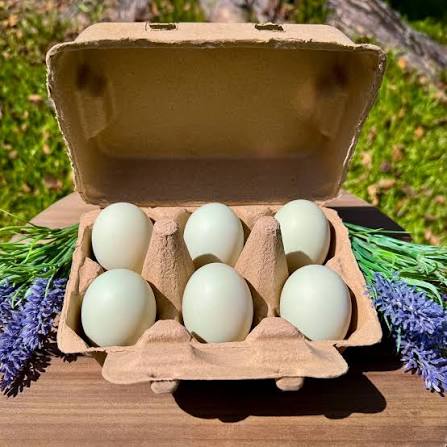
A duck egg is a different solid

The assumption that duck eggs are simply bigger chicken eggs is where most duck packaging goes wrong.

A Pekin duck egg weighs around 70 to 80 grams against roughly 57 for a large chicken egg. That weight difference is the part buyers notice. The shape difference is the part that breaks cartons.

Duck eggs are proportionally longer and more sharply pointed at the narrow end. Where a chicken egg is an oval that seats evenly into a conical cell, a duck egg sits lower at the point and higher at the broad end, which means it occupies more vertical space than its weight predicts. Drop one into a chicken cell rated for jumbo and the broad end still stands proud.

The shell is also thicker, around 0.4 mm against roughly 0.35 for chicken, with a tougher membrane underneath. Duck eggs survive handling that chips a chicken egg. What they do not survive is sustained lid pressure, because a thicker shell under constant point load cracks rather than flexes.

What we changed in the mold

Three dimensions, all of them in the same direction.

Cell depth increased to around 50 mm so the broad end seats below the lid line. Cell diameter widened to match the greater girth. And the clamshell profile itself is taller, which is why a duck carton looks visibly chunkier than a chicken carton of the same cell count.

The spacing between cells also opened slightly. Duck eggs sitting at chicken spacing touch at their widest point, and shell to shell contact in transit is what produces the hairline chips that show up as weeping eggs days later.

The Muscovy question

Muscovy eggs are the edge case worth naming honestly.

Most Muscovy eggs fit our standard duck mold. Some do not. Muscovy hens produce a noticeably variable egg, and birds at the larger end of the breed lay eggs that sit high even in a duck cell.

Producers running Muscovy exclusively should send us sample eggs before ordering. We will seat them in a production carton and tell you plainly whether the lid clears. If it does not, custom tooling is the honest answer rather than selling you a carton that almost fits.

Runner and Khaki Campbell eggs sit comfortably inside the standard mold. Pekin, which produces the majority of commercial duck eggs, is what the mold was dimensioned around.

Why duck producers pay more attention to packaging

Duck eggs sell at a premium, often two to three times the price of chicken eggs per unit in specialty retail. That changes the packaging calculation in two ways.

The cost of a better carton is a smaller fraction of the sale price, so there is room to specify properly rather than at the floor.

And the cost of a breakage is higher. A cracked duck egg loses more revenue than a cracked chicken egg, which means the deep cell that prevents it pays for itself across fewer saved eggs than the same logic would require in commodity chicken packing.

Duck buyers are also disproportionately baking customers, who buy for the higher fat and protein content in the yolk. They are repeat purchasers who notice when a producer’s eggs arrive intact every time.

Weight changes the handling math

A dozen duck eggs weighs close to 900 grams against roughly 680 for a dozen large chicken eggs. That extra third shows up in two places buyers do not anticipate.

Stacked on a pallet, a column of filled duck cartons loads the bottom carton considerably harder than the same column of chicken. Reduce stack height rather than assuming the carton compensates.

At the point of sale it matters too. A full dozen duck eggs is heavy enough that shoppers notice, which is part of why six count outsells twelve in almost every duck market we supply.

Counts that work for duck

Duck flocks are smaller than chicken flocks and lay less consistently, which pushes the count down.

Six is the most common retail format, and it is what most duck producers settle on. Four works for premium and gift sales, and crosses over with the molded pulp 4 egg carton which is already cut to a depth that accepts duck.

Twelve exists but moves slowly in most markets, because a dozen duck eggs is a serious purchase at duck pricing. Producers who do run twelves usually sell into restaurants rather than retail.

Producers running mixed flocks should read the molded pulp chicken egg carton page for the grade detail, and note that chicken eggs sit loose in a duck cell. Loose is safe, but a duck carton holding chicken eggs looks half empty, which is a presentation problem rather than a protection one.

For goose, turkey, and bantam, which need different geometry again, see molded pulp goose, turkey and bantam egg cartons. For color options across the range, start at molded pulp colored egg cartons.

Materialien für Entenei-Kartons Teile

Führende Unternehmen und Ingenieure verlassen sich auf BonitoPak, wenn es um schnelle Iterationen und langlebige, hochwertige Teile geht. Ob für die Herstellung von Prototypen oder für die Serienproduktion, unsere breite Palette an Materialien stellt sicher, dass wir die einzigartigen Anforderungen eines jeden Unternehmens erfüllen. Entenei-Kartons Projekt mit Präzision und Schnelligkeit.

Kompostierbares Kraftpapier ist die festeste Faser, die wir herstellen. Hergestellt aus Frischfaser

Farbiger Zellstoff ist keine eigenständige Faser. Es handelt sich dabei um einen unserer

Gebleichter Zellstoff ist das zu spezifizierende Material, wenn das Bauteil

Der Begriff „natürliche Pflanzenfasern“ umfasst die nicht aus Holz stammenden Zellulosequellen, die wir außerhalb der

Wellpappe als Formmasse bezeichnet wiederverwertete Kartons, die zu Zellstoff zerkleinert wurden

Strohfasern werden aus den nach der Getreideernte übrig gebliebenen Stängeln hergestellt, Material

Individuell Umweltfreundlich Zuverlässig

Maßgeschneiderte, umweltfreundliche Verpackung auf höchstem Niveau

Vollständig anpassbar

Passen Sie Ihre Verpackungen mit maßgeschneiderten Stilen, Größen, Farben und Veredelungen an Ihre spezifischen Bedürfnisse an.

Unterstützung durch Experten

Bonitopak bietet fachkundige Design- und Logistikberatung, um die Verpackungseffizienz zu maximieren und den ROI zu steigern.

Öko-Lösungen

Entscheiden Sie sich für nachhaltige, umweltfreundliche Verpackungen, um die Umweltbelastung zu reduzieren und die grünen Ziele Ihrer Marke zu unterstützen.

Qualitätssicherung

Bonitopak garantiert bei jeder Verpackungslösung einen erstklassigen Service und ein hervorragendes Produkt.

Häufig gestellte Fragen

Entenei-Kartons

  • Can I use duck cartons for chicken eggs to simplify my stock?

    You can, and the eggs will be safe, since a smaller egg in a deeper cell is protected rather than at risk. What you lose is presentation, because chicken eggs sit low and the carton reads as underfilled. Producers running both birds usually find the appearance penalty outweighs the simplicity of one SKU.

  • Do duck eggs need more ventilation than chicken eggs in packaging?

    No, and pulp handles both identically. Duck eggs have a slightly less porous shell than chicken, which is part of why they keep marginally longer unwashed. What matters is that the packaging neither traps condensation nor dries the shell, and fiber does neither because it regulates moisture rather than sealing it.

  • How do I know whether my Muscovy eggs will fit before ordering?

    Send us a few eggs, or send accurate measurements of your largest regular egg at both length and maximum girth. Length alone is not enough, since girth is what decides whether the egg seats or perches. We seat samples in a production carton and give you a direct answer rather than an estimate.

  • Are duck egg cartons more expensive than chicken?

    Per carton, yes, because deeper and wider cells use more fiber and the larger footprint nests slightly less efficiently per container. Per egg sold, the difference is small against duck egg pricing. Buyers comparing the two on carton cost alone are measuring against the wrong denominator.

  • Will a duck carton work for shipping hatching eggs?

     Inside an outer box with void fill, yes, and the deep cell is an advantage because it immobilizes the egg. Movement and rotation damage the air cell, which kills hatch rate well before the shell is at risk. We make no hatch rate claims, since outcomes depend on transit time and handling far beyond the packaging.

Biologisch abbaubar Ergebnis

0 Tage

7 Tage

14 Tage

30 Tage

Spezialisierte Industrien

Durch die Herstellung von Millionen von Teilen verfügt BonitoPak über umfassende Kenntnisse in zahlreichen Anwendungen. Wir zeichnen uns besonders in Branchen aus, die eine präzise und komplizierte Komponentenfertigung erfordern. Vertrauen Sie darauf, dass wir unabhängig von der Komplexität Fachwissen und Qualität liefern.

OEM- und ODM-Verpackungslösungen

Bonitopak bietet sowohl kundenspezifische (OEM) als auch vorgefertigte (ODM) Verpackungslösungen an. Ganz gleich, ob Sie vollständig maßgeschneiderte Designs oder gebrauchsfertige Verpackungen benötigen, wir bieten hochwertige, effiziente und flexible Optionen, um die Anforderungen Ihrer Marke zu erfüllen.

OEM-Dienste

OEM-Verpackungslösungen ermöglichen es Ihnen, vollständig maßgeschneiderte Produkte zu entwerfen und herzustellen, die Ihren spezifischen Anforderungen entsprechen. Wir von Bonitopak bieten umfassende Unterstützung während des gesamten Design-, Prototyping- und Fertigungsprozesses, damit Ihre Verpackung die einzigartige Identität Ihrer Marke widerspiegelt. Unsere Präzisionsfertigungskapazitäten garantieren eine hochwertige und konsistente Produktion, unabhängig von der Komplexität des Designs. Mit unserem End-to-End-Service kümmern wir uns um alles, vom Konzept bis zur Auslieferung, und helfen Ihnen, Ihren Verpackungsbedarf zu optimieren.

ODM-Dienste

ODM-Verpackungslösungen bieten vorgefertigte Produkte, die auf die Anforderungen Ihrer Marke zugeschnitten werden können. Mit dem innovativen Design-Know-how und dem effizienten Produktionsprozess von Bonitopak können Sie aus einer breiten Palette von gebrauchsfertigen Verpackungsoptionen wählen. Wir bieten flexible Anpassungsmöglichkeiten, die es Ihnen ermöglichen, Ihr Markenzeichen hinzuzufügen und aus verschiedenen Veredelungen, Farben und Größen zu wählen. Diese Lösung spart Zeit und Kosten und gewährleistet gleichzeitig eine hochwertige Verpackung, die Ihren Markenstandards entspricht.
Sind Sie bereit, Ihr Projekt aufzuwerten?

Erwecken Sie Ihre Entwürfe mit BonitoPak zum Leben

Erleben Sie Präzisionstechnik mit BonitoPak. Von detaillierten Prototypen bis hin zur Großserienproduktion - wir sind da, um Ihre Konzepte in die Realität umzusetzen. Kontaktieren Sie uns noch heute, um Ihre Projektanforderungen zu besprechen!

Unsere Produktkategorien

Entdecken Sie das vielfältige Angebot an Verpackungslösungen von Bonitopak, darunter geformte Zellstoffschalen, Lebensmittelverpackungen, kundenspezifische Designs und nachhaltige Optionen. Jede Kategorie ist auf Langlebigkeit, Funktionalität und Umweltverträglichkeit ausgelegt und auf Ihre spezifischen Anforderungen zugeschnitten.

A duck egg is a different solid

The assumption that duck eggs are simply bigger chicken eggs is where most duck packaging goes wrong.

A Pekin duck egg weighs around 70 to 80 grams against roughly 57 for a large chicken egg. That weight difference is the part buyers notice. The shape difference is the part that breaks cartons.

Duck eggs are proportionally longer and more sharply pointed at the narrow end. Where a chicken egg is an oval that seats evenly into a conical cell, a duck egg sits lower at the point and higher at the broad end, which means it occupies more vertical space than its weight predicts. Drop one into a chicken cell rated for jumbo and the broad end still stands proud.

The shell is also thicker, around 0.4 mm against roughly 0.35 for chicken, with a tougher membrane underneath. Duck eggs survive handling that chips a chicken egg. What they do not survive is sustained lid pressure, because a thicker shell under constant point load cracks rather than flexes.

What we changed in the mold

Three dimensions, all of them in the same direction.

Cell depth increased to around 50 mm so the broad end seats below the lid line. Cell diameter widened to match the greater girth. And the clamshell profile itself is taller, which is why a duck carton looks visibly chunkier than a chicken carton of the same cell count.

The spacing between cells also opened slightly. Duck eggs sitting at chicken spacing touch at their widest point, and shell to shell contact in transit is what produces the hairline chips that show up as weeping eggs days later.

The Muscovy question

Muscovy eggs are the edge case worth naming honestly.

Most Muscovy eggs fit our standard duck mold. Some do not. Muscovy hens produce a noticeably variable egg, and birds at the larger end of the breed lay eggs that sit high even in a duck cell.

Producers running Muscovy exclusively should send us sample eggs before ordering. We will seat them in a production carton and tell you plainly whether the lid clears. If it does not, custom tooling is the honest answer rather than selling you a carton that almost fits.

Runner and Khaki Campbell eggs sit comfortably inside the standard mold. Pekin, which produces the majority of commercial duck eggs, is what the mold was dimensioned around.

Why duck producers pay more attention to packaging

Duck eggs sell at a premium, often two to three times the price of chicken eggs per unit in specialty retail. That changes the packaging calculation in two ways.

The cost of a better carton is a smaller fraction of the sale price, so there is room to specify properly rather than at the floor.

And the cost of a breakage is higher. A cracked duck egg loses more revenue than a cracked chicken egg, which means the deep cell that prevents it pays for itself across fewer saved eggs than the same logic would require in commodity chicken packing.

Duck buyers are also disproportionately baking customers, who buy for the higher fat and protein content in the yolk. They are repeat purchasers who notice when a producer’s eggs arrive intact every time.

Weight changes the handling math

A dozen duck eggs weighs close to 900 grams against roughly 680 for a dozen large chicken eggs. That extra third shows up in two places buyers do not anticipate.

Stacked on a pallet, a column of filled duck cartons loads the bottom carton considerably harder than the same column of chicken. Reduce stack height rather than assuming the carton compensates.

At the point of sale it matters too. A full dozen duck eggs is heavy enough that shoppers notice, which is part of why six count outsells twelve in almost every duck market we supply.

Counts that work for duck

Duck flocks are smaller than chicken flocks and lay less consistently, which pushes the count down.

Six is the most common retail format, and it is what most duck producers settle on. Four works for premium and gift sales, and crosses over with the molded pulp 4 egg carton which is already cut to a depth that accepts duck.

Twelve exists but moves slowly in most markets, because a dozen duck eggs is a serious purchase at duck pricing. Producers who do run twelves usually sell into restaurants rather than retail.

Producers running mixed flocks should read the molded pulp chicken egg carton page for the grade detail, and note that chicken eggs sit loose in a duck cell. Loose is safe, but a duck carton holding chicken eggs looks half empty, which is a presentation problem rather than a protection one.

For goose, turkey, and bantam, which need different geometry again, see molded pulp goose, turkey and bantam egg cartons. For color options across the range, start at molded pulp colored egg cartons.

Verwandte Artikel und Einblicke

Bleiben Sie auf dem Laufenden mit den neuesten Informationen über nachhaltige Verpackungstrends, Einblicke in die Branche und Expertentipps in unserem Blog. Entdecken Sie innovative Ideen und Lösungen, um Ihr Verpackungswissen zu erweitern.

Von Leo Chan | Autor, BonitoPak | Über 20 Jahre Erfahrung im Bereich Verpackungen aus Formzellstoff Wodka ist

Von Leo Chan | Autor, BonitoPak | Über 20 Jahre Erfahrung im Bereich Formzellstoffverpackungen Fast jede

Von Leo Chan | Autor, BonitoPak | Über 20 Jahre Erfahrung im Bereich Verpackungen aus Formzellstoff Hier suchen

Häufig gestellte Fragen

Entenei-Kartons

  • Can I use duck cartons for chicken eggs to simplify my stock?

    You can, and the eggs will be safe, since a smaller egg in a deeper cell is protected rather than at risk. What you lose is presentation, because chicken eggs sit low and the carton reads as underfilled. Producers running both birds usually find the appearance penalty outweighs the simplicity of one SKU.

  • Do duck eggs need more ventilation than chicken eggs in packaging?

    No, and pulp handles both identically. Duck eggs have a slightly less porous shell than chicken, which is part of why they keep marginally longer unwashed. What matters is that the packaging neither traps condensation nor dries the shell, and fiber does neither because it regulates moisture rather than sealing it.

  • How do I know whether my Muscovy eggs will fit before ordering?

    Send us a few eggs, or send accurate measurements of your largest regular egg at both length and maximum girth. Length alone is not enough, since girth is what decides whether the egg seats or perches. We seat samples in a production carton and give you a direct answer rather than an estimate.

  • Are duck egg cartons more expensive than chicken?

    Per carton, yes, because deeper and wider cells use more fiber and the larger footprint nests slightly less efficiently per container. Per egg sold, the difference is small against duck egg pricing. Buyers comparing the two on carton cost alone are measuring against the wrong denominator.

  • Will a duck carton work for shipping hatching eggs?

     Inside an outer box with void fill, yes, and the deep cell is an advantage because it immobilizes the egg. Movement and rotation damage the air cell, which kills hatch rate well before the shell is at risk. We make no hatch rate claims, since outcomes depend on transit time and handling far beyond the packaging.

Füllen Sie dieses detaillierte Formular aus