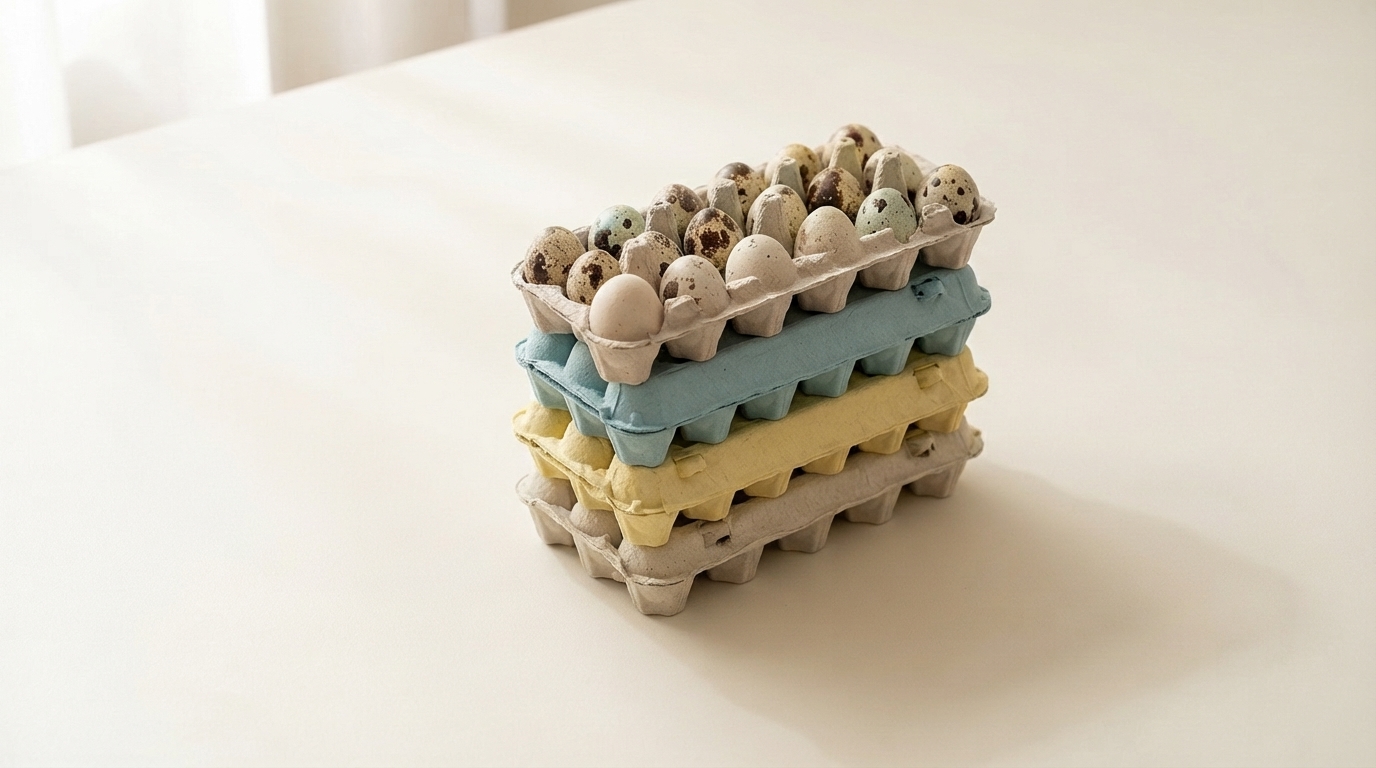
The most common problem in quail egg packaging is a carton that was never designed for quail.
A quail egg from a Coturnix hen measures roughly 32 mm long and 25 mm across, weighing between 10 and 14 grams. A large chicken egg measures about 57 mm long and 44 mm across at roughly 57 grams. The quail egg is not a smaller version of the same shape. It is a different proportion, more barrel than oval, with a flatter base and a much thinner shell relative to its size.
Drop a quail egg into a chicken cell and it sits at the bottom of a cup nearly twice its diameter. Nothing holds it. It rolls, it knocks against its neighbors, and the shell chips at the contact points. Quail shells are around 0.2 mm thick against roughly 0.35 mm for chicken, so they chip from contact that a chicken egg would shrug off.
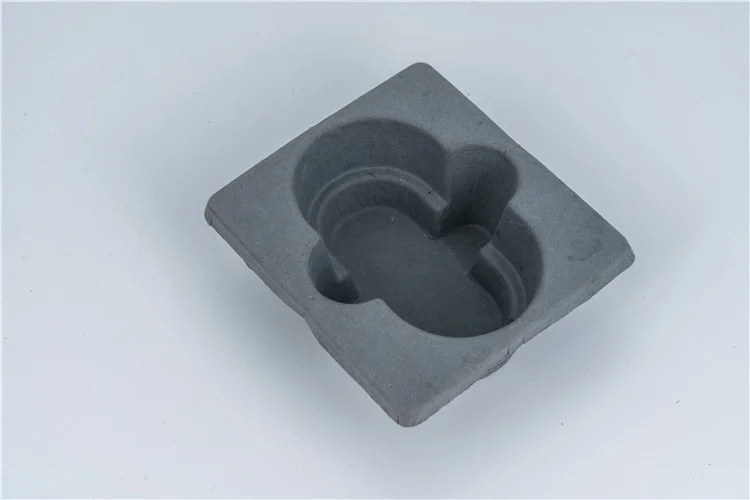
We cut quail molds to quail dimensions. The cell holds the egg at three contact points around its widest section, which stops rotation entirely.
Cell count and what each layout is for
Quail eggs sell in counts that look unusual to anyone used to chicken packaging.
Twelve is the entry retail pack, common in gourmet grocery and Asian food retail where quail eggs have the longest established market. Eighteen is the format most home breeders settle on, since it matches typical daily collection from a small covey. Twenty-four is the food service and wholesale count, buying at volume for restaurant kitchens that use quail eggs as a garnish or canape base.
All three run on a compact footprint, since quail cartons are physically small. A twenty-four cell quail carton is still shorter than a twelve count chicken carton. That has a practical benefit at retail: quail cartons fit shelf space that would not accommodate chicken packaging, which is often why a specialty grocer can stock them at all.
Shell fragility changes the design brief
Quail eggs break differently. A chicken egg cracks. A quail egg shatters, because the shell is thin and brittle and the membrane underneath is proportionally weaker.
That pushes the design toward containment rather than cushioning. Cushioning absorbs impact energy. Containment prevents the egg from moving in the first place, which is more effective when the shell cannot survive even minor contact.
Our cell profile tapers so the egg seats and stops rather than dropping to a flat floor. The lid closes close to the top of the eggs, adding a second point of restraint. Between the two, an egg in a filled carton has essentially no room to shift, which is the outcome that matters.
The breeder market and hatching eggs
A large share of quail egg carton demand comes from breeders rather than food producers.
Coturnix quail reach laying age at around six weeks and hatch in roughly seventeen to eighteen days, which makes them attractive to small breeders and means fertile eggs ship constantly between operations. Hatching eggs are more sensitive than eating eggs, since a detached air cell from rough transit will kill the hatch even when the shell survives.
For that use, the carton goes inside an outer box with void fill, and the tight cell fit does the critical work of preventing rotation. Breeders who have shipped in chicken cartons with foam packing generally report better results once they switch to a correctly sized cell, for the straightforward reason that the egg cannot move.
Market position and low competition
Quail packaging is one of the least contested product lines in egg packaging. Large converters build tooling around chicken volumes, and quail counts rarely justify their minimums. That leaves the market to a handful of specialists.
For a producer, it means a quail carton with correct geometry and a printed brand mark stands out immediately, because most of the competition is packing in repurposed chicken cartons or plain plastic. The barrier is tooling, not demand.
We keep quail stock molds running specifically so breeders and specialty producers can order sensible quantities without funding a tool.
Related formats
Producers who also run chickens usually pair quail cartons with a 6 egg carton oder eine dozen egg carton for the main flock, since the two products sell side by side at the same market stall.
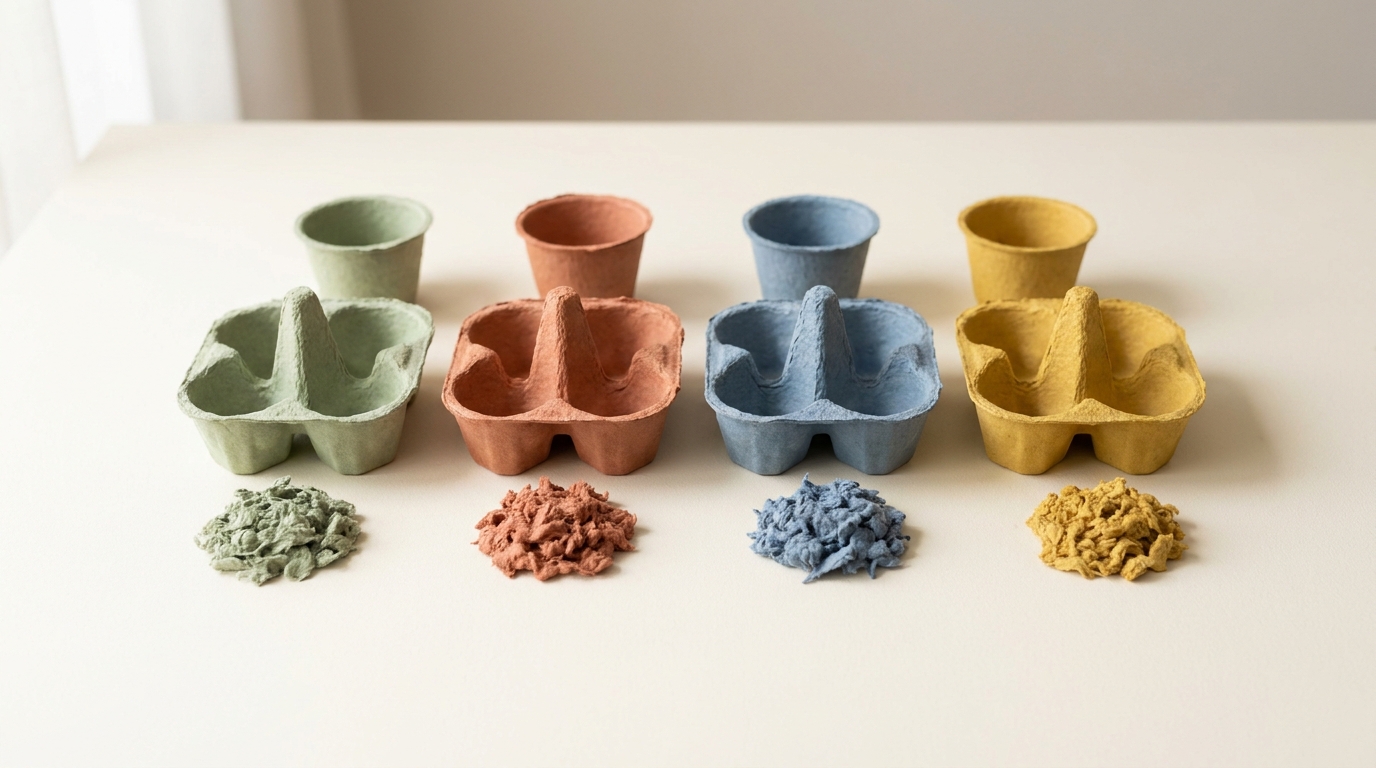
Buyers packing quail into gift and tasting sets should also look at the 4 egg carton format, which works as an outer component. Anyone specifying a brand color across a mixed range should start at farbige Eierkartons, since matching a shade across two different molds needs to be planned before either runs.