By Leo Chan | Writer, BonitoPak | 20+ years in moulded pulp packaging
Vodka is the hardest spirits category to package. There is no colour to show, no age statement to lean on, and in blind tasting most premium vodkas are difficult to separate. The bottle does more of the selling than in any other spirit, which is why vodka design moves faster than whisky or gin.
This analysis of vodka packaging trends 2026 covers those with actual commercial traction, the market data behind them, and an honest assessment of which are real shifts and which are presentation. It also covers the part of vodka packaging that gets least attention and causes most cost: the protective and secondary layer that gets the bottle to the shelf intact.
The Market Backdrop
Three data points frame the spirits packaging trends below.
Premiumisation is the dominant force. UPM Adhesive Materials cites a projected 10.89% compound annual growth rate for the premium alcoholic beverages market, reaching US$1.686 trillion by 2034. In a category where liquid differentiation is hard, that growth is carried substantially by packaging.
Launch activity is rising steadily. Innova Market Insights reported roughly 7% average annual growth in alcoholic beverage packaging launches between October 2022 and September 2025. More launches means more shelf noise and shorter design lifespans.
Secondary packaging is shrinking. As producers strip out cartons and sleeves, more brand messaging moves onto the label itself. UPM’s Stefano Pistoni has flagged that shift and the corresponding importance of label recyclability.
That last point matters more than it sounds. Removing a carton saves material and cost, but it also removes the protection the carton provided. The bottle now has to survive the supply chain on its own, or get that protection somewhere else.
Trend 1: Premium Aesthetics and Tactility
The most established trend, and the one with the clearest commercial logic.
Pistoni describes premiumisation as one of the strongest trends in the category, with colour, tactility, contrast and finishing all affecting perceived quality and purchase intent, particularly in premium, craft and artisanal segments.
What this looks like in vodka specifically:
- Tall, slender silhouettes reading as pure and premium, a cue associated with Grey Goose and Belvedere
- Sculptural forms with tapered necks, geometric bases and softened shoulders, which stand out on shelf and photograph well for social
- Metallic foil and embossing adding tactile premium signals
- Custom glasswork including embossing and engraved stoppers, which strengthens shelf impact at real cost and lead time
- Minimalist layouts with clean typography, conveying confidence by avoiding clutter
Assessment: real and durable, and the most reliable of the spirits packaging trends here. Tactility is one of the few packaging variables with a demonstrable link to perceived quality, and it cannot be replicated in a digital shelf. Expect this to continue.
Trend 2: Paperization
The genuinely new structural shift, and the one with the most commercial movement behind it.
Frugalpac produces the Frugal Bottle, described as the world’s first commercially available paper bottle. It is made from 94% recycled paperboard with a food-grade liner, and Frugalpac claims a carbon footprint up to six times lower than glass. More than 60 customers across 27 countries now use it.
PulPac has produced a paper bottle for Johnnie Walker, with the pulp coloured black to match the Black Label design. Its Baileys mini bottle trial, developed with Diageo and PA Consulting within the Bottle Collective, is a second example. Both use dry moulded fibre technology.
Local production is part of the model. Frugalpac’s Frugal Bottle Assembly Machine can produce up to 2.5 million bottles a year, which Malcolm Waugh of Frugalpac presents as letting producers make bottles on site or beside filling lines. That changes the freight equation substantially, because shipping empty glass is shipping air and weight.
Waugh also notes that younger consumers want full-surface branding, which a paper bottle offers in a way glass does not, combined with an easy-to-remove screw cap.
Assessment: real, early, and moving faster than most packaging shifts. Two caveats for vodka specifically. First, flint glass remains the default visual signal of purity in this category, and a paper bottle gives that up. Second, the trials so far are concentrated in whisky and cream liqueurs rather than premium vodka. The brands best placed to adopt it are those selling on sustainability credentials rather than on clarity.
Dry moulded fibre is named directly among sustainable vodka packaging trends, alongside lighter recycled glass, paper-based closures and vegetable-based inks.
Trend 3: Glass Lightweighting
Less visible than paperization and probably more consequential in volume terms.
Reducing glass weight cuts raw material, furnace energy and freight on every unit shipped. For a category shipping a dense, heavy container worldwide, that is where the largest absolute carbon reduction sits.
The tension: heft reads as quality. A light bottle can feel cheap in hand, which runs directly against the premiumisation trend above. Brands resolving this well are reducing weight in the base and shoulders while keeping perceived substance at the points a hand actually touches.
Assessment: real, quiet and underreported. Expect more of it than the press coverage suggests, because the savings are immediate and the consumer barely notices a well-executed reduction.
Trend 4: Finishes, Colour and Flavoured Expressions
Flavoured vodka behaves like a different category and packages like one.
- Frosted glass and coloured glass punts help flavoured variants stand apart
- Lightly tinted glass, blue in particular, gives quick shelf differentiation
- Bold retro colour systems and vivid nostalgic palettes suit flavoured expressions
- Silk-printed labels pair simple printing with premium ingredient stories
- Clear flint glass remains the default purity signal for unflavoured premium
Assessment: real but cyclical. Colour trends in flavoured spirits turn over every few years and should be treated as seasonal rather than structural.
Trend 5: Low and No Alcohol Packaging
A growing segment with its own visual language.
Soft, calm palettes position low and no-alcohol variants as deliberate choices rather than compromises. Brands in this space tend to lead with the ritual or occasion and keep ABV in the fine print.
Assessment: real and growing, with packaging conventions still forming. An opportunity for brands willing to define the category’s look rather than follow it.
Trend 6: Smart Packaging
QR codes and NFC chips extending the brand story beyond the label.
Assessment: the weakest trend on this list. QR codes have genuine utility for provenance, cocktail content and authentication, and NFC has real anti-counterfeiting value in premium spirits. But scan rates outside specific use cases remain low, and a QR code is not a design strategy. Useful as a layer; not a differentiator.
The Part Nobody Analyses: Protection and Secondary Packaging
Every trend above concerns the primary bottle. The more interesting commercial problem sits one layer out, and it is getting harder as secondary packaging shrinks.
The problem. A sculptural glass bottle with a tapered neck and a geometric base is harder to protect than a cylinder. A lightweighted bottle is more vulnerable to impact than a heavy one. And if you have removed the carton for sustainability reasons, you have removed a protective layer at the same time.
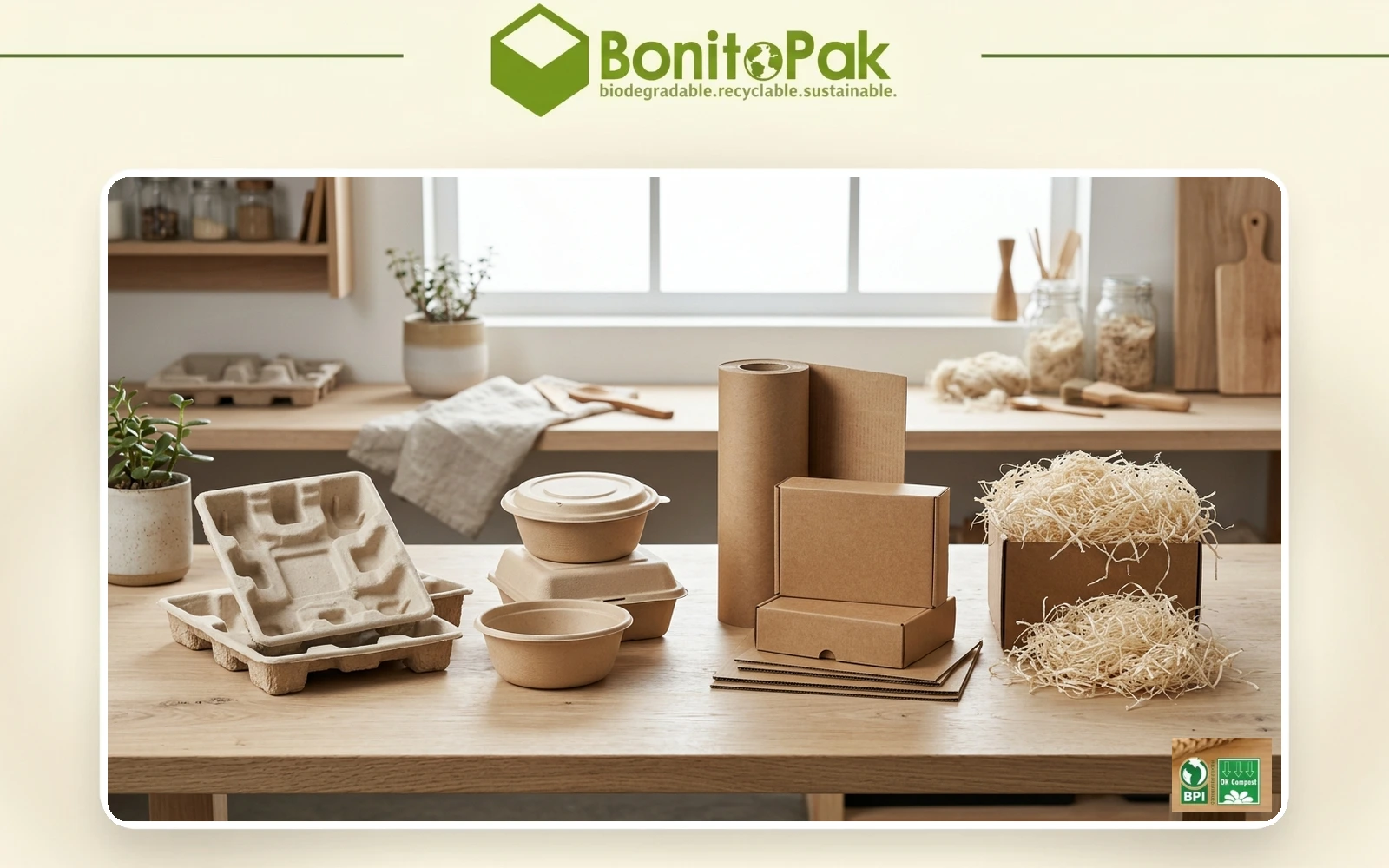
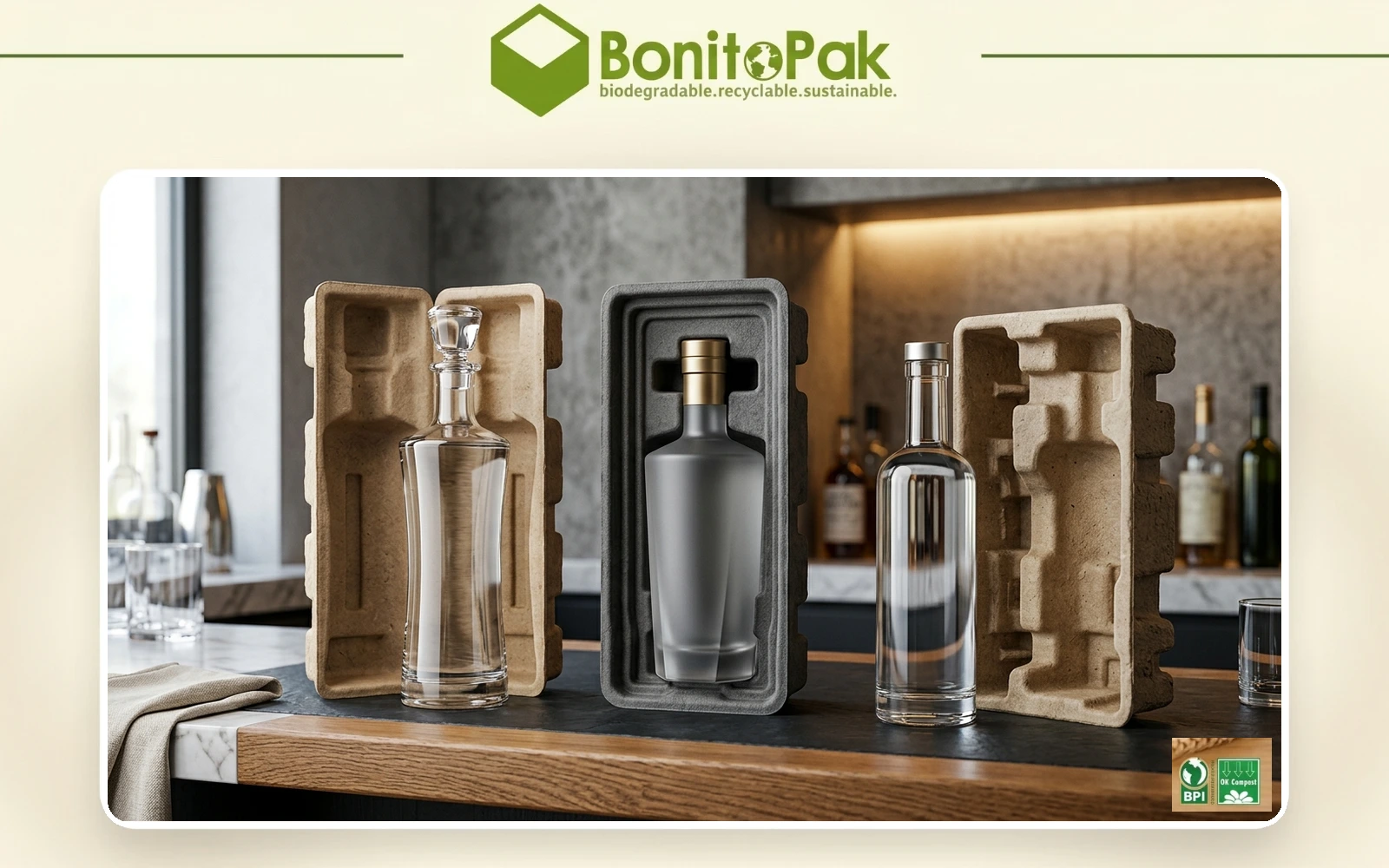
Where moulded fibre fits. Fibre bottle trays, dividers and inserts handle this. They cushion by compressing and recovering, they nest to cut freight volume, they recycle with paper through infrastructure most households can reach, and they can be formed to a sculptural bottle’s actual geometry rather than approximating it.
What that means in practice:
- Bottle trays and dividers for case packing, preventing glass-on-glass contact
- Fibre collars and clips for multipacks, replacing plastic ring and shrink formats
- Formed gift inserts for premium presentation boxes, where a fitted fibre cradle reads better than loose material. This is where sustainable vodka packaging and premium presentation stop conflicting
- E-commerce protection, which is the fastest-growing requirement and the least forgiving, since a direct-to-consumer bottle takes more handling than a retail pallet
Our wine bottle tray page covers the format most directly applicable, and our beer and liquor industry page covers the category. Our comparison of the four types of moulded pulp explains why a wet-pressed insert suits a presentation box while a dry-pressed tray suits case packing.
Which Trends to Act On
Here is how the vodka packaging trends 2026 brings forward actually rank.
|
Trend |
Verdict |
Act now if |
|---|---|---|
|
Premium aesthetics and tactility |
Real, durable |
You compete above the mid shelf |
|
Paperization |
Real, early |
Sustainability is central to your brand |
|
Glass lightweighting |
Real, underreported |
You ship significant volume |
|
Finishes and colour |
Real, cyclical |
You are launching flavoured expressions |
|
Low and no packaging |
Real, growing |
You have a variant in that space |
|
Smart packaging |
Overstated |
You have a specific provenance or authentication need |
|
Fibre protection and secondary |
Real, neglected |
You have removed secondary packaging or ship direct |
What to Do With This
If you are briefing vodka bottle packaging designs for 2026, the sequence that works is: settle the primary bottle on positioning rather than trend, decide lightweighting early because it constrains the design, and specify the protective layer at the same time rather than afterwards. That last step is the one most often left until the glass is tooled, which is when it becomes expensive.
Paperization is the trend worth watching closely rather than acting on reflexively. For a brand selling purity through flint glass, it is a hard trade. For a brand selling conscience, it is already viable.
At BonitoPak we make moulded fibre bottle trays, dividers and fitted inserts through our mould design and tooling team, with moulds cut per project from 1,000 pieces in six pulp colour systems. We do not make glass bottles, so if your question is about the bottle itself we are not your supplier. If it is about getting that bottle to the shelf intact, send us the bottle and your case configuration.
FAQs
Q: What are the biggest vodka bottle packaging designs trends for 2026? A: Premium tactility through finishing and embossing, paperization using moulded fibre and paperboard bottles, glass lightweighting, and distinct visual languages for flavoured and low-alcohol variants. Tactility and lightweighting have the most durable commercial logic.
Q: Are paper vodka bottles commercially viable yet? A: Increasingly. Frugalpac’s Frugal Bottle is in use by more than 60 customers across 27 countries, and PulPac has produced dry moulded fibre bottles for Johnnie Walker and a Baileys trial with Diageo. Premium vodka adoption lags, since flint glass signals purity.
Q: Does lightweighting hurt premium positioning? A: It can, because heft reads as quality. The workable approach reduces weight in the base and shoulders while retaining perceived substance where a hand makes contact. Executed well, consumers rarely register the difference.
Q: What protects vodka bottles if the carton is removed? A: Moulded fibre trays, dividers and fitted inserts, which cushion by compressing and recovering, nest to cut freight volume and recycle with paper. Specify them alongside the bottle design rather than after the glass is tooled.
Q: Is smart packaging worth investing in for vodka? A: Only for a specific purpose such as provenance storytelling or anti-counterfeiting, where NFC has genuine value in premium spirits. General scan rates remain low, so a QR code adds a layer rather than creating differentiation on its own.