Searching for custom printed egg cartons turns up two very different kinds of company, and the results do not distinguish between them. Some are molded fiber manufacturers running their own presses. Others are print brokers who buy blanks and apply artwork, or who quote the job and place it elsewhere.
Both can be the right answer. A broker serving a farm that needs 500 printed cartons is doing something a manufacturer with a 100,000-piece run cannot. But minimums, lead times, and quality control differ so much that comparing their quotes tells you little until you know which type you are talking to.
This guide names ten US suppliers, says which category each falls into, and sets out what to ask each type.
The Three Types of Supplier
|
Type |
Who they are |
Typical minimum |
What you control |
|---|---|---|---|
|
Molded fiber manufacturer |
Runs pulp lines and prints in house |
High, often tens of thousands |
Carton shape, fiber, color, print |
|
Specialist egg distributor |
Stocks cartons, prints or sources printing |
Low to moderate |
Print only, from stock shapes |
|
Custom print broker |
Buys blanks, applies artwork, or subcontracts |
Low |
Print only, limited shape choice |
A fourth option exists: overseas manufacturers who cut custom tooling at low minimums. More on that at the end, since that is where BonitoPak sits and you should weigh the comparison knowingly.
Molded Fiber Manufacturers
These are the egg carton suppliers USA buyers reach at volume, and they make the carton itself. If you need a shape that does not exist, or print at real volume, start here.
1. Huhtamaki North America One of the largest fiber egg packaging makers in the US. Offers a Smiley-Front style, described as giving more visible billboard space on shelf, and a FlatTop style built for line runnability. Available in 12-count and 18-count, made from 100% recycled material and manufactured in the United States. Best for: retail egg brands at national volume who want print space designed into the carton. Limitation: minimums suit established producers rather than small farms.
2. Pactiv Evergreen A major US food packaging manufacturer with a dedicated egg packaging line covering both fiber and plastic formats. Best for: buyers who already source other packaging categories from Pactiv and want to consolidate. Check: which egg formats are currently in production, since large portfolios change.
3. Henry Molded Products Lebanon, Pennsylvania. A long-established molded pulp manufacturer and International Molded Fiber Association member, serving the East Coast for decades. Best for: East Coast producers wanting a domestic molded fiber partner. Limitation: standard formats, with less specialty color and custom branding than a tooling-led supplier.
4. TekniPlex Consumer Products Announced an egg carton with 25% post-consumer recycled content at the IPPE show, alongside a broader diversified materials line. Best for: brands with a recycled-content target they need to document. Check: print capability specifically, since the public announcements focus on materials.
5. Zellwin Farms A Florida-based molded fiber manufacturer focused on sustainable egg cartons and flats for the southeastern US. Best for: southeastern producers wanting a regional supplier. Limitation: regional focus, with standard formats rather than bespoke work.
6. Genpak Produces food service packaging including foam and molded pulp, with egg packaging as one part of a broad range. Best for: operations buying egg cartons alongside other food packaging from one supplier. Limitation: egg cartons are a line item rather than a specialty.
Specialist Egg Distributors
These companies know egg packaging specifically and sit much closer to small and mid-size producers.
7. The Egg Carton Store Stocks paper-pulp cartons in printed, blank, view-style, 6-egg, jumbo, and colored formats, plus a Local Hens branded line with its own imagery and free online farm directory. Sells from single bundles up to wholesale pallets. Best for: farms that want a professional printed look without commissioning their own artwork. Check: whether their printed stock designs meet your state labeling requirements.
8. EggCartons.Com A specialist distributor that does genuinely custom work. Their published guidance is unusually candid: US manufacturers run around a million cartons a day and must pause operations to fit custom plates, which is why minimums exist. They indicate they can typically help at around 20,000 custom cartons or more, and they charge for custom molds on bespoke shapes. Best for: buyers in the 20,000-plus range who want custom print without going offshore. Why it is useful even if you do not buy: their explanation of why minimums exist is the clearest on the US market.
9. Poultry Cartons Supplies molded pulp cartons for chicken, duck, quail, and bantam eggs, in traditional dozen, half-dozen, sampler, and specialty square and octagon styles, with bulk and custom printed options. Best for: producers with non-standard egg types who also want branding. Check: which specialty shapes are stocked versus made to order.
10. MT Products Supplies printed and blank beige and natural pulp cartons in retail pack sizes, widely available through general retail channels as well as direct. Best for: very small volumes and testing a format before committing. Limitation: retail pack pricing, so the per-carton cost is high at small quantities.
A Word on Custom Print Brokers
Search results for custom printed egg cartons also surface a large number of general custom packaging websites. They advertise egg cartons alongside dozens of other box types, promise low minimums and fast turnaround, and often do not say who manufactures the carton.
Some are legitimate print brokers doing useful work for small businesses. Others are lead-generation sites that place your order with a factory you never speak to. Neither is automatically bad, but know which you are dealing with.
Questions that sort them quickly:
- Who manufactures the carton itself, and where?
- Is the carton molded fiber, or paperboard folded into an egg shape? These are different products.
- What is the actual print method, and will you see a physical proof?
- Does the quoted price include plates or setup?
- Can you see photos of previous egg carton work specifically, not general boxes?
A broker who answers all five clearly is worth considering. One who deflects is quoting work they have not done.
How Printing Actually Works on Molded Fiber
Worth understanding before you brief anyone, because it shapes what is possible.
Direct printing. Most printed egg cartons wholesale buyers encounter use flexographic printing applied to the carton surface. This is where custom egg carton printing usually starts and sometimes stops. Fiber is absorbent and textured, so fine detail, small type, and photographic images do not reproduce the way they would on coated board. Bold logos, simple shapes, and solid color work best.
Plates and setup. Direct printing needs a plate per color. That is a one-time charge per design and a large part of why custom egg carton printing carries higher minimums than the cartons themselves.
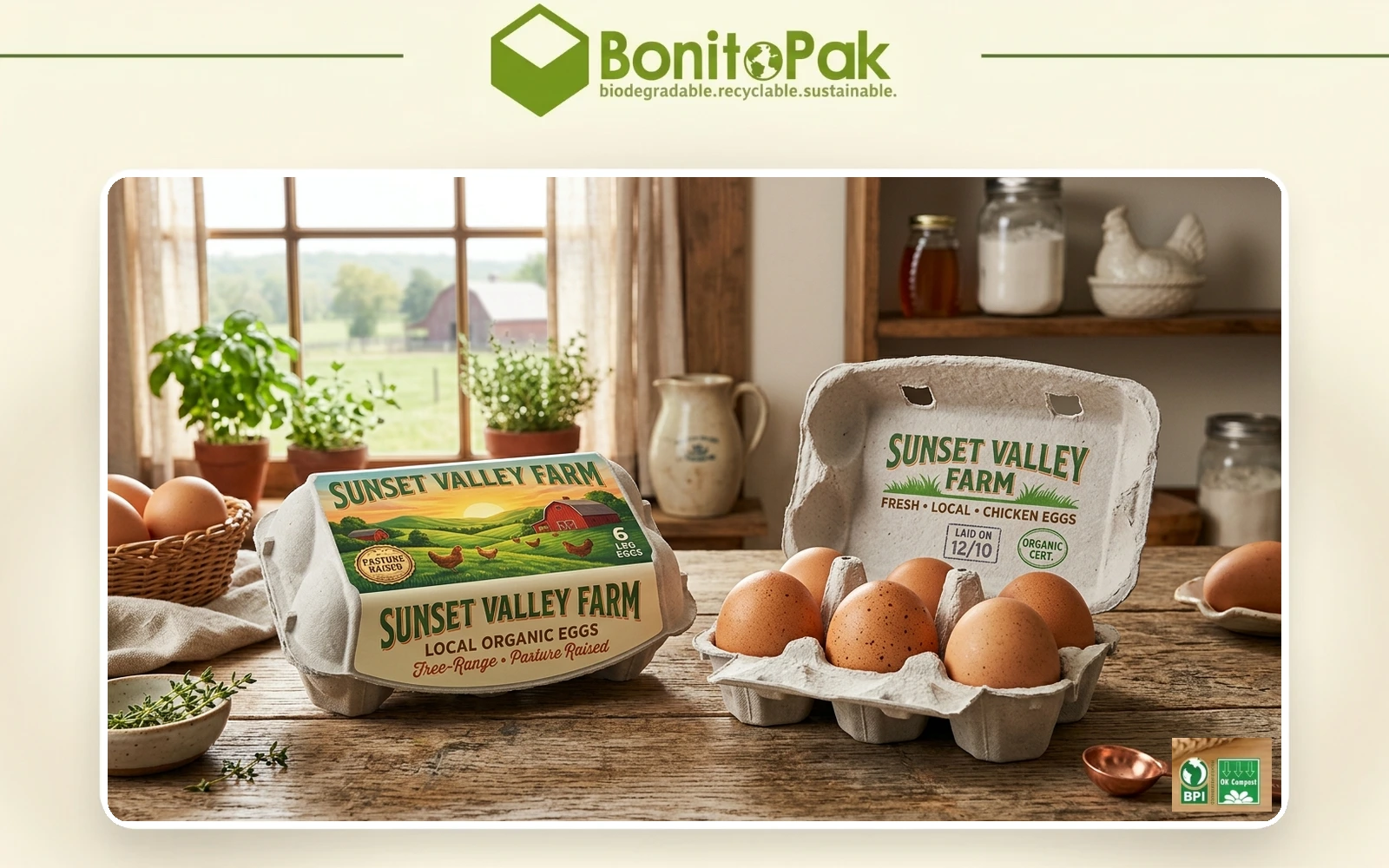
Labels and sleeves. A printed label or belly band applied to a blank carton gives you photographic quality and tiny minimums. It costs more per unit and adds a labeling step, but for a farm selling a few hundred dozen a week it is usually the right answer.
Embossing. A logo cut into the tooling, with no ink at all. It costs nothing per unit and survives handling that would smear print, but it needs custom tooling and reads as subtle rather than bold.
In-pulp color. Not printing at all, but often what buyers want. Color mixed into the fiber gives a branded carton with no ink, in a shade nobody else on the shelf has.
Our article on blank vs printed egg cartons covers when unbranded is the better commercial call, which is more often than most brands expect.
Do Not Forget the Compliance Text
Printing is not only branding. US shell egg cartons carry required information, including the safe handling statement, statement of identity and net contents, with state rules on top.
Two practical consequences. First, your artwork needs space reserved for compliance text before you start designing around a logo. Second, if you reuse cartons or buy pre-printed stock, previous labeling that does not apply to your eggs must be removed or fully covered under most state egg laws.
Our guide to egg carton labels and USDA and FDA requirements covers what has to appear, and our article on why pulp cartons are the eco-friendly choice covers the recycled-content claims brands often want printed alongside it. A compliance element with nowhere to sit becomes a reprint.
Choosing Between Them
|
Your situation |
Start with |
|---|---|
|
Under 5,000 cartons a year |
A distributor’s printed stock, or blank cartons plus labels |
|
5,000 to 20,000 |
Distributor custom print, or labels on in-pulp color |
|
20,000 to 100,000 |
Specialist distributor custom print, or an overseas manufacturer |
|
Over 100,000 |
A domestic molded fiber manufacturer |
|
Non-standard egg type or shape |
A manufacturer who cuts tooling, domestic or overseas |
|
Premium or gift positioning |
In-pulp color with embossing, which needs tooling |
If you are weighing domestic against overseas, our buyer’s guide to US egg tray manufacturers covers the domestic side in more depth, and our guide to what drives price at volume covers the arithmetic.
Where an Overseas Manufacturer Fits
The gap in the US market is the middle. Domestic manufacturers serve high volume well. Distributors serve low volume well. Between them sits the producer who needs a custom carton shape, a specialty egg size, or an in-pulp color at a few thousand pieces, and that is hard to buy domestically.
That is the gap BonitoPak fills. We cut molds per project, run six pulp color systems, and take orders from 1,000 pieces, with BPI and OK Compost certification. The trade-off is honest and worth stating: ocean freight adds roughly four to six weeks to your first order compared with buying domestic stock, and a domestic supplier will always beat us on reorder speed. Our custom egg trays and cartons pages show the formats, and we are happy to be quoted alongside anyone on this list.
Getting a Quote You Can Compare
Printed egg cartons wholesale pricing only becomes comparable when the brief is identical. Send every supplier the same package. Egg type and grade, measured egg width, count and format, annual volume and first order quantity, artwork or a description of it, whether you want direct print, labels, embossing or in-pulp color, and your destination. Ask each one to quote plates and setup separately from the per-carton price.
Different suppliers will propose genuinely different approaches to the same brief. That is the useful part.
FAQs
Q: What is the minimum order for custom printed egg cartons in the USA? A: It depends on supplier type. Domestic manufacturers often need tens of thousands, since custom print plates interrupt high-speed lines. Specialist distributors can work lower, around 20,000 for custom print, and labels on blank cartons have almost no minimum.
Q: Can I get photographic-quality printing on a fiber egg carton? A: Not with direct printing. Molded fiber is absorbent and textured, so flexographic printing suits bold logos and solid colors. For photographic detail, use a printed label, sleeve or belly band applied to a blank carton instead.
Q: Are print plate charges included in a quoted price? A: Often not, so ask explicitly. Plates are a one-time charge per color per design and are a significant part of first-order cost. Always request plates and setup quoted as separate lines from the per-carton price.
Q: How do I find real egg carton suppliers USA buyers can trust? A: Ask who manufactures the carton and where, whether it is molded fiber or folded paperboard, and for photos of previous egg carton work specifically. A supplier who cannot answer those three is reselling work they have not done.
Q: Is embossing cheaper than printing? A: Per unit, yes, because embossing adds no ink and no print step. Upfront it costs more, since the logo is cut into the tooling. At high volume embossing wins. At low volume, printing or labels are cheaper overall.