
By Leo Chan | Writer, BonitoPak | 20+ years in molded pulp packaging
Published: 15 August 2026 | Last reviewed: 15 August 2026
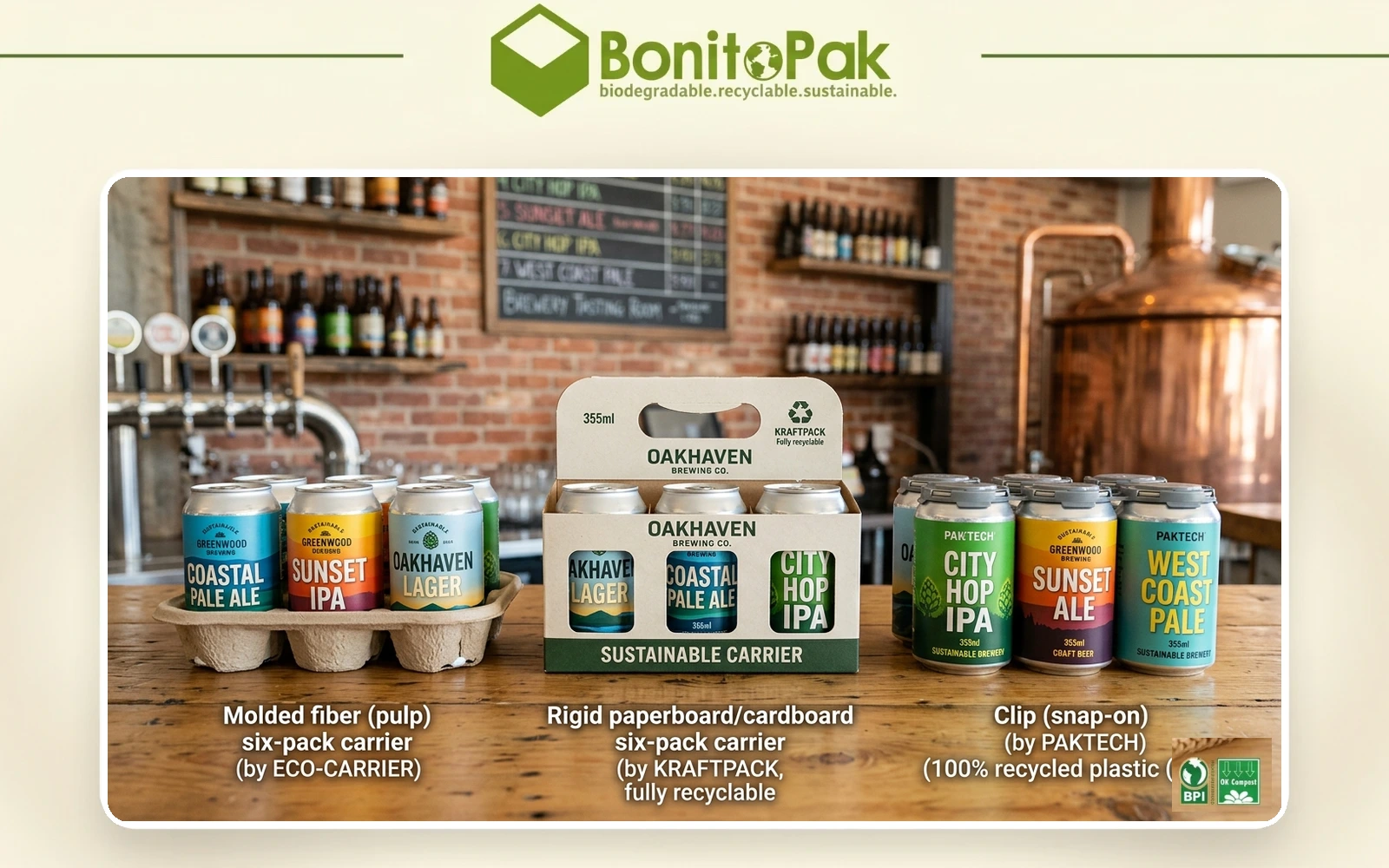
Can carriers are made from five materials: molded fiber from bagasse or recycled paper, folding paperboard, LDPE plastic rings, rigid recycled HDPE, and shrink film. Molded fiber is the fastest growing, and its performance depends on fiber blend and additives rather than on the word fiber alone.
The multipack that holds cans together looks like a minor packaging component. It is the part most likely to be questioned by a retailer, a regulator or a customer, because it is visible, it is single use in most formats, and it has become the symbol of plastic waste in the drinks aisle.
So what are can carriers made of, and what actually separates one material from another? The differences are real and they show up in cost, in strength when wet, and in what you are allowed to claim on the pack.
What Are Can Carriers Made Of? The Five Materials in Use
| Material | Common form | Typical end of life |
|---|---|---|
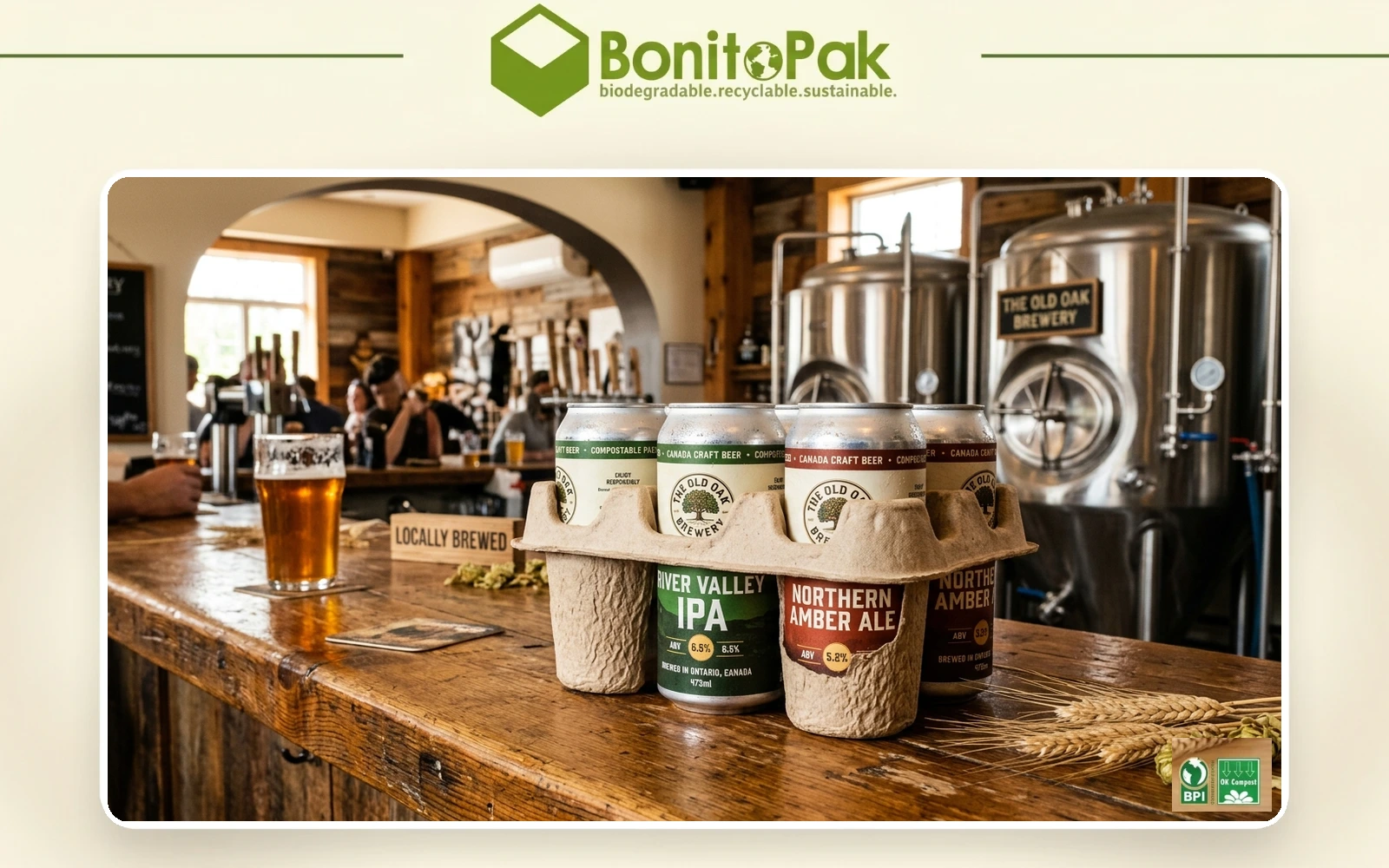
| Molded fiber | Formed 4 or 6 cell carrier | A compostable can carrier is possible, acceptance varies |
| Folding paperboard | Clip or collar applied to can tops | Recyclable with paper in most programs |
| LDPE | Flexible ring yoke | Rarely accepted curbside |
| Rigid recycled HDPE | Handle carrier clipped over can rims | Recyclable, often reusable |
| Shrink film | Heat shrunk sleeve around the pack | Store drop off film streams only |
Those five can carrier materials cover almost everything on shelf. The rest of this article works through what each one actually is, starting with the one that generates the most questions.
Molded Fiber, in Detail
A molded fiber can carrier is not made from a single material. Molded fiber is a process applied to a range of feedstocks, and the feedstock choice changes performance substantially. Two carriers can both be described as fiber and behave very differently.
The feedstocks
| Feedstock | Where it comes from | Characteristics |
|---|---|---|
| Sugarcane bagasse | Byproduct of sugar milling | Short fiber, low density, cost effective, food safe |
| Bamboo | Fast growing grass | Long fiber, adds tensile strength when blended |
| Recycled paper | Post consumer and post industrial paper | Lowest cost, shortest fiber, widely used |
| Wood pulp | Virgin softwood or hardwood | Cleanest and brightest, highest cost |
| Straw and plant fiber | Agricultural residue | Regionally available, variable consistency |
Bagasse deserves a note because it dominates this category. It is waste from sugar production rather than a crop grown for packaging, so it does not compete with food land use, and it combines high specific strength with low density and low cost.
Why fiber length is the specification that matters
Fiber length governs how a molded part behaves. Longer fibers interlock and provide strength, toughness and structure. Shorter fibers give bulk, a closer texture and a smoother surface finish, as set out in published research on molded pulp products for sustainable packaging. Neither is better in isolation. They do different jobs.
This is why hybrid blends have become standard in any demanding molded fiber can carrier. A common high performance formulation runs roughly 70 percent bagasse with 30 percent bamboo, using the long bamboo fiber to reinforce the shorter, cheaper bagasse. A carrier holding several full cans by their rims is exactly the kind of part where that reinforcement earns its cost.
It also explains why a carrier made purely from recycled paper is the cheapest option and the weakest. Recycled fiber has already been through several pulping cycles, so it is short and comparatively brittle before it ever reaches the mold.
The additives question, which nobody asks and everybody should
Fiber on its own absorbs water. Any carrier expected to survive refrigeration, condensation or a cooler needs some form of water resistance, and that is delivered by additives introduced into the pulp slurry rather than by the fiber itself.
The standard water resisting agent is alkyl ketene dimer, usually shortened to AKD. Added at around 0.5 to 1.5 percent of dry pulp, it bonds to the cellulose and raises the water contact angle so moisture beads instead of soaking in. For food contact applications, a state of the art review of moulded pulp fibers notes that AKD content is restricted to no more than 0.4 percent of total weight under FDA regulation 21 CFR 176.120.
The additive worth asking about directly is a different one. Fluorochemicals, including PFAS, were long used in molded pulp to provide grease and oil resistance, typically at around 2 percent addition. Their charge bonds strongly with cellulose, which makes them effective and difficult to substitute.
A can carrier is a case where this should not arise. Cans are sealed and the carrier faces water rather than oil, so grease resistance is not a functional requirement. If a supplier cannot confirm that a carrier is free of intentionally added fluorochemicals, that is worth resolving before you order, because several jurisdictions have moved to restrict PFAS in food contact packaging and retailers are increasingly asking for written confirmation.
- Ask what fiber blend is used, by percentage, not just the word fiber.
- Ask what sizing agent provides water resistance and at what addition rate.
- Ask for written confirmation on intentionally added fluorochemicals.
- Ask whether any coating or laminate is applied, since that changes end of life.
Folding Paperboard
Paperboard carriers take a different structural approach. Rather than forming a three dimensional cell around each can, a flat board blank is folded and clipped onto the can tops or wrapped as a collar.
The material is usually solid bleached board or recycled boxboard, sometimes with a thin coating for print quality. Because it is flat stock, it prints well by conventional litho or flexo, ships flat and is accepted in most paper recycling streams. The limitations are that it grips the can rim rather than supporting the can body, and coated grades can complicate recycling depending on the coating used.
LDPE Plastic Rings
Plastic six pack rings are the format everyone pictures. The flexible ring yoke is made from low density polyethylene, extruded as a thin sheet and die cut into connected rings that stretch over can tops.
It is extremely cheap, extremely light and mechanically effective. Its problem is disposal. Plastic six pack rings are thin flexible film, which is the hardest plastic category to recycle, and they are almost never accepted in curbside collection. That single characteristic, rather than any performance failure, is why the format has come under regulatory pressure and why most of the alternatives in this article exist.
Rigid Recycled HDPE Handle Carriers
These are the thick plastic handles that clip over can rims, usually molded from recycled high density polyethylene.
They are genuinely durable, reusable in practice, and HDPE has an established recycling market, so the environmental case is stronger than for flexible rings. The trade offs are cost per unit, which is the highest of the five materials, and the fact that the pack remains plastic, which does not satisfy a brand whose goal is plastic free packaging.
Shrink Film
Shrink film wraps the whole pack and is heat shrunk tight. It is inexpensive at volume, holds cans very securely and provides a large printable surface.
It is also the weakest performer on disposal. Film requires store drop off collection rather than curbside, participation is low, and the pack has no handle unless one is die cut into the film. For multipacks above six cans it remains common, but it is the format most often replaced first when a brand reviews its packaging.
How to Read a Material Claim
Descriptions of can carrier materials on packaging are frequently vaguer than they appear. Three distinctions are worth holding onto.
Recyclable describes what a material could become, not what your local facility accepts. Compostable means breakdown within a defined period under defined conditions, and should be backed by certification of the finished article rather than the base material. Biodegradable has no fixed timeframe or condition attached and carries the least meaning of the three.
A single material pack is the easiest to make any of these claims about. Once a carrier combines fiber with a plastic window, a laminate or an applied coating, most sorting systems treat it as contamination. We work through what actually happens to fiber packaging after collection in our article on whether pulp packaging is recyclable.
What We See on Our Own Production Line
We form molded fiber packaging at our facility in Chashan Town, Dongguan, across both pressing processes and six pulp systems. A few observations relevant to carrier formats.
Process changes what the part can do
Our wet pressing line produces a smooth, dense surface that holds emboss detail and renders color cleanly, which suits anything customer facing. Our dry pressing line compacts fiber for rigidity, crisp geometry and consistent tolerances, which is what a load bearing part needs. Across both, wall thickness is specified anywhere from roughly 0.8 to 3mm, and that range is the main lever for tuning strength against weight and cost.
A carrier is a load bearing part, not a tray
The distinction matters more than buyers expect. A tray supports a product from below. A carrier holds the full weight of its contents from the rim, in tension, often while being swung by one hand. The stress concentrates at the cell edges and the handle aperture, which is where a part fails first. That is a structural problem closer to our industrial and protective pulp packaging work than to a food tray, and it is why wall section and rib design get set before anything cosmetic is considered.
Color and material are the same decision
We run six pulp systems covering white, natural, black, orange, gray and blue, matched to better than 95 percent Pantone accuracy. Natural and white fiber are our recommendation for direct food contact, with pigmented systems better suited to tray and carrier applications where contact is limited. Because cans are sealed, a carrier sits comfortably in that second category. Details on the systems and material options are on our custom molded pulp packaging page.
On timing, sample molds run in about seven days and production molds follow around eight days after geometry approval, with minimums from 1,000 pieces. For a carrier specifically, the specification that takes longest to settle is not the material but the fit, because can diameter and lid format drive the cell geometry. We will cover that separately in a guide to can carrier sizing and fit.
Putting This Into Practice
Start from what the pack has to survive rather than from the material name. A carrier that will sit in refrigeration and be handled wet has different requirements from one moving through dry ambient retail, and that single question narrows the field faster than any sustainability comparison.
Then interrogate the specification rather than the label. Fiber blend by percentage, sizing agent and addition rate, any coating, and written confirmation on fluorochemicals. Two suppliers quoting a molded fiber can carrier can be offering materially different products, and the price gap between them usually reflects exactly those variables.
At BonitoPak we set fiber blend, wall section and geometry together at the tooling stage rather than treating material as a separate choice, which is how a fiber carrier ends up performing like a structural part instead of a tray. If you are comparing quotes, asking each supplier for the blend and additive detail is the fastest way to understand what you are actually being offered.
About the Author
Leo Chan is the founder of BonitoPak and has spent more than 20 years in molded pulp packaging, working with over 500 brands moving from plastic and foam to fiber based formats. BonitoPak manufactures molded pulp packaging at its facility in Chashan Town, Dongguan, Guangdong, running both wet pressing and dry pressing lines across six pulp systems, with in house mold design and tooling. The material observations here reflect production experience on that line alongside published research on molded pulp feedstocks, additives and food contact regulation.
Frequently Asked Questions
Q: Are fiber can carriers made from trees?
A: Not usually. Most use sugarcane bagasse, a byproduct of sugar milling, or recycled paper fiber. Bamboo is often blended in for strength. Virgin wood pulp is used mainly where a bright white finish is required.
Q: Do fiber carriers contain PFAS?
A: They can, since fluorochemicals were long used for grease resistance in molded pulp. Can carriers rarely need oil resistance, so PFAS should not be necessary. Ask any supplier to confirm in writing rather than assuming.
Q: What makes a carrier water resistant?
A: Usually an internal sizing agent such as alkyl ketene dimer added to the pulp slurry. It bonds to the cellulose and raises the water contact angle, so moisture beads rather than soaking straight into the wall.
Q: Is recycled HDPE better than fiber?
A: It depends on the goal. Recycled HDPE is durable, reusable and widely recyclable, but stays plastic and costs more per unit. Fiber suits single use and composting. Neither is universally better.
Q: Can a compostable can carrier also be recyclable?
A: Uncoated fiber often qualifies for both, though acceptance varies locally and compostability needs certification of the finished article. Any plastic component, coating or laminate generally rules out both claims.