By Leo Chan, Senior Packaging Consultant · November 2026
A molded pulp can carrier can carry your brand in three ways: an embossed or debossed mark pressed into the fiber, a color mixed into the pulp, or a print on the surface. Pressing and color work best on fiber, and fine print works worst. A bold brewery logo, a strong color and a clean can design give the best result.
Breweries ask about branding late, after they have chosen the format and the size. That order costs money, because the mark is cut into the mold, and a mold change after approval is expensive. This guide shows what branding a fiber carrier can and cannot do, how to prepare art, how color is made and held, what the beer label rules mean for a carrier and how we approve a sample at BonitoPak in Dongguan, China.
What Can You Brand on a Molded Pulp Can Carrier?
You can brand the shape, the surface and the color. Shape means the outline and the handle. Surface means a logo pressed into the fiber or printed on it. Color means the pigment in the pulp. The carrier is a three dimensional part, and its look comes from form, shadow and tone, not from a flat printed face.
That is the big difference from paperboard. A paperboard clip or collar has a wide, flat surface that prints in full color. A fiber carrier holds the can by the body and leaves the can top open, so the can art stays in view and the carrier plays a supporting role. Our molded fiber against paperboard comparison gives the full list of trade-offs. If the carrier must act as a billboard, paperboard wins. If your can art is the star, fiber frames it well.
How Does Emboss and Deboss Work on Fiber?
Emboss raises a mark above the surface and deboss presses it in. Both are cut into the mold, so the logo is part of the carrier and cannot peel, scuff or wear off. On pulp, the mark reads through shadow and not through contrast. Light from above catches the edge of the shape and the shadow draws the logo.
Nosso colored pulp page explains that darker pigment holds shadow more cleanly at the edge of a mark, so embossed detail looks sharper on dark shades than on light tints. A natural, light colored carrier still works, but the mark looks softer. Keep these rules in mind:
- Use a bold mark with thick lines. Thin lines fill in and disappear.
- Keep text to one word or a short name. Small text turns to noise.
- Leave empty space around the mark so the shadow has room.
- Place it on a flat panel the hand will not cover, not on a curve or a handle edge.
- Test the mark on a real part. A flat drawing and a formed fiber surface read very differently, and the shadow only shows once the part is pressed.
Which Is Better for a Brewery, Emboss or Deboss?
Neither wins everywhere, so choose by the look you want. A raised mark feels tactile and catches light from above. A pressed mark sits calmly inside the surface and holds a deeper shadow. The table sets out the main differences.
| Point | Emboss (raised) | Deboss (pressed in) |
|---|---|---|
| Veja | Raised, catches light | Sunken, holds shadow |
| Best on | Flat top panels | Flat panels and curved walls |
| Wear in handling | Edges meet other carriers when stacked | Protected inside the surface |
| Detalhes | Needs space around each line | Needs space around each line |
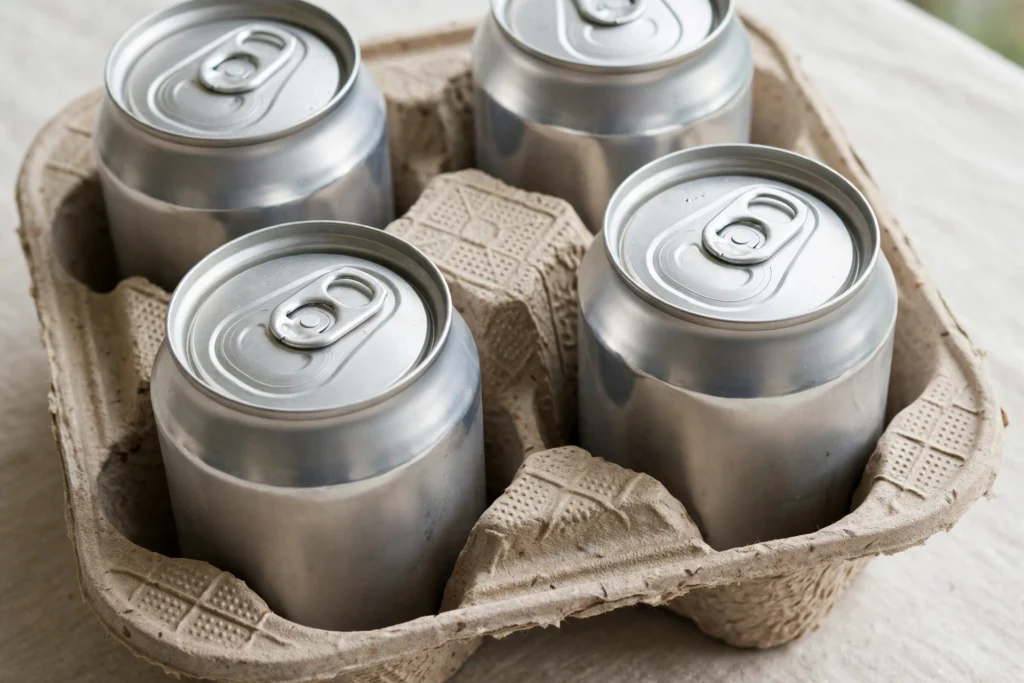
If your carriers stack in a cold room or on a line, a debossed mark is better protected from rubbing. If the carrier sits on a retail shelf, an embossed mark looks sharper from the front. Ask for both on a sample and place them under your own lights.
How Do You Choose a Color for a Can Carrier?
Choose a color that works with your can art and not against it. The color is part of the pulp, so it runs through the full wall depth. If you scuff the surface, the color underneath is the same. That is different from a coating, and it is why a colored carrier still looks right after a shipping run.
We hold six stock shades in continuous production, which means lower minimums. We can also match a Pantone reference or a physical sample, and we make a formed sample in your actual carrier shape for approval. A flat color chip and a molded surface read differently, so approve the formed part. Our colored pulp page explains the method.
Two limits shape your palette. Pigments used in compostable packaging must break down without heavy metals or lasting residue, which rules out several traditional colorants, particularly in the red and yellow ranges. The palette is narrower than plastic offers. Also, recycled fiber arrives gray brown and varies batch to batch. Dark shades cover that variation and reproduce consistently. Light tints show it.
Which Colors Suit Beer Cans?
Match the carrier to the can, and think about contrast. A dark carrier frames bright can art and holds an embossed mark well. A natural fiber carrier suits a craft, farm or rustic brand and keeps the recycled story plain. A mid tone color can echo your label.
Think about how many beers you sell. If you have a core range with three or four cans, a color per beer can help shoppers find the right pack, but each color adds a stock or custom shade to manage. A single neutral carrier across every beer keeps tooling and inventory simple. Seasonal releases are a good use of a stock color, since the minimum is lower than a custom match.
Keep the color decision separate from the fiber decision. Colored pulp runs on any base fiber, so choose the fiber first for strength and cost, then the color. Our material pages list the bases.
Can You Print on a Molded Pulp Can Carrier?
Print is limited, so keep it simple. Fiber texture breaks up continuous tone, so a photograph or a fine gradient does not reproduce on any pulp shade. A bold single color mark in a light ink on a dark carrier, or a dark ink on a natural carrier, works better. Ask us what print method suits your part, since we confirm this per project and do not publish a single rule for every carrier.
If you need detailed art, move it to a place that prints well: the can itself, a paper sleeve, a tag or a case label. Use the carrier for the mark, the color and the feel. Some breweries pair a plain embossed carrier with a richly printed can, and the combination reads as confident.
What Do Beer Label Rules Mean for a Carrier?
The legal label belongs on the can, not on the carrier. The US Alcohol and Tobacco Tax and Trade Bureau lists the required malt beverage information, such as brand name, class and type, net contents and the name and address of the producer. TTB’s page says this information must be on the container’s labels, and it defines a label as any material affixed to the container. See the TTB mandatory label information page for the full list.
The TTB page does not discuss multipack carriers, so do not treat a carrier mark as a replacement for any can label item. Treat the carrier as brand dressing. Check any claims about the carrier itself, such as recyclable or compostable, against your own documents, and confirm the rules for your state or province before you print. We are a manufacturer and not a law firm.
Nosso certification post, compostable and recyclable can carriers, explains why a claim needs a certificate for the finished product. If you want a compostable mark on a carrier, ask us what exists before you print it.
How Does Branding Change With Wall Thickness and Press Type?
Branding sits on a structural part, so the wall comes first. A can carrier holds the full loaded pack in tension while someone carries it with one hand. We specify wall thickness from roughly 0.8 to 3 mm against the loaded weight. A deep emboss thins the wall under the mark, so keep marks away from handle openings and cell edges, where stress concentrates.
Press type changes the surface. Wet pressing gives the smoother face where the carrier is customer facing, and dry pressing suits load bearing sections. A smooth wet pressed face takes a pressed logo cleanly. If you want both a smooth look and a strong wall, tell us the loaded weight and the can height, and we recommend the process. Our Guia de tamanhos para porta-latas explains why diameter sets the tooling, and the 4 pack or 6 pack guide shows how pack weight changes the design.
How Do You Prepare Art for a Custom Can Carrier?
Send the logo as a vector file, plus the can diameter, the pack count and your color reference. Our engineers place the mark, check that lines are thick enough to press and send a drawing for approval. Follow these steps to keep the job moving.
- Confirm the can formats you run, such as 66 mm standard or 57 mm sleek, since each diameter family needs its own tooling.
- Choose the pack count and say whether it is a four or a six pack.
- Send the logo as a vector file and note any minimum line width you can accept.
- Pick a stock color or send a Pantone reference or a physical sample.
- Approve the drawing, with the mark position marked on it.
- Test the formed sample with your cans, filled, cold and handled.
- Keep the approved sample as the physical standard for every reorder.
Sample molds run in about seven days and production molds around eight days after geometry approval, with minimums from 1,000 pieces. Confirm the dates and the minimum with each quote. Our cost per unit guide explains how tooling spreads across volume, which matters if you plan several can sizes.
How Do You Keep Brand Color Steady Across Reorders?
Retain a physical standard. Getting a shade right once is easy. Getting it again twelve months later is the hard part, and the control is measurement and not recipe. We read the base pulp brightness before dosing the pigment and adjust the dose against that reading. Formed samples are compared to a retained physical standard and not to a color chip on a screen, because fiber texture changes how a shade reads.
Batch records let a reorder be matched to the original. Approve and keep one sample at the first production run. Pale tints are hardest to hold because they show the recycled base, and dark shades are easiest. If your brand depends on a pale color, plan for a tighter approval.
How Do You Order a Branded Can Carrier From BonitoPak?
Email leo@bonitopak.com with your can size, pack count, logo and color. Ship a few of your own cans if you can, because a real can tells us more than a drawing. We design the cavity, place your mark, form a sample and quote the order, with the mold cost shown separately.
See the range for brewers on our beer and liquor packaging page, read about our custom service options, or start from the BonitoPak homepage. Price and lead time are confirmed with each quote.
Perguntas frequentes
Can I put my brewery logo on a molded pulp can carrier?
A: Yes. A logo can be pressed into the fiber as an emboss or deboss, and the carrier can be colored. Use a bold mark with thick lines, since fine detail does not hold on pulp.
Which looks better, emboss or deboss?
A: Emboss is raised and catches light. Deboss sits inside the surface and resists rubbing in stacks. Ask for both on a sample and view them under your own lights.
Can you match my brand color?
A: We match a Pantone reference or a physical sample and form a sample for approval. Pulp will not match printed ink exactly, and the palette is narrower in red and yellow.
Can I print a full color image on the carrier?
A: No. Fiber texture breaks up photographs and gradients. Use a bold single color mark, and put detailed art on the can, a sleeve or a case label.
Does the carrier need the beer label information?
A: No. TTB requires mandatory information on the container’s label. The carrier is not a label, so keep all required text on the can.
What is the minimum order for a custom branded carrier?
A: Custom tooling projects start from 1,000 pieces, and sample molds take about seven days. Confirm the minimum, the color minimum and the schedule with each quote.