These three are grouped because they share a commercial situation, not because they share a carton. Each needs its own mold, and the reasons are worth taking separately.
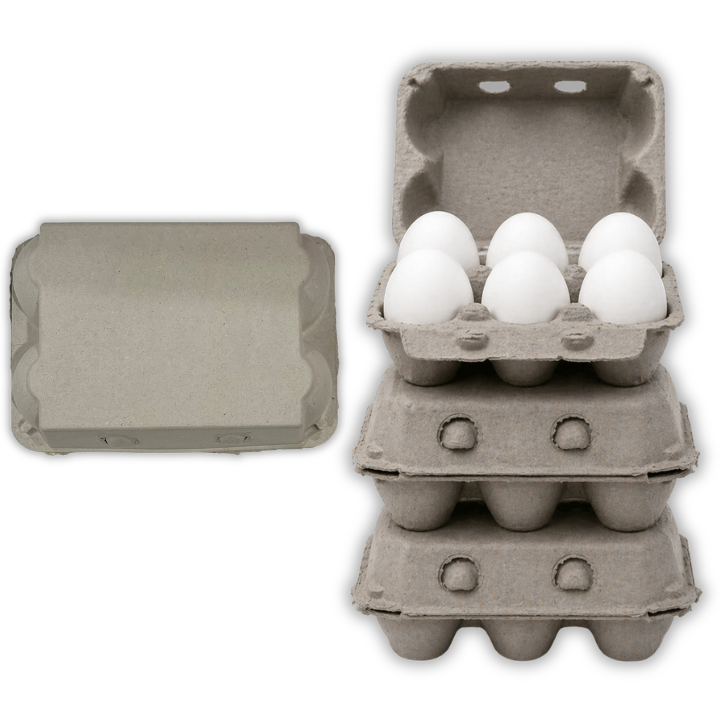
What they have in common is that they are produced by small flocks in quantities no large converter will tool for. That is why specialty keepers end up packing in whatever chicken carton fits least badly, and why it is worth stocking molds that actually fit.
Goose: the size problem
A goose egg from an Embden or Toulouse weighs between 140 and 200 grams. That is roughly three large chicken eggs in one shell.
No chicken carton holds one. The egg does not fit the cell at any depth, and attempts to pack geese in chicken cartons usually end with the eggs laid loose in the carton with the dividers crushed down, which protects nothing.
The goose mold uses cells roughly twice the diameter of a chicken cell and considerably deeper. The footprint is large enough that a six count goose carton approaches the size of an eighteen count chicken carton.
Counts run low because production is low. A goose lays seasonally, typically 20 to 50 eggs a year against 250 or more for a laying hen. Two and four count cartons are the realistic retail formats, and six is usually the maximum worth stocking.
Goose shells are thick and strong, so the protection requirement is lower than the size requirement. The mold exists because the egg needs somewhere to sit, not because it is fragile.
Turkey: the awkward middle
Turkey eggs sit between chicken jumbo and goose, around 75 to 95 grams, which puts them in the worst position of the three.
They are too large for a chicken carton, including a deep bed jumbo mold, where the lid closes on the shell. They are far too small for a goose cell, where they roll freely and knock against the walls.
The turkey mold is dimensioned specifically for that gap. Cells are deeper and wider than our deep bed chicken spec but well short of goose.
Turkey eggs also have a distinctly more pointed profile than chicken, with a noticeably tapered narrow end, which means they seat lower at the point. The cell profile accounts for that taper rather than assuming a chicken-shaped oval.
Most turkey egg demand is for hatching rather than eating, since turkey eggs are rarely sold as food at scale. Breeders shipping fertile eggs are the main buyers, and immobilization matters more to them than cushioning.
Bantam: the small end
Bantam eggs run around 25 to 35 grams, roughly half a standard chicken egg, from Silkie, Serama, Sebright and other true bantam breeds.
They face the same problem as quail, one step up. In a chicken cell a bantam egg sits at the bottom of a cup far wider than it is, with nothing holding it. It rolls, contacts its neighbors, and chips.
The bantam mold uses shallower, narrower cells that hold the egg at its widest point. Counts run higher than the other two because bantam hens lay reasonably well, so 12 and 18 counts are both practical.
Bantam eggs are sold mostly to specialty and novelty retail, and to breeders. Silkie eggs in particular carry a following in several Asian markets where they are valued above standard chicken eggs.
Seasonality changes how you should order
Goose and turkey both lay seasonally, concentrated in spring, against a laying hen that produces most of the year. That turns carton buying into an annual decision rather than a rolling one.
Producers in these categories should order their full season’s requirement ahead of the laying period rather than reordering through it, because a mid-season stockout cannot be solved quickly when production and sea freight both sit in the path. Bantams lay more evenly and do not carry the same constraint.
Why these molds are hard to find
Tooling economics. A mold costs the same to cut whether it will run ten thousand cartons or ten million, so converters tool for volume. Goose, turkey, and bantam together are a rounding error against commercial chicken production.
The result is a market served badly. Specialty keepers in these three categories are used to compromising, and a correctly sized carton is a genuine differentiator for a producer selling at a farmers market where every other stall is using repurposed packaging.
We hold stock molds for all three specifically so small flocks can order realistic quantities without funding tooling.
Related formats
Producers running quail should go to molded pulp quail egg cartons, which is a separate geometry again and not interchangeable with bantam despite the similar egg size.
Duck sits between turkey and chicken in most dimensions and has its own mold at molded pulp duck egg cartons.
Keepers running a standard flock alongside specialty birds should see the molded pulp chicken egg carton page for the grade and cell depth detail. For small gift and sampler counts across any bird, the molded pulp 4 egg carton is cut deep enough to take most specialty sizes below goose.