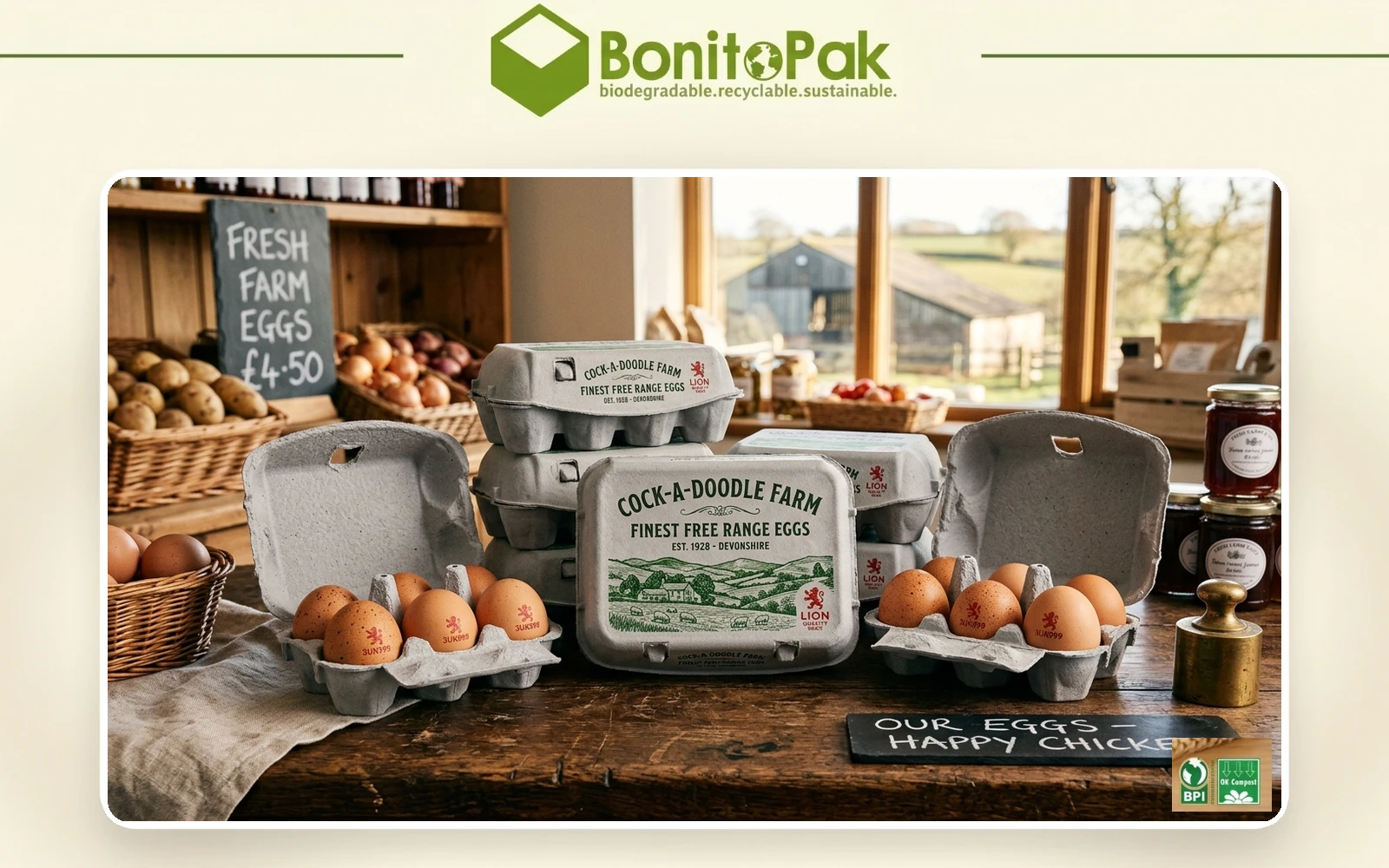
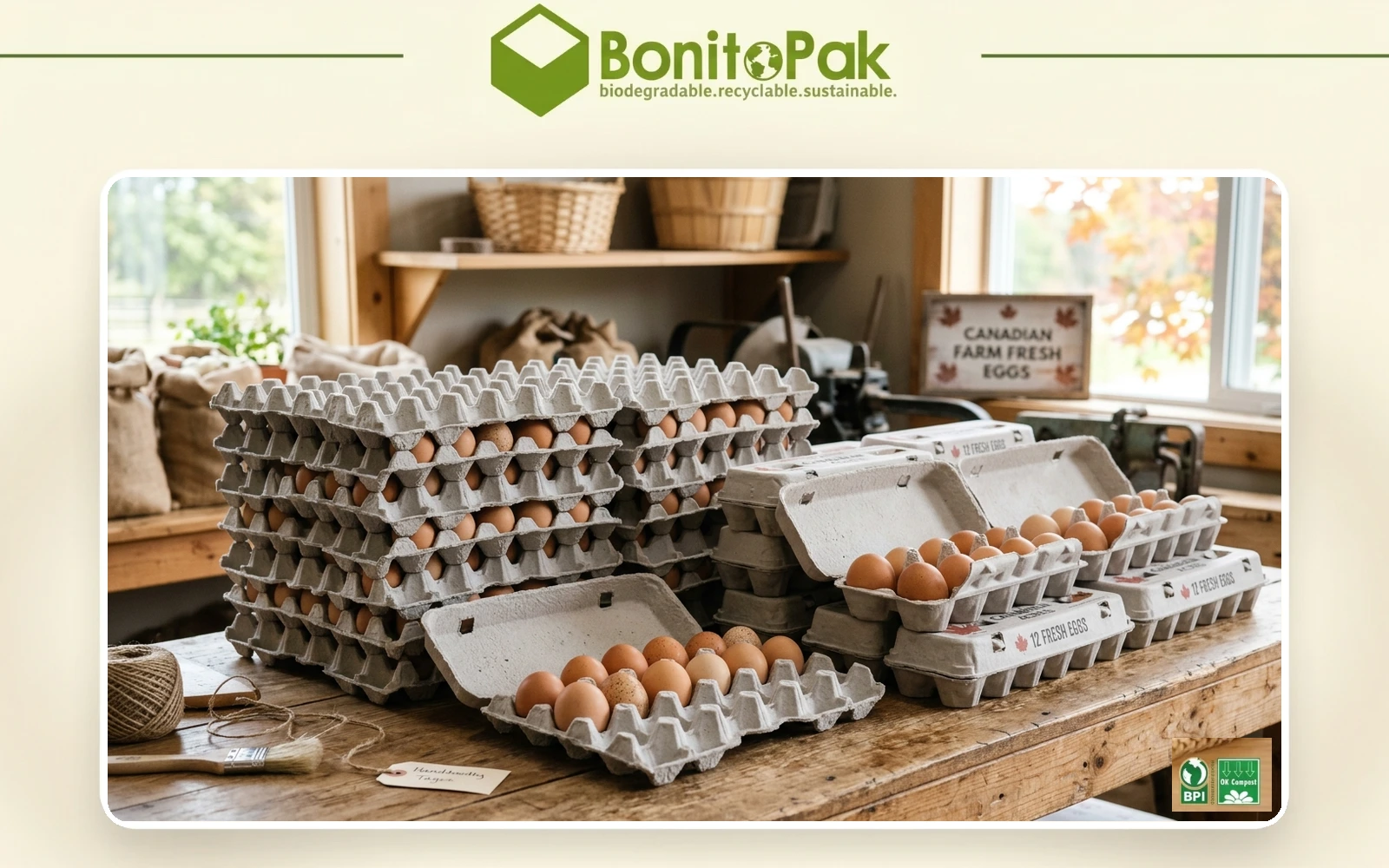
Canada has a smaller domestic moulded pulp sector than the United States, but it has a genuine one, and its largest player has been making fibre packaging since the Great Depression. For Canadian egg producers that means real domestic options for standard trays and flats, and a narrower choice once a specification goes outside the standard range.
This guide to egg tray manufacturers in Canada covers the domestic manufacturing picture, the distributors most Canadian producers actually buy from, the bilingual labelling requirement that catches importers out, and when looking overseas starts to make sense.
The Domestic Manufacturing Picture
CKF Inc
The anchor of Canadian moulded pulp. CKF is a Canadian-owned manufacturer of moulded pulp, foam and rPET food and protective packaging, running six plants across Canada and two in the United States, split into four pulp plants, two rPET plants and two foam plants. Its directory lists locations including Langley in British Columbia, Hantsport in Nova Scotia and Rexdale in Ontario, plus Clinton, Iowa and El Paso, Texas.
The company was founded in 1933 as Canadian Keyes Fibre Company Limited by R.A. Jodrey, and renamed CKF Inc in 1982. It started with pie plates and cake circles at a single Hantsport plant and now produces over a thousand SKUs. Its product range includes egg cartons, pulp produce packaging and moulded fibre cup carriers.
Best for: Canadian producers wanting a domestic moulded pulp supplier with coast-to-coast plant coverage and a long track record. Limitation: a broad portfolio across pulp, foam and rPET means egg packaging is one line among many rather than a specialty focus.
What Else Is Domestic
Beyond CKF, moulded pulp manufacturers Canada can claim as its own are few, and egg tray supply leans heavily on distributors, on US manufacturers shipping north, and on imports. Several US producers serve the Canadian market directly, including Huhtamaki North America, which makes moulded fibre egg cartons from 100% recycled material, and Pactiv Evergreen, which runs a dedicated egg packaging line.
The practical consequence: when a Canadian supplier quotes you, ask where the trays are actually made. “Canadian supplier” and “made in Canada” are not the same claim, and the difference matters for lead times, freight and any domestic-content story you want to tell.
Distributors and Foodservice Suppliers
Most Canadian egg carton suppliers are distributors rather than plants, and most producers buy through them.
Foodservice and packaging distributors carry CKF lines among others. Enterprise Paper, for instance, lists CKF flat top pulp blank egg cartons through its regional branches, which is typical of how Canadian stock reaches smaller buyers.
Agricultural and poultry suppliers across the provinces stock egg trays and cartons alongside feed and equipment. These rarely rank in search results but often serve small producers best, and collecting avoids freight entirely.
Online packaging retailers serving Canada cover small quantities, though per-unit pricing reflects that. These are the Canadian egg carton suppliers most small producers meet first.
What to ask a distributor: who manufactures the tray, how many trays per pallet in your format, whether freight to your postal code is included, and what the restocking lead time is for your specific item.
Bilingual Labelling Is Not Optional
Bilingual labelling egg cartons sold in Canada is the requirement that catches buyers importing printed stock, and it is worth getting right before you order volume.
Prepackaged food sold in Canada generally requires mandatory label information in both English and French, under federal food labelling requirements administered through the Canadian Food Inspection Agency. For egg packaging that typically affects the product identity, net quantity, storage instructions and the bilingual elements of grading and handling text.
Three practical consequences:
- Reserve more artwork space than a US carton needs. Two languages take more room than one, and a compliance element with nowhere to sit becomes a reprint or a new mould.
- A US-printed carton is often not Canada-ready. If you are importing printed stock from an American supplier, confirm the bilingual requirement is met rather than assuming.
- Grading and quality terminology differs. Canadian egg grading is a federal system distinct from the USDA grades, so text copied from a US carton may be wrong as well as unilingual.
Confirm your specific obligations with the CFIA or your provincial authority before printing. Requirements change, and this article is general information rather than legal or compliance advice.
Provincial Recycling and EPR
Canadian packaging rules are provincial, and extended producer responsibility programmes are expanding. Several provinces now run EPR for packaging and paper, with producer obligations and fees that vary by material.
Moulded fibre sits well in this environment. It recycles with paper in most Canadian municipal programmes and composts where facilities accept it, which usually places it in a lower fee band than plastic alternatives. Our article on whether egg cartons are recyclable or compostable covers the disposal routes in more detail.
If you sell across several provinces, confirm registration and reporting obligations in each. This is an area where rules have been changing and a supplier cannot answer for you.
When to Look Outside Canada
The gap in the Canadian market is the same shape as in most mid-size markets: standard formats are well served domestically, and bespoke formats are not.
Stay domestic when:
- You need standard 30-cell flats or common retail carton counts
- Lead time matters more than specification
- You want a made-in-Canada story
- Your volume is modest and freight would dominate an import
Look overseas when:
- You need bespoke cell geometry for duck, quail, jumbo or heritage eggs
- You want a custom pulp colour rather than stock grey or white
- You need embossed branding moulded into the tray
- Your annual volume can absorb tooling and a container
The trade-off deserves stating plainly. Ocean freight to Canadian ports adds weeks to a first order against domestic stock, and any Canadian supplier will beat an importer on reorder speed and on bilingual compliance knowledge. What import buys is a tray cut to your eggs.
Our guide to the landed cost of moulded pulp packaging covers the import arithmetic, and the principles apply to Canadian entry as much as American.
The Freight Factor
Canada punishes careless sourcing more than most markets, because of distance.
Moulded fibre fills a pallet or container by volume long before weight, so the number that decides your cost is trays per shipment rather than price per tray.
Landed cost per tray = (tray cost + freight + handling) ÷ trays received
A supplier in Ontario delivering to Alberta carries a freight cost that can exceed any unit price advantage. Two rules follow: ask every supplier for trays per pallet, and buy from the closest supplier whose format fits.
Matching Volume to Supplier
|
Your annual use |
Where to start |
|---|---|
|
Under 5,000 trays |
Local agricultural supplier or online retailer |
|
5,000 to 25,000 |
Regional packaging distributor carrying CKF or US lines |
|
25,000 to 100,000 |
Distributor account, or CKF and US manufacturers direct |
|
Over 100,000 |
Manufacturer contract, or import with bespoke tooling |
|
Non-standard egg type |
Import with bespoke moulds, since domestic formats are limited |
Cell fit matters more than volume tier if your eggs are not standard grades. Our guide to egg carton sizes and counts covers how count and grade pair up, and our article on designing a custom pulp egg tray covers the measurements a bespoke specification needs.
Sourcing Sensibly in Canada
The Canadian picture comes down to a few clear points. CKF is the domestic anchor and has been for ninety years. A large share of what Canadian distributors sell is made in the United States, so ask where trays are actually manufactured. Bilingual labelling needs artwork space reserved from the start. And freight distances mean the closest adequate supplier usually beats the cheapest distant one.
Test a small quantity with your actual eggs over your actual route before committing to pallets. Then ask for trays per pallet and buy as locally as your specification allows.
At BonitoPak we make moulded pulp egg cartons and custom egg trays with moulds cut per project from 1,000 pieces in six pulp colours. For standard flats delivered next week, a Canadian distributor is the better answer and we will tell you so. For a tray cut to your eggs, send us your specification and annual volume.
FAQs
Q: Who are the main egg tray manufacturers in Canada? A: Among moulded pulp manufacturers Canada hosts, CKF Inc is the principal Canadian-owned one, running four pulp plants across Canada with locations including Hantsport, Rexdale and Langley. Much remaining supply comes from US manufacturers and importers selling through Canadian distributors.
Q: Are egg trays sold in Canada actually made in Canada? A: Often not. Many Canadian distributors carry US-manufactured or imported trays. Ask where the tray is manufactured rather than where the supplier is based, since the two claims differ and affect lead time and freight.
Q: Do egg cartons sold in Canada need bilingual labels? A: Bilingual labelling egg cartons require is the norm, since prepackaged food in Canada generally needs mandatory information in English and French. Reserve extra artwork space, and confirm specifics with the CFIA.
Q: Is it worth importing egg trays into Canada? A: It depends on specification rather than price. Import suits bespoke cell geometry, custom pulp colours and embossed branding at volume. For standard flats in modest quantities, domestic stock almost always wins on freight and lead time.
Q: How does moulded fibre fit Canadian recycling rules? A: Plain moulded fibre recycles with paper in most Canadian municipal programmes and composts where facilities accept it. Provincial EPR fees generally favour fibre over plastic, though obligations vary by province and are worth confirming individually.