The phrase “bulk” means four completely different things in this category. For a farm selling at a weekend market, a case of 250 cartons is bulk. For a packing house, bulk starts at a truckload. The price per carton between those two points can differ by more than half, and the supplier you should call is different at each step.
Bulk egg cartons USA producers buy well come down to picking the right tier first. This guide breaks the US market into four buying tiers, names where to buy at each one, and sets out the freight arithmetic that decides your real cost. Because with a light, bulky product, freight is often the line that matters more than the quote.
The Four Buying Tiers
|
Tier |
Typical quantity |
Where to buy |
What drives your cost |
|---|---|---|---|
|
Case |
100 to 500 cartons |
Online specialist retailers |
Retail markup, parcel shipping |
|
Pallet |
2,000 to 10,000 |
Specialist distributors |
Freight class, LTL rates |
|
Truckload |
20,000 to 100,000 |
Distributors or domestic manufacturers |
Full truckload rates, warehouse space |
|
Container |
100,000 plus |
Domestic manufacturers or import |
Ocean freight, tooling if custom |
Find your tier before you call anyone. Asking a manufacturer for 500 cartons wastes everyone’s time, and asking a retailer for 100,000 gets you a price three times what you should pay.
Tier 1: Case Quantities
This is where most small farms start, and the suppliers are genuinely good at it.
The Egg Carton Store stocks paper-pulp cartons in printed, blank, view-style, 6-egg, jumbo and colored formats, plus the Local Hens branded line, selling from single bundles upward.
EggCartons.Com ships cartons free within the continental United States, which matters more than it sounds for a product this bulky. Their published pricing is tiered, and they describe pallet quantity as their wholesale pricing, with savings of up to 80% against the smaller-quantity price.
MT Products supplies printed and blank beige and natural pulp cartons in retail pack sizes, widely available through general retail channels.
Poultry Cartons covers chicken, duck, quail and bantam formats, which matters if you keep anything other than standard layers.
Realistic bulk egg carton pricing. At the time of writing, retail listings ran around 68 cents per carton for a 250-pack of blank natural dozen cartons. That is three to four times what the same carton costs at container volume, and it is still the right purchase if you only need 250.
Tier 2: Pallet Quantities
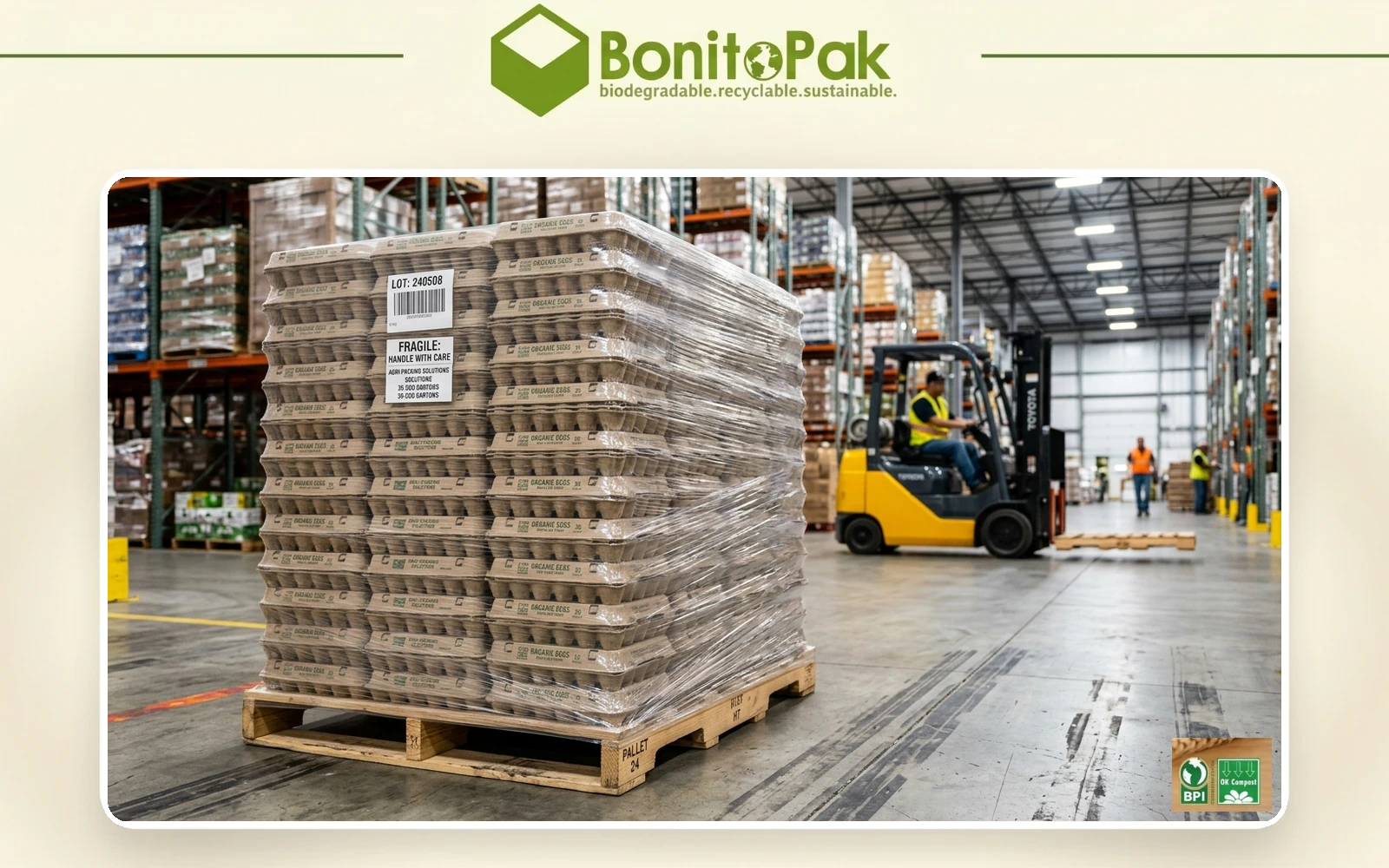
If you buy egg cartons in bulk at all, this is where it starts. The pallet is the first real break point, and the one most growing farms should aim for.
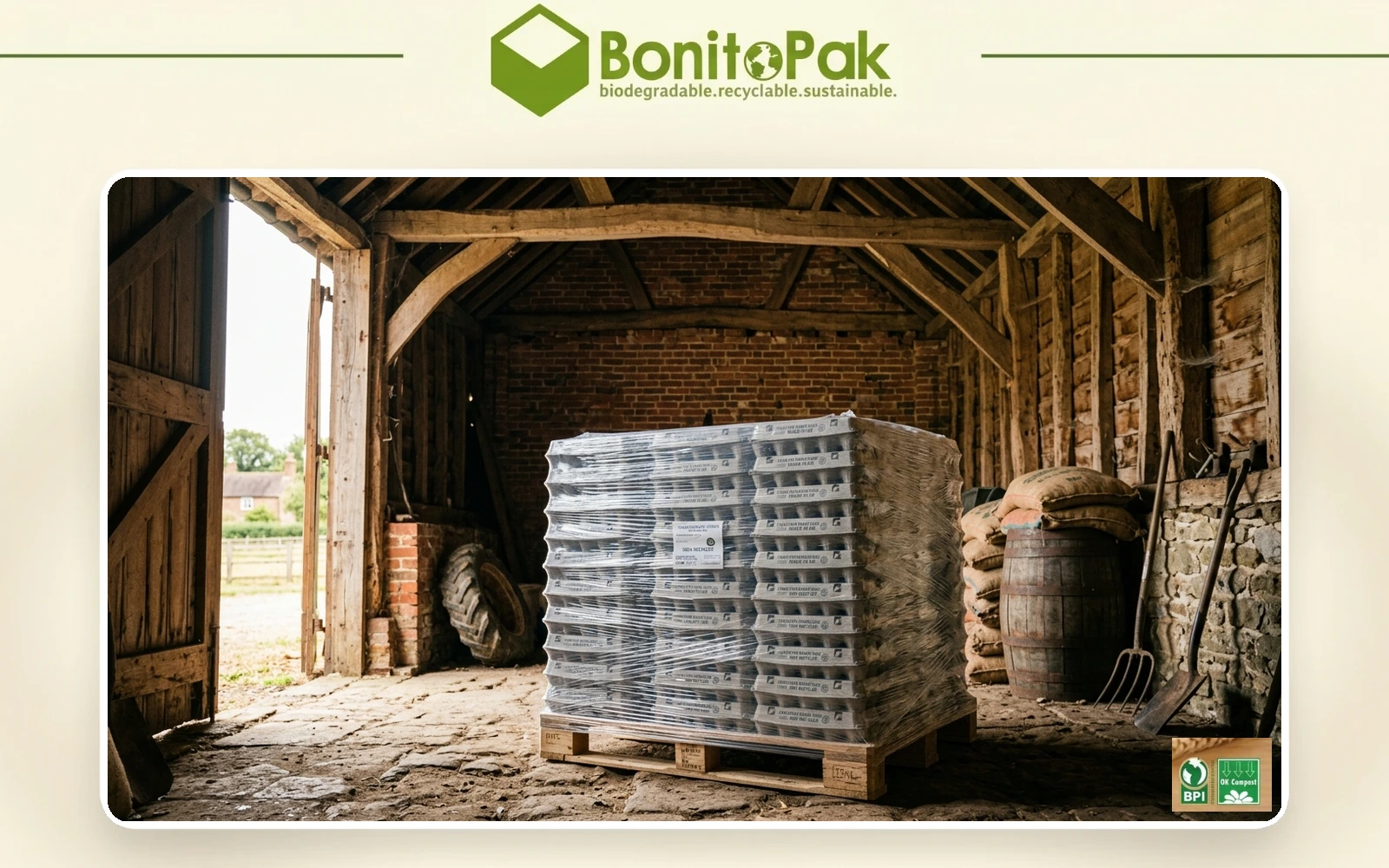
Two things change. First, per-unit pricing drops substantially, with distributors describing pallet quantity as their wholesale tier. Second, you move from parcel shipping to freight, which means an LTL carrier, a delivery appointment, and a decision about whether you have a loading dock.
Ask these before ordering a pallet:
- How many cartons are on a pallet for my specific format?
- Is freight included or quoted separately?
- Do you need a dock, or is liftgate delivery available?
- What is the pallet footprint and height, so I know it fits my storage?
That third question catches people. Liftgate service is a real surcharge and many farms do not have a dock.
Where to buy: the same specialist distributors as Tier 1 all sell by the pallet, and this is the volume where asking for a quote rather than using the website price starts paying off.
Tier 3: Truckload Quantities
At this point you are talking to distributors on account terms, or directly to US manufacturers.
Domestic manufacturers worth knowing:
- Huhtamaki North America makes molded fiber egg cartons from 100% recycled material in 12-count and 18-count, manufactured in the United States, with Smiley-Front and FlatTop styles.
- Pactiv Evergreen runs a dedicated egg packaging line covering fiber and plastic formats.
- Henry Molded Products in Lebanon, Pennsylvania has supplied molded pulp for decades and is an International Molded Fiber Association member.
- TekniPlex Consumer Products introduced an egg carton with 25% post-consumer recycled content.
- CKF Inc is Canadian-owned but runs plants in the United States as well as Canada, and makes egg cartons among a broad moulded pulp range.
At truckload volume, warehouse space becomes a genuine constraint. Molded fiber nests tightly, which helps, but a truckload of cartons still occupies real floor area for weeks. Work out where it goes before you order it.
Tier 4: Container Quantities and Custom Work
Above roughly 100,000 cartons a year, two new options open up.
Domestic manufacturer contracts. The large US producers will quote annual volumes with scheduled call-offs, which solves the warehouse problem.
Import. This is where custom tooling becomes viable, since the tooling charge spreads across enough units to disappear. It is also where wholesale egg cartons stop being a commodity purchase and start being a specification.
The trade-off is honest. Import adds roughly four to six weeks to a first order against buying domestic stock, and a domestic supplier will always win on reorder speed. What you get is a carton cut to your eggs, in a color nobody else has, usually at a lower unit price.
Our guide to what actually drives price at volume covers the pricing mechanics in more depth, and our buyer’s guide to US egg tray manufacturers covers the domestic options.
The Freight Math Nobody Shows You
This is the part that changes decisions, and it is simple arithmetic.
Molded fiber is light and bulky. You will fill a truck or a container by volume long before you reach its weight limit. So the number that matters is not price per carton but cartons per shipment.
Landed cost per carton = (carton cost + freight + handling) ÷ cartons received
Two consequences follow.
Nesting is money. Cartons that nest tightly carry far more units per pallet and per container. When comparing two suppliers, ask each for cartons per pallet and cartons per container. A slightly dearer carton that nests better can land cheaper.
Part loads are expensive. A half-filled pallet or a part-filled container carries almost the same freight cost as a full one. Consolidating two orders into one shipment is often the single biggest saving available to a mid-size buyer.
What Else Changes at Volume
|
Factor |
Small quantity |
Bulk |
|---|---|---|
|
Price per carton |
Highest |
Lowest |
|
Payment terms |
Card at checkout |
Invoice, sometimes deposit |
|
Lead time |
Days |
Weeks, or months if custom |
|
Storage burden |
Minimal |
Real, and needs planning |
|
Format choice |
Stock only |
Custom becomes possible |
|
Risk if wrong |
A wasted case |
A wasted container |
That last row deserves respect. The most expensive mistake in bulk egg carton pricing is committing to volume before testing fit. Order a case, test it with your actual eggs over your actual delivery route, then scale. Our article on why eggs crack in transit covers what to look for.
Common Mistakes When Buying in Bulk
- Buying on unit price alone. Bulk egg carton pricing looks simple until freight and storage erase a two-cent saving.
- Ordering a part pallet. You pay most of the full freight for fewer cartons.
- Not checking cell fit first. A cheap carton that cracks eggs costs more than a dear one.
- Forgetting labeling compliance. Pre-printed stock may carry text that does not apply to your eggs, and most state egg laws require that to be removed or covered. Our guide to egg carton labels and USDA and FDA requirements covers what must appear.
- Skipping the nesting question. It is the single most useful number in this category.
- Buying a year of stock to get a price break. Fiber absorbs moisture in damp storage, and cash tied up in cartons is cash not working elsewhere.
Matching Your Volume to a Supplier
|
Your annual use |
Buy from |
|---|---|
|
Under 5,000 cartons |
Online specialist retailers, by the case |
|
5,000 to 25,000 |
Specialist distributors, by the pallet |
|
25,000 to 100,000 |
Distributor account or domestic manufacturer |
|
Over 100,000 |
Manufacturer contract, or import with custom tooling |
|
Any volume, non-standard egg |
A manufacturer who cuts tooling |
If your eggs are duck, quail, jumbo or anything other than standard grades, format matters more than volume tier. Our guide to egg carton sizes and counts covers how count and grade pair up.
Buying Bulk Without Overbuying
Bulk egg cartons USA buyers purchase well tend to follow the same pattern. Test a case. Move to pallets when usage justifies it. Ask every supplier for cartons per pallet and per container rather than just price. Consolidate shipments. And only commit to container volume once the format is proven over a full season.
At BonitoPak we produce molded pulp egg cartons and custom egg trays at container volume from Dongguan, with custom tooling from 1,000 pieces and six pulp colors. If you are at Tier 1 or 2, a US distributor will serve you better and we will say so. If you are at Tier 4 and want a carton nobody else has, send us your egg specification and annual volume.
FAQs
Q: How many egg cartons are on a pallet? A: It varies by format and how tightly the carton nests, so ask your supplier for the figure on your specific carton. It is the number that turns a freight quote into a real cost per carton, and few buyers request it.
Q: What is the cheapest way to buy egg cartons in bulk? A: Full pallets or full containers, since part loads carry nearly the same freight as full ones. Consolidating orders into fewer, fuller shipments usually saves more than negotiating a lower unit price.
Q: Do bulk egg cartons ship free in the USA? A: Some distributors ship free within the continental United States at case quantities, which is significant for a bulky product. At pallet volume and above, freight is normally quoted separately and may include liftgate surcharges.
Q: How much cheaper are wholesale egg cartons than retail packs? A: Substantially. One specialist distributor describes pallet pricing as up to 80% below its smaller-quantity price. Compare landed cost per carton rather than list price, since freight differs sharply between tiers.
Q: Should I buy a year of cartons at once for the discount? A: Usually not. Fiber absorbs moisture in damp storage and loses strength, cash is tied up, and your format may change. Buy to a quarter or a season unless storage is dry and your specification is settled.