
By Leo Chan | Writer, BonitoPak | 20+ years in molded pulp packaging
Published: 12 August 2026 | Last reviewed: 12 August 2026
Egg flats are open 30 cell trays that stack and nest for volume handling, with no lid and no branding. Egg cartons close around the eggs for retail sale and labeling. Flats cost less per egg and move product. Cartons protect and sell it.
Buyers often treat these as two versions of the same thing. They are not. One is a handling format and the other is a selling format, and choosing the wrong one either adds cost you do not need or leaves eggs unprotected at the point where protection matters most.
This guide covers what separates them, the case and pallet math that usually decides it, and why a lot of operations end up running both.
What an Egg Flat Actually Is
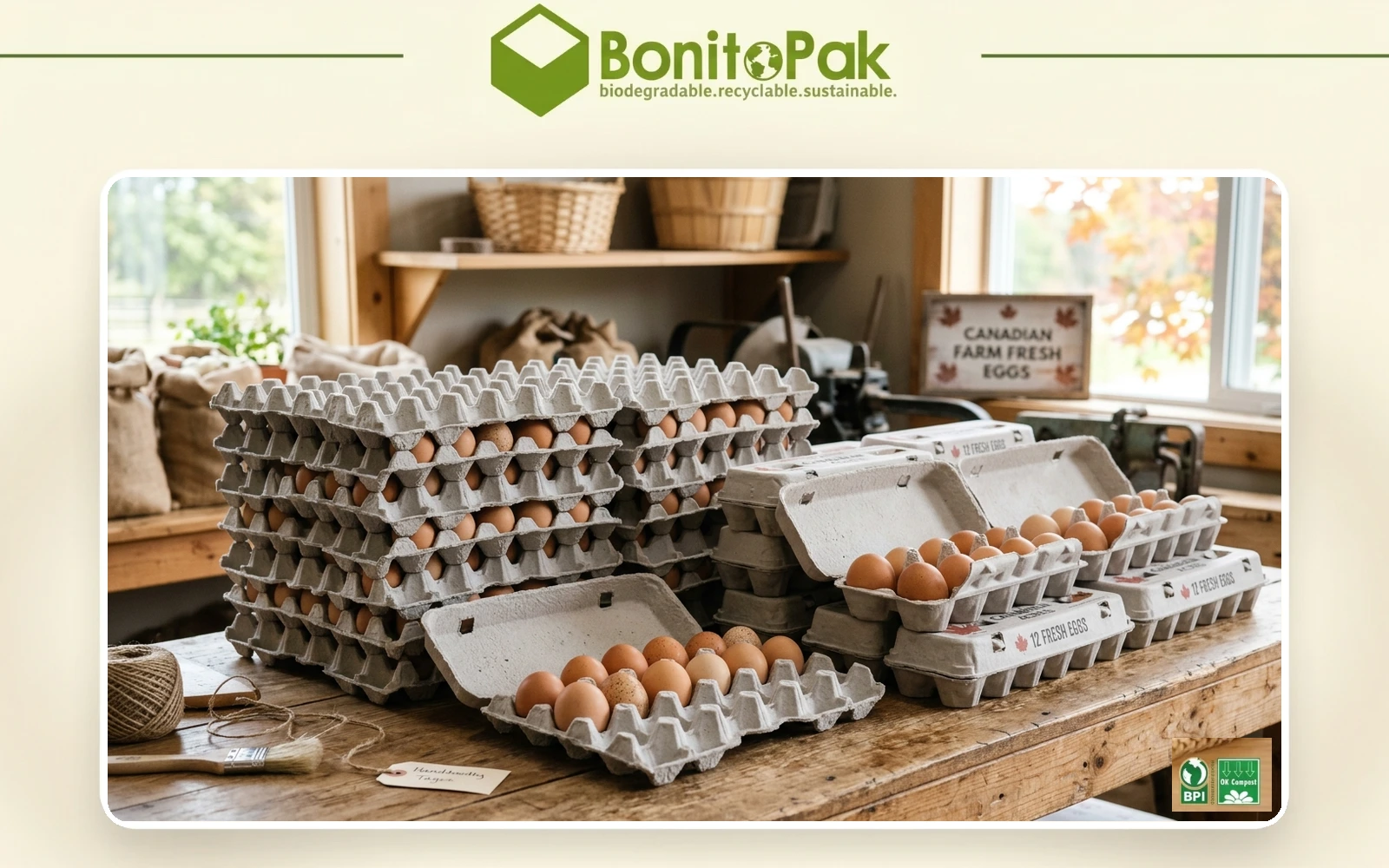
An egg flat is a single layer molded fiber tray with a grid of open cells, almost always 5 by 6 for a 30 egg capacity. There is no lid. Eggs sit exposed at the top, and protection above comes from the base of the next flat stacked on it.
The dimensions are close to standardized across the industry, which is what allows flats from different suppliers to stack together and fit the same cases. A typical 30 cell flat runs around 11.7 to 12 inches square with a height near 1.75 to 1.9 inches. Huhtamaki publishes its filler flat at 11-11/16 inches square with a height of 1-7/8 inches, a cell center pitch of 1-7/8 inches and a nested pitch of 11/32 inch.
That last figure is the one worth paying attention to. Nested pitch is how much height each additional tray adds once trays are stacked into each other. At roughly a third of an inch, a stack of twelve egg filler flats takes up a fraction of the height that twelve non nesting trays would. Cold storage is expensive per cubic foot, so that number translates directly into money.
The Terminology Is Genuinely Confusing
Suppliers use several names for the same product, which makes sourcing harder than it should be. Here is how the words actually get used:
| Term | What it usually means | Notes |
|---|---|---|
| Egg flat | Open 30 cell molded fiber tray | Most common term in North America |
| Filler flat | The same tray | Egg filler flats is the full form used on spec sheets |
| 30 egg tray | The same tray | Common in international sourcing |
| Egg crate | Reusable rigid plastic version | Washable, meant for repeat cycles |
| Egg carton | Closed pack with a hinged lid | 6, 12, 18 or 30 count for retail |
If you are requesting a quote, specify cell count, cell geometry and material rather than relying on the name. Two suppliers can send very different products against the same word. Asking for egg filler flats and asking for egg crates will get you two different materials from most catalogs, and the price gap between them is wide enough to matter at volume.
Egg Flats vs Egg Cartons: A Direct Comparison
| Factor | Open flats | Egg cartons |
|---|---|---|
| Capacity | 30 eggs, open 5 by 6 grid | 6, 12, 18 or 30 with a lid |
| Top protection | From the tray stacked above | From the carton’s own lid |
| Cost per egg | Lower | Higher |
| Branding surface | Minimal, no lid to print | Full lid for print or emboss |
| Retail ready | No | Yes |
| Stacking | Nests, very space efficient | Stacks but does not nest |
| Typical buyer | Processor, wholesaler, foodservice | Retailer, farm shop, direct to consumer |
| Single egg access | Immediate | Requires opening the pack |
When an Open Tray Is the Right Choice
Volume moving between businesses
If eggs are travelling from a grading facility to a processor, a bakery, a restaurant group or a distribution center, nobody in that chain needs a lid or a label. They need the eggs to arrive unbroken and to come out of the stack quickly. A flat does that at the lowest cost per egg available.
Cold storage where cubic feet cost money
Nesting is the argument. Because trays sit down into each other rather than resting on top, a pallet of flats holds substantially more eggs than the same pallet footprint of cartons. Over a full cold room that difference is large enough to change storage economics on its own.
Washing and grading lines
Open trays let eggs be inspected, candled and transferred without opening anything. On a grading line, any step that requires opening a lid is a step that slows throughput.
Foodservice kitchens
A commercial kitchen pulling eggs continuously through a shift wants immediate access. Flats sit in the walk in and the cook takes what is needed without handling packaging at all.
When a Carton Earns Its Extra Cost
Anything sold to a consumer
Retail sale generally requires closed, labeled packaging carrying grade, size, safe handling and pack date information. Grade and size designations follow USDA egg grading standards, and that information has to appear somewhere the buyer can read it. A flat has nowhere to put it.
When the packaging is doing marketing work
A carton lid is display space. For a farm selling at a premium, that surface carries the brand, the story and the differentiation from the commodity carton beside it. Print, emboss and colored pulp all work on a lid and none of them work on a flat.
Long or rough transit
A closed carton holds each egg between two formed surfaces. Under vibration and repeated handling that is meaningfully better protection than an open tray relying on the flat above it. If eggs are moving through parcel networks or over long distances, the carton is the safer format.
The Case Math That Usually Decides It
Most operations reach a decision faster by working the numbers than by comparing features.
| Unit | Flats | Cartons (12 count) |
|---|---|---|
| Eggs per unit | 30 | 12 |
| Units per 30 dozen case | 12 flats | 30 cartons |
| Eggs per case | 360 | 360 |
| Relative stack height | Low, trays nest | Higher, cartons do not nest |
| Handling steps to fill | One transfer | One transfer plus closing each lid |
A standard case holds 30 dozen either way. The difference is the space that case occupies, the labor to fill it and the cost of the packaging itself. Where the eggs are going determines which of those three matters most.
Labor is the figure most operations underestimate. Filling thirty cartons means thirty lid closures, and at line speed that is a real cost per case that never appears on the packaging invoice. Buyers pricing bulk egg trays against cartons on unit cost alone tend to miss it, then find the saving is larger than the quote suggested once handling time is included.
What We See on Our Own Production Line
We manufacture both formats at our facility in Chashan Town, Dongguan, and the difference between them starts at the forming process rather than at the mold.
Flats and cartons come off different processes
Flats are almost always a dry pressing product. Dry pressed trays finish at a wall thickness of roughly 2.5 to 3.0mm, which is thick, bulky fiber built for stacking strength and load bearing rather than appearance. That is exactly what a flat needs, because the tray above is resting its full weight on the eggs below.
Retail cartons are usually wet pressed, finishing at roughly 0.7 to 1.2mm. The wall is thinner and denser, the surface is smoother, and emboss detail holds cleanly. That finish is what makes a carton lid usable as a branding surface. It also means a wet pressed part is the wrong choice for a flat, because you would be paying for surface quality on a face nobody looks at.
Nesting is a tooling decision, not a material one
How well a flat nests is set by the draft angle on the cell walls when the mold is cut. Too little draft and trays lock together and are hard to separate on the line. Too much and the stack height grows and you lose the storage advantage that made you choose flats. This is one of the specifications we confirm before cutting tooling rather than after, because it cannot be adjusted later without a new mold.
Cell geometry has to match the grade
The most common sourcing mistake we see is specifying a count without specifying a grade. A 30 cell tray cut for large eggs will not hold jumbo securely, and a jumbo tray leaves medium eggs loose enough to move in transit. We set cell depth and diameter to the actual egg grade rather than a standard large profile, which is covered in more detail in our guide to egg carton sizes and counts.
The same principle applies harder to non chicken eggs. Duck, goose, turkey and quail all need different geometry, and quail in particular needs a much shallower, tighter cell than any chicken format provides, as we explain in our piece on quail egg carton cell sizing. Because we cut molds per project, sample molds run in about 7 days with production molds following around 8 days after geometry approval, and minimums start at 1,000 pieces.
Most Operations End Up Running Both
The choice is rarely permanent. A typical mixed setup looks like this:
- Flats from the layer house through washing, grading and cold storage.
- Flats out to processors, bakeries and foodservice accounts.
- Cartons for anything reaching a consumer, whether at retail, a farm stand or direct shipping.
- Flats retained inside shipping cases as a secondary layer under cartons for long transit.
Ordering patterns usually differ too. Cartons are bought to a forecast because they carry printed branding and a longer changeover, while bulk egg trays are commonly bought in larger, less frequent drops because they are unprinted and interchangeable. Planning the two on the same cycle is a common source of either overstock or shortage.
If you are running both, keep the fiber specification consistent across formats. It simplifies procurement, keeps disposal guidance the same for the customer, and means one supplier conversation instead of two.
Putting This Into Practice
Decide by destination rather than by price. If the eggs are moving between businesses and will be transferred again before anyone eats them, bulk egg trays are the cheaper and more space efficient format and the lack of a lid costs you nothing. If a consumer will pick the pack up, you need a carton, and the lid is doing work that justifies the extra cost.
Whichever way you go, specify grade and bird type alongside the count. That single detail prevents most of the fit problems that turn into breakage claims later.
At BonitoPak we produce both dry pressed flats and wet pressed retail cartons on the same site, with in house mold design, so a mixed program can be specified to one fiber standard across every format. If you are pricing a switch or adding a second format, the tooling conversation is easier before the season than during it.
About the Author
Leo Chan is the founder of BonitoPak and has spent more than 20 years in molded pulp packaging, working with over 500 brands moving from plastic and foam to fiber based formats. BonitoPak manufactures molded pulp packaging at its facility in Chashan Town, Dongguan, Guangdong, running both wet pressing and dry pressing lines across six pulp systems, with in house mold design and tooling. This comparison reflects specifications set on that production line alongside published industry tray dimensions.
Frequently Asked Questions
Q: Are egg flats and filler flats the same thing?
A: Yes. Flats, filler flats and 30 egg trays all describe the same open 5 by 6 molded tray. Egg crate usually means a reusable plastic version. The words are used interchangeably by most suppliers.
Q: How many flats fit in a standard case?
A: A standard 30 dozen case holds 12 flats stacked, giving 360 eggs. Nesting means that stack occupies far less height than 12 loose trays would, which is what makes flats efficient in cold storage.
Q: Can eggs be sold to consumers on flats?
A: Generally no at retail. Most jurisdictions require labeled, closed packaging for consumer sale. Flats are used for wholesale, foodservice and processing where the buyer transfers eggs or uses them directly.
Q: Do standard flats work for duck or quail eggs?
A: Not the standard 5 by 6 chicken flat. Duck eggs sit too tall in the cell and quail eggs move freely. Both need cell geometry cut for the actual shell dimensions rather than a chicken profile.
Q: Are plastic flats cheaper than pulp over time?
A: They can be for closed loop operations that wash and reuse them, such as restaurant delivery routes. For one way distribution where trays leave with the product, pulp is almost always the lower total cost.