By Leo Chan, Senior Packaging Consultant · November 14, 2026
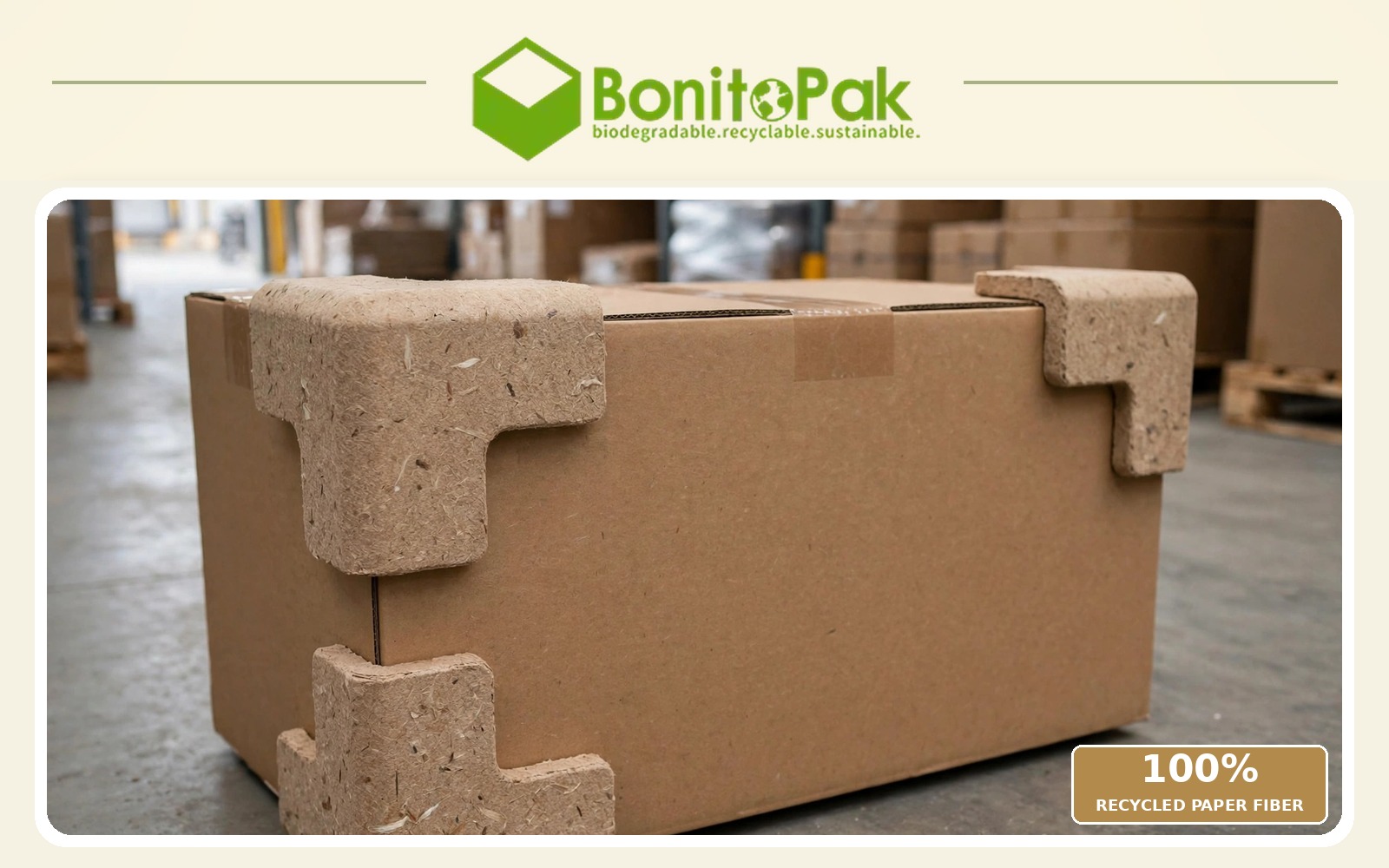
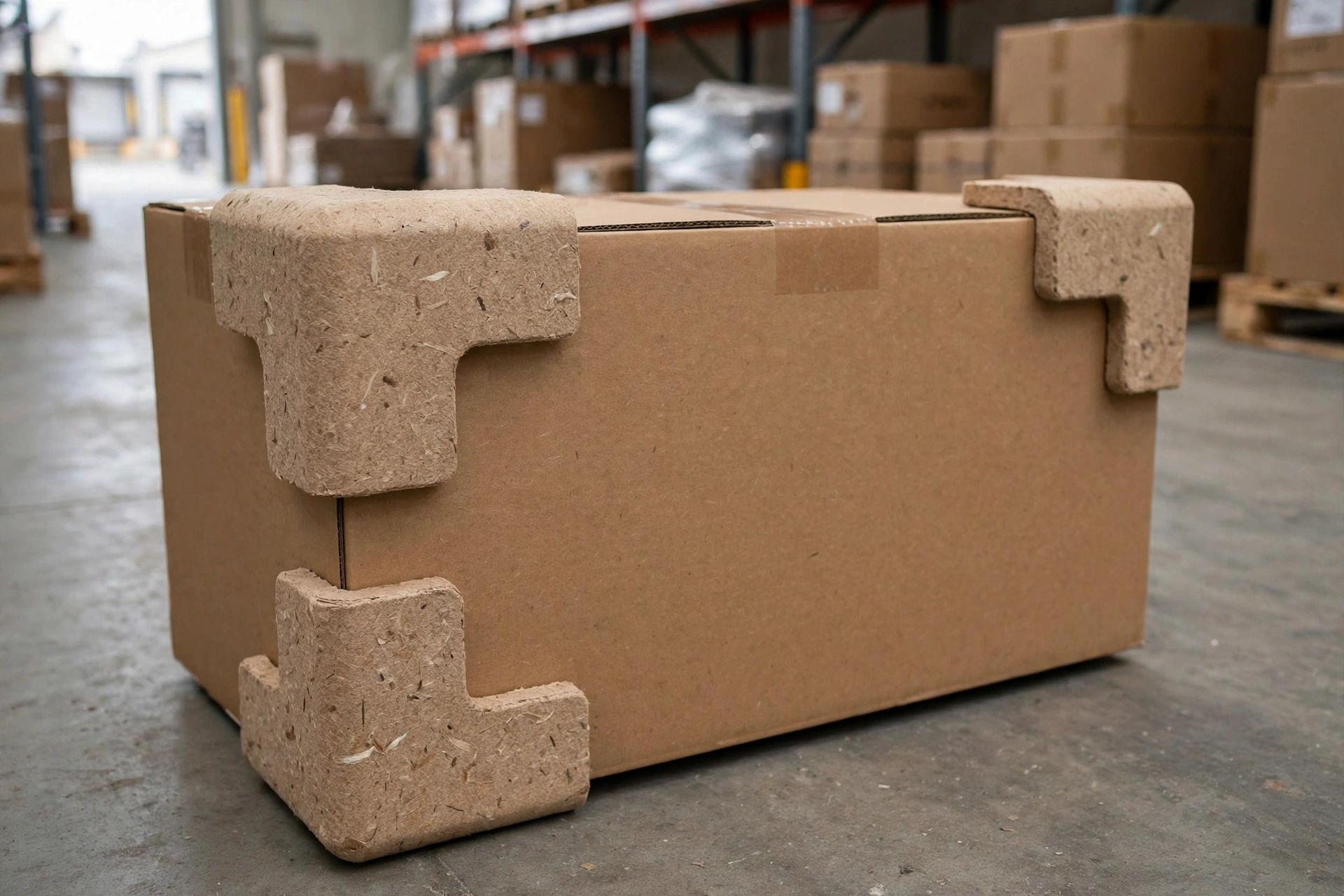
Molded pulp corner protectors are thick fiber blocks shaped to fit the corners of a product, such as a TV, a cabinet door or a glass panel. They absorb the impact when a carton is dropped on a corner and keep the product off the box wall. They replace EPS foam corner blocks, plastic corner guards and bubble wrap in shipping packaging, giving eco-friendly protection that customers can recycle with their cardboard.
Corners take the hardest hits in transit. A carton dropped on one corner concentrates the whole impact on a small area, and that is where panels chip, glass cracks and frames bend. Most damage during shipping starts at a corner or an edge. Edge protectors do the same job along long sides, and cradles hold round or cylindrical goods still.
Edge and corner protectors are among the simplest packaging products to switch to fiber, and they suit buyers who want a sustainable packaging solution without redesigning the whole box. This guide explains how these three part types work, and which fiber and process to choose. It also covers design for your product weight, testing, and what to expect on tooling, MOQ and lead time. The details come from the protective parts we form at our manufacturing plant in Dongguan, where sustainability targets from customers now drive most foam replacement projects.
What Are Molded Pulp Corner Protectors?
Molded pulp corner protectors are three-sided fiber pockets that slide over the corners of a flat or boxy product. Their thick, ribbed walls crush slightly on impact, which spreads the force and slows the product down. Four corners per item is the usual set, though heavy goods sometimes add edge pieces between them.
A corner protector does three things at once. It cushions drops onto the carton corner and gives shock absorption where a pad or a sheet of foam cannot reach. It holds the product centered so the sides never touch the box wall. And it braces the carton itself, which helps when cartons are stacked on a pallet and wrapped in stretch film. That bracing adds load security during handling and storage.
Typical products include flat screen TVs and monitors, picture frames and mirrors, glass shelves and tabletops, cabinet doors, flat pack furniture panels, stone and ceramic tiles, solar panels, and small appliances with sharp corners.
Most corner protectors are made by thick wall or dry press molding from recycled paper fiber. The surface is rough, the walls are thick, and nobody sees the part once the box is open. That keeps the focus on strength and cost rather than looks.
How Do Edge Protectors and Cradles Differ From Corner Protectors?
Edge protectors are long L-shaped or U-shaped fiber channels that cover the sides of a panel between its corners. Cradles are saddle-shaped supports with a curved groove that hold round goods, such as rolls, tubes, pipes and drums, so they cannot roll. All three are molded protective packaging, usually dry pressed from recycled fiber.
Edge protectors. Long products, such as doors, countertops and window frames, get damaged along the edge as well as at the corners. A molded edge protector runs the length of the side. It cushions side impacts and spreads strapping pressure so bands do not cut into the product. Molded pulp edge protectors are thicker and better at cushioning than flat paperboard edge boards, which mainly add stiffness.
Cradles. Rolls of film, fabric, paper and carpet, as well as pipes and drums, need to stay still on a pallet. A molded cradle has one or more grooves sized to the roll diameter. Several cradles under a stack of rolls stop them shifting and keep the roll surface off the pallet deck. Our custom molded fiber roll cradles are dry pressed with custom diameters, groove patterns and lengths, with a 5,000 piece MOQ.
End caps. For appliances and electronics, a full end cap covers the whole end of the product instead of just the corners. End caps suit products with fragile parts near the ends, such as a monitor stand or a kettle spout.
Which Material and Process Work Best for Corner and Edge Protectors?
Dry pressed or thick wall molded pulp made from recycled corrugated or paper works best for most corner protectors, edge protectors and cradles. The thick wall absorbs impact, the fiber is low cost, and appearance does not matter. Bagasse is an option for brands that want a cleaner look or a specific fiber claim.
Recycled corrugated and paper. Old corrugated boxes and paper are repulped into a gray or brown recycled paper pulp. Using recycled materials turns waste into product protection. It forms thick, strong walls and is the standard choice for heavy protective parts.
Bagasse. Sugarcane fiber is biodegradable and forms a finer surface. It is used when the protector is visible at unboxing, such as for premium furniture or retail glassware.
Thick wall vs dry pressed. Thick wall parts use a heavy fiber layer dried slowly. They are the strongest and suit very heavy goods. Dry pressed parts are thinner, at around 1.5 to 3.0 mm on our lines, and suit lighter products and cradles. Wet pressed fiber, at 0.7 to 1.2 mm, is too thin for most corner protection and costs more, so we rarely recommend it here.
We cover the four production types in more detail in our guide to the 4 types of molded pulp.
Standard Corner Protectors or Custom Molded?
Standard pulp corner protectors run on molds a factory already owns, so you pay no tooling and get parts fast. They suit common box corners, frames and panels in set sizes. Custom molded corner protectors are cut for your product’s exact corner shape, weight and drop height, so they protect better but need a mold and a sample round.
Start by asking which standard shapes the factory has. We keep 65+ molds in house, and a standard corner often fits flat goods such as frames, boards and panels with only a change to the carton size. That gives you cost-effective protection with the flexibility to switch to a custom part later.
Choose custom when the corner is not square, the product is heavy or a retailer test standard must be met. Custom also pays when volume is high enough that a better fit covers the tool. Our custom molded pulp packaging service covers the custom route from drawing to production.
What are the moisture limits of molded pulp protectors?
Plain recycled fiber absorbs moisture, so protectors left in a damp warehouse or a wet container lose some stiffness. Keep them in dry storage before packing, and for humid sea freight or cold storage ask about water resistant additives. Check how any additive affects recycling and compost claims before you approve it.
How Do Molded Pulp Protectors Compare With EPS Foam and Plastic?
Molded pulp corner protectors match EPS foam for most consumer goods and furniture in a shipped package, and they win on end-of-life options, nesting for storage and stacking strength. EPS still cushions better per gram for very heavy, very fragile items. Plastic corner guards resist scratches but give little cushioning. Paperboard edge boards add stiffness but little shock protection.
| Factor | Molded pulp protectors | EPS foam corner blocks | Plastic corner guards | Paperboard edge boards |
|---|---|---|---|---|
| Raw material | Recycled paper or plant fiber | Expanded polystyrene | PE, PP or PVC | Laminated paperboard |
| Shock cushioning | Good for most goods | Very good, light weight | Low | Low |
| Custom fit | Molded to the product | Molded to the product | Standard sizes | Standard angles |
| Stacking and bracing | Good, braces the carton | Fair | Low | Good |
| Empty storage | Nests tightly | Bulky, does not nest | Nests | Ships flat |
| Curbside recycling in the US | Accepted with paper in most programs | Rarely accepted | Depends on resin | Widely accepted |
| Tooling | Mold required | Mold required | Off the shelf | Off the shelf |
The nesting point matters more than buyers expect, especially for reducing shipping costs on the way to your packing line. EPS blocks ship and store as solid volume. Molded pulp protectors stack inside each other, so a pallet holds many times more parts and freight to the packing line costs less.
How Do You Design a Molded Pulp Corner Protector?
Design a molded pulp corner protector from the product’s weight, corner shape and drop height. Size the pocket to the corner with a small clearance and add ribs or crush zones on the outer faces. Keep a gap between the product and the carton wall, and add draft so the part releases from the mold. Then drop test the full packed carton.
Product weight. Weight decides wall thickness and rib layout more than anything else. Light frames need a thin dry pressed corner. A 60 lb cabinet needs thick wall parts with deep ribs.
Crush zones. Ribs and hollow bumpers on the outside faces crush first on impact. They act like a car’s crumple zone, absorbing energy so the product does not.
Standoff distance. The protector should hold the product a set distance from every carton wall, so the fiber can cushion the hit before the product feels it. Without that gap, a dent in the carton becomes a dent in the product.
Pocket fit. The corner should slide in by hand without force. A tight pocket tears when packers push it on. A loose one lets the product shift.
Strapping and handling. For edge protectors, plan where straps or tape cross the product. The protector must spread that pressure.
Nesting. Design the outer shape so empty protectors stack inside each other. It cuts storage space at your packing line.
How Should You Test Molded Pulp Protectors?
Test molded pulp protectors with the real product packed in the real carton as one complete package, using a drop test sequence onto corners, edges and faces from the height your carrier and package weight call for. Many shippers follow ISTA test procedures. Fix any failure by changing ribs, fiber or wall thickness before production tooling is cut.
The International Safe Transit Association publishes the ISTA test procedures that many retailers and carriers ask for. They set drop heights by package weight, along with vibration and compression steps, so the same package passes the same test every time. Ask your retailer or carrier which procedure they require.
A practical sequence for a first sample looks like this:
- Pack the product with the sample protectors in the production carton.
- Drop the carton onto one corner, then the three edges that meet at that corner, then the faces.
- Open the carton and check the product, the protectors and the carton.
- Note where the protector crushed, where it did not, and where the product touched the carton.
- Adjust the design and repeat with new samples before approving production tooling.
On our lines, sample molds produce about 10 test pieces in 7 to 10 days. Changing a rib on the sample tool is cheap. Changing it on a multi cavity production mold is not.
What Do Molded Pulp Corner Protectors Cost?
Molded pulp corner protector cost has two parts: a one-time mold and a unit price. The mold cost depends on part size, the number of shapes in a set and cavity count. Unit price depends on part size, wall thickness, fiber and volume. Protective parts run on thicker walls, so fiber use drives price more than finish.
Tooling. Corner sets often need one or two shapes if the product is symmetric. A left and right version, or separate top and bottom corners, add tools. Dry press tooling costs less than wet press tooling.
Unit price. Bigger, thicker parts use more fiber and take longer to dry. Recycled fiber keeps material cost low.
MOQ. Our MOQ starts at 1,000 pieces on most lines. Roll cradles start at 5,000 pieces. Larger parts start higher.
Lead time. A 3D drawing takes about 2 days, samples 7 to 10 days and production molds 8 to 12 days after sample approval.
For a full breakdown, read our guide to molded pulp packaging cost, tooling and MOQ.
Which Industries Use Molded Pulp Corner and Edge Protection?
Corner protectors provide the most value where a heavy package meets hard handling. Furniture, glass and mirrors, TVs and monitors, home appliances, building materials such as tiles and panels, solar panels, and roll goods such as film, fabric and carpet use molded pulp corner protectors, edge protectors and cradles. Each needs a part sized to its weight and shape, so most are custom molded.
Furniture and panels. Flat pack furniture, cabinet doors and tabletops ship with corners and edge protectors on every side.
Glass and mirrors. Frames and glass shelves need corners that hold the glass off the carton wall.
Electronics and appliances. TVs, monitors and appliances use corners, full end caps or molded fiber trays for home appliances in place of EPS.
Industrial and roll goods. Rolls, tubes and drums use cradles to stop rolling and protect the roll surface on the pallet.
Our industrial protective pulp packaging range covers the full set of heavy duty parts.
Ordering Custom Molded Pulp Corner Protectors
To order custom molded pulp corner protectors, send the product or its drawings, its weight, the carton size, the drop test standard you must pass and your annual volume. We reply within 24 hours with a part design, fiber recommendation and tooling plan, then a 3D drawing in about 2 days.
If you are moving off EPS foam, send one of your current foam sets as well. Protectors work best when they are planned with the carton, so share your full packaging and shipping setup. The foam set shows where the product needs support and saves a design round.
Molded protectors are one part of the wider move to fiber packaging, and an ideal first step for brands that want to reduce foam without changing their shipping boxes or mailer formats. Our guide to molded pulp packaging covers the full range, and our custom molded pulp packaging service handles design, tooling and production in one place. Request a quote to start.
Frequently Asked Questions
Are molded pulp corner protectors as strong as EPS foam?
A: For most furniture, glass, appliances and electronics, yes, when the corner is designed for the product weight and tested. EPS still cushions better per gram for very heavy or very fragile goods. Molded pulp adds stacking strength and nests for storage, which EPS does not. A drop test of your packed carton settles the question.
How thick are molded pulp corner protectors?
A: It depends on product weight. Dry pressed parts on our lines run about 1.5 to 3.0 mm, and thick wall parts go heavier for large furniture and appliances. Ribs and crush zones on the outer faces matter as much as wall thickness, so we design both together and confirm them on the sample.
What is the difference between a molded pulp edge protector and a paperboard edge board?
A: A paperboard edge board is a flat laminated strip folded to an angle. It stiffens the edge and spreads strap pressure but gives little shock cushioning. A molded pulp edge protector has a molded shape with ribs that crush on impact, so it cushions and holds the product off the carton wall.
Can molded pulp corner protectors be recycled?
A: Plain recycled fiber protectors with no plastic film or coating can go into paper recycling in most US curbside programs, along with the cardboard carton. Acceptance still varies by city. Protectors with water resistant additives or plastic labels may need to be checked against local rules first.
What is the minimum order for molded pulp roll cradles?
A: Our custom molded fiber roll cradles start at 5,000 pieces. They are dry pressed from recycled paper pulp or virgin bagasse, with custom diameters, groove patterns and lengths, and an optional embossed logo. Other protective parts start at 1,000 pieces on most lines.
How long does it take to make custom corner protectors?
A: On our lines, the 3D drawing takes about 2 days, samples 7 to 10 days and production molds 8 to 12 days after sample approval. Plan at least one round of drop testing on the samples before approving tooling, because a design change on the sample tool is quick and cheap.