By Leo Chan | Founder, BonitoPak | 20+ years in moulded pulp manufacturing Last Updated: October 2026
Custom molded pulp packaging UK buyers commission is now cheaper to own than plastic, and the gap is in the fee rules rather than the unit price. Illustrative pEPR disposal fees for 2026 put paper and board at £210 per tonne at the base amber rate against £455 per tonne for plastic (GOV.UK, year 2 illustrative fees). Plastic packaging with under 30% recycled content also attracts Plastic Packaging Tax at £228.82 per tonne from 1 April 2026. But one fibre category costs more than plastic, and most buyers walk straight into it.
In This Guide
- Why UK fee rules favour fibre
- The composite trap
- What the plastic tax adds
- How RAM ratings work
- What tooling costs
- UK plants or offshore
- What to send with an enquiry
Key Takeaways
- Paper and board sits at £210 per tonne against plastic at £455 at the 2026 base rate, so fibre roughly halves your disposal fee exposure per tonne.
- Fibre-based composite is the most expensive category of all at £525 per tonne, above plastic. Add a plastic window or liner to a fibre pack and you move into it.
- Plastic Packaging Tax adds £228.82 per tonne from 1 April 2026 on plastic components with under 30% recycled content, on top of pEPR.
- The RAM rating decides whether you pay the green, amber or red rate, with red set at 1.2 times amber.
- All 2026 pEPR figures are illustrative estimates and were expected to be confirmed in June 2026, so check for the confirmed schedule before budgeting.
Why UK Fee Rules Now Favour Fibre
Packaging EPR fees make the business placing packaging on the UK market pay for collecting and disposing of it, charged per tonne by material category. Those categories are not priced anything like each other, which turns a material decision into a recurring cost decision.
Here are the illustrative 2026 disposal fees, rounded to the nearest £5. Amber is the base rate, red is 1.2 times amber, and green carries a discount.
|
Material |
Green |
Amber (base) |
Red |
|---|---|---|---|
|
Glass |
£185 |
£205 |
£245 |
|
Paper and board |
£190 |
£210 |
£250 |
|
Other |
£205 |
£225 |
£270 |
|
Aluminium |
£245 |
£270 |
£325 |
|
Steel |
£260 |
£290 |
£345 |
|
Wood |
£410 |
£450 |
£540 |
|
Plastic |
£415 |
£455 |
£545 |
|
Fibre-based composite |
£475 |
£525 |
£630 |
The headline for anyone specifying packaging. Paper and board is the second cheapest category on the table and roughly half the rate of plastic. For a business putting hundreds of tonnes of packaging into the UK each year, that difference is not a rounding error, and it repeats annually.
An important caveat, and it belongs here rather than in a footnote. These are the government’s own current best estimates, described as likely to change significantly as producers submit more data. The green discount of roughly 9% was provisional pending a full year of reported data in April 2026, year 2 tonnages were extrapolated from only the first six months of 2025, and RAM categorisation data covered around 45% of that tonnage. Confirmed fees for 2026 to 2027 were expected in June 2026. Check for the confirmed schedule before you budget off these numbers. The fees also exclude regulator registration charges and the cost of packaging recycling notes.
The Fibre-Based Composite Trap
This is the part almost nobody tells UK packaging buyers, and it can reverse the entire saving above.
Fibre-based composite is priced at £525 per tonne at the amber rate. That is more than plastic, and it is the most expensive category on the whole table. A pack is a composite when fibre is combined with another material that cannot be readily separated.
What pushes a fibre pack into that category in practice:
- A clear plastic window, which is common on retail packaging
- A plastic or foil liner
- A laminate layer for barrier performance
- Any bonded non-fibre element the recycler cannot separate
So a plain moulded fibre tray is charged at £210 per tonne, and the same tray with a plastic window on the lid may be charged at £525. The window has more than doubled your fee rate and moved you above the plastic you were trying to replace.
The practical rule. If you are switching to fibre for fee reasons, switch properly. A partial conversion that leaves a plastic component bonded to the fibre can cost more than not switching at all.
This is the strongest argument for uncoated, unlined fibre that exists in the UK market right now, and it is a commercial argument rather than an environmental one. Our guide to moulded pulp covers which formats need a barrier and which do not, and our materials page sets out the fibre options.
What the Plastic Packaging Tax Adds
The UK plastic packaging tax sits on top of pEPR and is a separate regime with its own test. It applies to plastic packaging components containing less than 30% recycled plastic by weight, at £228.82 per tonne from 1 April 2026, up from £223.69 from April 2025. Registration is required once you manufacture or import 10 tonnes or more of finished plastic packaging components in a rolling 12 month period, regardless of recycled content.
Why the two regimes together change the arithmetic. A plastic component under the recycled content threshold can face both the tax and the higher pEPR rate. Fibre faces neither the tax nor the higher rate. That is two separate cost lines pointing the same direction.
Two things to keep straight, because conflating them produces wrong numbers:
- The 30% recycled content test applies only to the tax, not to pEPR. Hitting 30% recycled content removes the tax liability but does not change your pEPR category.
- The 10 tonne threshold is a registration trigger, not an exemption from the tax on the first 10 tonnes. Check your own position rather than assuming.
This is general information rather than tax or legal advice, and both regimes are amended regularly. Confirm your position with a qualified adviser.
How RAM Ratings Decide Your Rate
The Recyclability Assessment Methodology sorts packaging into green, amber and red, and that rating selects which column of the fee table you pay. Red is set at 1.2 times the amber base rate, and green carries a discount.
Across the materials above, that spread is worth between £20 and £155 per tonne depending on the category. For paper and board it is £190 green against £250 red, a £60 per tonne difference on the same material.
What this means when you commission a part. Recyclability is not only a material question. It is a design question, decided by whether a recycler can actually process what you have made. Plain single material fibre is the easiest case. Every added component, coating or bonded layer moves you the wrong way, first within a category and then potentially into the composite category entirely.
Worth asking your supplier directly: what RAM rating do you expect this part to receive, and why. A supplier who cannot engage with that question is not thinking about your fee exposure.
What Custom Moulded Pulp Costs to Commission
Tooling, not unit price, decides whether a custom part makes commercial sense. Moulds are cut for one specific part, paid once, and amortised across the quantity ordered. A programme that looks expensive at 1,000 units often looks obvious at 50,000.
Five variables move the quote:
- Part geometry. Deep draws, tight radii and undercuts need more complex tooling and slow the line.
- Wall thickness and fibre weight. More material per part costs more per part, and it also increases your per tonne fee exposure.
- Process. Wet pressing gives two smooth faces and tighter tolerances at higher tooling and unit cost. Dry pressing gives thicker, springier walls more cheaply.
- Fibre and colour. Recycled grey is the floor. Bagasse, bamboo and pigmented pulp cost more.
- Annual volume. The biggest lever, because it decides how thinly tooling spreads.
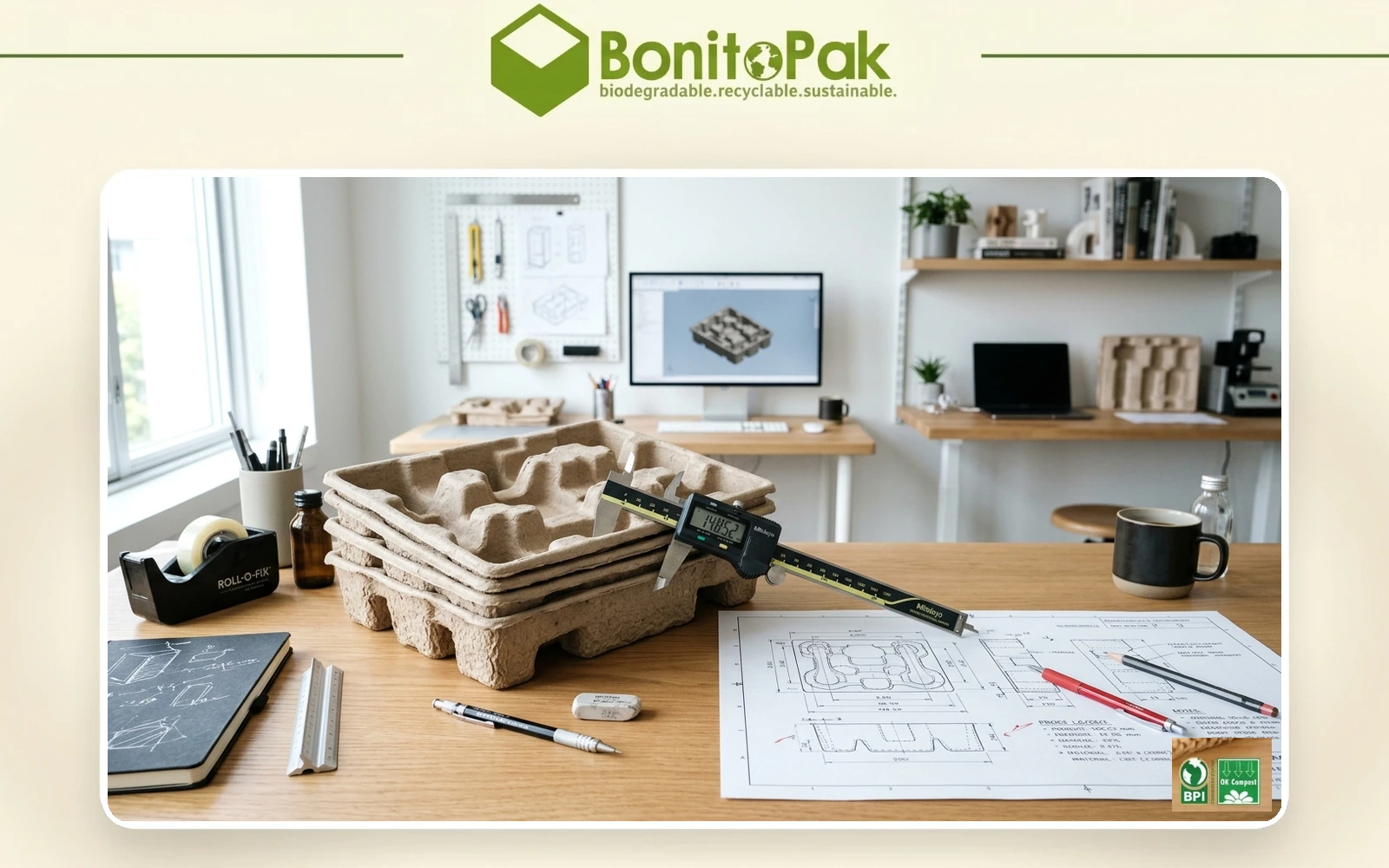
Ask for tooling quoted separately from unit price. It is the only way to calculate your own breakeven, and any supplier unwilling to separate them is hiding something. Our mould design and tooling team cuts moulds per project.
One UK-specific point on specification. Because fee exposure is charged by weight, over-engineering a part now carries an ongoing cost it did not before. Specifying a heavier wall than the application needs raises your unit price and your annual fee together. Ask your supplier for the lightest wall that passes your drop test rather than the safest one.
UK Plants or Offshore?
Both routes are real and the honest answer depends on your volumes and timelines. I run an offshore plant, so weigh the comparison accordingly.
Domestic manufacturers exist and are credible. Moulded fibre packaging UK production is real: OMNI-PAC, for example, designs and manufactures from a site at Flixborough Industrial Estate in Scunthorpe, with further plants in Allaire, France and Elsfleth, Germany. It works in recovered fibre through wet moulding, drying and after-pressing, offers in-house design and bespoke tooling, and serves medical, horticultural and fresh produce markets.
Where a UK plant wins: short runs, urgent timelines, uncertain geometry needing several prototype rounds, very bulky parts where freight dominates, and any programme where a two week quality problem would be unrecoverable. Sampling in days rather than weeks genuinely compresses development.
Where offshore wins: high annual volumes, families of parts needing several moulds, broader colour and fibre ranges, and lower tooling cost. The offsets are real too: ocean transit runs weeks, sample cycles are slower, and import duty and freight must be in your landed cost model before any comparison means anything.
Post-Brexit, confirm two things before you commit to any non-UK supplier: the commodity code and duty rate that applies to your specific part, and who is acting as importer of record. Both affect your landed cost and neither is the supplier’s decision to make for you.
What to Send With a UK Enquiry
Six items get you an accurate quote first time instead of a fourth round of questions.
This week: send the product itself, not a drawing. Fibre geometry is designed around the object and a sample tells a toolmaker what a drawing cannot.
Send your annual volume, split by size if you need a family of parts. This is the number that decides whether tooling amortises.
Send your tonnage estimate for the packaging you are replacing. It turns the fee comparison above from a general argument into your actual number.
Say whether the part needs a window, liner or barrier. If the answer is yes, say so early, because it changes your fee category and may change the recommendation entirely.
Say whether the part will be seen by the end customer, which decides wet or dry pressing.
Say what you use now and what is wrong with it. The useful comparison is against your incumbent, not against a specification.
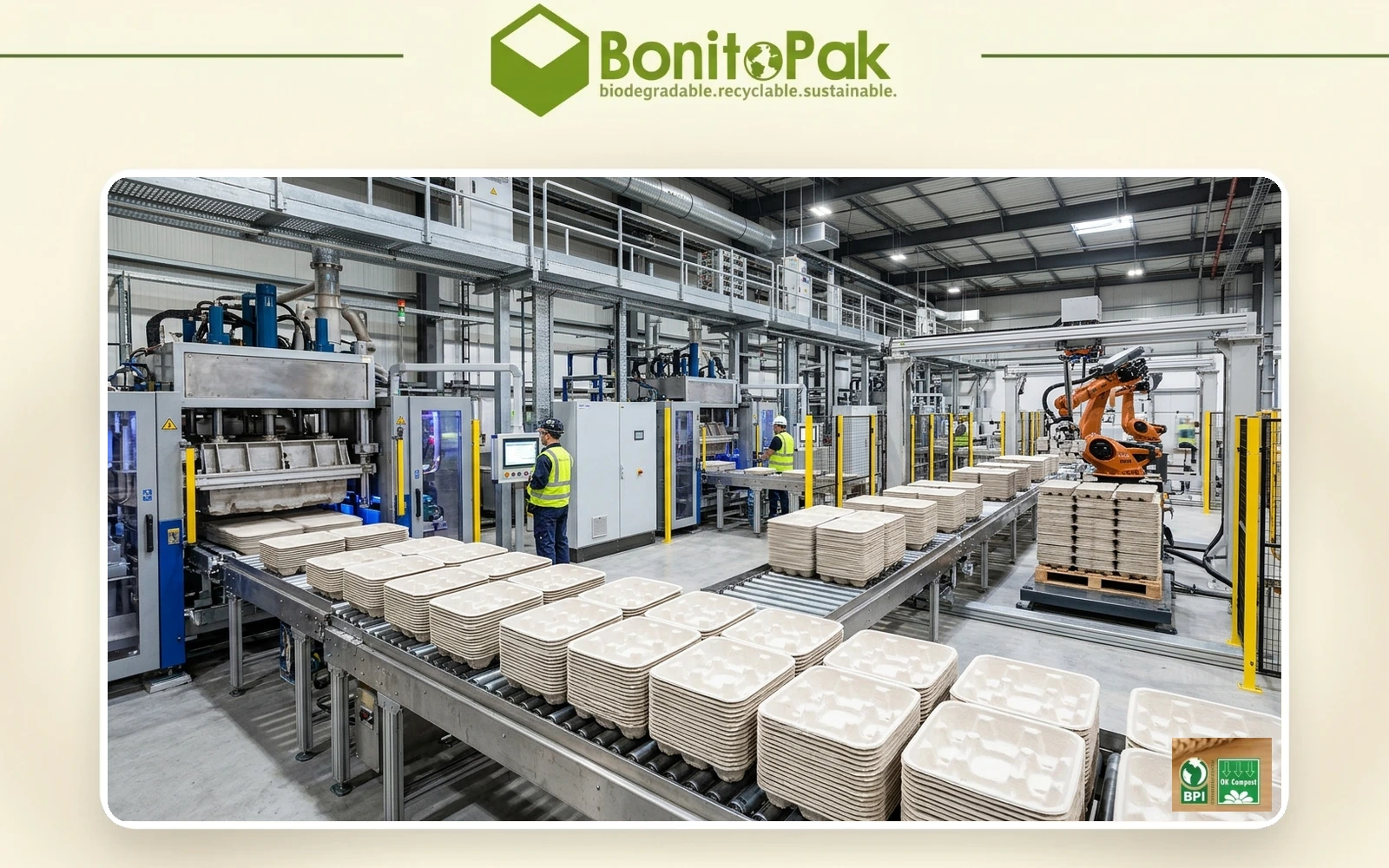
At BonitoPak we manufacture moulded fibre packaging from recycled paper, sugarcane bagasse and bamboo, uncoated in plain formats, running both wet and dry pressing with in-house tooling. Our manufacturing facilities page shows the operation, our custom service page covers development, and our IP protection page sets out how tooling and design ownership are handled. Send us the product, your annual volumes and your tonnage and we will tell you whether offshore makes sense for your programme, including when it does not.
FAQs
Q: How much does custom molded pulp packaging UK sourcing cost?
A: Tooling dominates at low volumes and unit price dominates at high ones, so ask for both separately. Beyond the quote, factor pEPR at an illustrative £210 per tonne for paper and board against £455 for plastic in 2026, since that difference recurs annually for as long as you ship the pack.
Q: Does moulded fibre packaging UK buyers specify reduce pEPR fees?
A: Substantially, if it is plain single material fibre. Paper and board is charged at an illustrative £210 per tonne at the 2026 base rate against £455 for plastic. But fibre combined with a plastic window or liner is classed as fibre-based composite at £525 per tonne, which is higher than plastic.
Q: Does the UK plastic packaging tax apply to fibre packaging?
A: No. The tax applies only to plastic packaging components with under 30% recycled plastic by weight, at £228.82 per tonne from 1 April 2026, up from £223.69. Fibre packaging falls outside it entirely. Registration is triggered at 10 tonnes or more of finished plastic components in a rolling 12 month period.
Q: What is a fibre-based composite under the pEPR rules?
A: Fibre combined with another material that cannot be readily separated, such as a plastic window, a foil or plastic liner, or a bonded laminate layer. It is the most expensive category in the illustrative 2026 schedule at £525 per tonne at the amber base rate, above plastic at £455 and well above plain paper and board at £210.
Q: Are the 2026 packaging EPR fees final?
A: No. They are the government’s current best estimates, described as likely to change significantly as more producer data arrives. The green discount of roughly 9% was provisional, year 2 tonnages were extrapolated from only six months of 2025 data, and confirmed fees for 2026 to 2027 were expected in June 2026.
Q: Should I buy custom moulded pulp from a UK plant or offshore?
A: UK plants suit short runs, urgent timelines and bulky parts where freight dominates, with sampling in days rather than weeks. Offshore suits high annual volumes, families of moulds and broader colour and fibre ranges. Model landed cost including duty and freight, and confirm your commodity code and importer of record before committing.
Sources
- GOV.UK, Year 2 illustrative waste disposal fees, extended producer responsibility for packaging. Per tonne figures by material with green, amber and red rates, plus the caveats on provisional status. https://www.gov.uk/government/publications/illustrative-waste-disposal-fees-2026-extended-producer-responsibility-for-packaging/year-2-illustrative-waste-disposal-fees-extended-producer-responsibility-for-packaging
- Plastic Packaging Tax rates, covering the £223.69 and £228.82 per tonne rates, the 30% recycled content threshold and the 10 tonne registration threshold. https://www.gov.uk/guidance/check-if-you-need-to-register-for-plastic-packaging-tax
- Packaging Extended Producer Responsibility producer disposal fees modulation, on the RAM green, amber and red structure. https://www.gov.uk
- OMNI-PAC Group, moulded fibre manufacturing sites, processes and markets. https://www.omnipacgroup.co.uk/
- International Molded Fiber Association, industry classification of fibre production types. https://www.imfa.org