 コンテンツにスキップ

Introduction: Why Bagasse Manufacturing Is No Longer Optional
The shift toward compostable food packaging is not a marketing trend anymore. It is regulatory pressure, consumer demand, and brand survival converging at once. Bagasse — the fibrous residue left after sugarcane extraction — has emerged as one of the most viable raw materials for sustainable food packaging. But while many companies want to enter this market, few fully understand what it takes to manufacture bagasse packaging efficiently at scale.
A bagasse material molded fiber pulp food packaging machine is not simply a generic molded pulp system loaded with a different fiber. Bagasse has its own drainage characteristics, density behavior, and moisture absorption profile. If the machine is not engineered specifically for these properties, you end up with warped containers, inconsistent thickness, and unnecessary energy waste.
Sustainable packaging only works when the manufacturing system behind it is equally optimized. That philosophy of integrated efficiency is central to how we approach fiber-based production at ボニートパック, where machinery and material performance are engineered together rather than treated separately.
How a Bagasse Material Molded Fiber Pulp Food Packaging Machine Works
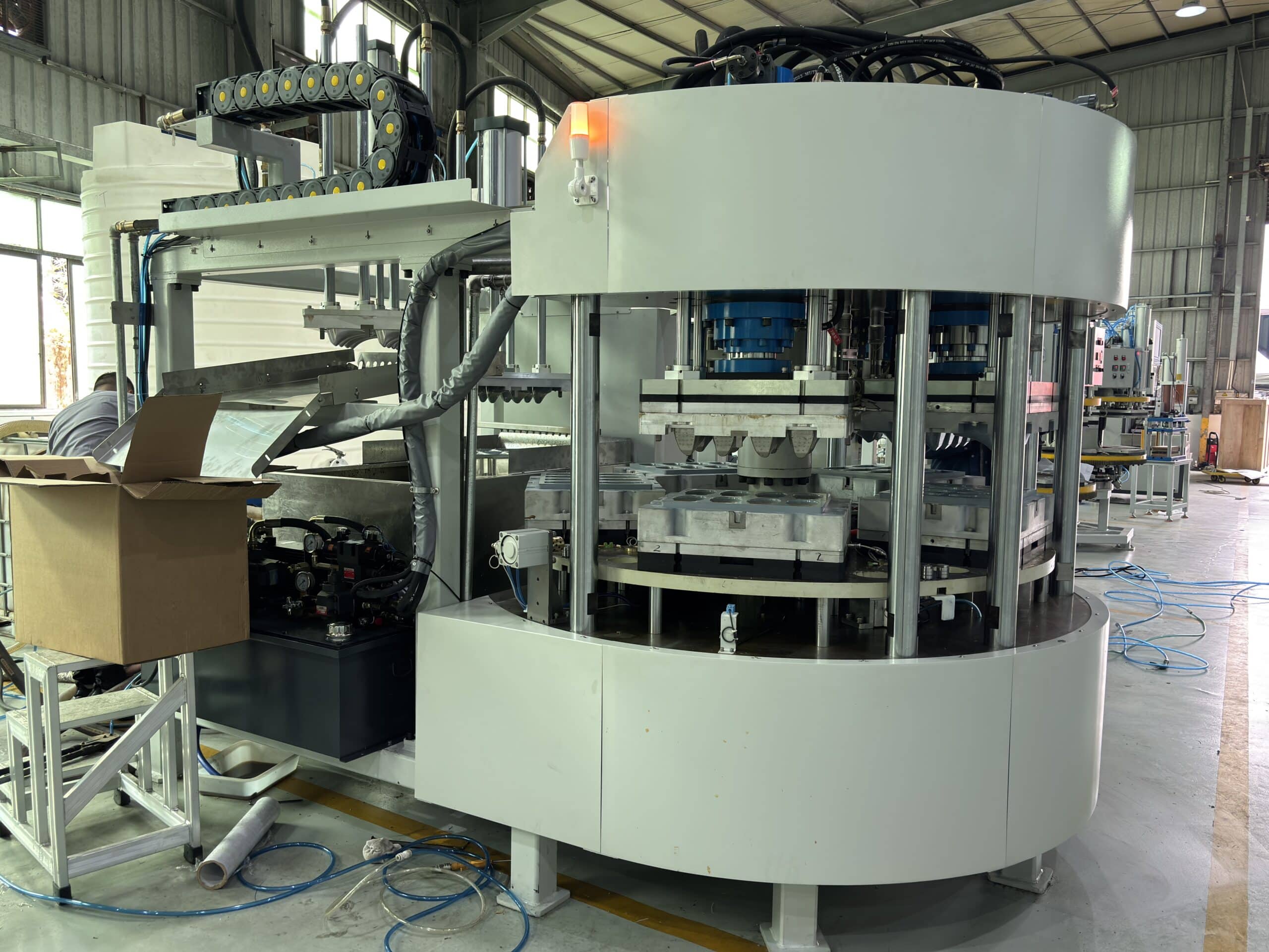
A bagasse material molded fiber pulp food packaging machine transforms processed bagasse pulp into food containers through coordinated forming, pressing, drying, and finishing stages. The pulp slurry is first distributed evenly across forming molds using calibrated vacuum suction. This stage determines fiber distribution and wall thickness consistency. Excess water is removed to create a wet preform, which then moves into a heated pressing stage.
Hot pressing is critical in bagasse production. It increases density, improves surface smoothness, and stabilizes structural strength. Unlike industrial packaging, food packaging must maintain dimensional precision for lids, stacking, and sealing performance. The final drying phase ensures moisture content is reduced to a stable level that prevents deformation during storage and transport.
This same forming-and-press integration principle is used in advanced molded fiber production systems such as ドライプレス成形パルプトレイ, where precision pressure and moisture control determine product durability. In food packaging, that precision becomes even more important because hygiene standards and structural consistency cannot be compromised.
Energy Distribution in Bagasse Packaging Production
Energy consumption in bagasse molded fiber manufacturing is heavily influenced by moisture control. The more efficiently water is removed during forming and pressing, the lower the thermal load required in drying.
In a typical mid-to-large scale bagasse material molded fiber pulp food packaging machine setup, energy distribution may resemble the following:
| System Area | Primary Energy Type | Approximate Share of Total Energy |
| Hot Press & Drying Section | Thermal | 45–55% |
| Vacuum & Forming | Electricity | 20–25% |
| パルプ調製 | Electricity | 10–15% |
| Trimming & Auxiliary | Electricity | 5–10% |
The hot press and drying section represent the largest energy demand. When vacuum calibration and pressing pressure are optimized for bagasse fiber specifically, residual moisture entering the drying phase decreases significantly. That reduction directly lowers operating cost per unit.
Factories that treat drying as the primary control point often overspend on energy. Factories that optimize forming first reduce total consumption naturally.
Standard Molded Fiber Systems vs Bagasse-Optimized Machines
Many manufacturers attempt to run bagasse pulp through machines designed primarily for recycled paper fiber. While production may appear functional at low volume, scaling reveals weaknesses in density control, surface smoothness, and cycle stability.
A customized bagasse material molded fiber pulp food packaging machine modifies mold venting structure, vacuum sequencing, pressing temperature, and drying airflow to align specifically with bagasse fiber behavior.
The operational difference becomes clear in measurable outcomes:
| Metric | Standard Fiber Machine | Bagasse-Optimized Machine |
| Wall Thickness Variation | ±0.5 mm | ±0.2 mm |
| Surface Finish Consistency | 中程度 | 高い |
| Energy Consumption per Ton | より高い | Reduced |
| Rejection Rate | 5–8% | 2–4% |
| Production Stability at Scale | 中程度 | 強い |
Even small reductions in rejection rate significantly improve profitability in high-volume food packaging production. Consistency builds long-term supply confidence with restaurant chains and retail distributors.
The Role of Customization in Competitive Food Packaging
The food packaging market is becoming increasingly competitive. Brands now demand not only compostability but also smooth finishes, branding compatibility, oil resistance, and stacking durability. Industry discussions around customization and branding in molded fiber packaging, such as those explored in パルプ成型箱はカスタマイズ可能か?, show how production capability influences market opportunity.
A bagasse material molded fiber pulp food packaging machine must therefore support:
Controlled wall thickness for structural reliability
Uniform moisture removal for dimensional accuracy
Surface quality suitable for food contact
Scalability without increasing rejection rates
Customization is not an upgrade feature. It is the foundation of production stability.
Scaling Production Without Losing Margin
The transition from pilot production to industrial scale is where many manufacturers struggle. Fiber moisture content varies with climate. Ambient humidity changes drying behavior. Press temperature drift affects surface quality. Without automated monitoring and integrated calibration, these variables introduce inconsistency.
An optimized bagasse production system incorporates feedback controls for vacuum timing, pressing pressure, and thermal balance. These controls reduce operator dependency and stabilize production output across longer shifts.
Sustainable packaging must also be economically sustainable. Lower energy intensity and reduced scrap rates ensure that environmental goals align with financial goals.
Conclusion: Bagasse Packaging Demands System-Level Thinking
A bagasse material molded fiber pulp food packaging machine represents more than a forming device. It is a coordinated system that transforms agricultural residue into functional, scalable, food-grade packaging. Success depends on aligning fiber characteristics with mechanical precision and energy optimization.
Standard molded pulp equipment may function in early stages, but long-term competitiveness requires customization and integration. When forming, pressing, and drying are engineered as a unified system, operational efficiency improves, rejection rates decline, and product quality stabilizes.
In a market where sustainability claims are scrutinized and margins are tight, precision manufacturing becomes a strategic advantage.
よくある質問
What is a bagasse material molded fiber pulp food packaging machine?
It is a specialized production system designed to form, press, and dry sugarcane bagasse pulp into food-grade packaging products such as trays, bowls, and clamshell containers.
Why can’t standard molded pulp machines handle bagasse efficiently?
Because bagasse fibers have different drainage and structural properties, requiring adjusted vacuum calibration, pressing temperature, and drying control.
How energy-intensive is bagasse packaging production?
Thermal energy for hot pressing and drying typically accounts for 45–55% of total consumption, making moisture optimization essential.
Is customization necessary for large-scale food packaging contracts?
Yes. Large-scale supply agreements require stable thickness, low rejection rates, and consistent surface quality, which standard machines often struggle to maintain.
Can bagasse packaging truly replace plastic food containers?
With proper engineering and quality control, bagasse packaging can meet structural and environmental requirements for many food service applications.




 Japanese
  English
  German
  Spanish
  French
  Russian
  Portuguese
  Arabic