 コンテンツにスキップ

In molded pulp tofu packaging production, most manufacturers focus heavily on forming speed, mold quality, and drying efficiency. Yet in real factory environments, stacking is often the silent bottleneck that limits output.
Manual stacking depends on labor availability, operator consistency, and physical endurance. As production volumes increase, even well-trained teams struggle to maintain uniform stacks, leading to downstream problems such as uneven drying, product deformation, and inefficient packing.
This is where an 自動スタッキング豆腐型機 becomes a strategic investment rather than a simple automation upgrade. It is designed to stabilize production flow, reduce labor dependency, and prepare molded pulp tofu products for consistent drying and packaging at scale.
In this guide, you’ll learn how these machines work, where they fit in a molded pulp line, what benefits they actually deliver in real operations, and the common mistakes manufacturers make when adopting stacking automation.
What Is an Automatic Stacking Tofu Molds Machine?
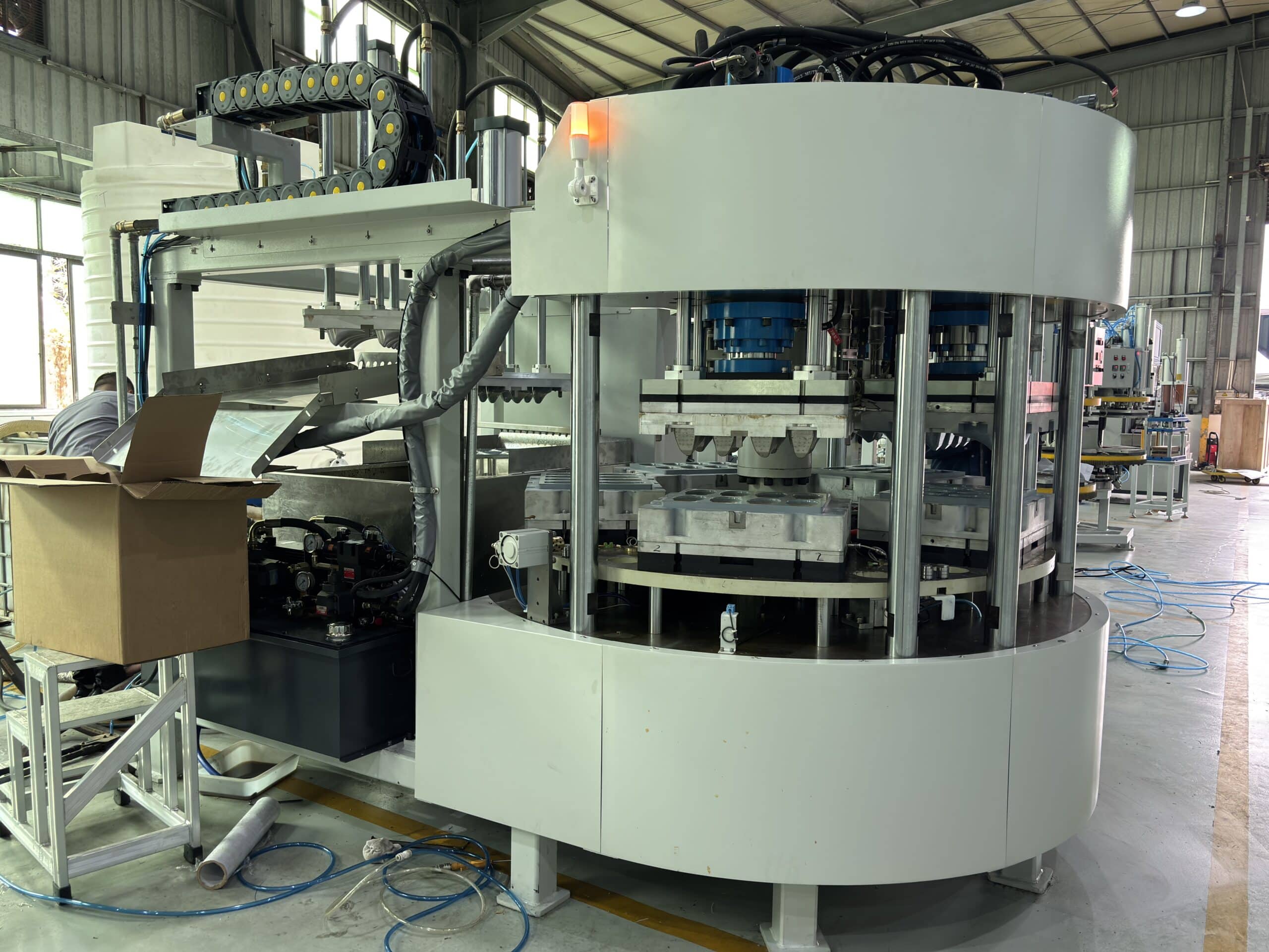
An 自動スタッキング豆腐型機 is a specialized piece of equipment used in molded pulp production lines to automatically collect, align, and stack tofu molds or trays immediately after the forming stage.
Unlike manual or semi-automatic stacking, the system performs these actions with controlled precision. Each molded pulp product is positioned accurately, stacked to a defined height, and transferred smoothly to the next stage—typically drying or packaging.
Modern systems, such as this 自動積み重ね豆腐型機, are engineered to handle food-grade molded pulp products while maintaining consistent stack pressure to avoid deformation.
Where the Machine Fits in the Molded Pulp Production Process
To understand the real value of automatic stacking, it’s important to look at the entire molded pulp workflow.
A standard tofu mold production line includes:
- Pulp preparation
- Forming (rotary or reciprocating)
- Stacking
- 乾燥
- Trimming and packing
Stacking acts as the bridge between forming and drying. If stacks are misaligned or uneven, drying airflow becomes inconsistent, resulting in warped products or higher reject rates. Automated stacking ensures uniform spacing and alignment, which directly improves drying efficiency and final product quality.
This is especially critical for food packaging formats, which fall under different categories outlined in the 4種類の成型パルプ, each with specific structural and hygiene requirements.
How an Automatic Stacking Tofu Molds Machine Works in Practice
Rather than relying on intermittent manual handling, the machine operates continuously alongside the forming system.
After forming, molded tofu trays are transferred automatically via conveyor or robotic handling. Sensors detect product position and orientation, ensuring each item is aligned correctly before stacking. The machine then stacks the molds in precise layers, applying controlled pressure to prevent crushing while maintaining stability.
Once the preset stack height is reached, the stack is discharged smoothly to the drying line or collection area. This uninterrupted flow eliminates delays, reduces handling damage, and allows the forming machine to operate at optimal speed.
Who Should Invest in Automatic Stacking—and Who Should Wait
Automatic stacking is not a one-size-fits-all solution.
Factories producing medium to high volumes of tofu molds benefit the most, particularly when daily output exceeds levels that are practical for manual labor. Operations facing labor shortages, high turnover, or rising wages often see the fastest return on investment.
However, small-scale producers or facilities still testing product designs may not need full automation immediately. In such cases, stabilizing forming quality and mold design should come first before adding stacking automation.
Manual vs Semi-Automatic vs Automatic Stacking (Comparison Table)
| 特徴 | Manual Stacking | Semi-Automatic Stacking | Automatic Stacking |
|---|---|---|---|
| Labor Dependency | 非常に高い | 中程度 | 非常に低い |
| Stack Uniformity | Inconsistent | Partially Consistent | Highly Consistent |
| 生産スピード | Limited by workers | ミディアム | High & Continuous |
| Product Damage Risk | 高い | ミディアム | 非常に低い |
| Scalability | 貧しい | 限定 | 素晴らしい |
| Long-Term Cost | 高い | ミディアム | 低い |
This comparison highlights why automatic stacking becomes essential as production volume increases.
Key Benefits You’ll See on the Factory Floor
Improved Production Stability
Automatic stacking removes human variability from one of the most repetitive processes. This consistency stabilizes the entire production line.
Lower Labor Costs
Many factories reduce stacking-related labor by more than half, reallocating workers to higher-value tasks such as quality control or maintenance.
Better Drying Results
Uniform stacks allow hot air to circulate evenly, improving drying efficiency and reducing deformation or cracking.
Cleaner, More Organized Workflow
Automated stacking minimizes floor congestion, improving safety and material flow within the plant.
Common Mistakes Manufacturers Make (And How to Avoid Them)
1. Buying Automation Before Fixing Forming Issues
If forming output is inconsistent, stacking automation will only amplify existing problems. Ensure mold quality and forming stability first.
2. Ignoring Mold Compatibility
Not all tofu mold designs stack well. Mold geometry, wall thickness, and edge strength must be evaluated before automation.
3. Underestimating Integration Requirements
Stacking machines must match the cycle time of the forming machine. Mismatch leads to bottlenecks or idle equipment.
4. Choosing Price Over Engineering Support
Cheaper machines without proper technical support often cost more in downtime and retrofits over time.
Advanced Optimization: Scaling with Fully Automated Lines
For manufacturers planning long-term expansion, automatic stacking works best when combined with rotary forming systems and continuous drying tunnels. This creates a stable, high-output production line capable of meeting large orders without increasing labor proportionally.
Automation at this level transforms tofu mold production from labor-driven to system-driven, significantly improving cost predictability and operational control.
Conclusion: Is Automatic Stacking Worth It?
An 自動スタッキング豆腐型機 is not just about reducing labor—it’s about creating a stable, scalable, and predictable molded pulp production system.
If your factory is growing, facing labor challenges, or aiming to improve product consistency, stacking automation is often the missing link between forming efficiency and finished product quality.
To explore a production-ready solution, review this 自動積み重ね豆腐型機 and evaluate how it fits your current and future capacity goals.
よくある質問
Is an automatic stacking tofu molds machine food-safe?
Yes, when designed with food-grade materials and proper surface treatments.
Can it handle multiple mold sizes?
Most modern machines support adjustable settings for different tofu mold formats.
How complex is maintenance?
Routine sensor checks, lubrication, and alignment inspections are typically sufficient.
What is the typical ROI period?
Many factories recover their investment within 12–24 months, depending on labor savings and production volume.




 Japanese
  English
  German
  Spanish
  French
  Russian
  Portuguese
  Arabic