 コンテンツにスキップ
レオ・チャン著 | BonitoPak ライター | 成形パルプ製包装分野で20年以上の経験
Published: 20 August 2026 | Last reviewed: 20 August 2026
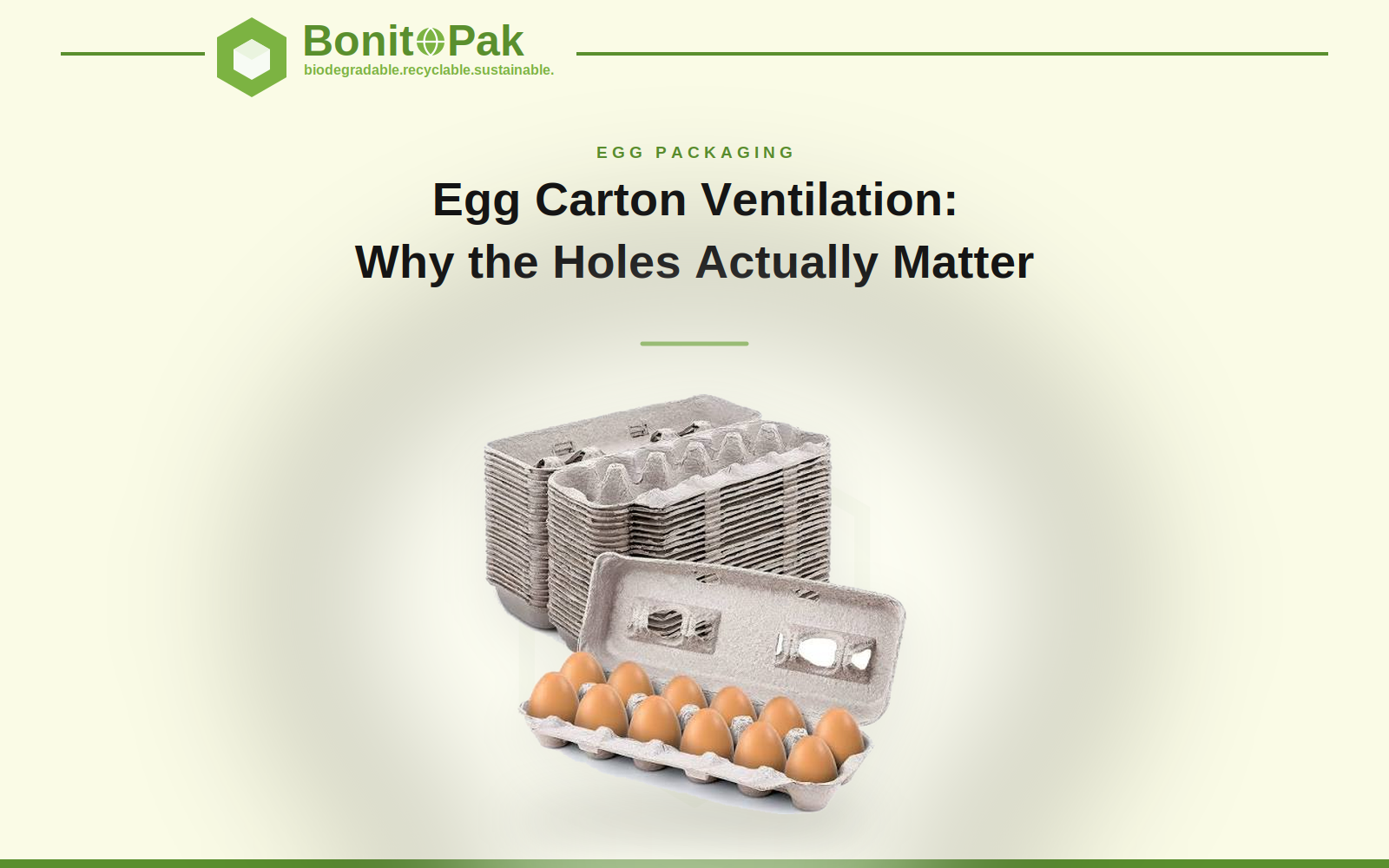
Egg carton vents do two jobs. They let heat escape so warm eggs cool quickly after packing, and they let condensation evaporate instead of sitting on shells. Both matter because an eggshell is porous, and moisture on the surface helps bacteria get through it.
The holes in an egg carton look decorative, or at best like a way to see the eggs. They are neither. Egg carton ventilation is one of the more deliberate parts of a carton design, and getting it wrong in either direction costs product quality.
This article covers what the vents actually do, the physics behind condensation on shells, why more ventilation is not automatically better, and how vent placement gets decided at the tooling stage.
Why Do Egg Cartons Have Holes?
Egg carton holes do three jobs, in order of importance:
- Letting heat out so freshly packed eggs cool down quickly.
- Letting moisture evaporate rather than pooling against the shell.
- Preventing odor and stale air building up around the eggs.
Ask why do egg cartons have holes and the first two answers are the ones with real consequences. Both trace back to a single fact about eggshells.
The Shell Is Not a Sealed Barrier
An eggshell looks solid and is not. It carries somewhere between 10,000 and 20,000 microscopic pores, and gases and moisture pass through them continuously from the moment the egg is laid.
Through those pores the egg steadily loses water vapor and carbon dioxide. The air cell inside grows, the albumen thins, and interior quality declines. That process never stops. Storage conditions only change how fast it runs.
Those same pores are the route in. Anything sitting on the shell surface has a pathway to the interior, and that is why surface moisture is a genuine problem rather than a cosmetic one.
Egg Sweating Is Not Actually Sweating
This is the most commonly misunderstood part, including by people who handle eggs daily.
The term suggests moisture coming out of the egg. It does not. As hatchery technology guidance puts it plainly, the water on the shell does not come from within the egg at all. It condenses out of the surrounding air onto a cold shell, exactly the way a bottle taken from a refrigerator beads up on a warm day.
The mechanism runs like this. Cold eggs meet warmer air. The air immediately around each egg cools rapidly. Cold air holds less water than warm air, so relative humidity in that thin layer climbs until the air is saturated. At that point water condenses onto the shell.
This matters for carton design because it means the moisture arrives from outside the pack. A carton that lets warm humid air reach cold eggs, and then traps the resulting condensate, is working against you twice.
When Egg Carton Condensation Will Happen
Egg sweating is predictable rather than random, which means it can be designed and scheduled around.
The controlling rule is dew point. Condensation forms when the dew point of the air the eggs move into is above the temperature of the eggs themselves. Extension guidance gives a concrete example: an egg taken from 55 degree Fahrenheit storage into a 70 degree room will sweat once relative humidity reaches roughly 58 percent, which is ordinary summer weather in much of the country. Published temperature and humidity tables let you check specific combinations rather than guessing.
Three practical levers follow from that. Reduce the temperature gap between storage and the next environment. Lower humidity in the warmer space. Or let the eggs temper gradually rather than moving them straight across.
Why Surface Moisture Is a Real Risk
Water on a shell does three things, and none of them are good.
It weakens the shell’s natural defenses and creates conditions where microorganisms multiply quickly. It helps those organisms penetrate the pores, and once inside they are shielded from routine surface sanitizing, so washing afterwards does not undo it.
Then there is a pressure effect that is easy to miss. If a wet egg subsequently cools, the contents contract and internal pressure drops, which can draw contaminated surface water inward through the pores. So a warm humid stop followed by a return to refrigeration is worse than either alone.
Shell integrity changes the stakes considerably. Research on sweated eggs found contamination in a small percentage of intact eggs against a very high percentage of eggs with hair cracks under the same conditions. Since a meaningful share of table eggs pick up some shell damage during routine handling, the carton is protecting against both impact and moisture at the same time.
The Cooling Job Nobody Talks About
The second function of vents is thermal, and it happens in the first hours after packing.
Eggs are frequently packed while still warm, well above refrigeration temperature, then cased and moved into cold storage. The pack has to shed that heat quickly, and it has to do it through the carton and the case around it.
Well designed cartons handle this as an airflow path rather than as a set of holes. Vents low down let cold air enter. Small projections inside the cells lift each egg slightly so cool air can reach underneath rather than stopping at the top. Warmed air rises and exits through apertures near the top of the carton. The result is convection through the pack rather than a stagnant pocket of warm air sitting around the eggs.
The same path then carries away any condensate that forms as the eggs cool. Cooling and drying are the same airflow problem solved by the same geometry.
More Egg Carton Ventilation Is Not Better
This is where the design becomes a genuine trade off rather than a case of adding holes.
Too little ventilation traps moisture and heat. Too much accelerates the water loss that is already happening through the pores. The air cell expands faster, the albumen thins sooner, and the egg is measurably older than its pack date suggests.
The context is that a weight loss of roughly two to three percent is normal through ordinary marketing and distribution, and beyond that the effects start showing in both the contents and the internal structure. Optimal storage humidity sits around 70 to 80 percent. Below that range, moisture escapes too quickly. Above it, condensation and mold risk rise.
So vent area is tuned rather than maximized. The target is enough airflow to shed heat and evaporate condensate, without turning the carton into an accelerated drying rack.
Placement Matters More Than Area
Where the vents sit changes their effectiveness more than how many there are.
The problem case is a carton where every cell is a fully enclosed pocket. Each egg sits in a recess with its own unbroken wall, which holds the egg securely and ventilates poorly, particularly at the closed bottom of the recess. Moisture collects at the base of the cell, precisely where it cannot evaporate, and in hot humid conditions that is where deterioration starts.
The design answers are structural rather than cosmetic. Partition walls can stop short of the closing edge so air moves between cells rather than sitting in isolated pockets. A ventilating groove can run along the base of a row so the bottom of each recess is connected to moving air. Vents in the lid work with vents in the base rather than duplicating them.
自社の生産ラインで目にする光景
We form molded pulp egg packaging in Chashan Town, Dongguan, and vent geometry is settled at the mold stage rather than afterwards. Some observations from doing it repeatedly.
Vents cannot be added later
Vent openings, base grooves and cell projections are all formed by the tool. Adding them to a finished carton means punching through a wall that is carrying load, usually right where the cell needs its strength. Sample molds run in about seven days and production molds follow around eight days after geometry approval, and that sample stage is where vent performance should be checked. Our custom egg tray page sets out what remains adjustable at that point.
Wall thickness changes how the pack breathes
Fiber itself is somewhat breathable, and thickness affects that. Our wet pressed cartons finish at roughly 0.7 to 1.2mm with a dense, smooth wall, while dry pressed trays finish at roughly 2.5 to 3.0mm of bulkier fiber. The thicker section holds moisture longer once it gets damp, which is worth knowing when a pack is moving through a cold chain rather than sitting on a dry shelf.
The cold chain question we ask first
Before drawing vent geometry we ask where the pack will actually go. A carton that stays in consistent refrigeration from packing to retail has a different requirement from one that will be loaded on an ambient dock in summer, sit in a van, and go back into a chiller. The second case sees repeated condensation cycles, and the vent path has to be able to clear them.
Material choice sits alongside this rather than separate from it. Uncoated fiber lets moisture move through the wall, whereas a coating or laminate blocks it and also changes end of life options, which we cover in our article on whether egg cartons are recyclable. Cell geometry interacts too, since a cell cut for the wrong egg grade leaves gaps that change airflow as well as fit, as set out in our guide to 卵パックのサイズと入数. The base fiber matters as well, since our recycled paper pulp cartons use a mechanical pulping process with no chemical additives, keeping the wall uncoated and breathable.
これを実践に活かす
Treat egg carton ventilation as a cold chain question rather than a packaging feature. Map where the eggs go from packing to the customer, note every point where they meet warmer or more humid air, and specify vent geometry against the worst of those transitions rather than the average.
On the handling side, the three levers are the same everywhere. Keep temperature differences small, keep humidity down in the warmer space, and give eggs time to temper instead of moving them straight from cold storage into warm air. None of that costs anything, and all of it reduces how hard the carton has to work.
で ボニートパック we set vent openings, cell projections and base grooves when tooling is cut, because airflow through a pack is geometry rather than a finishing detail. Telling us the cold chain the pack will travel through is more useful at quote stage than a vent count, since the route determines what the geometry has to achieve.
著者について
Leo Chan is the founder of BonitoPak and has spent more than 20 years in molded pulp packaging, working with over 500 brands moving from plastic and foam to fiber based formats. BonitoPak manufactures molded pulp packaging at its facility in Chashan Town, Dongguan, Guangdong, running both wet pressing and dry pressing lines across six pulp systems, with in house mold design and tooling. The design observations here reflect tooling work on that line alongside published research on egg storage, shell condensation and carton ventilation engineering.
よくある質問
Q: Should I block the vents to keep eggs fresher?
A: No. Sealing a carton traps moisture and heat around the shells, which accelerates deterioration rather than slowing it. The vents exist to let heat and condensate escape, and closing them removes that path.
Q: Do sealed plastic cartons perform worse than vented pulp?
A: They can in warm conditions, because a closed plastic pack traps both heat and moisture against the shell. Vented designs and breathable fiber let condensate evaporate instead of sitting on the egg.
Q: Is egg carton condensation a sign the eggs are bad?
A: Not by itself. It means the pack met warmer, humid air. The risk is duration. Brief condensation that evaporates is different from moisture sitting on shells for hours in a warm room.
Q: What temperature should eggs be stored at?
A: Retail rules generally require 45 degrees Fahrenheit or below. Consistency matters as much as the number, since repeated moves between cold and warm air are what create condensation cycles.
Q: Can extra egg carton holes be added to an existing design?
A: Only by cutting new tooling. Vent geometry is formed into the mold, so it is set at the design stage. Adding holes after production risks weakening the wall around the cell.



 Japanese
  English
  German
  Spanish
  French
  Russian
  Portuguese
  Arabic