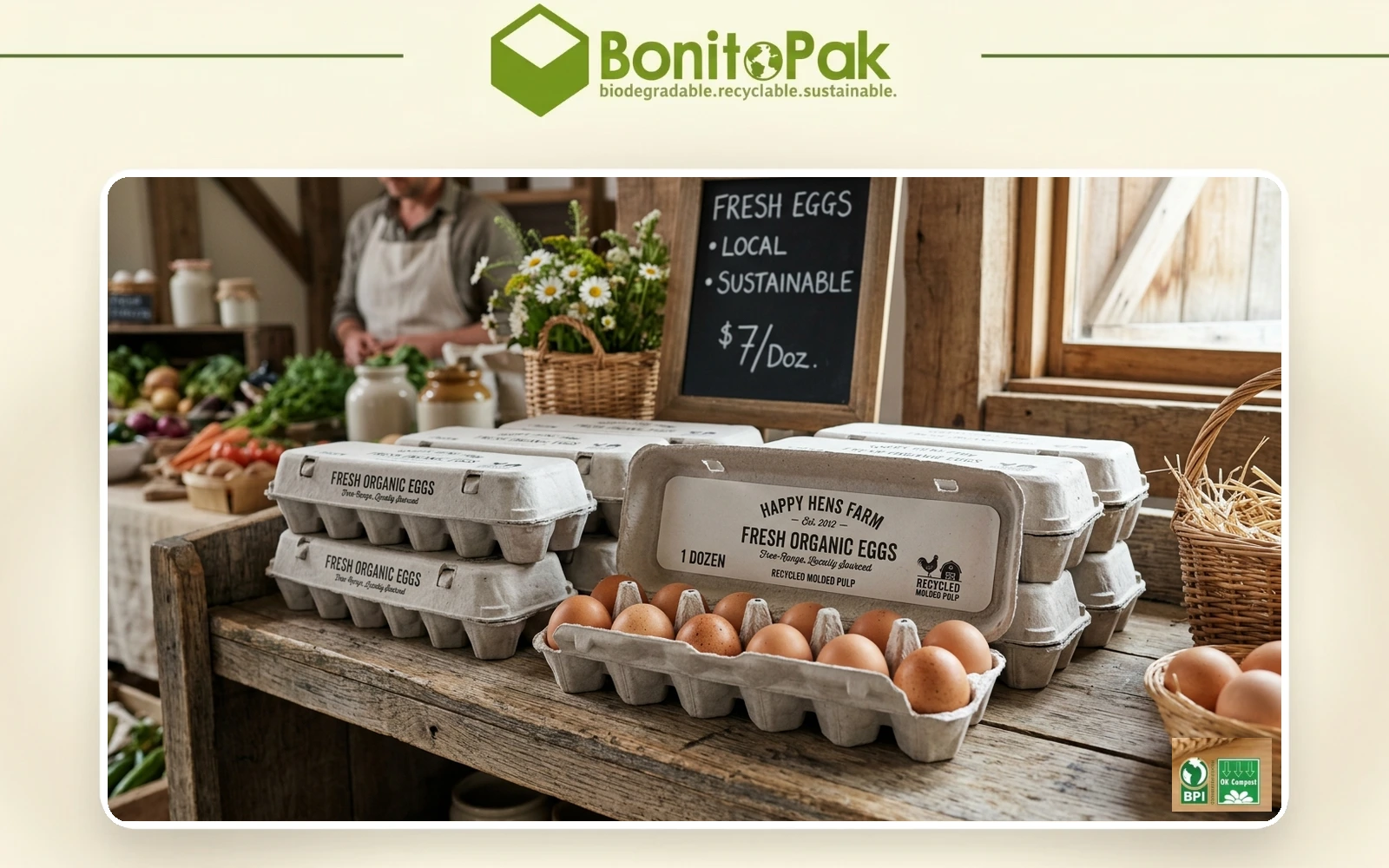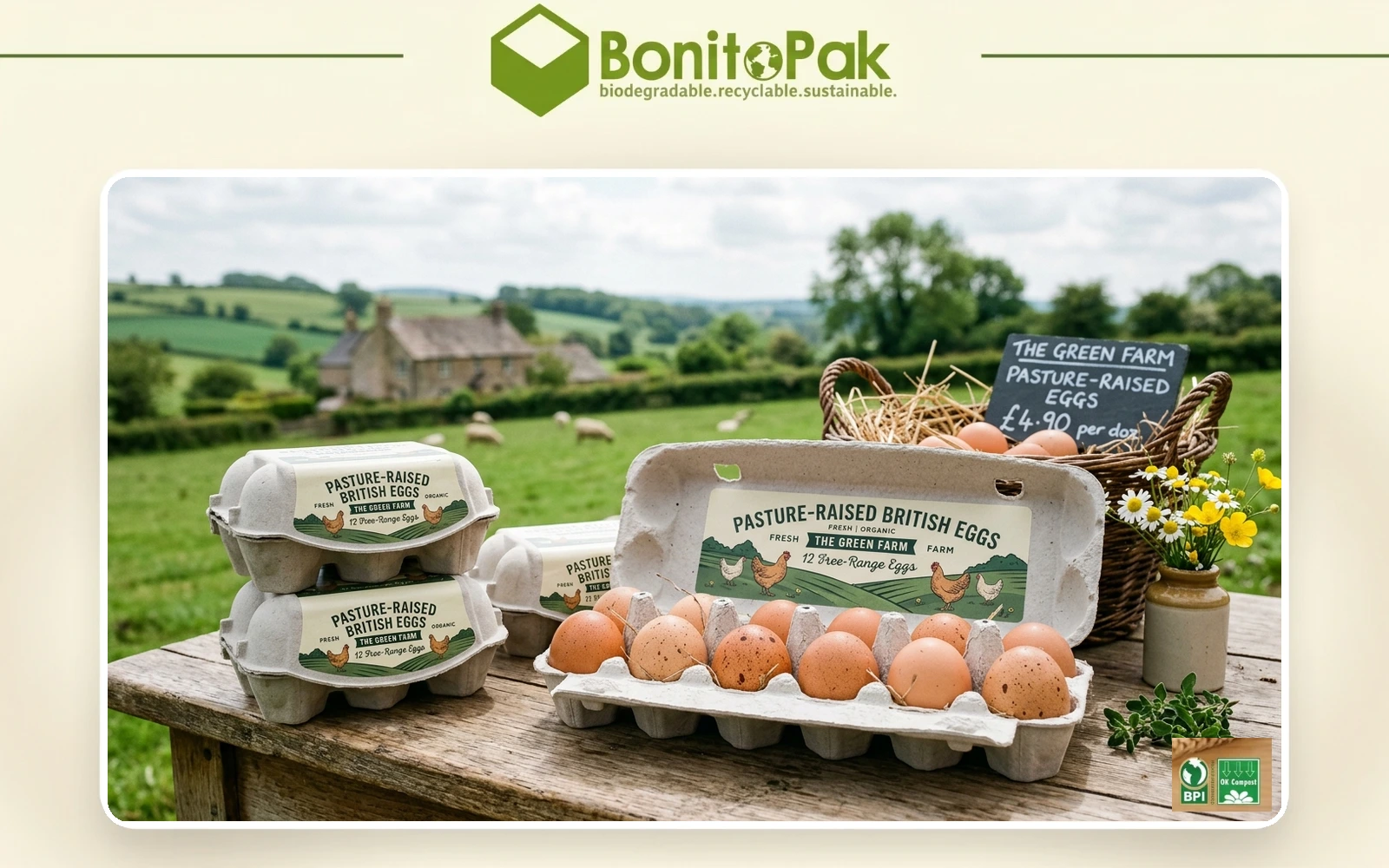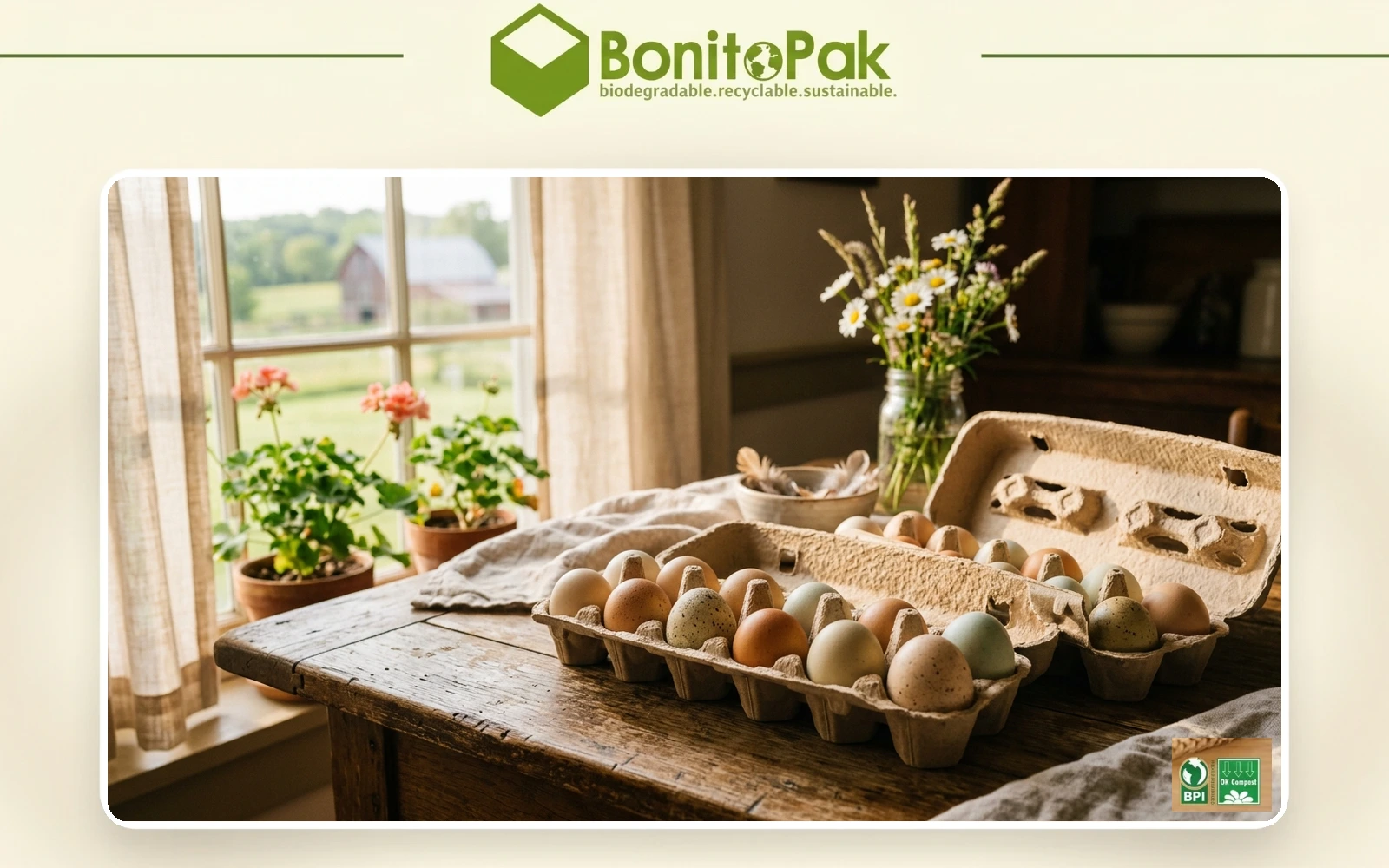
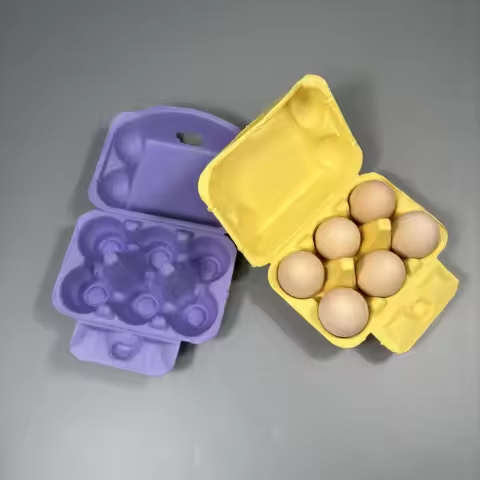
Count and size aren’t the same thing, and mixing them up causes most carton mistakes. Count is simply how many eggs the carton holds, 6, 12, 18. Size is the cell geometry, how wide and deep each pocket is, which has to match your egg grade. You need to get both right, not just the count.
It’s easy to order “a 12-count” and assume that’s the whole spec. It isn’t. A 12-count is a number of pockets sitting on top of a particular pocket size, and that pocket size is cut for one egg grade.
So two 12-count cartons can be completely different products. One cut for large chicken eggs cradles them perfectly and holds a jumbo loosely. One cut for jumbos swims a medium egg around. Same count, different size, different result.
The short version: decide your count from how you sell, and your size from what you lay. We’ll take them one at a time, and if you want the deeper dive on cell geometry itself, our custom egg cartons guide covers it.
The Common Egg Carton Counts, and Who Uses Them
The everyday counts are 6 and 12 for retail, 4 for gift and premium, and 18 or 30 for volume and food service. Buyers genuinely search by count, a 6 egg carton, an 18 egg carton, so picking the count is really about matching your channel and price point, not the eggs themselves.
People shop for eggs by the number in the box, which is why the whole market is organized around counts rather than cell sizes. Here’s how the common ones tend to break down:
Egg carton counts by channel and use:
| カウント | 典型的な購入者 | Why it fits |
| 4-count | Gift, premium, sampler | Low entry price, feels special, good for specialty eggs |
| 6-count | Retail, small households, farmers market | Half-dozen classic; low commitment, easy to carry |
| 12-count | Retail mainstay, the dozen | The default most shoppers expect |
| 15 / 18-count | Larger households, value buyers | More eggs per trip, better value per egg |
| 30-count (flat/tray) | Food service, bakeries, bulk | High volume, lowest packaging cost per egg |
A 6-count keeps the price accessible and is easy to carry, which is why it does so well at markets and with smaller households. The 12-count dozen is simply what most shoppers reach for out of habit. Move up to 18 and you’re serving value buyers and bigger families, and by the time you’re at a 30-count flat you’re really in food-service and bakery territory, where the packaging cost per egg matters more than shelf appeal.
The 4-count is the interesting one. It’s small, so the price stays low, but that smallness reads as premium or giftable, which makes it a smart entry format for specialty eggs. If you’re moving real volume in any of these, our bulk and wholesale guide covers how the per-unit cost changes.
Egg Grade: The Size Half of the Equation
Egg grade decides the cell size you need. A carton cut for large eggs won’t seat jumbos, duck, or quail eggs properly, they’ll either poke above the rim or rattle. So always pair a count with a grade, and if you lay anything other than standard chicken eggs, say so before the tooling is cut.
Egg grade is basically weight, and it maps to physical size. The US grades run from peewee up through small, medium, large, extra large, and jumbo, and each step needs a slightly bigger pocket.
This is where a lot of orders go wrong. Specify a count without a grade and you’re gambling on fit. A cell cut for large eggs holds a large egg beautifully, a medium a little loosely, and a jumbo not at all, the jumbo sits proud of the rim and the lid presses down on the shell.
Here’s a rough guide to how grade maps to the cell you need:
Egg grade vs cell requirement (chicken, indicative):
| Grade | Approx. weight (per egg) | Cell requirement |
| ミディアム | ~44g | Smaller cell; loose in a large-cut carton |
| Large | ~57g | Standard cell most cartons are cut for |
| Extra large | ~64g | Deeper, wider cell than large |
| Jumbo | ~71g+ | Jumbo cell; large-cut cartons won’t close |
If you run a mixed flock, size the cell for your biggest regular egg and let the smaller ones sit a touch looser. We go deep on the outsized end of this in the jumbo egg cartons guide, and the same logic applies in reverse for tiny eggs in our quail piece.
Does Carton Size Change the Material or Cost?
Count and size don’t really change what the carton is made of, but they do affect cost. More cells and bigger cells use more fiber, so a 30-count uses more material than a 6, and jumbo cells more than medium. The bigger lever, though, is press type and volume, not the count itself.
All the counts and sizes run in the same molded pulp: recycled paper, sugarcane bagasse, or bamboo, on either a dry press or a wet press line. The count doesn’t force a material choice.
It does move the cost a little, in the obvious direction, more cells and bigger cells mean more fiber per carton. But that’s usually a smaller factor than whether you go dry press (cheaper, thicker walls, great for distribution) or wet press (smoother, branded, retail-facing), and how many you order. For most volume buyers, a dry press format off our dry pressing trays line is the cost-effective pick regardless of count.
So don’t over-optimize the count to shave cost. Pick the count that fits how you sell, pick the size that fits your eggs, then let press type and order volume do the heavy lifting on price.
When to Go Custom Instead of Standard
Go custom when your eggs or your channel don’t fit a catalog format, an odd count like 8 or 10, a non-standard bird, or a cell size between grades. Because molded pulp tooling is cut per project, a custom count or cell usually starts around 1,000 pieces, with a sample in about a week, so it’s more accessible than most small producers assume.
Standard counts exist because they’re what catalog suppliers stock, not because they’re the only options. Farms run 8-count displays, 10-count specialty packs, and gift formats all the time.
The trigger for going custom is usually one of three things: your count isn’t on the standard list, your eggs sit awkwardly between grades, or you’re packing a bird the standard cells were never cut for. Any of those, and a per-project mold gets you a carton that actually fits, from around 1,000 pieces with a sample in roughly a week.
You can start by browsing the standard egg tray and carton range to see what’s already close, then spec the difference. Often you’re only one dimension away from a perfect fit.
よくある質問
What is the most common egg carton size?
The 12-count dozen is the default most shoppers expect, followed by the 6-count half-dozen. 4-count packs suit gift and premium eggs, while 18 and 30-count formats serve value buyers, food service, and bulk. Buyers usually search by count, so the range is built around those numbers.
What’s the difference between a 6 egg carton and an 18 egg carton?
Just the number of cells and who it suits. A 6-count keeps the price low and is easy to carry, ideal for markets and small households. An 18-count gives more eggs per trip and better value per egg, which suits larger families and value buyers. The cell size can be identical; only the count changes.
Does egg grade change which carton I need?
Yes. Grade is essentially egg weight, and it sets the cell size. A carton cut for large eggs won’t seat jumbos (they poke above the rim) or hold mediums snugly. Always pair a count with a grade, and flag any non-standard bird before the tooling is cut.
Can I get an 8 or 10-count egg carton?
Yes. Standard counts are just what catalog suppliers stock. Because molded pulp tooling is cut per project, odd counts like 8 or 10 are available, usually from around 1,000 pieces with a sample in about a week.
Do bigger egg cartons cost more?
A little, since more cells and bigger cells use more fiber. But the count is usually a smaller cost factor than press type (dry vs wet) and order volume. For most buyers, a dry press format at volume is the cost-effective choice regardless of count.
What size carton do jumbo eggs need?
Jumbo eggs run about 71g and up, so they need a deeper, wider cell than large eggs. A large-cut carton won’t close over a jumbo. Specify jumbo grade, or send samples, so the cell is cut to fit rather than forcing the lid down on the shell.
結論
Picking an egg carton size comes down to two clean questions: how many eggs do you want to sell in one box, and how big are those eggs? Answer the first from your channel and price point, answer the second from your actual eggs, and you’ve specified the carton properly, count and size, instead of guessing at one and hoping for the other.
BonitoPak makes molded pulp egg cartons and trays across the common counts and any custom format, dry and wet press, six pulp colors, BPI and OK Compost certified, from 1,000 pieces. Browse the full egg tray and carton range, or send your count, grade, and volume for a quote.