What “energy-saving” means and what it doesn’t
When suppliers say “energy-saving household paper machine,” they might mean any of these:
- Lower electricity use (kWh) via efficient drives, pumps, and vacuum systems
- Lower thermal energy (steam/gas) via better dewatering, hood control, and heat recovery
- Lower total cost per ton because the machine reaches target dryness/quality faster with less rework
Here’s the key buyer insight:
In many paper/tissue processes, the biggest energy lever is usually drying.
Electricity matters, but evaporating water is expensive—so anything that increases mechanical dewatering or recovers heat can outperform “premium motors” in real savings. Industry guidance emphasizes that paper machine areas are major energy consumers and that reducing energy requires attention to design + operation + monitoring.
So don’t accept “energy-saving” as a label. Treat it as a measurable performance claim:
- kWh/ton (electric)
- steam (or gas) per ton (thermal)
- finished product quality at target GSM and softness/bulk
Where household paper machines consume energy
Even if your exact line differs (toilet roll vs facial tissue), energy typically concentrates in these areas:
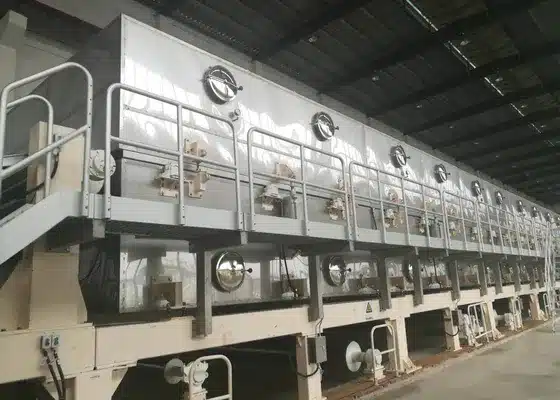
- Drying system (Yankee / dryer + hood)
- Steam or gas is used to drive evaporation. Tissue systems with a Yankee cylinder + hood are widely used, and research highlights the drying section as a major heat consumer and optimization target.
- Vacuum system (dewatering & sheet handling)
- Vacuum pumps/blowers can be major electricity users; vacuum design and control strategy strongly affect kWh. (Industry articles and technical guidance repeatedly focus on vacuum efficiency improvements.)
- Drives + fans + pumping
- Variable speed drives (VFDs), right-sized pumps/fans, and good control loops reduce wasted power. ENERGY STAR/LBNL’s guide catalogs cross-cutting measures (motors, drives, compressed air, pumping, steam systems) used across pulp/paper plants.
- Water systems & heat losses
- Fresh water reduction can reduce energy for heating, treatment, and pumping.
Buyer takeaway: If a supplier sells “energy-saving” but can’t talk clearly about drying, vacuum, and heat recovery, you’re probably looking at marketing—not engineering.
The highest-impact energy-saving features ranked
Below is a practical ranking: features that usually produce meaningful savings first, followed by features that help but rarely move the needle alone.
Energy-saving features and what they actually change
| Feature / design choice | What it reduces | What proof to ask for | When it’s most valuable |
|---|---|---|---|
| Higher press dryness / better dewatering | Steam/gas for evaporation | Press exit dryness targets, commissioning data | Any line where drying is bottleneck |
| Hood optimization + heat recovery | Fuel/steam; exhaust losses | Hood balance, exhaust temp, heat recovery schematic | Tissue/Yankee-style systems |
| Vacuum system optimization (right-sizing + control) | Electricity (kWh) | Vacuum power curves, control philosophy, installed kW | High-speed or vacuum-heavy forming |
| Steam system efficiency (traps, insulation, condensate return) | Thermal losses | Steam & condensate P&ID, trap plan | Plants with unstable steam costs |
| VFDs/servo control for drives, pumps, fans | Electricity | Motor list + VFD list + control loops | Variable loads, frequent grade changes |
| Automation to reduce breaks/rejects | “Hidden” energy per good ton | OEE, break frequency, waste % | New teams, unstable furnish |
This ranking aligns with widely shared best-practice thinking: the biggest wins come from system-level optimization (steam, vacuum, process control) rather than single components.
Supplier types: who sells what and what you should expect
When searching for energy-saving household paper machine suppliers, you’ll see several supplier “types.” Knowing which type you’re dealing with helps you predict risk and support quality.
1) Turnkey OEM (design + build + install + commissioning)
Best for: first-time buyers, fast scale-ups, buyers who need guaranteed performance
Pros: single accountability, process know-how, stronger commissioning
Cons: higher capex, sometimes less flexible on custom parts
2) Machine builder + third-party integrators
Best for: experienced mills with in-house engineers
Pros: flexible pricing; you can choose best-in-class drives/automation
Cons: accountability splits (“not our scope” problems)
3) Trading company / directory supplier
Best for: very small budgets and simple lines (high risk)
Pros: easy sourcing, quick quotes
Cons: weak technical proof, weak after-sales, unclear warranty support
4) Retrofit/energy-upgrade specialists
Best for: existing lines needing energy reduction
Pros: focused ROI; heat recovery, vacuum upgrades, hood upgrades
Cons: you still need a stable baseline and measurement plan
Buyer rule: If you’re buying “energy-saving,” favor suppliers who can provide system design documentation and an acceptance test plan—not just a brochure.
How to verify energy-saving claims (buyer proof checklist)
This is where most buyers win or lose.
Step 1: Define your “energy-saving” KPI before you request quotes
Pick 2–3 measurable KPIs:
- kWh/ton (electricity per finished ton)
- steam/ton or Nm³ gas/ton (thermal energy per finished ton)
- finished product specs (GSM, moisture, softness/bulk) at target speed
If you don’t define these, suppliers will define them for you—and your “savings” may disappear in the fine print.
Step 2: Demand an “energy balance” narrative, not just features
Ask each supplier to explain:
- Where energy enters (steam, gas, electric)
- Where it leaves (exhaust, condensate, waste heat)
- What design choices reduce losses
This is consistent with how energy efficiency is approached in industrial guides—identify end uses and opportunities across systems, not only components.
Step 3: Request the evidence package (minimum documents)
Ask for:
- Utilities list (installed motor kW, fan kW, vacuum system kW, steam pressure/flow ranges)
- Process flow diagram (PFD) + P&ID for steam/condensate and vacuum
- Reference project data: same grade, similar width/speed
- Acceptance test protocol (FAT/SAT) stating how energy is measured
- Instrumentation list (meters, accuracy, calibration plan)
Step 4: Verify the measurement method (this is the trap door)
A supplier can “win” on paper by:
- measuring at a partial load
- excluding auxiliaries (pumps, compressors, trimming)
- using short test windows
- using non-standard moisture basis
To prevent that, define:
- measurement window (e.g., 8–24 hours stable run)
- included loads (whole line or clearly stated boundary)
- moisture correction basis (e.g., finished ton at specified moisture)
EU BAT thinking and industry benchmarking efforts emphasize consistent boundaries and comparable measurement rules; without that, “efficiency” comparisons become meaningless.
A practical comparison table you can copy into procurement
Use this scorecard to compare suppliers fairly (and to justify your decision internally).
Supplier evaluation scorecard (weighted)
| Category | Weight | What “good” looks like | Supplier A | Supplier B | Supplier C |
|---|---|---|---|---|---|
| Energy proof & KPIs | 25% | kWh/ton + steam/gas/ton defined + test protocol | |||
| Drying & hood engineering | 15% | clear hood balance, heat recovery options, controls | |||
| Vacuum system design | 10% | right-sized blowers/pumps, variable control strategy | |||
| Automation & quality stability | 10% | controls reduce breaks/waste; clear alarm philosophy | |||
| References (same grade) | 15% | site references + comparable specs + contactable | |||
| After-sales & spares | 10% | guaranteed response time, spares list, training plan | |||
| Warranty & performance clauses | 10% | penalties/retention tied to SAT results | |||
| Total cost of ownership | 5% | utilities modeled for 3–5 years |
How to score: 1–5 per category, multiply by weight.
Factory acceptance test (FAT) + site acceptance test (SAT)
If you want real energy savings, your contract must include measurement and consequences.
FAT (before shipment): prove build quality + control logic
FAT should verify:
- electrical panels, VFDs/servos, safety
- control logic, interlocks, alarms
- instrumentation and data logging
- mechanical checks (vibration, alignment)
FAT won’t prove final energy numbers, but it prevents the “it’s wired differently onsite” excuse.
SAT (after commissioning): prove performance in your mill
SAT should include:
- product quality targets (GSM, moisture, softness/bulk targets you define)
- stable runtime window
- energy KPI measurement:
- total kWh during test window
- steam/gas consumption during test window
- tons of saleable product produced
Important: Paper machine energy work is often about monitoring and benchmarking—TAPPI guidance specifically frames it as continuous tracking and optimizing energy-intensive operations. (NormSplash)
Contract clause idea (plain language)
- “Supplier guarantees that under defined furnish and operating conditions, line will achieve X kWh/ton and Y steam/ton at Z tons/day, measured over N hours stable operation.”
- “If not met, supplier must implement corrective actions within 30 days. If still not met, liquidated damages or price retention applies.”
(Use your legal team, but don’t skip the concept.)
Common mistakes buyers make
- Buying “energy-saving motors” while ignoring drying
Drying energy dominates in many tissue processes; you can’t out-motor a poor drying system. (MDPI) - Comparing suppliers by machine price, not cost per ton
ENERGY STAR/LBNL frameworks repeatedly highlight cost-saving opportunities from efficiency measures—because operating costs are huge over time. (ENERGY STAR) - No reference project calls
A brochure isn’t proof. Ask: “Show me a similar machine running my grade.” - Weak boundaries in energy measurement
If you don’t define what’s included, you’ll “win” a quote and lose on your utility bill. - Underestimating commissioning and operator training
Even the best design can waste energy if hood/vacuum controls aren’t tuned or operators bypass controls.
Troubleshooting: when the “energy-saving” machine isn’t saving
If your utilities are higher than expected, troubleshoot in this order:
1) Check dryness where it matters
- Is press exit dryness meeting spec?
- Is moisture profile stable?
- Are you compensating with extra hood heat?
Small dryness losses can create big evaporation loads. Research on tissue machines highlights the coupling of process parameters (moisture before/after pressing, steam parameters, hood air parameters) to energy consumption. (MDPI)
2) Audit vacuum power and control
- Are vacuums running constant when they should be variable?
- Are there leaks?
- Is the vacuum level higher than needed?
Vacuum systems are a known energy target in paper machine efficiency discussions. (paper360.tappi.org)
3) Validate steam system basics
- steam traps working?
- insulation installed?
- condensate return functioning?
Steam systems are a major efficiency lever in industrial energy guides. (ENERGY STAR)
4) Confirm instrumentation accuracy
Bad meters create fake “savings” or fake “losses.” Calibrate, verify boundaries, and log continuously.
Advanced: build lasting savings with ISO 50001 thinking
Even if you’re not getting certified, use ISO 50001 logic:
- establish an energy policy
- define energy baselines
- track performance indicators
- continuously improve (Plan–Do–Check–Act)
ISO positions 50001 as a structured system to improve energy performance across organizations. (ISO)
Simple “ISO 50001-lite” setup for a household paper line
- Baseline: kWh/ton and steam(or gas)/ton for 2–4 weeks
- Drivers: speed, GSM, furnish, moisture targets
- Controls: hood setpoints, vacuum levels, press loading
- Review cadence: weekly energy + quality review with production and maintenance
This is how you prevent energy drift after commissioning.
FAQ (schema-ready)
What is an energy-saving household paper machine?
A household paper machine designed to reduce energy per ton (electricity + thermal energy) through better dewatering, optimized drying/hood systems, efficient vacuum design, and automated controls.
Which matters more for energy savings: electricity or steam/gas?
Often drying thermal energy is the largest lever, especially in tissue/Yankee + hood systems. Electricity still matters (vacuum, drives), but don’t let a supplier sell “premium motors” as the whole story. (MDPI)
What documents should suppliers provide to prove energy savings?
At minimum: utilities list, PFD/P&ID, reference data from similar installs, and a SAT protocol defining how kWh/ton and steam(or gas)/ton are measured.
How do I compare suppliers fairly?
Use a weighted scorecard and normalize quotes by:
- same product grade/spec
- same boundary for energy measurement
- same runtime and stability window
- total cost of ownership (3–5 years)
Should I require an acceptance test for energy?
Yes. If you want energy savings to be real, your SAT should measure energy KPIs over a defined stable run and tie results to payment/retention.
Conclusion and next steps
If you’re searching for energy-saving household paper machine suppliers, the smartest move is to stop comparing claims and start comparing proof.
Here’s your next step workflow:
- Define your KPIs (kWh/ton + steam/gas/ton + quality targets)
- Shortlist suppliers who can provide diagrams, references, and test protocols
- Use the scorecard to compare apples-to-apples
- Put energy measurement + consequences into SAT terms
If you do just one thing: make energy measurable and contractual.