レオ・チャン | BonitoPak 創業者 | 成形パルプ製造業界で20年以上の経験 最終更新日:2026年10月
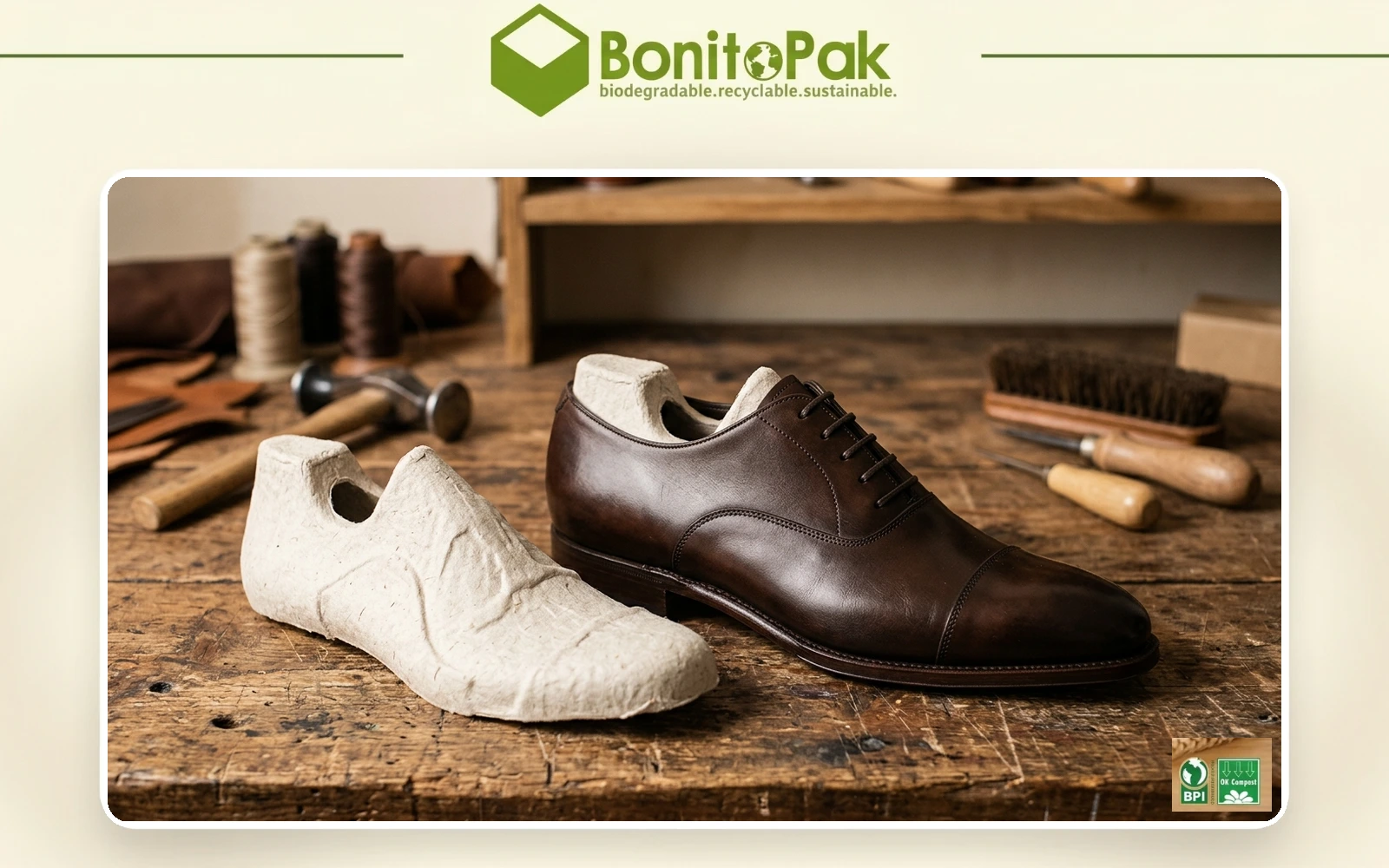
A paper shoe tree is a molded fiber form inserted into a shoe to hold its shape, stop the vamp creasing and absorb moisture from the lining. It is made from pulped waste paper or bagasse, vacuum formed on a mesh mold and dried, the same process behind egg cartons and protective trays. Suppliers describe the material as recyclable and naturally degradable, with high compressive strength, anti-static properties and nesting that makes it stack efficiently. Consumer packs retail in sized pairs, typically EU 39-40 through 45-46, while manufacturers order custom sizes and colors at volume, quoted FOB China.
このガイドの内容
- What it is, exactly
- Why shoes need a form in the box
- Pulp against tissue, plastic and cardboard
- Why moisture absorption is the point
- Sizes and specifications
- Who actually buys them
- Cost and ordering
- How to specify forms for your line
主なポイント
- Fiber’s biggest weakness in packaging, moisture absorption, is the selling point in a shoe. The form draws damp out of the lining instead of trapping it against the leather.
- A form does three jobs at once: holds the shape through freight, stops the toe box collapsing on a shelf, and keeps the vamp from creasing in storage.
- Molded pulp beats crumpled tissue on shape retention and beats plastic on cost, disposal and freight volume.
- Forms nest, so a carton holds far more pulp shapers than rigid plastic equivalents. That freight difference often outweighs any unit price gap.
- Sizes are usually sold as ranges rather than exact fits, because one form flexes across two or three sizes.
What Is a Pulp Shoe Form, Exactly?
It is a molded fiber shape, roughly the profile of a foot’s front half, pushed into the toe of a shoe to keep the upper from collapsing. Manufacturers also call it a shoe form, a shoe filler or a shoe shaper. It is not the same thing as a cedar shoe tree, which is a rigid wooden device with a heel block that a customer buys separately and reuses for years.
The distinction matters because the two products solve different problems. A wooden tree is a long term shoe care tool. A pulp form is packaging: it ships with the shoe, protects it until the customer puts it on, and is then recycled or composted.
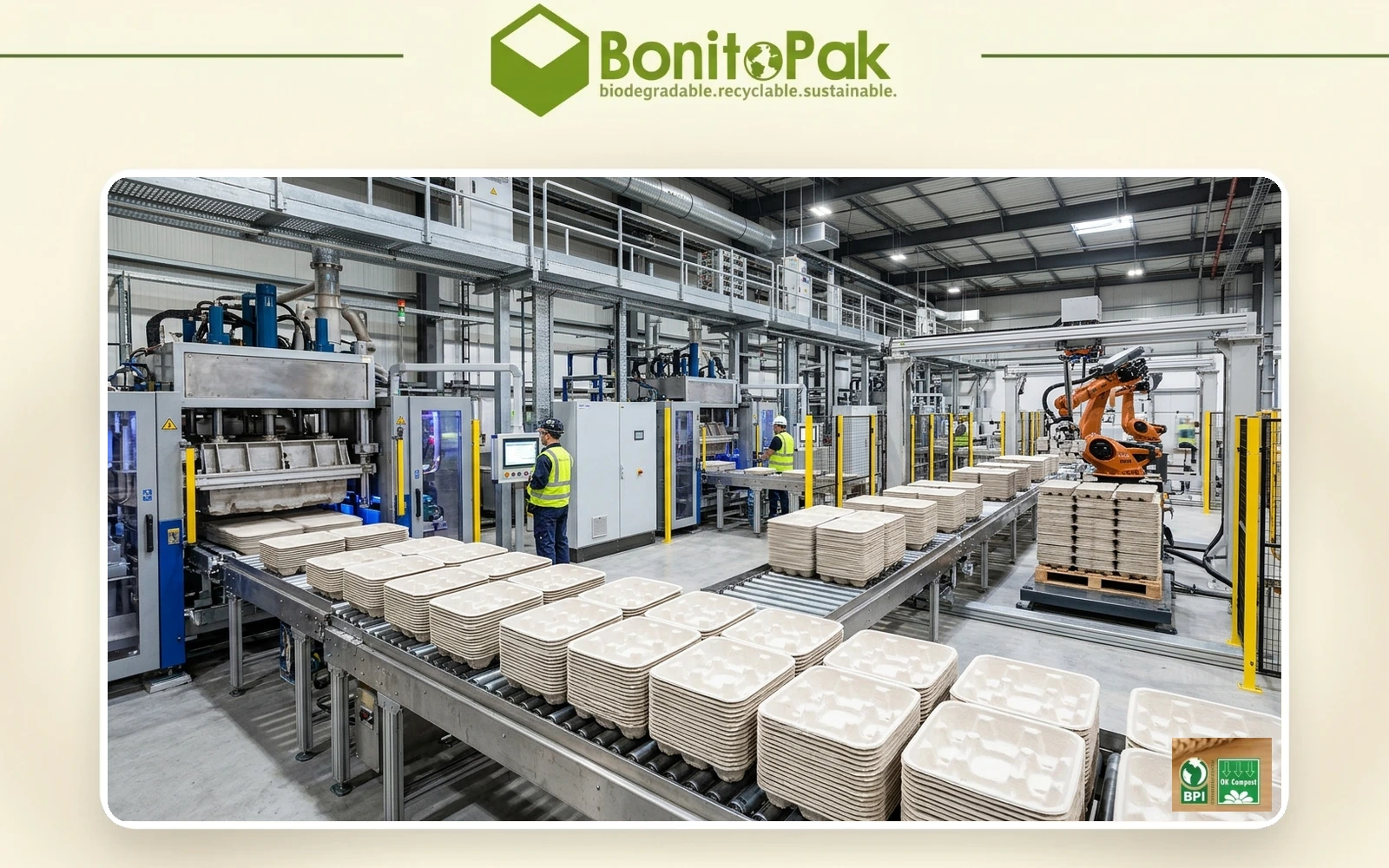
Production is the same as any other molded fiber part. Waste paper or bagasse is pulped with water into a slurry, a mesh covered mold draws the slurry under vacuum, and the wet part is dried into a rigid shape. Our guide to モールドパルプ covers the process in detail.
Why Do Shoes Need a Form in the Box?
An empty shoe has no internal structure. The upper holds its shape only because a last held it during construction, and once that last comes out the toe box will deform under its own weight, under the weight of shoes stacked above it, and under the pressure of a tightly packed carton. A form replaces the last for the life of the packaging.
Three failures a form prevents:
- Toe box collapse. The most visible one. A caved toe reads as damaged goods on a shelf, even when the shoe is perfect.
- Vamp creasing. The upper folds across the flex point in storage, and on leather that crease can set permanently.
- Freight deformation. Compression in transit, especially at the bottom of a pallet, where load is highest.
There is a fourth problem a form solves that most buyers never think about, and it is covered below.
Pulp Against Tissue, Plastic and Cardboard
Four materials compete for this job. Molded pulp wins on the combination of shape retention, cost and disposal, though it is not the best at any single one of those.
|
ファクター |
成型パルプ |
Crumpled tissue |
Injection molded plastic |
Folded cardboard |
|---|---|---|---|---|
|
Shape retention |
Good, holds a formed profile |
Poor, compresses and shifts |
Best, rigid |
中程度 |
|
Moisture handling |
Absorbs from the lining |
Absorbs, then stays damp |
Traps moisture against the upper |
Absorbs, warps |
|
単価 |
低い |
最低 |
最高 |
低い |
|
Freight volume |
ぎっしりと詰まっている |
Bulky |
Poor, rigid shapes do not nest |
Flat packs, needs assembly |
|
廃棄 |
Recycles with paper, composts if plain |
Recycles if clean |
Rarely recycled at kerbside |
紙と一緒にリサイクルできます |
|
棚への陳列効果 |
Clean, matte, premium enough |
Looks like filler |
Looks like plastic waste |
Plain |
|
Labor at packing |
Insert and done |
Hand crumpling, slow |
Insert and done |
Fold then insert |
Tissue is the real incumbent, not plastic. Most footwear still ships with paper stuffed in the toe, because it is cheap and needs no tooling. The hidden cost is labor: someone crumples and inserts by hand, the result varies between pairs, and it compresses within days of packing.
Plastic holds shape best and loses on everything else. It traps moisture against the upper, it does not nest so it burns container volume, and it sits in the highest producer fee bands as extended producer responsibility programs take effect.
私たちの insert guide covers the same trade off across other product categories.
Why Moisture Absorption Is the Point, Not the Problem
In every other fiber packaging application, moisture absorption is the material’s main weakness. Here it is the reason to choose it. Shoe forms are described by suppliers as absorbing moisture from the lining, and that is the fourth job referred to above.
The problem is real. A shoe comes off the production line with residual moisture from adhesives, finishing and the leather itself. Seal it in a box with a plastic insert and that moisture has nowhere to go. It sits against the lining and the upper through weeks of ocean freight and however long the box spends in a warehouse. The results are mildew spotting, adhesive problems and a musty smell the customer notices on opening.
A fiber form does the opposite. Cellulose draws damp out of the lining and distributes it through the wall of the part, where it can leave through the carton.
This is the strongest single argument for the material in this application, and it is almost never made. Competing product pages list “eco-friendly” and “biodegradable” and skip the one functional advantage that actually matters to a footwear brand.
Two caveats worth stating. A fiber form is not a desiccant and will not rescue a genuinely wet shoe, so it complements rather than replaces a silica sachet where one is specified. And a form that has absorbed moisture softens, which is why compressive strength and wall thickness need specifying for long ocean transits rather than assumed.
What Sizes and Specifications Are Available?
Sizes are sold as ranges rather than exact fits, because one molded profile flexes enough to serve two or three consecutive sizes. Consumer packs run in pairs across EU bands such as 39-40 and 45-46. For manufacturing, size, shape and color are all customizable, which is the point of commissioning a mold rather than buying stock.
What a specification should cover:
- Size band, with the actual lasts you build on rather than a nominal range
- Profile depth, which decides how far into the shoe the form sits
- Wall thickness and compressive strength, specified against your pallet load and transit length
- 食物繊維, recycled grey for cost or bagasse for a lighter, cleaner surface
- カラー, pigmented in the slurry so it runs through the part
- Printing or embossing, where the form is visible at unboxing
- Men’s or women’s profiles, which differ enough to need separate tooling
Stock profiles exist and work for standard sizes. If your lasts are distinctive, or the form is part of the unboxing experience, custom tooling is the route. Our mold design and tooling team cuts molds per project.
Who Actually Buys Pulp Shoe Trees?
Three groups buy them for genuinely different reasons, and they want completely different products.
Footwear brands and manufacturers. Buy at volume for packing lines, usually with custom sizing and sometimes with printing. They care about compressive strength, transit performance, nesting and cost per pair. This is where molded pulp shoe forms compete with tissue and plastic.
Retailers and dry cleaners. Buy stock packs for display shoes, returns handling and storage. They care about size coverage and price, not tooling.
Consumers. Buy multi-pair packs for wardrobe storage and crease prevention in sneakers and boots. They are shopping against cedar trees and plastic shapers on price.
Why this matters for sourcing. A manufacturer quoting FOB China at volume and a consumer pack on a marketplace are not the same transaction. If you are a brand, the stock consumer product will not fit your lasts and the economics are wrong. If you want 20 pairs for a wardrobe, a factory with tooling minimums is the wrong supplier.
What Do They Cost and How Are They Ordered?
Unit cost is low, with Indian suppliers listing pulp shoe fillers around ₹6 per piece. Shoe packaging inserts are quoted on the same variables as any molded fiber part: size, wall thickness, fiber, color and volume. As with every fiber project, tooling rather than unit price decides whether a custom form makes sense.
How the commercial terms usually work:
- Minimum order quantity depends on part size, since larger parts fill a mold cycle differently.
- 工具 is cut per profile and paid once, then amortized across the order. A separate men’s and women’s profile means two molds.
- Trade terms are commonly FOB a Chinese port with payment by telegraphic transfer, which is standard for this category.
- Freight favors fiber heavily, because forms nest. Compare container utilization rather than unit price alone.
Ask any supplier to quote tooling separately from unit price. That is the only way to calculate your own breakeven, and it is the number that decides the project.
How to Specify Shoe Forms for Your Line
If you are evaluating this for a footwear line, work in this order.
今週は: send your supplier actual shoes, ideally one pair per size band and one per last profile. A fiber form is designed around the object, and no drawing captures what a physical shoe does.
Before tooling: confirm your annual pairs per size band, since that decides how thinly tooling spreads. Confirm your longest transit route, because that sets the compressive strength requirement. Confirm whether the form is visible at unboxing, because that decides fiber and finish.
Then ask for: samples in your chosen fiber, a quote separating tooling from unit price, a compression figure rather than a general strength claim, and container quantities so you can compare freight against your current solution.
で ボニートパック we manufacture molded fiber parts from recycled paper, sugarcane bagasse and bamboo on dry pressing lines suited to formed protective shapes like these, with in house tooling and six pulp color systems. Our dry pressing trays page shows the process and finish, our 素材ページ sets out the fiber options, and our カスタマーサービスページ covers development. Send us a pair of shoes and your transit route and we will tell you what the form needs to be.
よくあるご質問
Q: What is a paper shoe tree used for? A: Holding a shoe’s shape inside its box. It stops the toe box collapsing under stacking load, stops the vamp creasing in storage, and absorbs residual moisture from the lining during freight. Suppliers also cite high compressive strength and anti-static properties. It is packaging rather than a reusable shoe care tool.
Q: Is a pulp shoe tree the same as a wooden shoe tree? A: No. A cedar shoe tree is a rigid reusable device with a heel block that a customer buys for long term shoe care. A pulp form is packaging: it ships inside the shoe, protects it until first wear, and is then recycled with paper or composted if the fiber is plain and uncoated.
Q: Do paper shoe forms stop shoes going mouldy? A: They help, by drawing moisture out of the lining rather than trapping it against the upper the way a plastic insert does. They are not desiccants, so for genuinely humid routes they complement a silica sachet rather than replacing it. A form that absorbs moisture also softens, so specify compressive strength for long transits.
Q: What sizes do pulp shoe forms come in? A: Usually size bands rather than exact fits, because one molded profile flexes across two or three consecutive sizes. Consumer packs run in pairs across EU ranges such as 39-40 and 45-46. For manufacturing, size, shape and color are customizable, and men’s and women’s profiles differ enough to need separate tooling.
Q: Are shoe packaging inserts recyclable? A: Plain uncoated fiber forms recycle through the paper stream, which reaches most US households, and compost where facilities accept them. Suppliers describe the material as recyclable and naturally degradable. Any coating, heavy printing or plastic component changes that, so confirm the specification before making a disposal claim on the box.
Q: Can a pulp shoe shaper replace tissue paper stuffing? A: Yes, and that is the usual switch. Tissue is cheaper per unit but needs hand crumpling, varies between pairs and compresses within days of packing. A molded form inserts in one motion, holds a repeatable profile, and nests in freight so container utilization improves. Compare total packing labor and freight rather than material cost alone.
出典
- Molded pulp shoe insert product specifications, including the moisture absorption from lining, compressive strength, anti-static and recyclability claims, and customizable size, shape and color. https://www.bestpluspulp.com/product/pulp-shoe-tree-138/
- Consumer pulp shoe tree listings showing sized pair packs across EU size bands and stated anti-crease and shape retention uses, Amazon.
- Paper pulp shoe filler pricing, Indian supplier listing at ₹6 per piece. https://www.indiamart.com
- Paper pulp shoe tree supplier listings and product range, Alibaba. https://www.alibaba.com
- American Forest and Paper Association, US paper recovery figures. https://www.afandpa.org