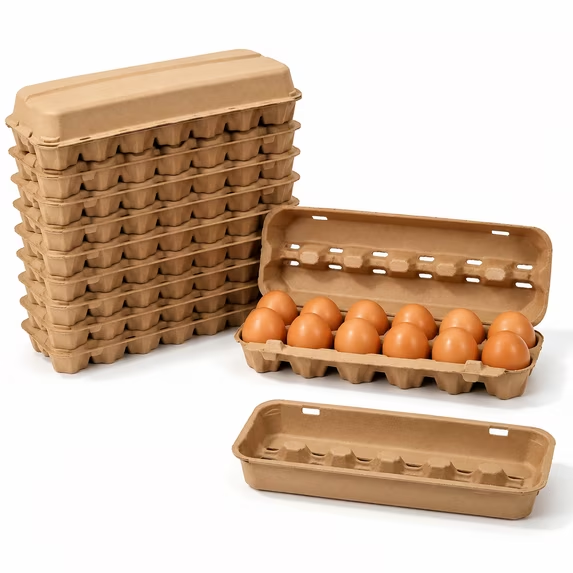
A plain carton sounds like a carton with something missing. In practice it is the format with the most specific requirement attached, because the surface has to accept something else.
If a carton is going to carry a pressure sensitive label, the lid surface has to be consistent enough for adhesive to bond across its full area. Molded pulp varies in surface density depending on how the fiber drained during forming, and a lid with uneven density will hold a label at one end and lift at the other.
We finish blank lids to a controlled surface density for this reason. It is the difference between a label that survives six weeks in a cold case and one that curls at the corner within a week.
Buyers who have had labels lift on pulp cartons before have usually bought a carton that was blank by omission rather than blank by specification.
Who buys blank, and what each group needs
Three groups, with genuinely different requirements.
Distributors and resellers buy blank because they supply many small producers who each want their own identity. The carton has to carry no supplier marks at all, including ours, because the distributor is the supplier as far as their customer is concerned. We do not put our name on these cartons anywhere.
Private label packers buy blank and apply a retailer’s printed label. Their requirement is dimensional consistency, since labels are applied by machine against a fixed registration point, and a carton that varies in height will label crooked.
Small farm sellers buy blank because they cannot reach printing minimums. They label by hand or stamp with a custom rubber stamp. Their requirement is simply low minimum order quantity, which blank cartons give them because there is no plate or mold cost to amortize.
Cost, and why blank is the cheapest route
Blank cartons carry the lowest unit cost in our range, and the reasons compound.
There is no plate charge, since nothing is printed. There is no mold tooling charge, since blanks run on stock molds. There is no print pass, which removes an entire operation from the production path. And blank runs can be scheduled flexibly against other production, because there is no color or artwork changeover to plan around.
That last point also makes blank the shortest lead time we offer. For a buyer whose constraint is timing rather than branding, blank plus a quickly printed label is almost always faster than a printed carton.
Labeling that actually holds
Four practical points from buyers who label blanks.
Paper labels outperform film on pulp. Film has less conformability and lifts at the edges where the lid surface is slightly textured. Uncoated paper labels bond better and look more appropriate on fiber.
Apply at room temperature, not in the cold room. Adhesive needs time to flow into the surface, and cold slows that to the point where the bond never fully forms.
Keep the label away from the hinge and the front tab. Both flex, and a label bridging a flex point peels from that edge first.
And size the label to the flat center panel rather than edge to edge. The lid curves slightly at its margins and a full-width label will tent at the corners.
Stamping as an alternative to labels
Small producers often skip labels entirely and use a custom rubber stamp with food safe ink. On natural pulp it works well, because the absorbent surface takes stamp ink cleanly without smearing, and the slightly irregular result reads as handmade rather than as a printing defect.
It is the cheapest branding route available, it needs no minimum order, and it suits farm stand selling where the handmade impression is an asset. It does not scale, since every carton is a manual operation, and it does not work on darker colored pulp where the ink has nothing to contrast against.
When blank stops being the right answer
Blank is the correct choice up to a point, and past that point it costs more than printing.
Labels have a per unit cost that never falls away, same as printing. Once annual volume is high enough, the accumulated label cost passes what embossing would have cost once in the mold. The crossover is usually lower than buyers expect, because labels also carry an application labor cost that printing does not.
Producers who find themselves hand-labeling thousands of cartons have usually passed that point already. Embossing is covered at cajas de huevos con impresión personalizada, and it costs nothing per unit once the tool exists.
Across the range
Blank is available in every count. The volume formats are the caja de cartón moldeado para una docena de huevos and the molded pulp 18 egg carton, and both are commonly ordered blank for private label work.
Blank is also available in color, which buyers often miss. A colored blank gives shelf differentiation with no printing at all, and for small producers it is frequently the best value in the catalog. See cajas de huevos de pulpa moldeada de colores.
For bulk ordering and pricing tiers, see wholesale egg cartons.