 Zum Inhalt wechseln

Introduction: The Reality Behind the Paper Bottle Trend
The demand for sustainable packaging is no longer a niche movement. Brands across beverage, cosmetics, and personal care industries are under pressure to reduce plastic usage and demonstrate measurable environmental responsibility. Among the most talked-about innovations is the paper water bottle. It looks simple from the outside a fiber-based alternative to plastic but manufacturing it consistently, safely, and economically is far from simple.
A paper water bottle manufacturing machine is not just another forming line. It is a precision system that must balance structural integrity, moisture resistance, production speed, and sustainability goals at the same time. Many companies enter this space assuming the transition from plastic to paper is mostly a material change. In reality, it is a process transformation.
If you are considering investing in a paper water bottle manufacturing machine, understanding the engineering behind the system is critical. Because success in this category is not determined by concept alone it is determined by manufacturing discipline.
What a Paper Water Bottle Manufacturing Machine Actually Does
Unlike conventional molded pulp products such as trays or inserts, a paper water bottle must withstand internal liquid pressure, resist moisture penetration, and maintain structural rigidity during storage and transport. This requires a manufacturing system that goes beyond basic pulp forming.
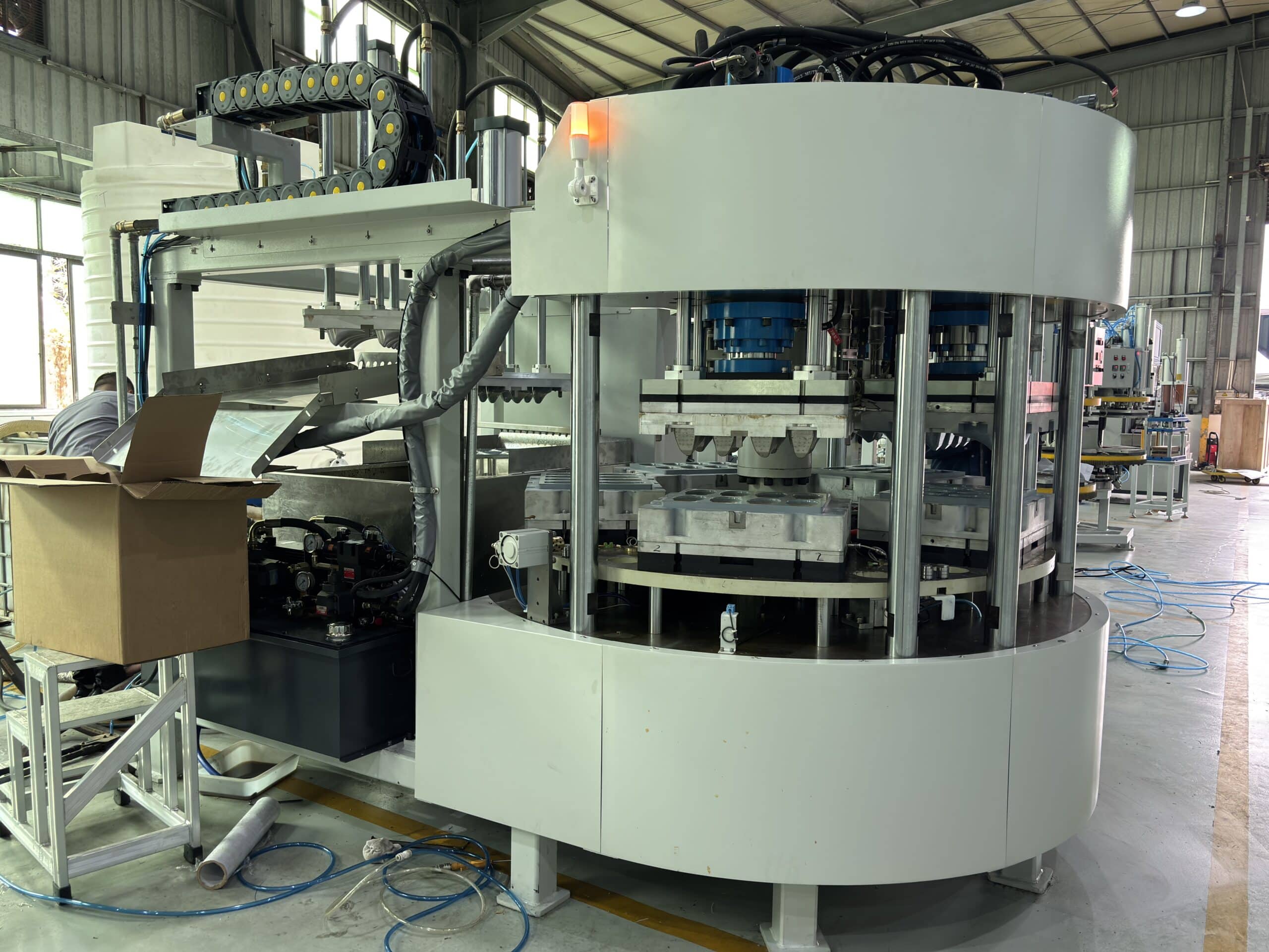
A paper water bottle manufacturing machine typically integrates pulp preparation, precision forming, controlled pressing, high-efficiency drying, trimming, surface treatment, and in some cases barrier coating application. Each stage must be synchronized. If fiber distribution is uneven, wall thickness varies. If drying is inconsistent, dimensional stability suffers. If moisture resistance layers are misapplied, leakage risk increases.
The forming stage must ensure uniform density around curved surfaces. The pressing stage must remove sufficient moisture without compromising structural strength. The drying stage must maintain controlled temperature gradients to prevent warping or cracking. These are not minor adjustments they are structural requirements.
Companies already operating in molded fiber production, such as those producing precision packaging solutions like Trockenpressen von Zellstoffschalen, understand that forming pressure, fiber dispersion, and drying control directly affect final product strength. Paper water bottle production demands even tighter tolerances.
The Engineering Challenges of Liquid-Holding Fiber Products
The biggest misconception about paper water bottle manufacturing machines is that they are simply upgraded molded pulp lines. They are not. Liquid containment introduces new variables that standard fiber products do not face.
First, structural compression strength must withstand filling pressure and stacking loads. Second, internal moisture resistance must prevent fiber breakdown over time. Third, dimensional precision must ensure compatibility with caps, closures, or integrated sealing systems.
This means the machine must support precise control over fiber length distribution, forming pressure uniformity, and post-forming conditioning. Even slight inconsistencies can compromise performance.
Energy control is also more sensitive in bottle production. Over-drying increases brittleness. Under-drying increases deformation risk. Thermal balance must be engineered carefully.
In a typical mid-scale paper water bottle manufacturing setup, energy consumption may distribute approximately as follows:
| Systembereich | Primärenergie Art | Ungefährer Anteil an der Gesamtenergie |
| Drying Section | Thermische | 45-55% |
| Forming & Press Section | Elektrizität | 15–20% |
| Vacuum System | Elektrizität | 10-15% |
| Zellstoffaufbereitung | Elektrizität | 10-15% |
| Trimming & Finishing | Elektrizität | 5-10% |
The drying section remains the dominant energy load, but forming precision determines how much thermal input is required. A well-designed paper water bottle manufacturing machine reduces moisture before drying through optimized press calibration, minimizing unnecessary energy use.
Standard Systems vs Customized Bottle Manufacturing Lines
Many equipment suppliers offer semi-standard molded pulp systems adapted for bottle shapes. While these systems may produce acceptable prototypes, scaling to commercial production often reveals limitations in throughput, consistency, and energy efficiency.
A customized paper water bottle manufacturing machine is engineered around specific bottle dimensions, fiber composition, and coating strategy. Instead of adjusting production around machine limitations, the machine is designed around product requirements.
The performance difference becomes clear when comparing long-term operational metrics.
| Metrisch | Semi-Standard Line | Customized Line |
| Average kWh per Unit Produced | Höher | Verringert |
| Variation der Wanddicke | ±0,5 mm | ±0,2 mm |
| Ablehnungsquote | 6–8% | 2-4% |
| Drying Time per Batch | Longer | Optimized |
| Scaling Stability | Mäßig | Hoch |
While customization increases initial engineering investment, improved energy performance and lower rejection rates significantly influence long-term profitability. In high-volume beverage markets, even small efficiency gains translate into substantial cost advantages.
Integration with Sustainable Manufacturing Goals
The push toward paper bottles is not only about replacing plastic but about building credible sustainability narratives. Companies must demonstrate that their packaging solution genuinely reduces environmental impact rather than shifting it.
A well-designed paper water bottle manufacturing machine supports this objective by minimizing fiber waste, optimizing energy consumption, and integrating recyclable or compostable barrier systems. System integration becomes essential. Fiber preparation, forming, drying, and finishing must operate within tightly controlled parameters to reduce scrap rates.
This broader sustainability philosophy aligns with integrated manufacturing approaches seen across fiber-based production platforms such as those developed at BonitoPak, where efficiency and environmental responsibility are engineered simultaneously rather than treated as separate goals.
Industry conversations around eco-friendly packaging customization, including insights like Sind geformte Zellstoffkisten für das Branding anpassbar?, reflect a growing understanding that sustainable design begins with manufacturing precision. Paper water bottle production sits at the forefront of this transition.
The Financial Perspective: Scaling Beyond Prototype
Prototype development for paper water bottles often succeeds in controlled environments. The challenge emerges during scale-up. Cycle time consistency, moisture stability, coating uniformity, and cap integration must all perform reliably under continuous production conditions.
When evaluating a paper water bottle manufacturing machine, decision-makers should analyze lifecycle cost rather than purchase price alone. Energy efficiency per unit, material yield percentage, rejection rates, and maintenance frequency all determine long-term profitability.
Manufacturers who invest in integrated system design at the outset avoid costly retrofits later. Retrofitting drying capacity or reconfiguring forming molds after installation is significantly more expensive than engineering customization from the beginning.
Paper bottle production is a precision process. Precision demands alignment.
Conclusion: Innovation Requires Engineering Discipline
The transition from plastic bottles to fiber-based alternatives is not a marketing shift; it is a manufacturing evolution. A paper water bottle manufacturing machine must combine structural strength, moisture resistance, energy efficiency, and scalability within one cohesive system.
Standard molded pulp equipment may produce acceptable samples, but commercial success requires integration. Forming precision must align with drying capacity. Fiber preparation must match density targets. Finishing processes must ensure leak resistance without compromising recyclability.
Manufacturers who approach paper bottle production with system-level thinking position themselves for long-term competitiveness. Those who rely on adapted standard machinery often encounter operational limits during scale-up.
If you are considering entering the paper bottle market, the most important question is not whether the product concept is viable. It is whether your manufacturing system is engineered to support it at scale.
Häufig gestellte Fragen
What is a paper water bottle manufacturing machine?
It is an integrated production system designed to form, press, dry, and finish fiber-based bottles capable of safely holding liquids.
How energy-intensive is paper bottle production?
Drying typically accounts for the largest energy share, often around 45 to 55 percent of total consumption, making thermal optimization essential.
Can standard molded pulp machines produce paper bottles?
They can produce prototypes, but scaling requires customization for structural integrity, moisture control, and dimensional precision.
Is customization necessary for commercial production?
In most cases, yes. Customization improves consistency, reduces rejection rates, and enhances long-term energy efficiency.
How does paper bottle production support sustainability goals?
By reducing plastic use and integrating recyclable fiber materials, while engineered manufacturing systems minimize waste and energy inefficiency.




 German
  English
  Spanish
  French
  Russian
  Japanese
  Portuguese
  Arabic