 Zum Inhalt wechseln

Sustainability is no longer a trend — it’s a global shift. Across food service, consumer goods, electronics, agriculture, and medical industries, one product is rapidly replacing plastic, foam, and Styrofoam: molded fiber trays.
Many companies have already set strong benchmarks, and businesses worldwide are now exploring molded fiber trays as a scalable, reliable, and eco-friendly alternative.
What Are Molded Fiber Trays and Why Are They Replacing Plastic?
Molded fiber trays (also called pulp trays, geformte Zellstoffschalen, or biodegradable fiber trays) are packaging trays produced from natural fibers such as:
- Sugarcane bagasse
- Bamboo
- Recyceltes Papier
- Holzschliff
- Wheat straw
Unlike plastic trays, molded fiber trays:
- Decompose naturally
- Come from renewable materials
- Have no harmful microplastics
- Are safe for food contact
They offer the functionality of plastic while eliminating long-term environmental pollution.
Why Plastic Is Losing Ground?
Traditional petrochemical plastics remain in ecosystems for hundreds of years. Governments are banning single-use plastics, and consumers now expect eco-friendly choices from brands. Molded fiber trays give businesses a compliant and future-proof solution.
How Are Molded Fiber Trays Manufactured and What Makes the Process Eco-Friendly?
The production of molded fiber trays involves a unique low-impact process:
Zellstoffherstellung
Fibers (bagasse, bamboo, recycled paper, etc.) are blended with water to form a soft slurry. This water-based process uses far less energy and chemicals compared to plastic manufacturing.
Gießen
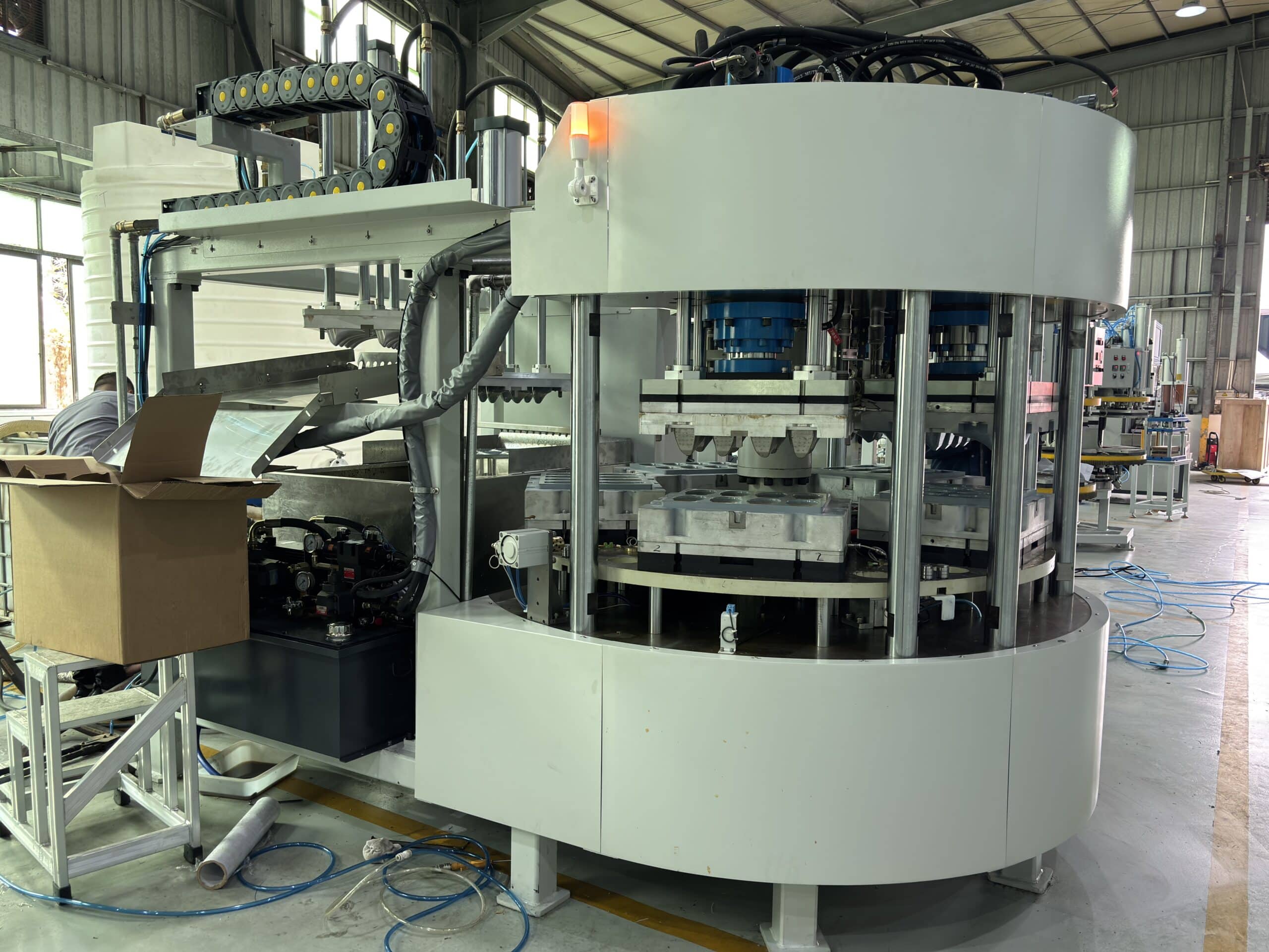
Automated forming molds shape the slurry into tray forms. Vacuum suction removes excess water while preserving the tray’s geometry and strength.
Pressing & Drying
Hot pressing or thermoforming compresses the tray, improving:
- Rigidity
- Smoothness
- Dimensional accuracy
- Water and oil resistance
Trimming & Finishing
Edges are trimmed clean, and trays can be customized or coated based on industry requirements.
Because the entire process is energy-efficient and avoids toxic petroleum-based chemicals, Schalen aus Formfasern have one of the lowest environmental footprints in the packaging industry.
What Types of Molded Fiber Trays Are Available?
Molded fiber trays are highly adaptable and used across multiple sectors. The most popular categories include:
Food & Beverage Trays
- Meal prep trays
- Frozen food trays
- Produce trays
- Eierkartons
Electronics Trays
- Protective device trays
- Component separators
- Shock-absorbing inner trays
Medical & Pharmaceutical Trays
- Surgical instrument trays
- Medication kits
- Single-use sterile packaging
Cosmetic & Skincare Trays
- Bottle inserts
- Luxury product trays
- Gift set holders
Shipping & Warehouse Trays
- Stackable industrial trays
- Automotive component trays
- Reusable heavy-duty trays
Each type can be customized for dimensions, structural strength, moisture resistance, and branding needs.
Why Do Businesses Prefer Molded Fiber Trays Over Plastic, Foam, or Styrofoam?
Companies are switching to molded fiber trays for multiple high-impact reasons:
Environmental Leadership
Plastic bans, corporate sustainability mandates, and ESG frameworks push brands toward renewable packaging. Molded fiber makes compliance simple.
Überlegener Produktschutz
Fiber trays are naturally shock-absorbent and provide excellent cushioning — often better than EPS and plastic.
Strong Brand Positioning
Eco-packaging improves:
- Brand credibility
- Consumer trust
- Product presentation
Heat & Cold Resistance
Food-grade molded fiber trays can handle ovens, microwaves, freezers, and hot food applications.
Cost Savings in the Long Run
Although sometimes priced slightly higher than low-quality plastics, molded fiber significantly reduces:
- Waste management costs
- Environmental penalties
- Customer complaints
- Shipping damages
What Industries Are Driving the Global Demand for Molded Fiber Trays?
2025 market reports show strong adoption across:
Food Service & Meal Delivery
Meal prep companies prefer molded fiber because it is microwave-safe, freezer-safe, and leak-resistant.
Electronics & Home Appliances
Brands like Apple and Samsung use molded fiber for devices, accessories, and internal protective trays.
Healthcare & Medical Packaging
Fiber trays meet strict hygiene standards and reduce the footprint of disposable medical waste.
Agriculture & Fresh Produce
Growers use biodegradable trays for fruits, vegetables, eggs, and specialty crops.
Cosmetics & Luxury Packaging
Premium brands now choose molded fiber for nachhaltig, eco-focused unboxing experiences.
How Sustainable Are Molded Fiber Trays Compared to Other Packaging Materials?
Molded fiber trays shine in sustainability metrics:
100% Compostable & Biodegradable
They break down naturally within 30–90 days, depending on the environment.
Made From Agricultural Waste
Using bagasse or wheat straw reduces:
- Agricultural burning
- Air pollution
- Fossil fuel dependency
Geringere Kohlenstoffemissionen
Manufacturing molded fiber consumes less:
- Energy
- Wasser
- Heat
than plastic, aluminum, or polystyrene.
No Microplastics
They don’t release harmful chemicals into soil or waterways.
Supports Circular Economy Systems
Fiber trays can be recycled back into new Zellstoffprodukte, forming a fully closed-loop cycle.
What Customization Options Do Molded Fiber Trays Offer for Brands?
Brands choose molded fiber because of its flexible customization:
Design & Structure Customization
- Multi-cavity trays
- Stackable and nestable formats
- Reinforced ribs for durability
- Precision-fit components
Branding-Optionen
- Embossed logos
- Printed graphics
- Custom colors (plant-based dyes)
Functional Enhancements
- Oil-resistant barriers
- Moisture-proof coatings
- Oven-safe and freezer-safe finishing
- Antimicrobial coatings (optional)
This high level of flexibility allows molded fiber trays to fit seamlessly into supply chains.
Are Molded Fiber Trays Safe for Food Contact and High-Heat Use?
Yes — molded fiber trays are widely used for hot and cold food applications.
Why They Are Safe?
- Made from natural, non-toxic fibers
- Certified for food contact
- PFAS-free versions available
- Can withstand oven and microwave temperatures
Hitze-Toleranz
Pressed molded fiber trays can sustain up to 200°C (392°F) depending on formulation and coating.
Cold Resistance
They remain stable in refrigeration and freezing environments without cracking.
What Are the Limitations of Molded Fiber Trays?
Not Ideal for Extremely Heavy-Oil Foods Without Coating
Molded fiber is naturally absorbent, so very oily or greasy foods can soften the tray if no barrier coating is applied. High-fat meals like fried items or saucy foods may cause seepage over time. Plant-based, PFAS-free coatings solve this by adding strong grease and moisture resistance while keeping the tray compostable.
Slightly Higher Initial Cost Than Low-Grade Plastics
Compared to cheap plastics like EPS, molded fiber trays cost more upfront due to renewable materials and higher production standards. However, brands recover this through fewer environmental penalties, stronger customer trust, and lower waste-handling issues. Long-term savings often outweigh the initial price difference.
Some Regions Lack Composting Facilities
Even though molded fiber is compostable, many countries don’t have industrial composting systems to process it quickly. This can push trays into regular waste streams where decomposition is slower. Home-compostable and recyclable fiber variants help brands adapt to local waste infrastructure.
Limited Color Choices
Because molded fiber uses natural plant fibers, it typically comes in earthy tones rather than bright, synthetic colors. Strong dyes can affect compostability, limiting color range. Many brands use embossing, natural dyes, or minimalist printing to maintain attractive packaging while staying eco-friendly.
How Cost-Effective Are Molded Fiber Trays for Long-Term Business Use?
Molded fiber trays offer cost efficiency through:
Reduced Environmental Penalties
Helps meet plastic ban regulations.
Lower Transportation & Storage Costs
They are lightweight and nestable, reducing shipping volume.
Waste Management Savings
Fully biodegradable → lower disposal fees.
Brand Value & Customer Loyalty
Consumers prefer eco-conscious brands, resulting in increased sales and trust.
How Do Molded Fiber Trays Support ESG, Zero-Waste, and Circular Economy Goals?
ESG Compliance
Fiber trays support environmental responsibility goals across all three ESG pillars. Environmental criteria improve with lower carbon emissions and the use of renewable materials. Social responsibility also advances through safer manufacturing methods that remove toxic chemicals found in plastic production.
Governance standards are enhanced when companies show transparent and sustainable supply chains to investors. Many institutional investors now ask for ESG reporting, and molded fiber packaging offers clear metrics for sustainability disclosures. Brands that switch to fiber trays frequently notice better ESG scores, drawing in environmentally conscious investors.
Zero-Waste Policies
100% compostability makes molded fiber trays suitable for zero-waste packaging programs in various industries. Unlike plastic options that need special recycling facilities, fiber trays break down naturally within 30 to 90 days. Many formulations can be composted at home, making it easier for consumers to dispose of them.
Zero-waste certification programs accept molded fiber as an approved material. Businesses aiming for TRUE Zero Waste certification find that fiber trays help meet compliance requirements. Moreover, making fiber trays produces little waste since any leftover pulp goes back into the production process.
Circular Economy
Recycling → Repulping → Reuse creates a closed-loop sustainability system that plastic packaging cannot rival. Molded fiber trays can be recycled many, as seven times before fiber deterioration impacts quality. Every recycling iteration consumes energy than producing virgin materials.
Composted fiber trays contribute nutrients to agricultural soil, potentially growing crops that become future packaging feedstock. This biological cycle creates regenerative systems where packaging waste becomes agricultural input.
Carbon Footprint Reduction
Manufacturing molded fiber trays emits fewer greenhouse gases than plastics across every lifecycle stage. Pulp molding operates at lower temperatures than plastic thermoforming, and many manufacturers utilize renewable energy sources.
Final Words
If your business priorities include sustainability, brand reputation, customer loyalty, and long-term cost efficiency, then molded fiber trays represent the future of environmentally responsible packaging. As industries continue shifting toward sustainable practices, embracing molded fiber trays is no longer simply an option — it’s a strategic necessity for competitive success




 German
  English
  Spanish
  French
  Russian
  Japanese
  Portuguese
  Arabic