By Leo Chan, Senior Packaging Consultant, BonitoPak. Last updated: November 2026.
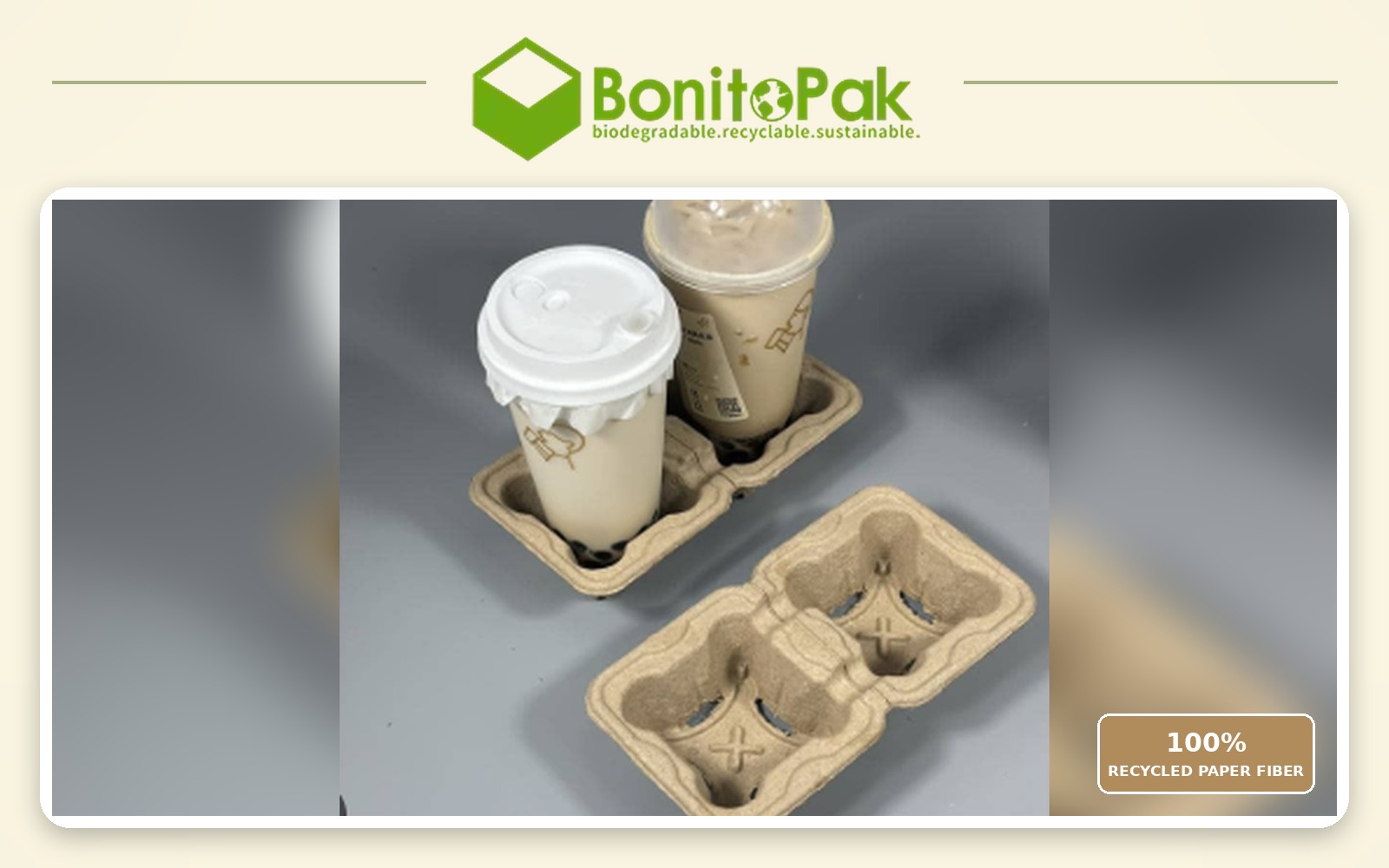
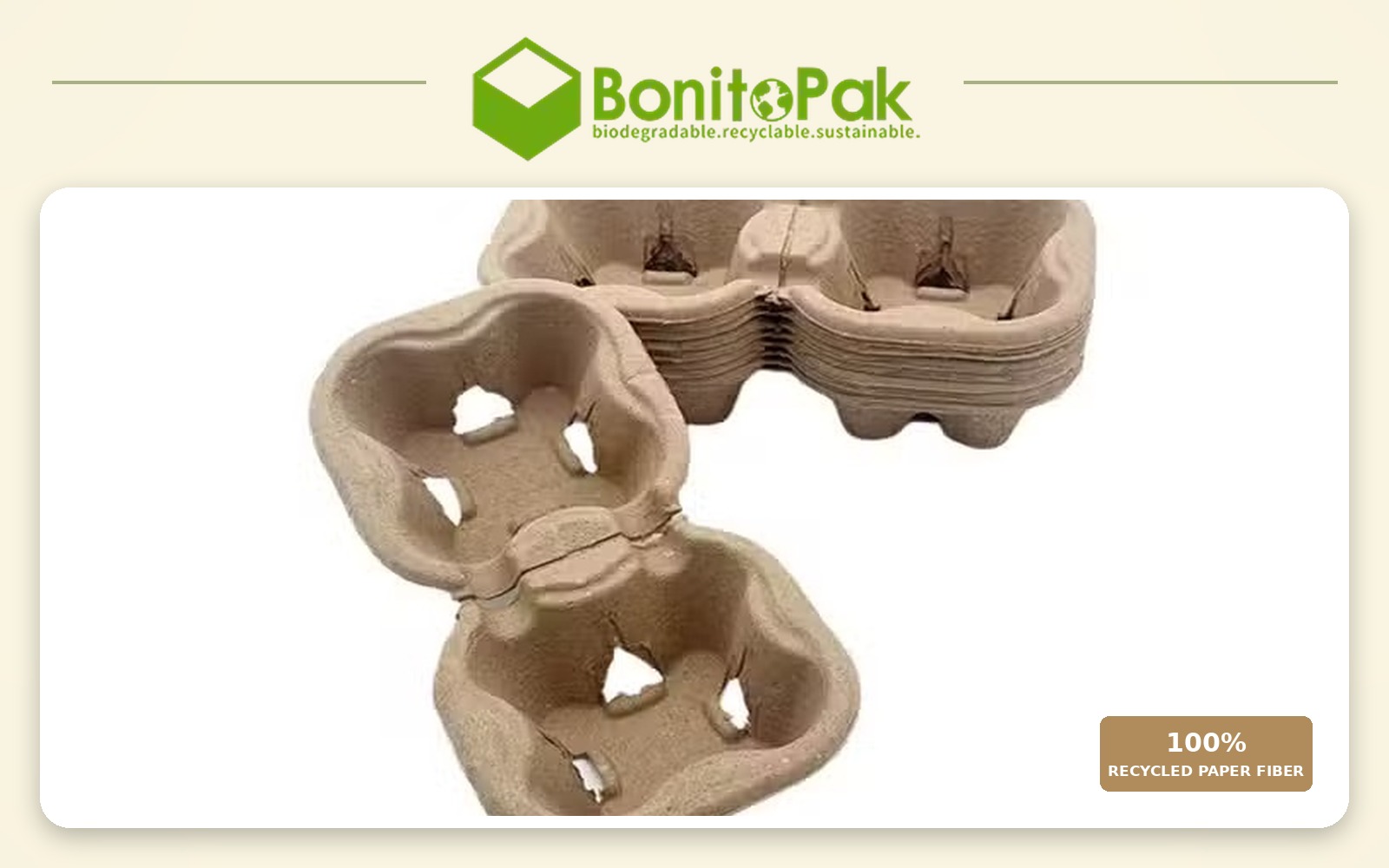
A molded pulp cup carrier is a one piece tray, pressed from recycled paper pulp, that holds two or four takeaway cups upright. Ours is made in Dongguan, China by wet pressing, measures 278 x 221 x 154 mm (10.9 x 8.7 x 6.1 in) in the listed model, and carries a minimum order of 5,000 pieces. It is plastic free, stackable and can carry your logo.
A carrier looks simple, but it fails in two ways: the cup does not seat, or the pulp softens under a wet cup. This guide covers sizes, cup fit, strength, branding, disposal claims and a test you can run before ordering, using the specs we publish.
Key Takeaways
- The cup fit is the spec that matters most. Give us your cup bottom diameter, cup height and lid height before anything else.
- Our listed carrier is 278 x 221 x 154 mm. Confirm which cup count and cup range that size covers before you plan a case pack.
- Test with filled, sweating cups, not empty ones. Pulp strength shows up under a wet cup.
- Do not print “compostable” or “PFAS free” on your own packaging until you hold a document that supports it.
- MOQ is 5,000 pieces, with custom cavities, embossed logos and brand colors available.
What Is a Molded Pulp Cup Carrier and Who Uses It?
A molded pulp cup carrier is a rigid tray with deep pockets that hold cups upright during carry. It is formed from a water and fiber slurry, pressed in a heated mold and dried. Coffee shops, tea chains, juice bars, bakeries with a drinks counter and delivery brands use it to move two to four drinks in one hand.
Buyers search for it as a molded fiber, paper pulp, recycled pulp or plant fiber carrier. Ours is made from recycled paper pulp, the material on our product page. If you want a plant fiber version, such as straw or bamboo, ask us, because that is a separate material choice with a separate price and look. Our cup carrier trays page shows the standard 2 and 4 cup models.
What Sizes Do Molded Pulp Cup Carriers Come In?
Our standard line has a 2 cup and a 4 cup carrier, and custom cavities are cut to your cup size. The listed model is PM-042, with a PM-233 variant, and the listed size is 278 x 221 x 154 mm. The table shows the spec as published.
| Feature | BonitoPak cup carrier |
|---|---|
| Models | PM-042, variant PM-233 |
| Listed size | 278 x 221 x 154 mm (10.9 x 8.7 x 6.1 in) |
| Capacity | 2 cup or 4 cup, custom cavities by cup size |
| Material | Recycled paper pulp, wet pressed |
| Shape | Rectangle, custom shapes accepted |
| Color | Custom color |
| Logo | Embossed or debossed |
| MOQ | 5,000 pcs |
| Customization | OEM and ODM, custom package accepted |
One point needs a check before you rely on the size. The page lists a single set of outer dimensions for a 2 and 4 cup range. A four cup carrier and a two cup carrier cannot share one footprint, so ask us which cup count the 278 x 221 x 154 mm figure describes, and request a drawing of the other. We would rather you hear that from us than from a prototype that does not fit your counter bag.
How Do Cups Fit a Molded Pulp Cup Carrier?
A cup fits when the bottom sits in the pocket and the cup wall has support at a point above it. The pocket has to match the bottom diameter of your cup. A cup that is too loose tips and spills, and a cup that is too tight is hard to load and may split a paper cup seam.
Cup bottoms are narrower than cup rims, because every takeaway cup tapers. For example, a cup with a 3 1/2 inch rim might have a bottom closer to 2 1/2 inches. A retail 4 cup carrier from a restaurant supplier states a hard limit of 2 5/8 inch bottom diameter, which shows why a carrier fits some cups and not others. That is a retail example, not a statement about ours.
Give us three numbers for each cup size you serve:
- Bottom diameter, measured at the base of the cup.
- Total cup height with the lid on.
- Rim diameter of the lid.
If you serve 12, 16 and 20 ounce cups from one brand, say so. A single carrier can suit more than one size if the bottom diameters are close, but when they are not, a custom cavity per size is the cleaner answer. This is the part of the job our design and tooling team handles, and it is why a physical sample cup helps more than a drawing.
How Strong Is a Molded Pulp Cup Carrier With Cold and Hot Drinks?
Pulp is strong while dry and softens when it stays wet. A carrier holding a hot latte for a few minutes is usually fine. A carrier under a sweating iced drink for an hour is the harder test, because condensation pools in the pocket and the fiber takes up water.
Reviews of a retail pulp carrier show the pattern. Some buyers call it solid and others report that the carrier went limp or failed when a heavy drink sat in it. The vendor of that carrier recommends a paperboard carrier for heavy drinks. We take that as an honest signal that strength depends on the cup weight and the time in the carrier, and not only on the supplier.
However, we do not publish a wet strength figure or a condensation hold time, so we will not state one here. Ask us for a test result, or run the test described below with your own drinks. If your menu is mostly iced coffee or boba, tell us, because wall thickness and ribbing can be adjusted at the tooling stage.
Is a Molded Pulp Cup Carrier Better Than a Paperboard Carrier?
Neither wins in every case. Molded pulp is a formed, three dimensional shape with deep pockets, so cups sit in it rather than being pinched by flaps. Paperboard carriers are flat die cut sheets that fold, print in full color and ship flat, which saves storage space.
| Question | Molded pulp | Paperboard |
|---|---|---|
| Cup support | Deep formed pockets | Folded flaps and slots |
| Branding | Emboss, deboss, color | Full color print |
| Storage | Nests, but takes volume | Ships flat |
| Heavy drinks | Depends on wall design | Vendors point to it for heavy loads |
| Tooling | Mold needed for custom cavity | Die needed |
In general, choose pulp when you want a rigid, stable, premium feeling carrier and a natural fiber look. Choose paperboard when you need the lowest storage footprint or photographic print. Some cafes use pulp for delivery and paperboard for walk up counters, and that mix is reasonable.
Can You Brand a Molded Pulp Cup Carrier?
Yes, with a mark, a color or both. Our carriers take an embossed or debossed logo pressed into the surface, and custom colors that match your brand. Pulp is not a print surface in the way a coated board is, so thin lines and small text do not reproduce well. A bold mark and a short word work best.
Color works two ways. The natural tone of recycled pulp reads as plain and eco, which suits a plain, eco-minded cafe. A colored pulp carrier takes a stock color or a Pantone or sample based match, and we say plainly that an exact ink match is not possible on fiber. If your brand red or green is fixed, send a physical sample and approve the formed shade before the run.
Also, place the logo where a hand will not cover it. On a carrier the flat top rim and the long side wall are the two visible zones.
How Do You Stack, Store and Pack Pulp Carriers?
Molded pulp carriers nest into each other, so a stack takes less room than the number suggests. Nesting depends on the draft angle of the pockets, and a tall carrier at 154 mm still takes real shelf space compared with flat paperboard.
Therefore, plan storage before you order. A cafe with a small back room should ask for the packed carton size and count per carton, and confirm that stacks hold shape under a few cartons high. Keep cartons dry and off a concrete floor. Pulp takes up room humidity, and a damp carton can soften the bottom row. Our packaging can be customized, so tell us your pallet and shelf limits.
Can You Print “Compostable” on a Pulp Cup Carrier?
Only if you hold a certificate that covers the exact product. Our product page describes the carrier as recyclable, plastic free and designed to be biodegradable, and it does not claim certification. Your local rules decide what you may say on the pack.
Two programs matter in North America. The Biodegradable Products Institute (BPI) certifies specific products against ASTM D6400 and D6868, and its certificate belongs to an approved product, not to every plant fiber item. OK compost, run by TÜV Austria, has an industrial and a home category. Our certification explainer lays out both and states that we make no certification claim on this page. If your market or your customer needs a certificate, ask us what exists for the product you plan to order.
Compost access is also local. Even a certified item only composts where a facility accepts it. A heavy duty pulp carrier from a US supplier carries a note that such facilities may not exist in every area. For most cafes, “recyclable pulp, plastic free” is the safer line unless you can back up more.
PFAS is the other claim to avoid by default. The FDA reported in 2024 that grease proofing agents containing PFAS were no longer sold into the US market for paper food packaging, as described on the FDA PFAS update. That is a market statement. It is not a certificate for any one carrier. A cup carrier does not touch the drink itself, since the cup does, but if you want to print “PFAS free”, ask us for a written statement for your exact product first.
How Do You Test a Molded Pulp Cup Carrier Before You Order?
Run the test with filled cups and your normal service pace. A carrier passes when every cup sits upright, no pocket softens, and the carrier holds shape for the full length of a delivery run.
- Seat each cup size you sell and check that the base sits flat in its pocket.
- Add the lid and check that it does not catch on the carrier wall.
- Fill the cups with real drinks, cold and hot, in the weights you serve.
- Lift with one hand by the long edge and check for flex.
- Leave filled cold cups in the carrier for as long as a delivery would take and check the pocket for softening.
- Stack two empty carriers and check that they separate easily.
- Place one in your bag and check it fits the bag and the counter.
Finally, keep the passing sample as the reorder standard. If it fails, tell us which step failed and we adjust the cavity or the wall.
How Do You Order Cup Carriers From BonitoPak?
Email leo@bonitopak.com with your cup sizes, how many drinks per carrier, your logo and the volume you expect. Standard models start at 5,000 pieces, and custom tooling for a special cavity is quoted with the mold cost shown separately. Ask for a sample first, and include a few of your own cups so we can match the pockets.
We offer both OEM, where we build to your design, and ODM, where you adapt a design we already have. See the full range on our coffee packaging and beverage pages, and our custom service page for the process. You can also read about our other molded fiber food packaging or start from the BonitoPak homepage. A coffee and tea cup holder catalogue is available as a PDF download on our site.
For this reason, lead time and unit price depend on size, color and tooling, so we confirm both with each quote and do not publish a fixed number.
Frequently Asked Questions
Q: What size is a pulp cup carrier?
A: Our listed model is 278 x 221 x 154 mm (10.9 x 8.7 x 6.1 in), in 2 and 4 cup versions with custom cavities. Ask us which cup count that size covers and request a drawing for the other.
Q: What is the MOQ for a custom cup carrier?
A: Our product page lists a minimum order of 5,000 pieces. Custom cavity tooling is quoted separately, and we confirm the exact figure with each quote.
Q: Can a pulp carrier hold a hot drink?
A: Pulp handles a hot drink for the short time of a normal carry. We have no published heat or wet strength rating, so test your own cups and ask us for test data if your menu is heavy on hot or iced drinks.
Q: Is a pulp cup carrier recyclable?
A: Our product page calls it recyclable and plastic free. Whether your local program takes it depends on your area, so check with your hauler.
Q: Can I get my logo on the carrier?
A: Yes. We press an embossed or debossed logo into the pulp and match brand colors by Pantone or sample. Bold marks work best, and thin lines do not show well.
Q: Do you offer carriers made from sugarcane or bamboo?
A: Our cup carrier page lists recycled paper pulp. Plant fibers are a separate material choice, so ask for a quote and sample if you want one.
About the author: Leo Chan is a Senior Packaging Consultant at BonitoPak, a molded pulp packaging manufacturer in Dongguan, China.