 Skip to content
By Leo Chan | Writer, BonitoPak | 20+ years in molded pulp packaging
Three numbers decide whether a custom packaging project makes sense: the minimum you have to order, what the tooling costs, and how long a reorder takes. Suppliers quote all three differently, which is why two quotes that look far apart are often closer than they appear.
This guide explains what sits behind each number, what ranges are normal, and how to plan orders so the minimum works for you rather than against you.
The Three Numbers, Side by Side
| What it is | What it covers | When you pay it |
|---|---|---|
| Tooling charge | Forming, transfer, and where needed hot press molds, plus design and sampling | Once, before production |
| MOQ | The smallest production run the supplier will schedule | Every order |
| Reorder lead time | Production, packing, freight, and clearance on repeat orders | Every reorder cycle |
Tooling is one-time. The other two repeat, which makes them the ones that shape your working capital.
Why Minimums Exist at All
A molded pulp packaging MOQ is not a sales tactic. It comes from how the line runs.
Every production run needs the mold installed, the pulp system set to your fiber and color, the line adjusted, and a first article approved. That setup happens whether you order 1,000 pieces or 100,000. Below a certain quantity, the setup cost per piece grows faster than any price break can offset.
The second reason is tooling amortization. A mold has a cost and a working life, and that cost gets spread across the pieces it produces. A project running 500,000 units a year absorbs tooling almost invisibly. A project running 5,000 units a year does not, and there the tooling charge can exceed the total unit cost.
That is the real function of a minimum. It marks the point where the numbers start working.
Typical MOQ Ranges
Minimums vary by supplier, process, and part size, so treat these as orientation rather than quotes.
| Situation | Typical minimum |
|---|---|
| Standard catalog item, no tooling | A few hundred to a few thousand pieces |
| Custom part, dry pressed | Often 1,000 pieces and up |
| Custom part, wet pressed | Usually higher, because cycle time is longer |
| Custom color run | Higher again, since the pulp system is set for your color |
| Large parts | Lower piece counts, because each part uses more fiber and line time |
At BonitoPak, custom tooling projects start at 1,000 pieces. Some older listings on our site show 5,000 for specific catalog items, so confirm the figure for your exact part when you request a quote.
Ask two questions about any stated molded pulp packaging MOQ. Is it per order, or per item per order? And does it apply per color, since a four-color launch can quietly become four separate minimums.
What Drives the Tooling Charge
Custom packaging tooling cost is not a single fee. It covers a set of tools and the work around them.
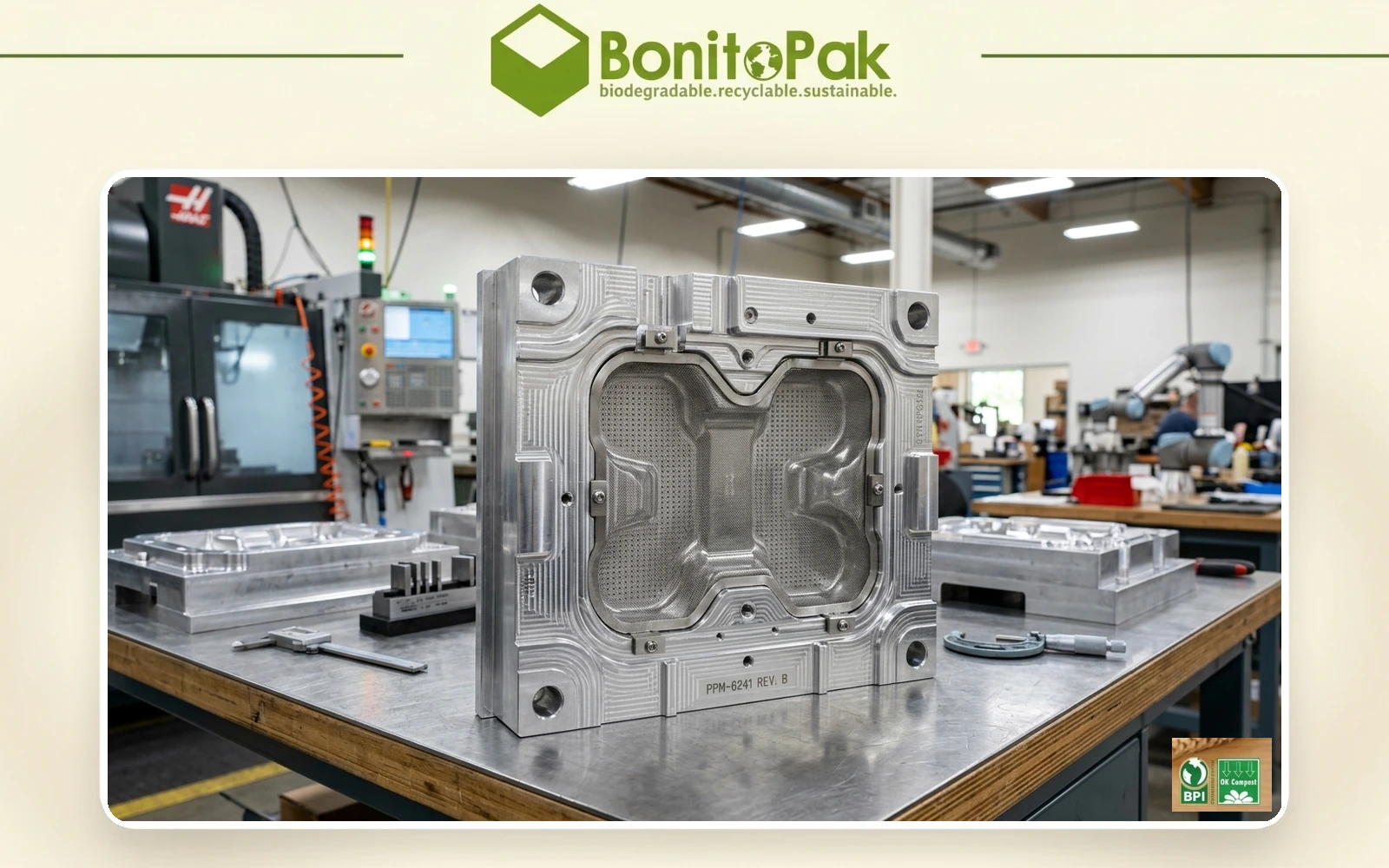
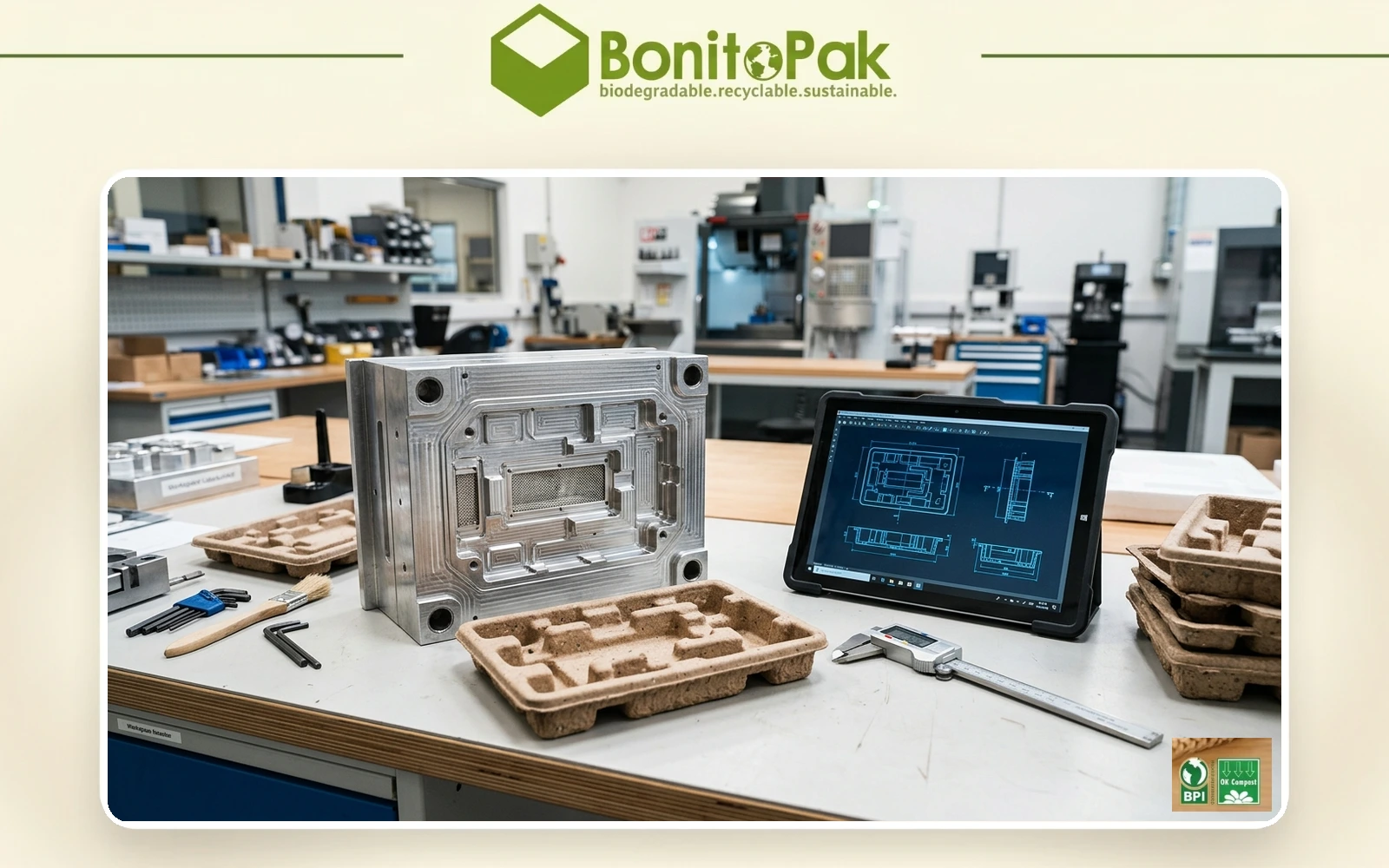
- Forming mold, the mesh-covered tool that draws fiber from the slurry
- Transfer mold, which lifts the wet part off the forming mold
- Hot press mold, for wet pressed parts and some finished dry pressed parts
- Design and sampling, including the 3D drawing, the sample mold, and trial runs
The charge moves with part size, cavity count, geometry complexity, process type, and mold material. Wet press tooling costs more than dry press, because it needs heated matched tools rather than a single forming screen. More cavities mean more parts per cycle and a lower unit price, but a larger and more expensive tool.
Our mold design and tooling page covers what our in-house team builds, and our step-by-step guide to the pulp mold process walks through how a mold is actually made.
Questions That Make Two Quotes Comparable
Custom packaging tooling cost is quoted differently by every factory. Before you compare tooling numbers, ask each supplier:
- Which tools are included, and which are quoted separately?
- Is the sample mold fee separate, or credited against production tooling?
- How many revision rounds are included before the production mold is cut?
- What is the mold made of, and what service life should I expect?
- Who owns the mold, where is it stored, and can it be moved?
- Is there a storage or maintenance charge after a period of inactivity?
Without those answers you may be comparing a full tool set against a forming mold alone.
The Expensive Mistake
A production mold that needs a geometry change is generally replaced, not modified. That makes the sample stage the cheapest insurance in the whole project. Test the sample with your real product, your real case, and your real delivery route before you approve production tooling.
How Tooling and MOQ Interact
These two numbers only make sense together. The useful calculation is what the tooling adds to each piece across your first order.
Tooling per unit = tooling charge ÷ first order quantity
Take a $4,000 tooling charge as an illustration. It is not a quote, just arithmetic:
| First order quantity | Tooling cost per piece |
|---|---|
| 1,000 | $4.00 |
| 5,000 | $0.80 |
| 25,000 | $0.16 |
| 100,000 | $0.04 |
At 1,000 pieces, tooling dominates everything. At 100,000, it disappears into the noise. If your annual volume sits at the low end, a standard catalog format or a shared tool may serve you better than custom tooling, and an honest supplier will say so.
Run the same calculation across a full year rather than a single order, since tooling is paid once but used repeatedly.
What Changes the Unit Price
Beyond volume, six variables move the per-piece number:
- Part size, which is the largest single lever, since fiber use scales with surface area and wall thickness
- Process, with wet pressing costing more per unit than dry pressing
- Fiber, where recycled paper is cheaper than bagasse or bamboo
- Color, since custom color adds pigment and a pulp system changeover
- Wall thickness, which is fiber consumption in another form
- Order volume, which sets how much fixed cost each piece carries
One pairing to avoid is wet pressing over recycled paper. Recycled fiber has a gray base tone, so reaching a clean white or a saturated color over it takes more pigment and processing, and the finish still falls short of what bagasse or bamboo would give. If you are paying for the premium process, do not undercut it at the input. Our materials page covers the fiber options.
Reorder Timelines
Once tooling exists, repeat orders are much faster, because design, sampling, and tooling are all behind you.
| Stage | Typical duration |
|---|---|
| Production | 1 to 3 weeks, by volume |
| Inspection, packing, container booking | 3 to 7 days |
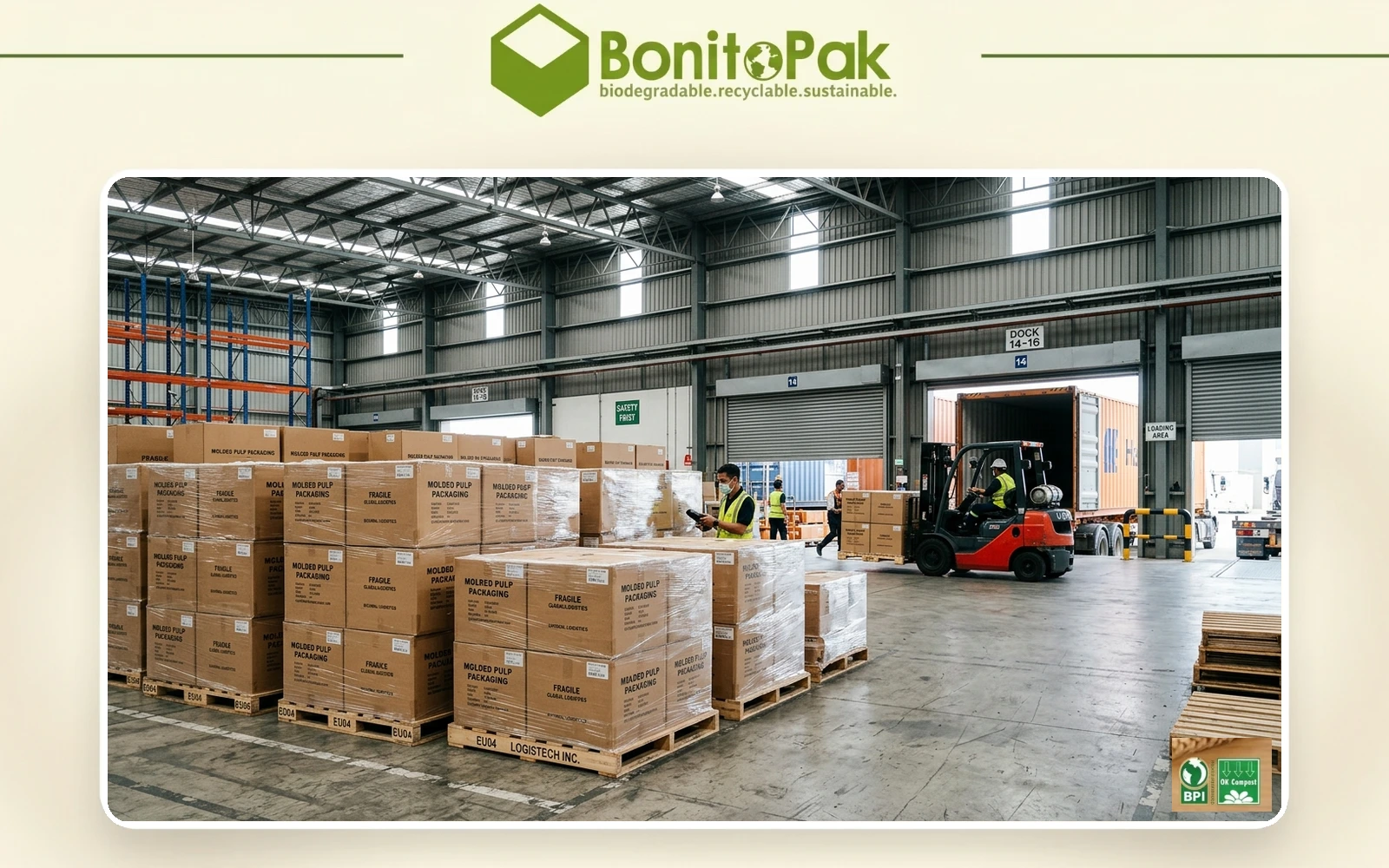
| Ocean freight from South China | 14 to 21 days West Coast, 28 to 40 days East Coast |
| Customs clearance and inland delivery | 5 to 10 days |
That packaging reorder lead time comes to roughly 5 to 8 weeks for a West Coast destination and 7 to 10 weeks for the East Coast. Air freight moves in about 3 to 7 days but rarely suits molded fiber, which is bulky and light, so air freight on a pallet of trays costs far more than the trays.
Setting Your Reorder Point
Work backwards from that packaging reorder lead time.
Reorder point = (weekly usage × lead time in weeks) + safety stock
A brand using 2,000 trays a week, on an 8-week cycle, needs 16,000 units of cover plus buffer. Two to four weeks of safety stock is a reasonable starting buffer, and more if your route has been unreliable.
Two calendar items deserve a permanent note in your planning: Chinese factories close for roughly two to three weeks around Chinese New Year, which falls in early February 2027, and again for Golden Week from October 1 to 7. Either can absorb an entire buffer.
Making the Minimum Work for You
A minimum is a constraint, but there is usually room to shape it.
- Consolidate SKUs onto shared geometry. Similar parts specified together can sometimes share tooling logic, and always share a conversation.
- Order in annual volume, call off in batches. Some suppliers will produce to an annual commitment and release stock in scheduled shipments.
- Start with natural or standard colors. Color changeovers add cost and can raise the minimum.
- Combine SKUs into one container. Freight economics improve sharply when a container ships full.
- Ask about the catalog first. If a standard format is close enough, you skip tooling entirely and the minimum drops.
- Confirm whether the minimum is per order or per item. This single question changes plenty of project plans.
Our custom service team works through these options at the quote stage rather than after the order is placed.
Budgeting a First Custom Project
For planning, a first order has four cost blocks:
| Block | Notes |
|---|---|
| Tooling | One-time, paid before production |
| Unit cost at MOQ | Your highest per-piece price, since volume is lowest |
| Freight and duties | Ocean freight, customs clearance, and inland delivery |
| Testing and samples | Sample cartons, air freight, and any third-party inspection |
Budget the first order at a higher per-unit landed cost than your steady state. That is normal, and it improves at the second order once tooling is behind you.
Getting the Three Numbers Right
The minimum, the tooling charge, and the reorder cycle are the three numbers to settle before anything gets designed. They decide whether custom molded pulp packaging is the right move for your volume, and they decide how much working capital sits in packaging at any moment.
If your annual volume cannot absorb the tooling within a reasonable period, a standard format now and custom tooling later is the better sequence. That is not a smaller project. It is a correctly timed one.
At BonitoPak, we cut tooling in house, quote the tooling charge and the unit price separately so you can see both, and take custom orders from 1,000 pieces across molded pulp trays and cartons in six pulp colors. Send us your part, your annual volume, and your target date, and we will show you where the numbers break even.
FAQs
Q: What is a typical minimum order for custom molded pulp packaging? A: It varies by supplier, process, and part size. Custom tooling projects at BonitoPak start at 1,000 pieces. Ask whether a quoted minimum applies per order or per item, and whether each color counts separately.
Q: Do I pay for tooling again when I reorder? A: No. Tooling is a one-time charge, and the same mold runs your repeat orders. Ask whether the supplier charges for mold storage or maintenance after long periods of inactivity, since terms differ.
Q: How long does a reorder take once tooling exists? A: Roughly 5 to 8 weeks to a US West Coast destination and 7 to 10 weeks to the East Coast, covering production, packing, ocean freight, and clearance. Add the full closure length if a Chinese holiday falls inside the window.
Q: Can I lower the minimum by ordering fewer colors? A: Often, yes. Color is set in the pulp system, so each color can behave like a separate run. Launching in one color and adding others at the second order is a common way to keep the first order manageable.
Q: Is custom packaging worth it at low volume? A: Usually not, if tooling would take several years to absorb. Divide the tooling charge by your annual volume. If the per-piece figure is significant against your unit price, start with a standard format and revisit custom tooling as volume grows.
About the author: Leo Chan is the founder of BonitoPak and has spent more than 20 years in molded pulp packaging, working with over 500 brands moving from plastic and foam to fiber-based formats. BonitoPak manufactures molded pulp packaging at its facility in Chashan Town, Dongguan, Guangdong, running both wet pressing and dry pressing lines with in-house mold design and tooling. Figures in this article are planning illustrations, not quotes.

 English
  German
  Spanish
  French
  Russian
  Japanese
  Portuguese
  Arabic