 Skip to content
What Sustainable Packaging Actually Means in 2026
Ask ten people what sustainable packaging means and you will get ten different answers. Recyclable. Compostable. Made from recycled content. Low carbon footprint. Plant-based. Minimal plastic. All of those are part of it. None of them is the whole picture on its own.
The most useful framework is lifecycle thinking. Sustainable packaging performs well across four stages: where the materials come from, how the packaging is made, how it performs in use, and what happens to it at end of life. A packaging made from recycled content but coated in a synthetic film that prevents composting is only partially sustainable. The complete picture requires all four stages to hold up.
The Regulatory Shift Changing Buyer Decisions
Until recently, sustainability claims in packaging were largely self-certified. A manufacturer could print biodegradable on a product without independent verification. That era is ending.
The EU Green Claims Directive, which entered enforcement in 2025 and 2026, requires that environmental claims be specific, independently verified, and not misleading. Vague terms like eco-friendly and sustainable without substantiation carry legal exposure. The EU Packaging and Packaging Waste Regulation adds specific recyclability and compostability requirements for packaging sold into European markets.
In the US, FTC Green Guides require that compostability and biodegradability claims be substantiated. For buyers, the sourcing question has shifted from does this packaging claim to be sustainable to can the supplier provide a verifiable certificate number. BPI under ASTM D6400 for North America. OK Compost under EN 13432 for Europe.
Where Molded Pulp Packaging Fits
Molded pulp has been around since the 1930s. The material is formed from natural plant fibers: sugarcane bagasse, bamboo, recycled paper. Water is the processing medium. No plastic binder, no resin, no adhesive is required. The fiber bonds through hydrogen bonding as it dries. The result is a single-material natural fiber product from forming through to end of life. That single-material status is what makes molded pulp score well on the sustainable packaging framework.
Molded pulp lifecycle performance:
| Lifecycle Stage | Molded Pulp Performance | Key Advantage |
| Raw material sourcing | Agricultural byproduct (bagasse), fast-regrowth (bamboo), recovered waste (recycled paper) | No dedicated virgin timber required on primary inputs |
| Production | Water-based process, no synthetic binders or resins | No plastic additives at any production stage |
| Use phase | Food safe, -30 to 120C stable, structural, lightweight | Performs in transit, retail, and storage without synthetics |
| End of life | Composts in 90 days (certified lines), recycles in paper stream, no microplastics | Dual disposal: recycle when clean, compost when soiled |
Molded Pulp Applications Beyond Egg Trays
Most buyers first encounter molded pulp in an egg carton. But the application range has expanded well beyond that.
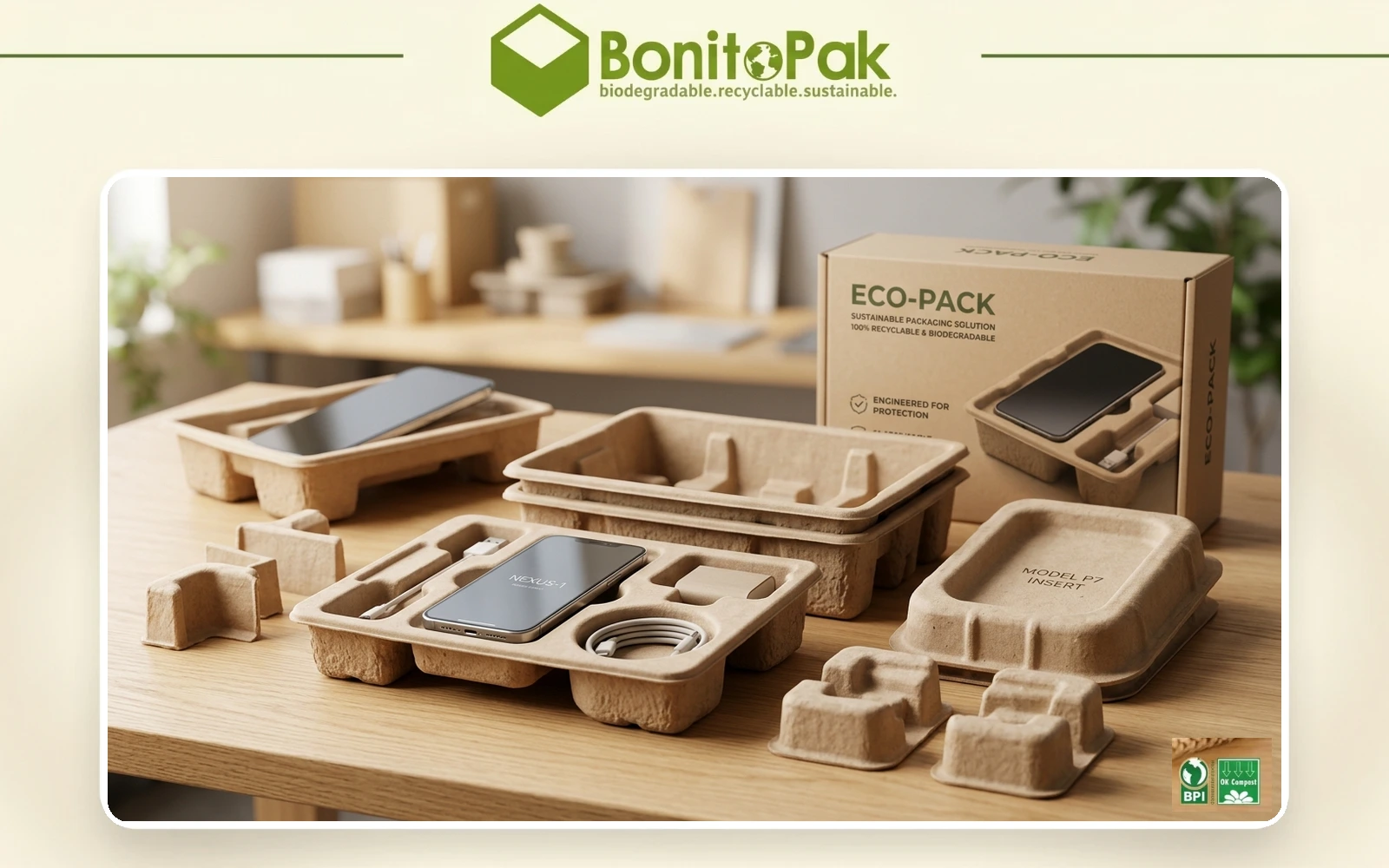
Electronics packaging is driving approximately 38% of molded fiber demand in 2026. Consumer electronics brands are replacing foam and plastic inserts with custom molded pulp forms for smartphones, earbuds, laptops, and accessories.
Cosmetics and personal care is a fast-growing segment. Molded pulp inserts for skincare sets, fragrance packaging, and beauty accessories are replacing plastic blisters and foam. The in-pulp color capability on wet press lines adds premium aesthetics that fit luxury brand positioning.
Food service, wine and spirits, medical and pharmaceutical, and e-commerce protective packaging are all confirmed and growing application segments with active use of custom molded pulp forms.
Molded Pulp vs Alternative Sustainable Materials
| Material | Compostable | Recyclable | Microplastic Risk | Custom Form Available | Cost Range |
| Molded pulp (bagasse/bamboo/recycled paper) | Yes, certified | Yes, paper stream | None | Yes, tooling per project | Low to mid |
| Recycled PET plastic | No | Yes, plastic stream | Yes if degrades unrecycled | Yes, injection mold | Mid |
| Bioplastic (PLA) | Industrial compost only | Limited programs | Potential if improperly disposed | Yes, injection mold | Mid to high |
| Foam (EPS) | No | Specialist drop-off only | Yes, fragments to microplastics | Yes, cut or mold | Low |
| Flat cardboard/paper | Yes | Yes | None | Limited geometric forms | Low to mid |
What to Ask a Sustainable Packaging Supplier Before You Order
Five questions that separate suppliers who understand sustainability from those who use it as marketing language.
Can you provide the certificate number for your compostability certification? If the answer is vague or they offer general language rather than a number tied to a certifying body public registry, the certification is likely not current or not on the finished product.
Is the color in-pulp or surface applied? In-pulp color keeps the product as a single-material fiber item. Surface coatings can remove compostability even on an otherwise certified product.
Does the certification cover the finished product or just the raw fiber? These are different things. A certified fiber going into an uncertified carton with a synthetic coating does not give you a certified carton.
What is the fiber source and can you provide traceability documentation? Sugarcane bagasse, recycled paper, and bamboo all have different supply chain profiles. Brand sustainability reporting increasingly requires documentation, not just a description.
Can the facility be audited and does it hold any third-party environmental certifications? Production-side credentials support the product-side sustainability story.
Frequently Asked Questions
What is sustainable packaging and how is it defined?
Sustainable packaging performs well across four lifecycle stages: responsibly sourced materials, lower-impact production, effective use-phase performance, and clean end-of-life disposal through recycling, composting, or biodegradation. The most reliable indicator in 2026 is independent certification: BPI under ASTM D6400 for compostability in North America, OK Compost under EN 13432 for European markets. Marketing language without verifiable certificate numbers is not evidence of sustainability, and regulators in both the US and EU are actively enforcing this distinction.
What regulations apply to sustainable packaging claims in 2026?
In the EU, the Green Claims Directive and Packaging and Packaging Waste Regulation require that environmental claims be specific, independently verified, and scientifically substantiated. Vague terms without verification carry legal exposure. In the US, FTC Green Guides require compostability and biodegradability claims to meet applicable scientific standards and be qualified to specify home versus industrial composting where the distinction applies. BPI and OK Compost certification satisfy the evidence requirements in their respective markets.
Is molded pulp more sustainable than plastic packaging?
Molded pulp from natural plant fibers composts at end of life under certified conditions, recycles in paper streams when clean, and biodegrades without leaving microplastic residue. Plastic packaging is recyclable in some programs but not compostable and breaks into microplastics when it degrades outside of recycling systems. Molded pulp generally outperforms plastic on end-of-life metrics and does not require petroleum-derived raw material inputs at any production stage.
What industries use molded pulp packaging most heavily?
Electronics packaging accounts for approximately 38% of molded fiber demand in 2026, driven by brands replacing foam and plastic inserts with compostable fiber forms. Food and beverage including egg trays, food service containers, and pizza trays is the largest historically established segment. Cosmetics and personal care, wine and spirits, medical and healthcare, and e-commerce protective packaging are all growing segments with confirmed active commercial use.
What fiber is used in molded pulp packaging?
The most common fiber inputs are sugarcane bagasse, bamboo fiber, and recycled paper pulp. Bagasse is an agricultural byproduct of cane juice extraction requiring no dedicated land or crop for packaging production. Bamboo grows without replanting after harvest and provides consistent fiber properties. Recycled paper diverts post-consumer waste from landfill and is the lowest cost input. All three are 100% natural plant fiber with no plastic, resin, or adhesive, and all biodegrade cleanly without synthetic residue.
Can molded pulp packaging carry a compostability certification?
Yes. Bonitopak’s food grade molded fiber line holds BPI certification under ASTM D6400 for North American markets and OK Compost certification from TUV Austria under EN 13432 for European markets. The certified line biodegrades within 90 days under industrial composting conditions. Certification must cover the finished product as manufactured, not just the raw fiber input. Surface laminates or synthetic coatings added after forming can remove a product from certification even if the underlying fiber is certified.
Explore Sustainable Molded Pulp Packaging From Bonitopak
Bonitopak produces certified molded pulp packaging from sugarcane bagasse, bamboo fiber, and recycled paper. BPI and OK Compost certified. Custom cell geometry, six in-pulp colors, wet and dry press, emboss branding. Ships to more than 50 countries. MOQ from 1,000 pieces.
See the full product range at /egg-tray/ or contact Bonitopak to discuss your sustainable packaging requirements.
Suggested Internal Links:
- /egg-tray/, molded pulp egg tray product range
- /biodegradable-egg-tray/, BPI and OK Compost certification details
- /bagasse-egg-tray/, sugarcane bagasse as a sustainable packaging material
- /colored-egg-tray/, in-pulp color for compostable packaging
Suggested Schema Types: Article, FAQ, BreadcrumbList
About the Author
[Author Name Placeholder] is a sustainable packaging specialist with over a decade of experience advising brands, farms, and manufacturers on packaging specification, eco-certification, and supply chain decisions. With deep expertise in molded pulp and molded fiber solutions across food, cosmetics, and electronics sectors, [Author Name] has helped operations across North America and Europe adopt certified, brand-aligned, and compostable packaging programs. [Author Name] writes regularly on sustainable packaging trends, EU and US packaging regulations, and molded fiber manufacturing for industry publications.

 English
  German
  Spanish
  French
  Russian
  Japanese
  Portuguese
  Arabic