 Ir al contenido
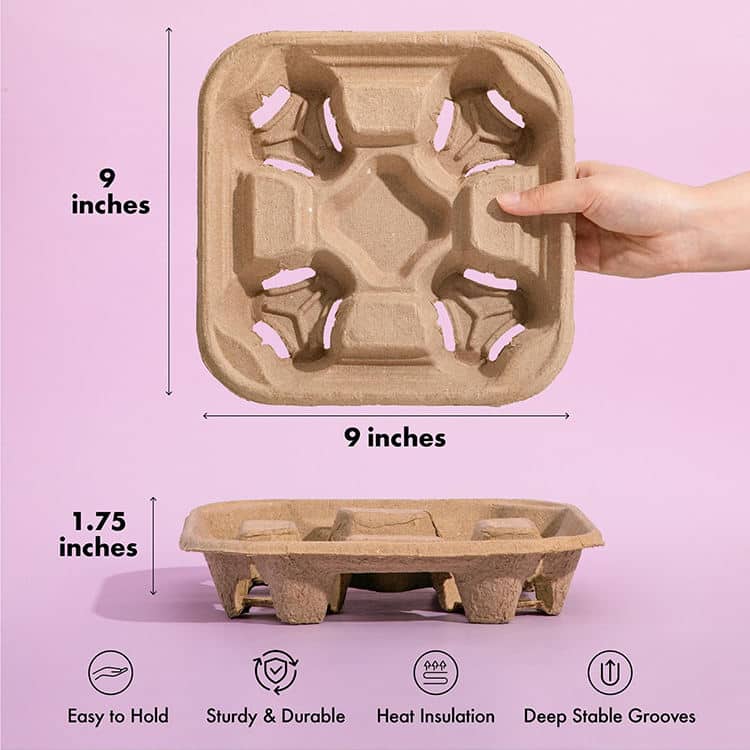
Molded pulp packaging is packaging pressed from natural plant fiber sugarcane bagasse, bamboo, wood pulp, or recycled paper into trays, inserts, clamshells, and food containers, using either a wet-pressing or dry-pressing process. It’s biodegradable, compostable, and used across food, electronics, cosmetics, and protective packaging. This guide covers how it’s made, what materials are used, how it compares to plastic and foam, and where it fits across different industries, using Bonitopak’s own production process in Dongguan, China as the working example throughout.
Molded pulp packaging is the material behind more everyday packaging than most people realize — egg cartons, wine shipping inserts, electronics trays, and an increasing share of food-service containers are all molded pulp, even when the packaging doesn’t look like the classic gray egg carton texture most people picture. If you’re evaluating molded pulp packaging for a product, this guide covers what it actually is, how it’s manufactured, what materials are available, and how it stacks up against plastic and foam alternatives — grounded in how a working manufacturer, Bonitopak in Dongguan, China, actually produces it.
What Is Molded Pulp Packaging?
Molded pulp packaging is packaging formed from natural plant fiber — pulped, shaped in a mold, and pressed or dried into a rigid or semi-rigid final form. It’s also called molded fiber packaging, and it’s the material used for egg cartons, protective inserts, food trays, and clamshell containers.
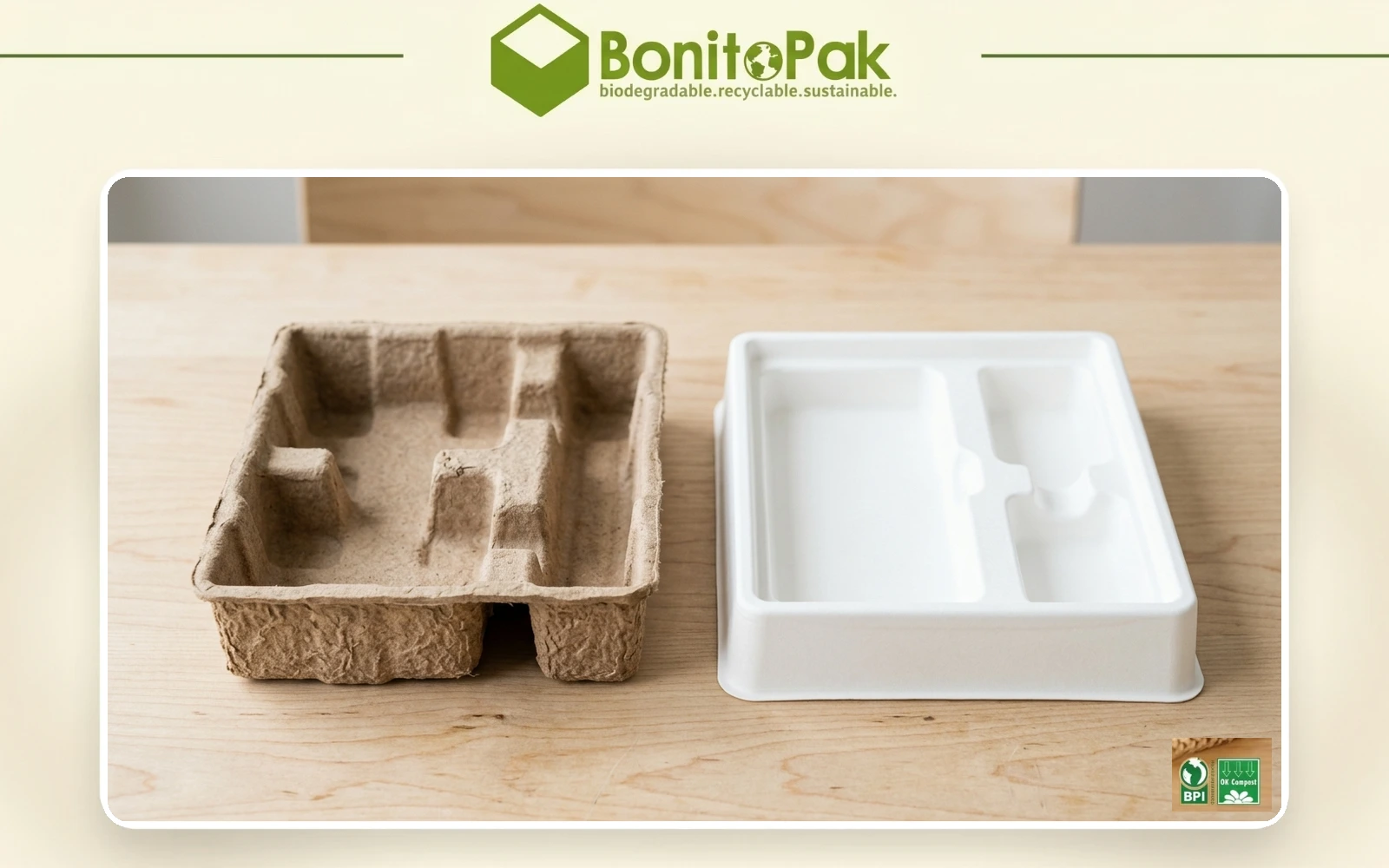
The “molded” part refers to the forming process: fiber is mixed with water into a slurry, then shaped using a mold — either through a wet-pressing process, where the mold presses the fiber into shape while it’s still saturated, or a dry-pressing process, which starts from a drier recycled stock. Bonitopak runs both processes, using wet pressing for trays that need a smoother, more finished surface — electronics, cosmetics, and colored trays — and dry pressing for general protective and industrial packaging.
How Is Molded Pulp Packaging Made?
Molded pulp packaging is made by blending fiber into a water-based slurry, forming it over a mesh mold using vacuum suction, releasing and drying the formed shape, and pressing it with heated tools to smooth the surface. That’s the general industry process; the specific process a given manufacturer runs — wet or dry — determines the finish, wall thickness, and cost of the final product.
At Bonitopak specifically, the two processes work like this:
Wet pressing
presses fiber into a mold while it’s still saturated, which produces a smoother surface finish and holds finer detail — useful for packaging that sits visibly inside a retail box. Bonitopak uses wet pressing for trays serving electronics, cosmetics, wine bottle packaging, and colored tray lines.
Dry pressing
uses 100% recycled corrugated or paper stock instead of virgin fiber, pressed at a 2.5–3.0mm wall thickness engineered to pass standard drop testing. It’s built for function over finish — general protective and industrial packaging — and stacks efficiently, saving up to 20% in stacking space compared to less space-efficient formats.
A manufacturer that only runs one of these processes will push every project toward it regardless of fit. Ask which process is actually right for your product, and why — a smooth-finish retail tray and a rough-and-tough shipping insert have different requirements, and the answer shouldn’t be the same for both.
What Materials Is Molded Pulp Packaging Made From?
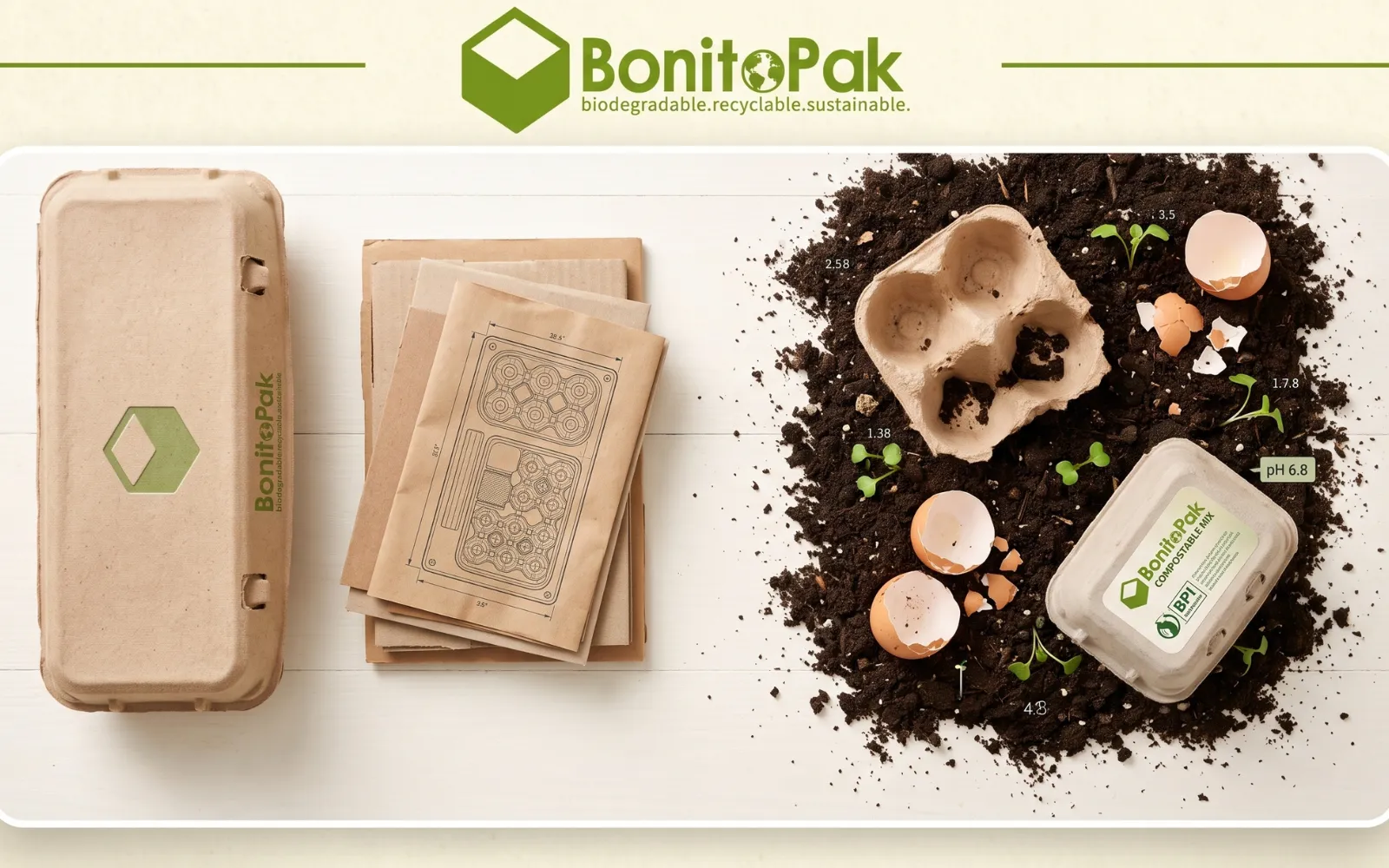
Molded pulp packaging is most commonly made from sugarcane bagasse, bamboo fiber, wood pulp, or recycled paper — all renewable or recycled fiber sources, and all biodegradable. Bonitopak uses all four across its wet-pressed and dry-pressed product lines, with every finished product biodegrading within 90 days.
- Sugarcane bagasse — a byproduct of sugar processing, wet-pressed, common for retail-facing trays with a smoother finish
- Bamboo fiber — wet-pressed, a fast-renewing raw material source
- Wood pulp — wet-pressed, also the base material for colored tray lines
- Recycled paper pulp and recycled corrugated pulp — dry-pressed, made from 100% recycled stock, typical for general protective packaging
Color isn’t limited to the natural tan or gray most people associate with molded pulp. Bonitopak runs 6 color systems — white, natural, black, orange, gray, and a Pantone-matched blue — with custom color accuracy close to 95%. White trays are bleached with hydrogen peroxide rather than chlorine-based bleach; natural trays are unbleached, and both are the colors recommended when the tray will be in contact with food.
Molded Pulp Packaging vs. Plastic and EPS Foam
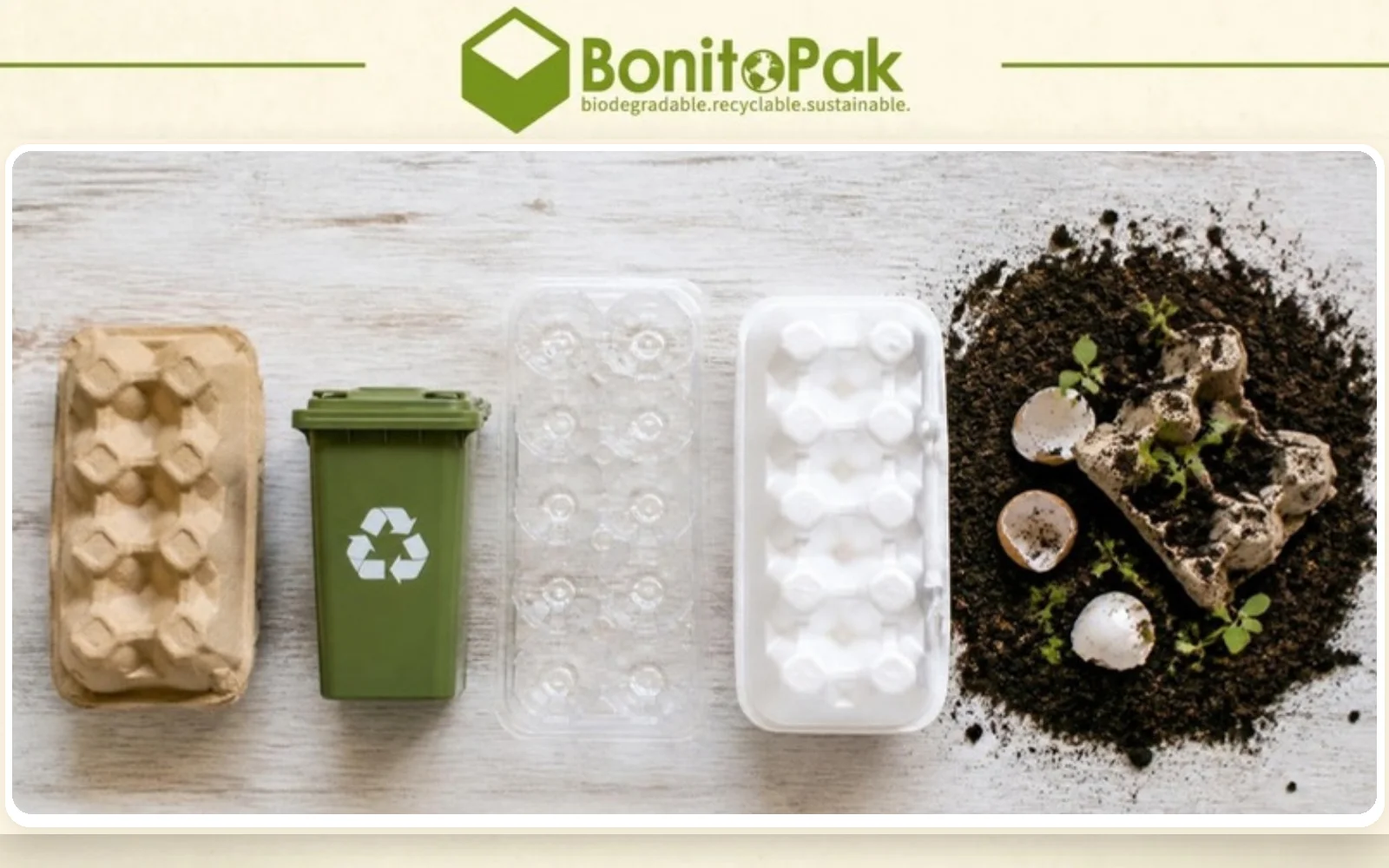
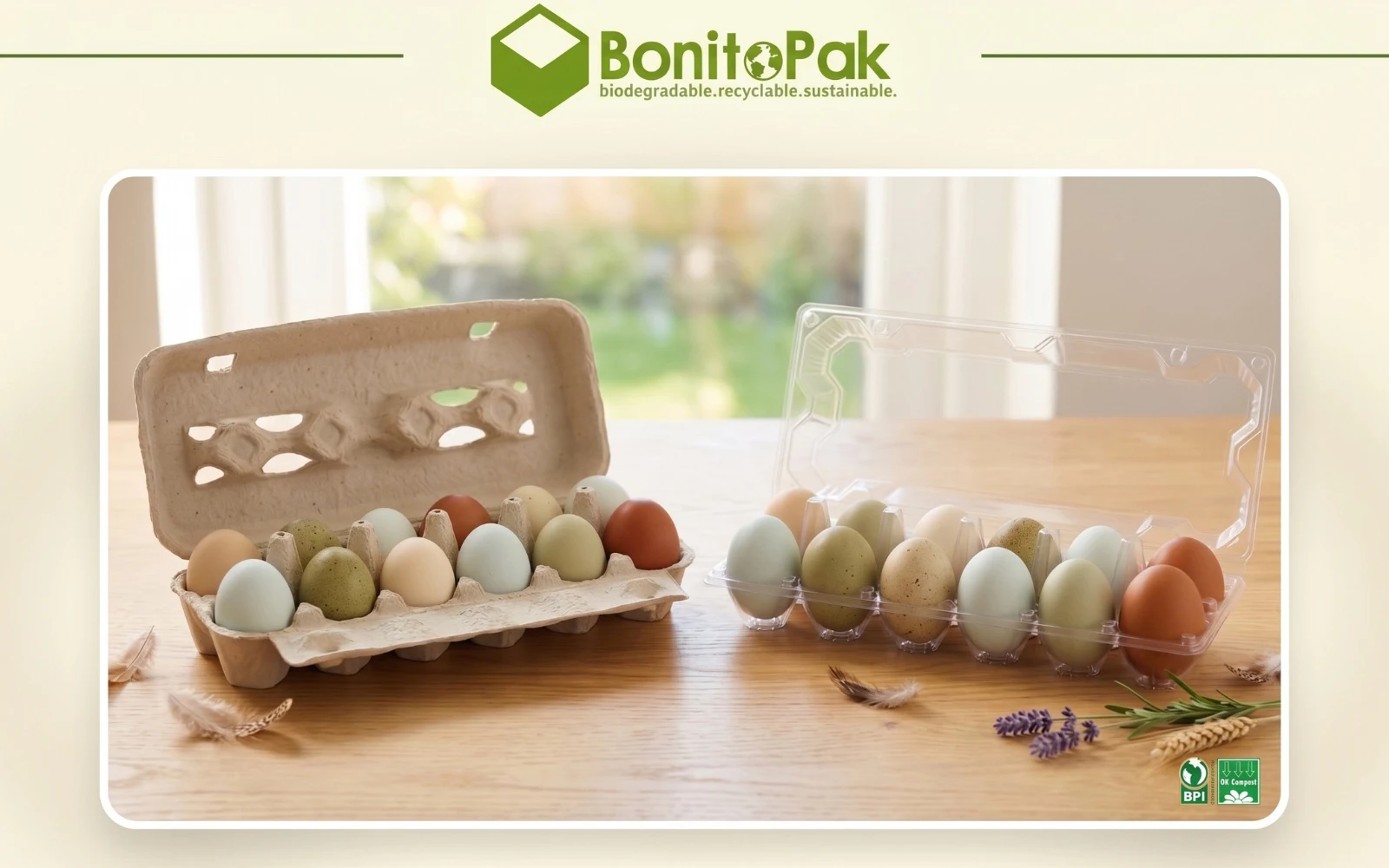
Molded pulp packaging biodegrades within 90 days and doesn’t rely on a plastics recycling stream that may not exist wherever the packaging ends up, while plastic and EPS foam packaging can persist in landfills for decades and face a growing wave of state-level restrictions. For many applications, molded pulp is also less expensive than EPS foam, vacuum-formed PET, or PVC packaging at comparable volumes.
The tradeoff isn’t purely aesthetic. Molded pulp has a visible fiber texture rather than a smooth plastic finish, and its structural properties differ from rigid plastic — dry-pressed trays at 2.5–3.0mm wall thickness are engineered to pass standard drop testing, but they behave differently under sustained load or moisture exposure than a rigid plastic tray would. For most protective and food-packaging applications, that difference is a non-issue; for applications requiring extended wet exposure or very high compressive load, it’s worth testing a sample against your actual use case before switching materials.
Retail and brand perception is shifting in molded pulp’s favor faster than the material itself has changed. Consumer brands increasingly use molded pulp specifically because it visibly signals a sustainability commitment — the fiber texture that used to read as “cheap packaging” now reads as “sustainable packaging” to a growing share of buyers, which is part of why demand for custom-colored, retail-facing molded pulp trays has grown alongside the plainer industrial protective packaging use case.
Certifications and Sustainability Claims to Look For
“Biodegradable” and “eco-friendly” appear on a lot of packaging pages without anything backing them up. Look for a named, third-party certification — Bonitopak’s food packaging line carries BPI (Biodegradable Products Institute) certification and OK Compost certification, and all Bonitopak pulp products biodegrade within 90 days regardless of whether the specific SKU carries a food-packaging certification.
A certification is only meaningful if you know what it actually covers. Certifications are frequently scoped to specific product lines rather than a manufacturer’s entire catalog — ask which SKUs a certification applies to, not just whether the manufacturer holds one. Beyond formal certification, ask for a specific, checkable number: how many days to biodegrade, and under what conditions (home compost vs. industrial composting facility). A manufacturer that gives you a specific answer is a stronger signal than one that just says “eco-friendly.”
Applications: Where Molded Pulp Packaging Is Used
Molded pulp packaging spans food service, electronics, cosmetics, industrial protective packaging, and consumer retail — the common thread across all of them is a need for protective, often visible packaging that doesn’t rely on plastic. Bonitopak’s product lines break down across roughly these categories:
- Food packaging — dishes, plates, food boxes, containers, clamshells, bowls, and drinking cups, using food-grade plant fiber
- Electronics and cosmetics protective trays — wet-pressed for a smoother finish, often custom-colored to match brand packaging
- Wine and bottle packaging — wet-pressed inserts that cushion glass during shipping
- Industrial and general protective packaging — dry-pressed trays built for drop-test performance over finish
- Egg trays and cartons — one of the highest-volume, most recognizable molded pulp applications, typically dry-pressed for cost efficiency at scale
Each of these applications weighs the wet-pressing vs. dry-pressing tradeoff differently — a cosmetics brand cares more about finish quality, while a protective shipping insert cares more about drop-test performance and cost per unit.
How Molded Pulp Packaging Manufacturing Actually Works at Scale
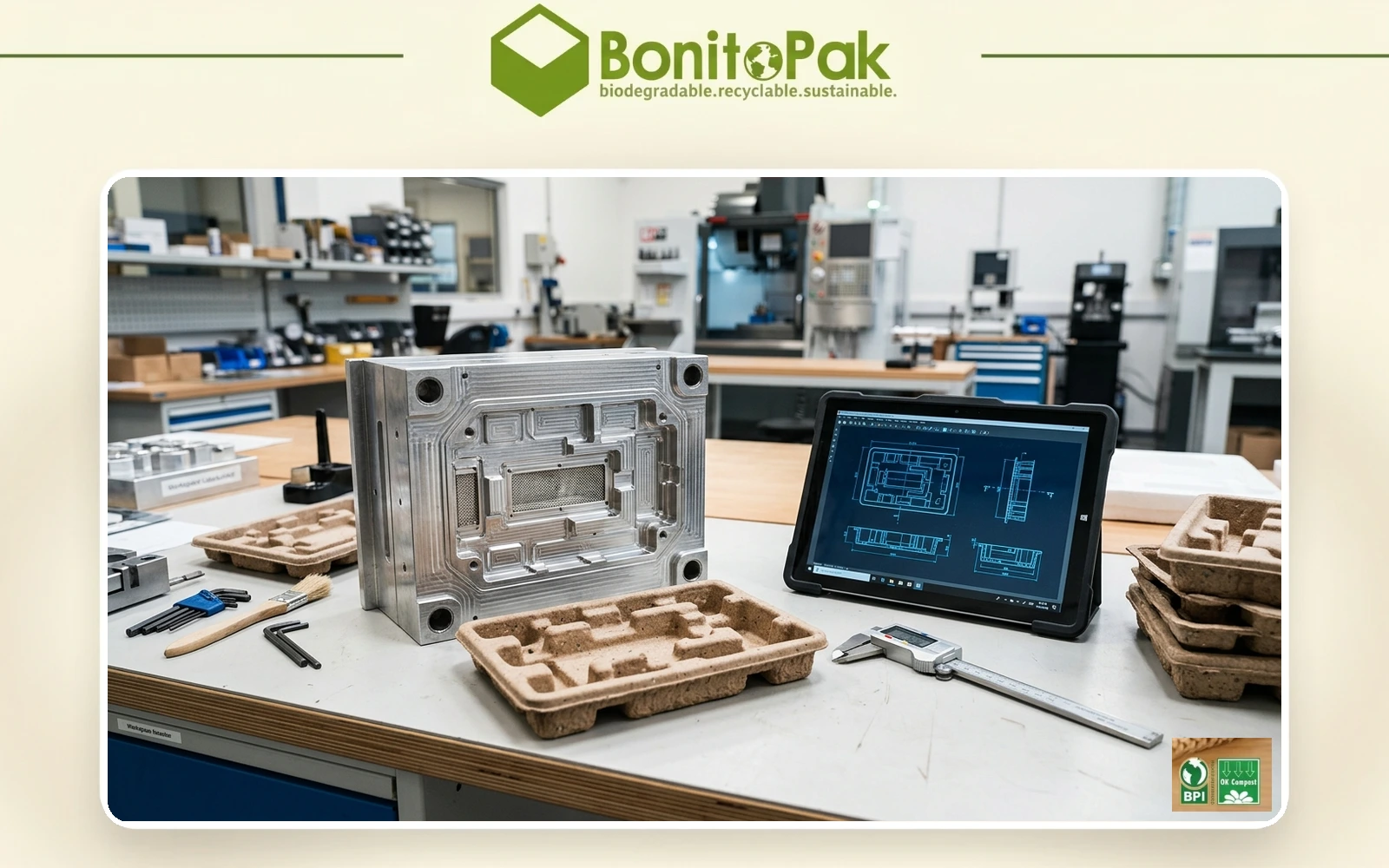
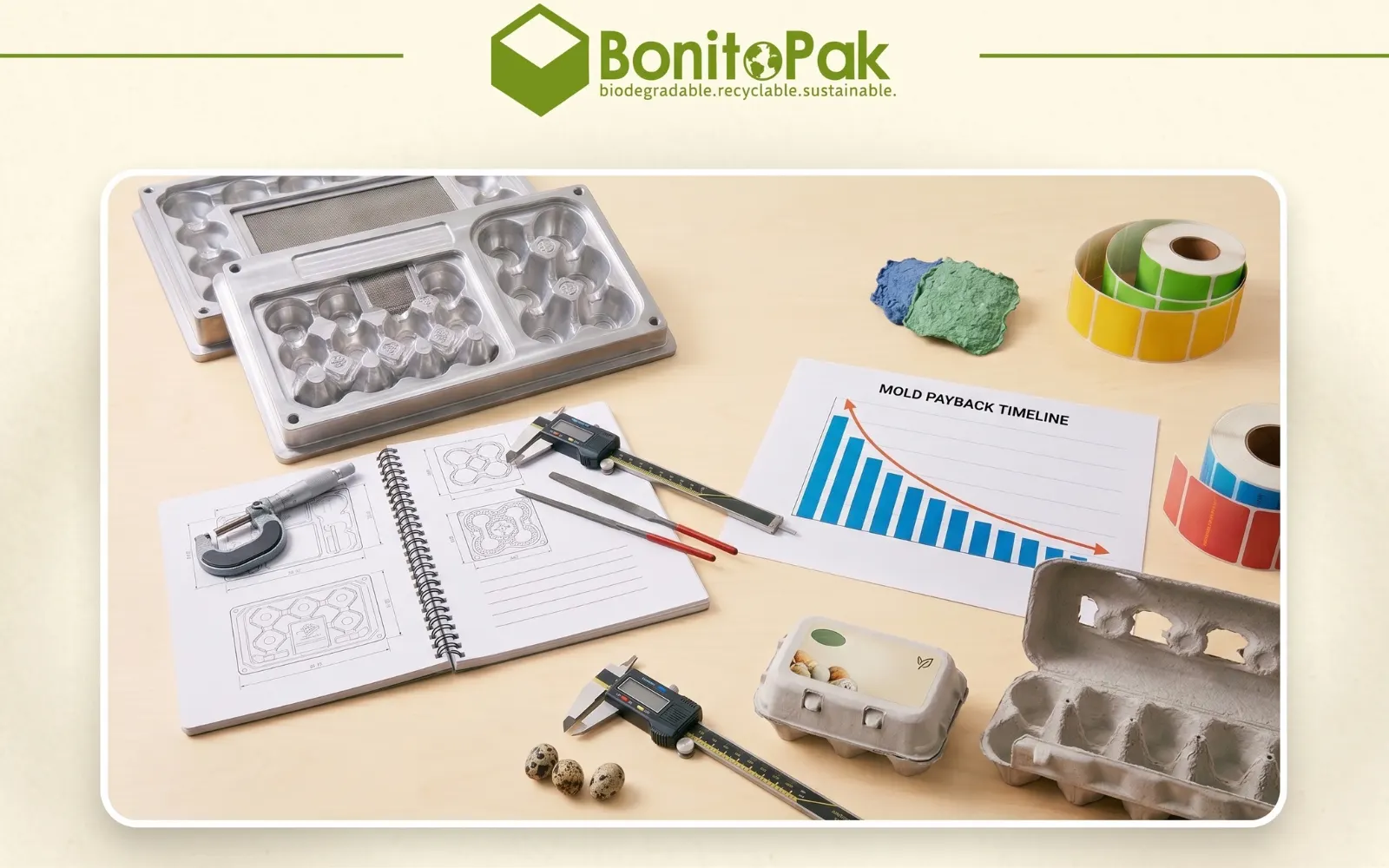
Custom molded pulp packaging starts with mold design, not the pressing line itself — the mold is what determines the shape, cell count, and dimensions of the final product, and building it correctly the first time is what keeps a project on budget. Bonitopak’s process runs through four stages: a 3D drawing from a sample or reference (2 days), a design concept review, a sample mold built and tested before committing to production tooling (physical samples ship in 7 days), and finally the production mold itself (ready in 8 days once the design is approved) — a design-to-mold window of roughly two weeks.
Keeping mold design and tooling in-house, rather than outsourcing to a third-party mold shop, is what makes that timeline possible — every step from the initial 3D drawing (in SolidWorks or Creo, accepting IGS and STEP files) through the finished production mold happens under one roof. That matters more than it might seem: outsourced tooling adds both time and cost between your drawing and your first sample, and makes last-minute design changes slower and more expensive.
Cost, MOQ, and Lead Time: What to Actually Expect
Molded pulp packaging pricing depends on material choice, mold complexity, and order volume — there’s no single per-unit number that applies across the category, which is why a manufacturer quoting a flat price without seeing your design is a weaker signal than one asking for your drawing first. Dry-pressed, recycled-material trays are generally the lower-cost option per unit at volume; wet-pressed, virgin-fiber trays with custom colors cost more but deliver a smoother, more presentation-ready finish.
Minimum order quantity works the same way — it’s set by the mold’s complexity and the material, not a single figure that applies to every project. This is true across the industry, not just for one manufacturer, and it’s worth treating a supplier’s refusal to quote a real MOQ against your actual drawing as a yellow flag. The practical approach: request MOQ, unit pricing, and lead time together in a single quote, tied to your specific cell count, dimensions, and material choice, rather than trying to back into a number from a generic FAQ page.
Lead time splits into two distinct phases that are worth tracking separately: the design-and-mold phase (which Bonitopak states specifically — 2 days for the drawing, 7 for the sample, 8 for the production mold) and the full production-and-shipping phase, which depends on order volume and hasn’t been published as a fixed figure by most manufacturers, Bonitopak included. Get both numbers in writing before you set a launch date around them.
Common Mistakes When Sourcing Molded Pulp Packaging
The most common mistake in sourcing molded pulp packaging is choosing a process — wet or dry pressing — based on price alone rather than the actual use case, which often means paying for a finish the product doesn’t need or, worse, ending up with a surface finish too rough for a retail-facing application. Match the process to whether the packaging is customer-facing or purely functional before comparing quotes on price.
A second common mistake is treating “biodegradable” or “eco-friendly” as interchangeable with a real certification. As covered above, those words alone don’t mean much without a named certification body behind them — verify what’s actually certified, and for which specific product line, rather than assuming a general sustainability claim on a homepage covers the exact SKU you’re ordering.
A third mistake is skipping the sample stage to save time. A sample mold exists specifically to catch design problems — a cell count that’s slightly off, a wall thickness that won’t survive your actual shipping conditions — before they show up in a full production run. Skipping straight to production tooling to save a week of lead time routinely costs more than a week once a design flaw has to be fixed after the fact.
Finally, buyers sourcing at volume sometimes underweight stacking efficiency in their cost comparison. A tray that costs slightly more per unit but stacks 20% more efficiently — the kind of difference between well-engineered and poorly-engineered dry-pressed trays — can be the cheaper option once shipping and warehousing cost are factored in, not just the sticker price per tray.
Conclusión
Molded pulp packaging is a mature, well-understood material category — sugarcane bagasse, bamboo, wood pulp, and recycled paper, formed through wet or dry pressing into trays, inserts, and food containers that biodegrade within 90 days. The real differentiation between manufacturers isn’t the material itself, which is broadly similar across the industry, but process control: whether mold design and tooling happen in-house, how fast a real sample actually ships, and whether sustainability claims point to a named certification or just a marketing phrase.
Bonitopak runs both wet and dry pressing in-house at its Dongguan, China facility, with BPI and OK Compost certification on its food packaging line and a design-to-mold timeline of about two weeks. Solicita un presupuesto al equipo de embalaje de Bonitopak to evaluate it against your specific product — or go deeper on a specific application: see the Página del producto «bandeja para huevos», read about dry-pressed, recycled paper pulp packaging specifically, or get a full buyer’s guide to evaluating any molded pulp packaging manufacturer.
Preguntas frecuentes
What is molded pulp packaging made of?
Molded pulp packaging is made from natural plant fiber — most commonly sugarcane bagasse, bamboo fiber, wood pulp, or recycled paper. Bonitopak uses all four, and every finished product biodegrades within 90 days.
Is molded pulp packaging biodegradable?
Yes. Molded pulp is one of the most biodegradable packaging materials available — Bonitopak’s pulp products biodegrade within 90 days, compared to plastic and foam packaging that can persist in landfills for decades.
What’s the difference between wet-pressed and dry-pressed molded pulp?
Wet pressing forms the tray while the fiber is still saturated, producing a smoother, more finished surface used for electronics, cosmetics, and retail packaging. Dry pressing uses 100% recycled paper/corrugated stock at a 2.5–3.0mm wall thickness, built for drop-tested protective packaging rather than shelf appearance.
Is molded pulp packaging more expensive than plastic?
For many applications, molded pulp is actually less expensive than EPS foam, vacuum-formed PET, or PVC packaging at comparable volumes, though exact pricing depends on your specific design, material, and order volume.
Can molded pulp packaging be customized with brand colors?
Yes — Bonitopak offers 6 color systems (white, natural, black, orange, gray, and Pantone-matched blue) with custom color accuracy close to 95%, plus custom mold design for shape and branding.
What industries use molded pulp packaging?
Food service, electronics, cosmetics, wine and beverage shipping, industrial protective packaging, and egg cartons are among the most common applications — Bonitopak serves all of these categories.
How long does it take to get custom molded pulp packaging made?
At Bonitopak, the initial 3D drawing takes 2 days, a physical sample ships in 7 days, and the production mold is ready in 8 days — roughly two weeks from first drawing to an approved production mold.
Are molded pulp packaging certifications real, or just marketing language?
It depends on the manufacturer — look for a named, third-party certification body rather than the word “eco-friendly” alone. Bonitopak’s food packaging line carries BPI and OK Compost certification.

 Spanish
  English
  German
  French
  Russian
  Japanese
  Portuguese
  Arabic