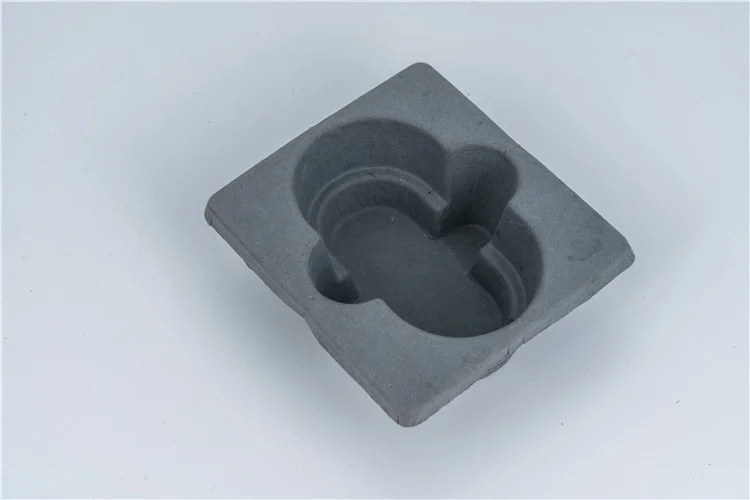
Dry-pressed molded pulp relies on mechanical compression rather than slurry forming to achieve final shape. If cavity geometry or press alignment is inconsistent, trays will warp, vary in thickness, or fail to nest properly.
This tooling is designed to apply even pressure across each cavity, producing trays that hold their shape under load and stack reliably during packing and transport.
Engineered Tooling for Dry-Press Production Lines
Cavity design accounts for fiber spring-back, compression ratios, and heat transfer, all of which affect final tray dimensions. Draft angles are tuned to allow release without tearing fiber edges, while perimeter geometry controls nesting depth.
Tool layouts are developed using CAD-based design, allowing optimization for cavity count, press size, and throughput. Branding elements, if required, are integrated directly into the tooling as emboss or deboss features, avoiding secondary processes.
It is important to note that dry-pressed molded pulp has material limits. While strong and rigid, it cannot achieve the cosmetic smoothness of wet-pressed trays and is not suitable for high-gloss presentation.
الأسئلة الشائعة
What is this tooling used for?
It is used to manufacture dry-pressed molded pulp trays and inserts for packaging applications.
How does dry-pressed tooling differ from wet-pressed tooling?
Dry-pressed tooling compresses pre-formed fiber under heat and pressure, producing stiffer parts with rougher surface texture.
Can tray size and cavity layout be customized?
Yes. Tooling is designed around product dimensions, weight, and packing requirements.
Is this suitable for electronics packaging?
Yes, commonly for accessories and components where rigidity and organization are required.
What affects final tray quality most?
Fiber consistency, press temperature, pressure control, and tooling accuracy all play key roles.
Request Technical Review or Quotation
If you are evaluating dry-pressed molded pulp tooling for structured fiber trays and need realistic input on strength, nesting, or production constraints, request a technical review or quotation to confirm suitability for your press line.