 Ir al contenido
Por Leo Chan | Redactor, BonitoPak | Más de 20 años de experiencia en embalajes de pulpa moldeada
Publicado: 21 de agosto de 2026 | Última revisión: 21 de agosto de 2026
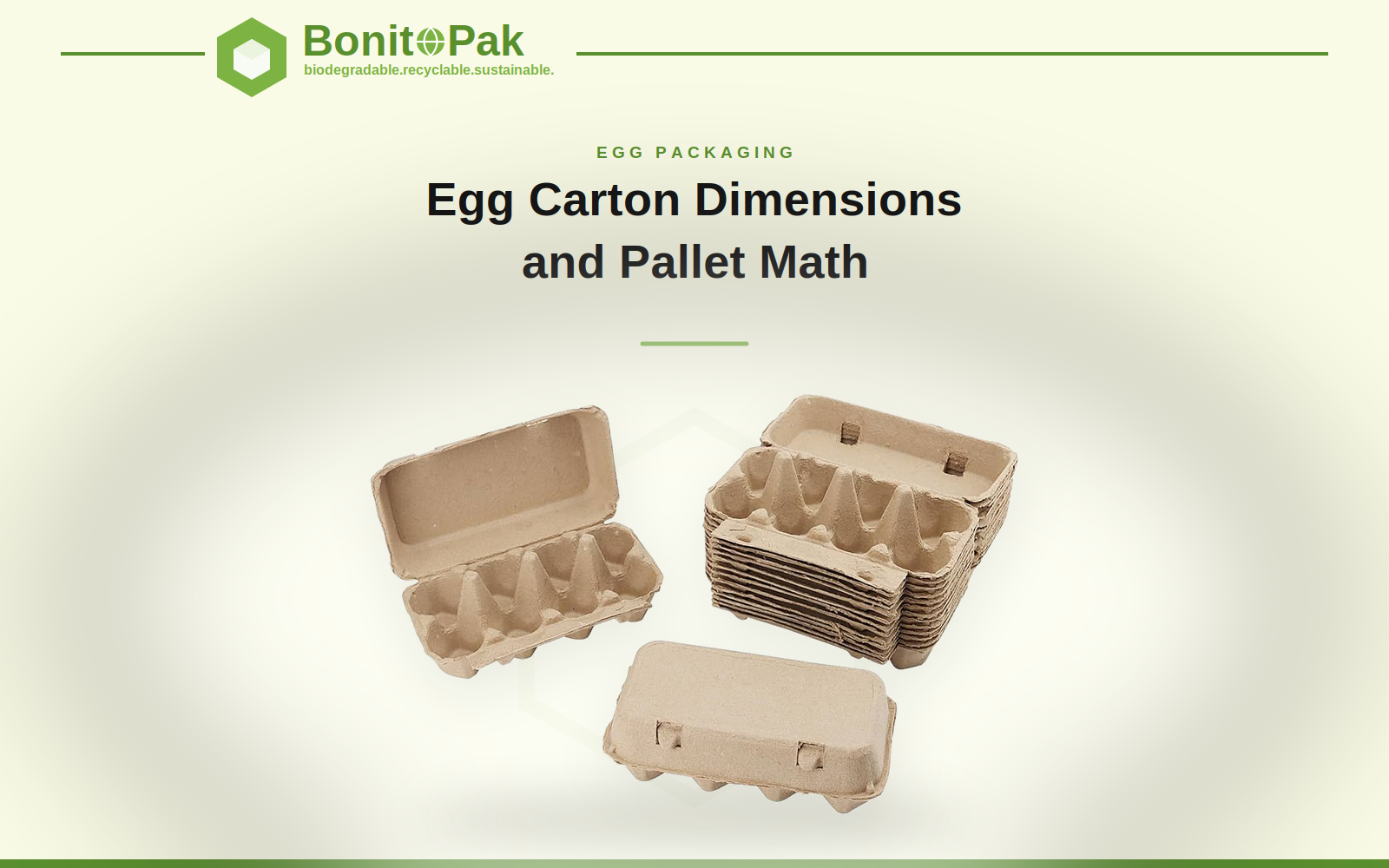
Una caja estándar de 12 unidades mide aproximadamente 11,75 pulgadas de largo por 4 pulgadas de ancho, con una altura de entre 2 y 2,25 pulgadas para los huevos grandes y de entre 3 y 3,25 pulgadas para los jumbo. Una bandeja de 30 cavidades mide cerca de 11,7 pulgadas de lado. El número de cajas y palés se calcula a partir de estas cifras.
Las dimensiones de una caja de huevos no son lo mismo que el número de unidades. El número de unidades indica cuántos huevos hay en el envase. No dice nada sobre el espacio que ocupa el envase en la cámara frigorífica, cuántos caben en una caja o cuántas cajas caben en un palé. Esos datos se obtienen a partir de las dimensiones físicas, y son estos los que determinan realmente los costes de embalaje.
Esta guía aborda las medidas en sí mismas y, a continuación, explica los cálculos relacionados con las cajas y los palés. Si aún estás eligiendo un formato en lugar de especificar uno, nuestra guía sobre Tamaños y número de huevos de los cartones aborda primero esa decisión.
Dimensiones de las cajas de huevos según el formato
Utiliza esta tabla de medidas de cartones de huevos como valores orientativos, no como una norma. Los cartones se fabrican con moldes que varían según el fabricante, así que tómalos como un rango de valores que cabe esperar y confirma las medidas exactas consultando el plano de tu proveedor.
| Formato | Longitud aproximada | Ancho aproximado | Altura en posición cerrada |
|---|---|---|---|
| Paquete de 6 unidades, tamaño grande | de 7 a 7,5 pulgadas | de 4 a 4,25 pulgadas | de 2 a 2,25 pulgadas |
| Paquete de 12 unidades, tamaño grande | de 11,75 a 12 pulgadas | de 4 a 4,25 pulgadas | de 2 a 2,25 pulgadas |
| Paquete de 12 unidades, tamaño gigante | de 11,75 a 12 pulgadas | de 4,25 a 4,5 pulgadas | de 3 a 3,25 pulgadas |
| 18 unidades, tamaño grande | de 11,75 a 12 pulgadas | de 6 a 6,5 pulgadas | de 2 a 2,25 pulgadas |
| Apartamento de 30 celdas | 11,7 pulgadas | 11,7 pulgadas | de 1,75 a 1,9 pulgadas |
Hay dos aspectos que llaman la atención. La longitud se mantiene notablemente constante tanto en el formato de 12 como en el de 18 unidades, ya que la longitud de cada fila es fija: seis casillas. Lo que cambia es la anchura, ya que el formato de 18 unidades añade una tercera fila en lugar de ampliar la caja. Y la caja jumbo no es más larga, sino más alta.
La profundidad de la cavidad depende del grado, no del recuento
Esta es la especificación que los compradores suelen omitir en los presupuestos, y es la que determina si los huevos se mantienen bien sujetos.
Las clases de tamaño del USDA se definen en función del peso mínimo por docena y no de las dimensiones físicas. La clase «Jumbo» es de 30 onzas por docena, la «Extra grande» de 27, la «Grande» de 24, la «Mediana» de 21 y la «Pequeña» de 18, tal y como se establece en la publicación Referencias sobre formatos de envases al por mayor. Los huevos más pesados son los más grandes, y los huevos más grandes necesitan cavidades más profundas y un mayor espacio libre entre la tapa y el recipiente.
Así pues, una caja descrita únicamente como «de 12 unidades» podría estar cortada para el tamaño «grande» o «jumbo», y se trata de moldes diferentes que producen alturas exteriores distintas. Especifica el calibre junto con el número de unidades y el proveedor podrá facilitarte las dimensiones reales en lugar de un rango nominal.
El problema práctico es que la tapa se cierra sobre la carcasa en lugar de por encima de ella. Aunque a simple vista parezca aceptable, acaba rompiéndose tras cien millas de vibraciones en la carretera, ya que cada punto de contacto de la tapa se convierte en un punto de tensión.
Dimensiones de los estuches para huevos y qué cabe realmente en ellos
Las dimensiones de las cajas de huevos están más estandarizadas que las de los cartones, lo que facilita los cálculos.
| Caso | Dimensiones aproximadas | Sirve para guardar cajas de cartón | Sujeta los pisos | Total de huevos |
|---|---|---|---|---|
| 15 docenas de cartón ondulado | 12 x 12 x 13,5 pulgadas | 15 x 12 unidades | 6 x 30 celdas | 180 |
| 30 docenas de cartón ondulado | Mayor superficie de apoyo | 30 x 12 unidades | 12 x 30 celdas | 360 |
| 15 docenas de plástico | 14,1 x 14,1 x 15,4 pulgadas | 15 x 12 unidades | 6 x 30 celdas | 180 |
A caution on published figures. Several widely circulated articles state that a 30 dozen case holds fifteen 30 cell trays, which would give 450 eggs rather than 360. Others describe a 15 dozen case as fifteen flats of twelve. Neither matches the specifications published by companies actually selling these cases, which consistently describe a 30 dozen case as twelve 30 cell flats and a 15 dozen case as six. Work from a supplier product specification rather than from a general article, including this one.
Note also that jumbo changes the flat as well as the carton. A jumbo filler flat holds 20 eggs rather than 30, so a case that takes twelve standard flats does not carry 360 jumbo eggs.
Working Out Your Egg Carton Pallet Configuration
The standard North American pallet is the GMA footprint at 48 by 40 inches. The method is the same regardless of case size.
Step one, cases per layer
Divide pallet length by case length, divide pallet width by case width, round both down, and multiply. Then repeat with the case rotated and keep whichever result is higher.
For a 15 dozen case at 12 by 12 inches: 48 divided by 12 gives 4, and 40 divided by 12 gives 3 after rounding down. That is 12 cases per layer. Rotating a square case changes nothing, which is one small advantage of a square footprint.
Step two, layers high
Take your maximum load height, subtract the pallet deck, and divide by case height. Working to roughly 95 inches of usable height above a five inch pallet, and a case height of 13.5 inches, gives 7 layers.
Step three, multiply out
12 cases per layer times 7 layers is 84 cases. At 180 eggs per case that is 15,120 eggs per pallet.
This is the calculation behind the TI and HI figures on pallet pattern sheets, where TI is cases per layer and HI is layers high, as explained in packaging references. Retail distribution centers expect those numbers on inbound pallets, and getting them wrong causes rejected shipments and repalletizing charges.
The Trap: Cube Utilization Is Not Pallet Efficiency
This is the most useful thing on the page, and it catches experienced buyers.
It is natural to optimize a case so it holds the maximum number of cartons with minimum wasted space inside. That is cube utilization, and maximizing it can lose you money.
The reason is that pallet fit depends on how case dimensions divide into 48 and 40, not on how efficiently the case is packed. A case that is beautifully full inside but divides badly into the pallet footprint wastes far more space on the pallet than it saved in the box. Published packaging worked examples show cases at 100 percent internal cube utilization shipping fewer units per pallet than cases at 93 percent, because the tighter case fitted only six per layer while the looser one fitted twelve.
The order of operations matters. Work out what divides cleanly into the pallet first, then design the case to those dimensions, then check how many cartons fit inside. Doing it the other way round optimizes the wrong variable.
Worth sanity checking the answer against a known figure. Standard egg cases are often quoted as loading somewhere in the region of 30 to 40 cases per pallet in general references, which reflects larger 30 dozen cases rather than the 15 dozen case worked through above. If your own calculation lands far outside the range you would expect for your case size, the usual cause is a rounding error or a forgotten clearance rather than a genuinely unusual configuration.
Clearances Everyone Forgets
Four allowances routinely get left out of a first calculation, and together they are enough to lose a layer.
- Internal versus external case dimensions. Corrugated board has thickness, and single wall C flute costs roughly five sixteenths of an inch across each dimension. Pack to internal dimensions, palletize to external.
- Assembly clearance. A theoretical zero clearance pack jams on a line. Allow an eighth to a quarter inch per dimension so flaps close and cartons load cleanly.
- Stretch wrap and corner boards. These add several millimetres per side to the finished load, which matters when you are within an inch of a rack opening.
- Trailer height. Most dry vans allow around 100 to 102 inches total including the pallet, and warehouse racking is often lower. Calculate to the lower of the two.
There is also weight. A pallet can be height limited or weight limited, and the real layer count is whichever comes first. Eggs are dense enough that a full height stack of cases can exceed a pallet weight budget before it runs out of vertical space.
Lo que vemos en nuestra propia línea de producción
We cut tooling per project in Chashan Town, Dongguan, so external dimensions are something we set rather than something we look up. A few observations.
Forming process changes the wall, and the wall changes the dimensions
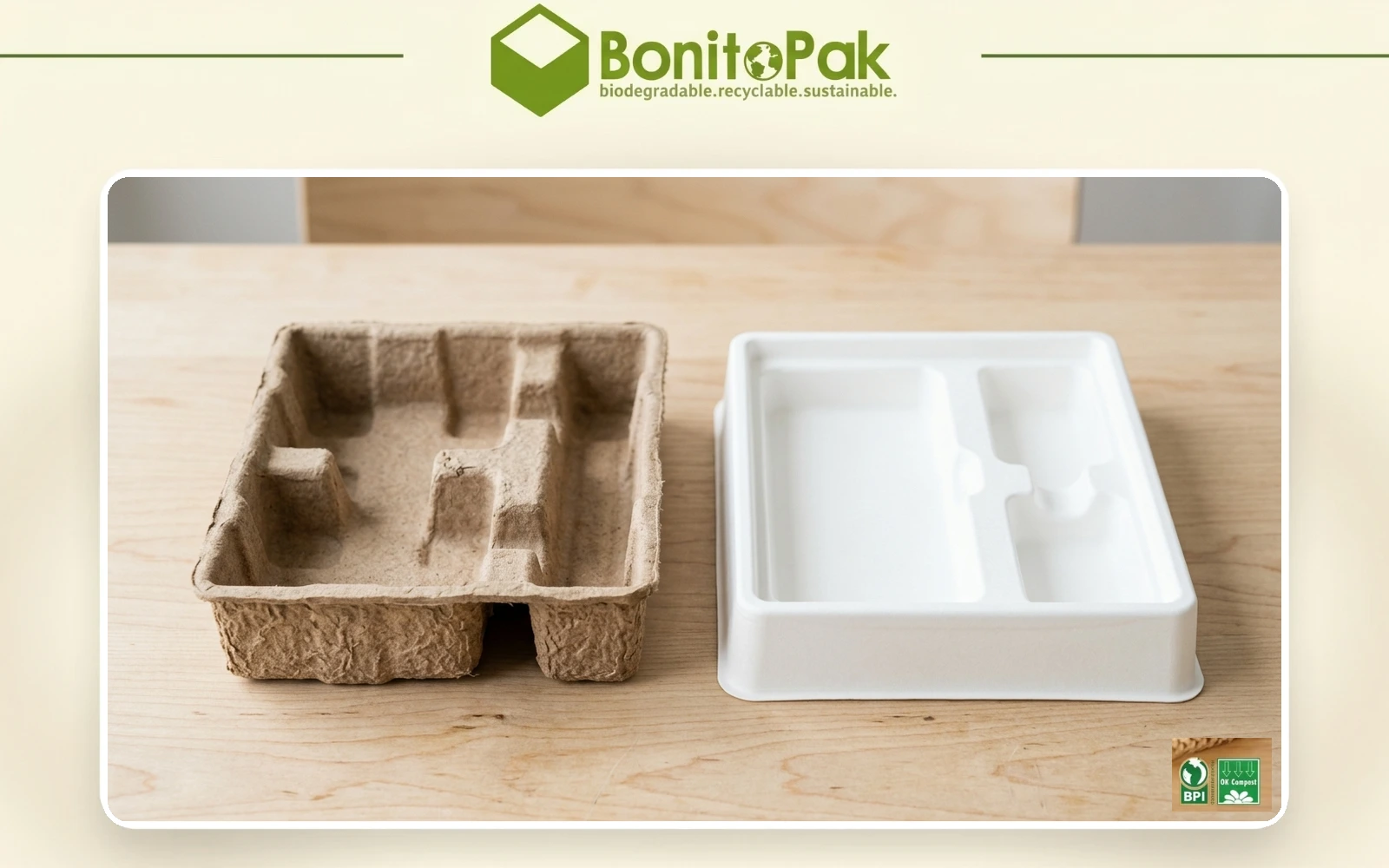
Nuestra cartones prensados en húmedo finish at a wall thickness of roughly 0.7 to 1.2mm, while bandejas de prensado en seco finish at roughly 2.5 to 3.0mm. At the same internal cell geometry those produce different external dimensions. It is a small difference per carton and a meaningful one across a stack of fifteen inside a case.
Nesting is a tooling decision that changes your pallet count
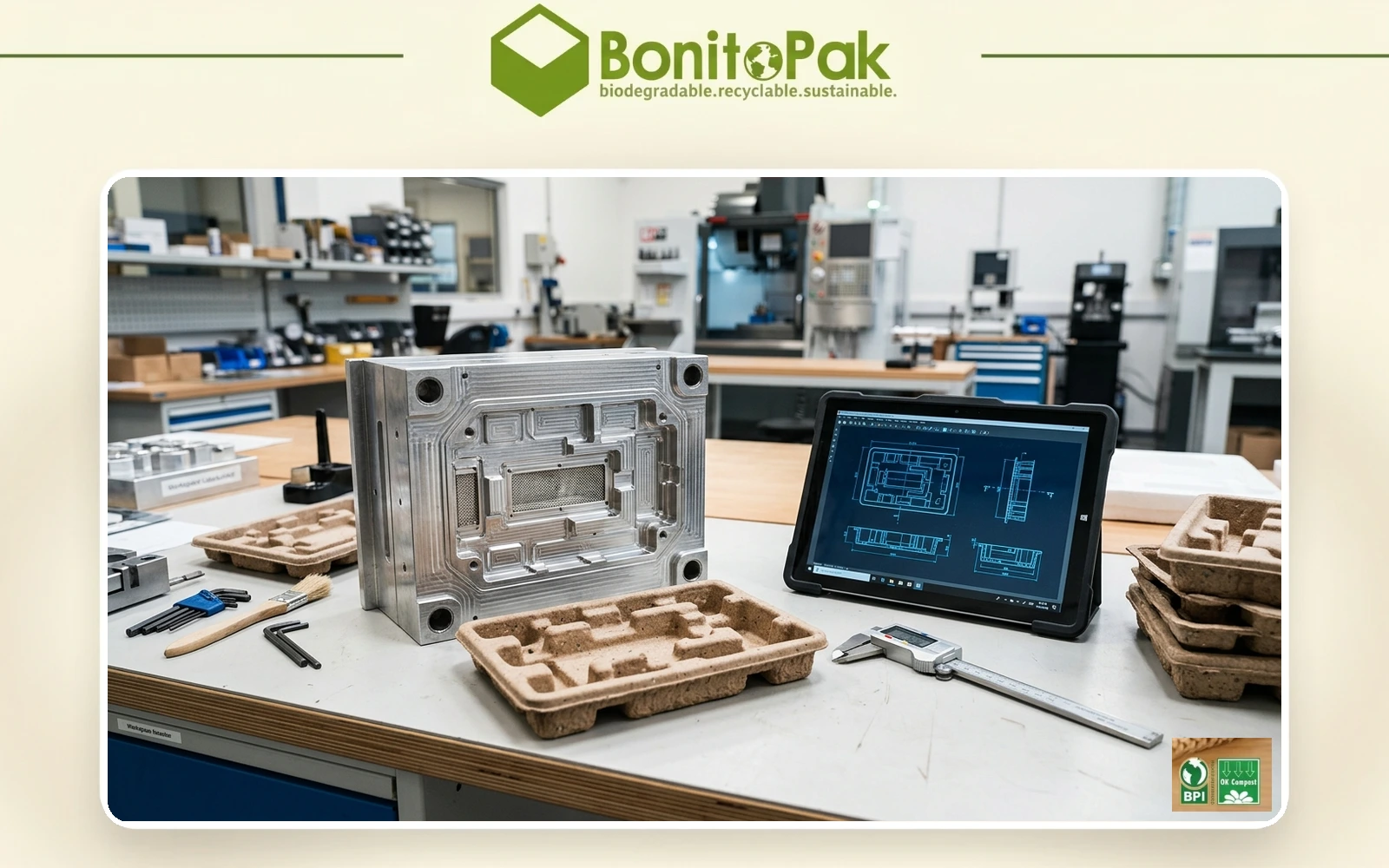
How well flats nest is governed by the draft angle on the cell walls when the mold is cut. Too little draft and trays lock together and slow the packing line. Too much and stack height grows, which can cost you a layer on the pallet. We settle draft before cutting tooling because it cannot be adjusted afterwards without a new mold.
Check pallet fit at sample stage, not after production
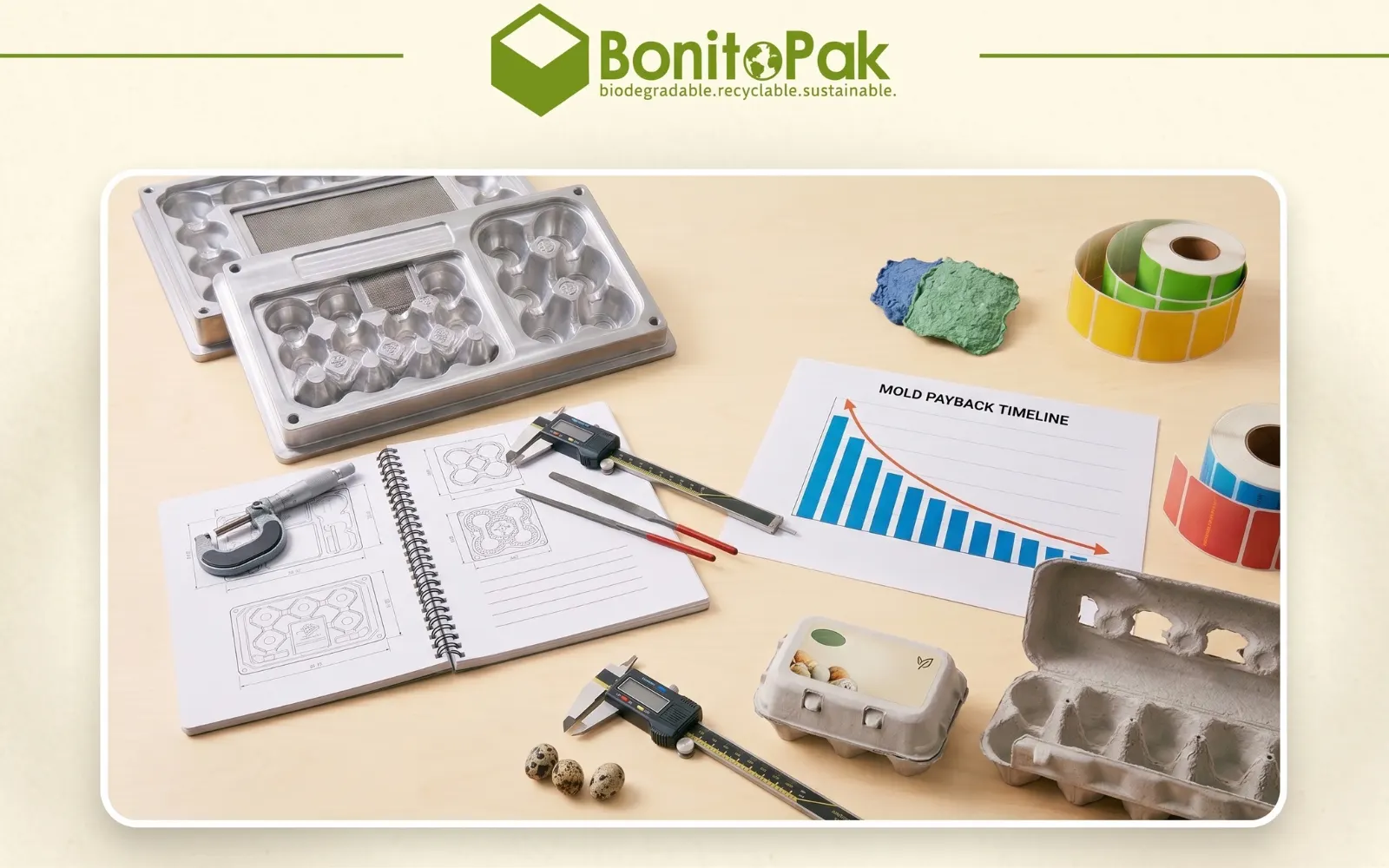
Sample molds run in about seven days and production molds follow around eight days after geometry approval, with minimums from 1,000 pieces. That gap exists so real parts can be measured and stacked before the production tool is committed. Once external dimensions come off a production mold, changing them means new tooling. Our página de bandejas para huevos personalizadas sets out what is adjustable at that stage, and the same nesting logic applies to stacked bandejas de pulpa moldeada.
One recurring request worth flagging. Customers sometimes ask for a thinner wall purely to gain a pallet layer. That trade is available, but wall section is carrying the stacking load, and the eggs at the bottom of a seven layer pallet are relying on it. The materials side of that decision is covered in our article on De qué están hechos los cartones de huevos.
Poner esto en práctica
Specify grade alongside count on every quote request, and ask for external dimensions rather than a size name. Those two habits eliminate most fit surprises before they reach production.
Then work the logistics in the right order. Establish what case footprint divides cleanly into 48 by 40, design the case around that, and only then check how many cartons fit inside it. Deduct board thickness, assembly clearance, wrap and a realistic height limit before you commit, and check whether weight or height binds first.
En BonitoPak we confirm external dimensions on physical samples before a production mold is cut, because a carton that fits the eggs but not the case is an expensive thing to discover at the first shipment. Sending your case and pallet targets alongside the egg grade lets both be designed together rather than sequentially.
Sobre el autor
Leo Chan is the founder of BonitoPak and has spent more than 20 years in molded pulp packaging, working with over 500 brands moving from plastic and foam to fiber based formats. BonitoPak manufactures molded pulp packaging at its facility in Chashan Town, Dongguan, Guangdong, running both wet pressing and dry pressing lines across six pulp systems, with in house mold design and tooling. The dimensional guidance here reflects tooling work on that line alongside published case specifications and pallet loading references, which should always be confirmed against your own supplier drawings.
Preguntas frecuentes
Q: Why does every egg carton size chart show different numbers?
A: Cavity depth and wall section differ by tooling, and forming process changes wall thickness. A wet pressed carton and a dry pressed one at the same count will not have identical external dimensions.
Q: Does egg grade change the carton footprint?
A: Rarely the footprint, usually the height. Cell diameter and depth grow with grade, which pushes closed lid height up. Jumbo cartons are noticeably taller than large at the same length and width.
Q: How do I calculate eggs per pallet myself?
A: Divide pallet length and width by case dimensions to get cases per layer, divide usable height by case height for layers, multiply the two, then multiply by eggs per case. Round every division down.
Q: What height should an egg carton pallet configuration allow?
A: Most dry vans allow around 100 to 102 inches total including the pallet deck. Deduct roughly five inches for the pallet, then leave margin for stretch wrap and any load top sheet.
Q: Can I change egg carton dimensions after tooling is cut?
A: No. External dimensions come from the mold, so any change means new tooling. This is why pallet fit should be checked at the sample stage rather than after the first production run ships.

 Spanish
  English
  German
  French
  Russian
  Japanese
  Portuguese
  Arabic