By Leo Chan, Senior Packaging Consultant, BonitoPak
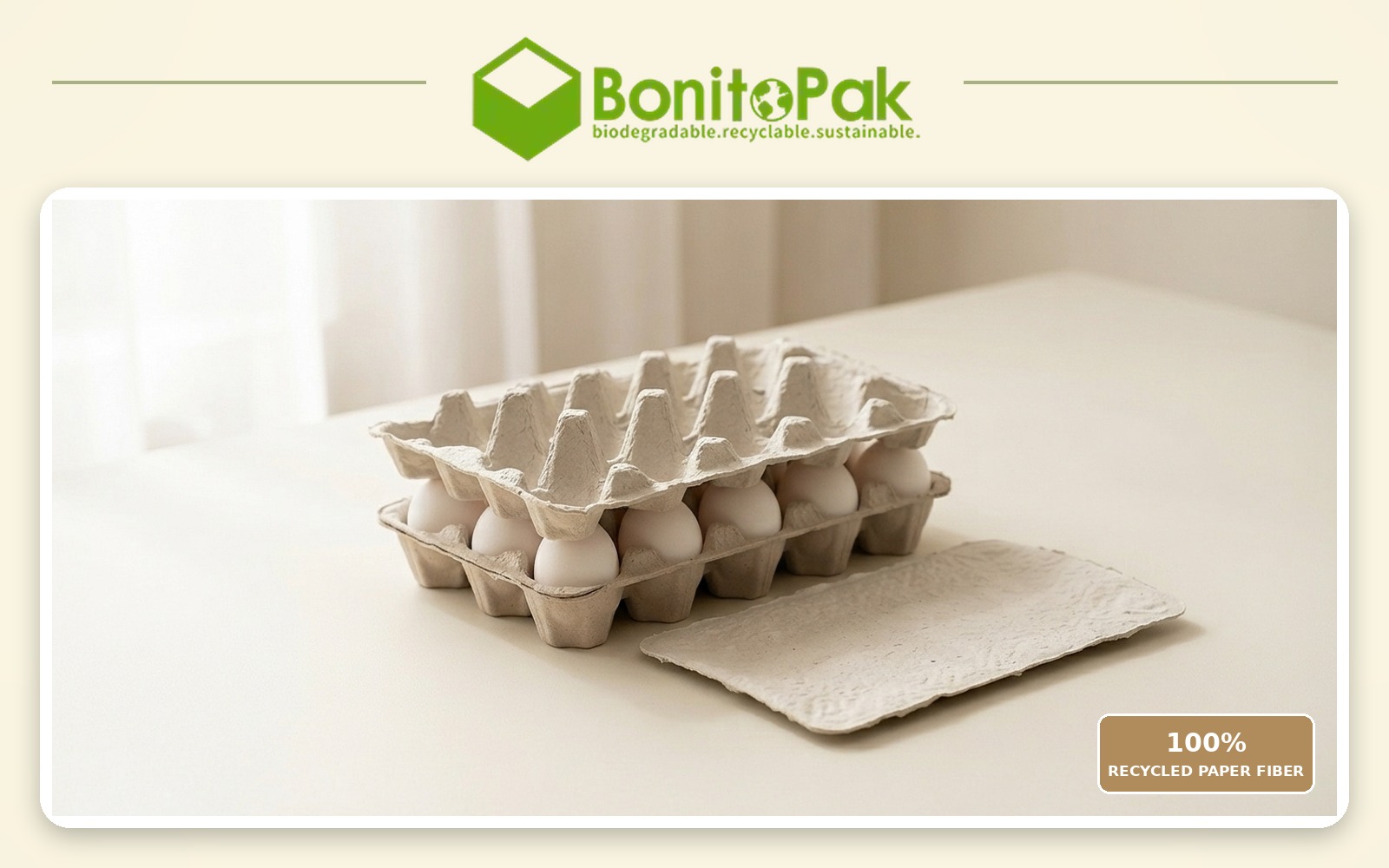
Egg carton sizes come down to two numbers: the number of cells in the carton, and how heavy the eggs are. Our BonitoPak molded pulp cartons measure 120 x 105 x 78 mm for 4 cells, 175 x 105 x 75 mm for 6 cells, and 300 x 105 x 75 mm for a 12 cell carton in the long 2×6 layout. A compact 3×4 dozen measures 205 x 150 x 75 mm.
The eggs are the other half of the answer. The USDA sorts shell eggs into six weight classes, from Peewee at 15 ounces per dozen to Jumbo at 30 ounces per dozen (USDA Agricultural Marketing Service, 7 CFR 56.218). A carton built for Large eggs can leave a Jumbo egg sitting too high for the lid to close.
This guide gives you the exact egg carton dimensions we make, the weight classes behind them, and a simple fit test to run before you order. We build these cartons in Dongguan, China, so every number below comes from our own spec sheets, not from a catalog we copied.
What Do Egg Carton Sizes Actually Mean?
These sizes describe two separate things: the cell count, such as 4, 6 or 12, and the outer dimensions of the carton. A third factor hides inside the cells. Each cell is cut for an egg weight class, so a carton labeled 12 can still be wrong for your eggs.
Buyers mix up the two meanings of “size.” A grocery shopper sees “Large” printed on a carton and thinks the carton is large. That word describes the eggs inside. In the USDA system, eggs are graded by weight, not by length or width, so a Large egg is a weight class rather than a measurement.
For a packer, the useful question is different. What count goes in one pack, and how deep must each pocket be? Our spec sheets answer both. The 12 and 6 cell cartons take standard to jumbo chicken eggs. The 4 cell carton is cut deeper and takes standard chicken eggs up through duck and jumbo.
How Big Is a 12 Egg Carton?
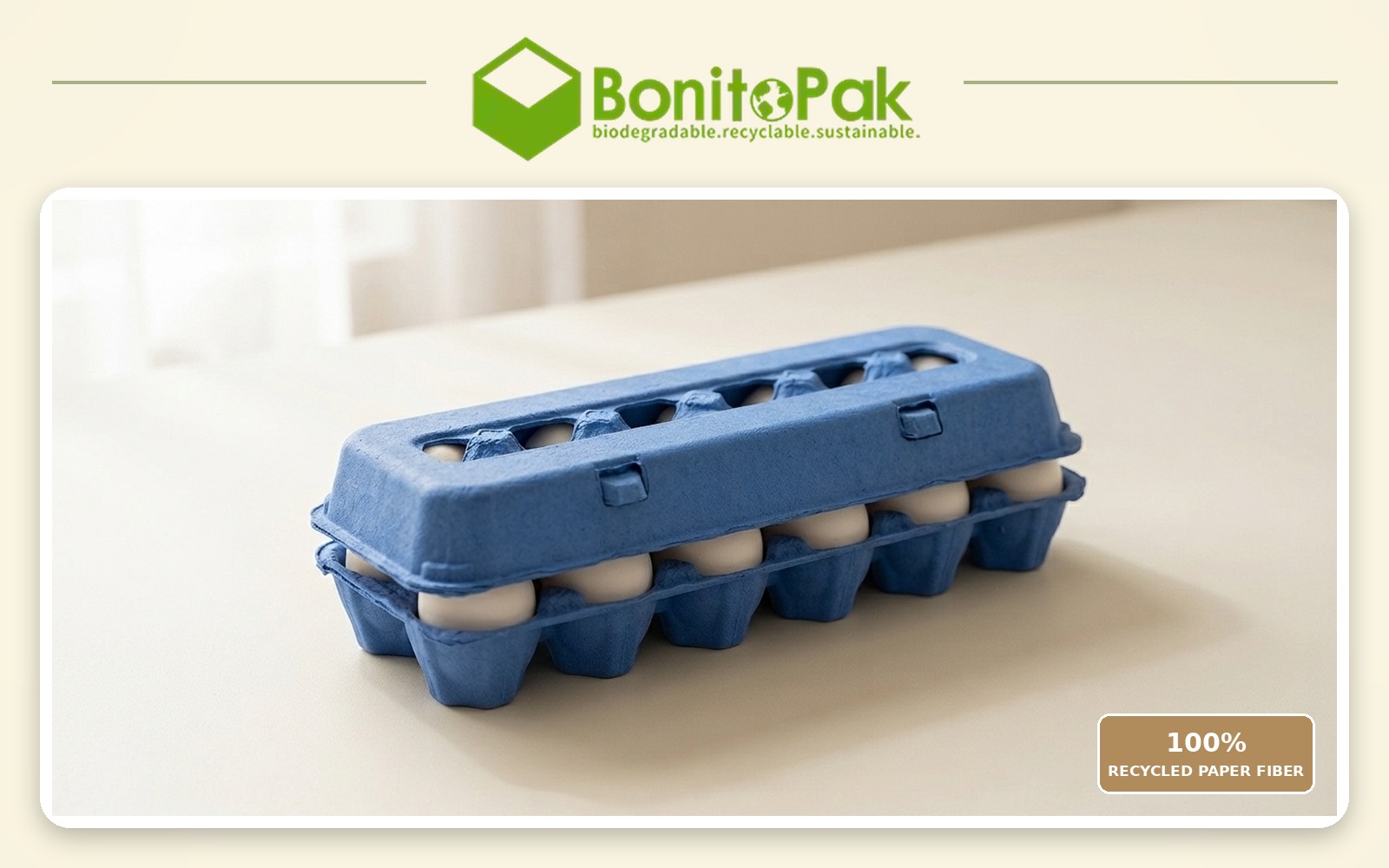
A BonitoPak 12 egg carton measures 300 x 105 x 75 mm in the long 2×6 layout and 205 x 150 x 75 mm in the compact 3×4 layout. Both hold twelve cells, weigh 48 to 58 g empty, and fit standard to jumbo chicken eggs. In inches, that is 11.8 x 4.1 x 3.0 for the 2×6 and 8.1 x 5.9 x 3.0 for the 3×4.
The 2×6 is the shape most shoppers know from the grocery cooler. The 3×4 takes less shelf length, which helps when your display or case is short. Our علبة بيض سعة اثني عشر بيضة comes in both. Each one is a top fold clamshell with a front locking tab and a full width lid panel for grade labels, nutrition text and your brand mark.
Strength matters as much as the 12 egg carton size itself. The rib structure carries stacking load through the frame, not through the eggs. That is why you can stack filled cartons without the lid pressing on a shell.
| BonitoPak molded pulp egg carton dimensions (BonitoPak product specifications) | |||||
| Cell count | Layout | Outer size (mm) | Outer size (in) | Empty weight | Egg range |
| 4 | 2×2 | 120 x 105 x 78 | 4.7 x 4.1 x 3.1 | 20 to 26 g | Standard chicken through duck and jumbo |
| 6 | 2×3 | 175 x 105 x 75 | 6.9 x 4.1 x 3.0 | من 28 إلى 34 غرامًا | Standard to jumbo chicken |
| 12 | 2×6 | 300 x 105 x 75 | 11.8 x 4.1 x 3.0 | 48 to 58 g | Standard to jumbo chicken |
| 12 | 3×4 | 205 x 150 x 75 | 8.1 x 5.9 x 3.0 | 48 to 58 g | Standard to jumbo chicken |
What Are the Dimensions of 4 and 6 Egg Cartons?
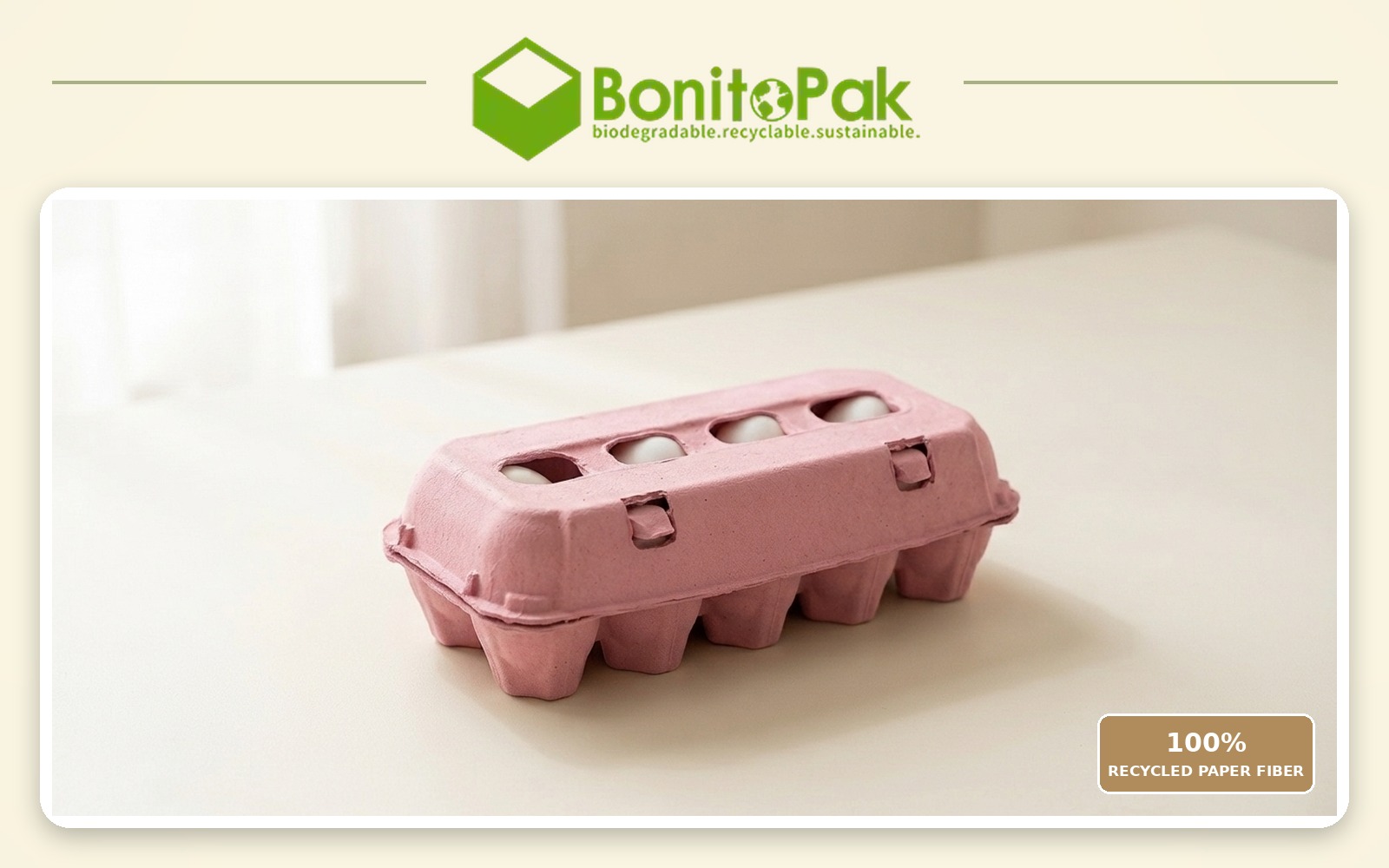
The 6 egg carton measures 175 x 105 x 75 mm and the 4 egg carton measures 120 x 105 x 78 mm. Both share a 105 mm width with the 2×6 dozen. The 4 cell carton is slightly deeper at 78 mm because it is built for larger eggs.
لدينا علبة بيض سعة 6 بيضات is the half dozen pack. Poultry farms, farm stands, grocery shelves and gift packers use it for specialty and premium egg lines. A shared width means you can line up half dozens and dozens side by side in one display row.
إن 4 egg carton serves samplers, gift sets and tasting boxes. It is also a common choice for hatching egg shipments inside an outer box. The deeper cell holds the egg still, and movement is what damages an egg, not a lack of cushioning. We make no hatch rate claims, since results depend on handling and transit time.
Why cut the four count deeper? Four count buyers usually pack bigger eggs. Duck, jumbo and heritage breed eggs all need more depth than a commercial Large chicken egg. At 20 to 26 g, the carton is also light enough to ship in letter rate mailers for direct sales.
Do You Make 10, 18 and 20 Cell Cartons?
Yes. Our علب البيض المصنوعة من اللب المقولب range also runs 10, 18 and 20 cell layouts on molds we already own, so most orders skip the tooling charge. We have not published outer dimensions for those three counts, so ask our team for a drawing before you plan shelf or case sizes.
Egg Carton Size by Egg Weight: What Are the USDA Size Classes?
The USDA sorts shell eggs into six weight classes by minimum net weight per dozen: Jumbo 30 ounces, Extra Large 27, Large 24, Medium 21, Small 18 and Peewee 15 (USDA Agricultural Marketing Service, 7 CFR 56.218). Weight sets the class. Length and width do not.
| U.S. weight classes for consumer grade shell eggs (source: USDA AMS, 7 CFR 56.218, Table I; per egg grams are our calculation) | ||
| Size class | Minimum per dozen | Average minimum per egg |
| جامبو | 30 oz | 70.9 g |
| Extra Large | 27 oz | 63.8 g |
| كبير | 24 oz | 56.7 g |
| متوسط | 21 oz | 49.6 g |
| Small | 18 oz | 42.5 g |
| Peewee | 15 oz | 35.4 g |
Read the numbers as floors. A flock sorted as Large can include eggs averaging anywhere from 56.7 g up to just under the 63.8 g Extra Large floor. That spread is why a carton can fit your Medium morning eggs and still crowd the biggest ones from the same hens.
Does Egg Size Change Which Carton You Need?
Yes. Cell depth and diameter are cut for a weight class, so Jumbo and duck eggs need deeper cells than Large chicken eggs. Shell color does not matter. A carton made for Large eggs holds brown and white Large eggs the same way, because grading uses weight, not color.
Real flock keepers feel this problem first. On a Backyard Chickens forum thread, one owner describes hens that lay round extra large and jumbo eggs. The small end of each egg does not reach the carton floor, so the lid barely closes and the biggest eggs do not fit at all (Backyard Chickens community thread, accessed October 2026). Round eggs are the hard case, because a round egg sits higher than an oval egg of the same weight.
Small eggs have the opposite problem. A small egg in a large cup is an egg that chips. That is why our chicken cells follow the USDA weight grades, and why we cut our quail egg cartons to true quail diameter. Duck and goose keepers can see the same logic in our علب بيض البط, which are made for larger eggs.
How Do You Test a Carton Before Ordering a Full Run?
Weigh a sample of your own eggs, pick the heaviest and roundest ones, and test them in a sample carton before you order. A carton is the right size when every egg rests on its cell floor and the lid closes without pressing on any shell.
- Weigh 24 eggs collected over several days. Write down the three heaviest.
- Ask for a sample of the cell count you plan to use.
- Seat the eggs small end down, close the lid, and check that the front tab locks without force.
- Stack three filled cartons. The lids should not bulge, since the ribs carry the load.
- Mail one filled carton to yourself, or carry it to the farm stand and back. Check for cracks.
- Repeat the test with your largest eggs. If they fail, move up a size or ask for custom cells.
Egg trays, sometimes called flats, follow the same weight classes, and plastic cartons use the same cell logic, so this test works for any material.
How Do Carton Weight and Nesting Affect Freight and Bulk Orders?
Empty carton weight is small and predictable: 20 to 26 g for 4 cells, 28 to 34 g for 6 cells and 48 to 58 g for 12 cells. Our cartons nest, so empties pack tightly in export cartons. A thousand 12 cell cartons add 48 to 58 kg of packaging before any eggs go in.
Nesting changes your freight math. A nested stack of blank cartons takes less space than the same count of rigid boxes, and we ship them bulk nested in export cartons. Custom packing is available. Ask for the pack count per export carton and per pallet, so you can price freight before you order. Pricing depends on count, color, print method and order size.
Can You Order Custom Cartons With Your Brand?
Yes. We accept OEM and ODM sizing on every cell count. Stock molds carry a lower minimum order than custom tooling, so start with a stock size unless your eggs or your shelf need something different. Confirm current minimums with our sales team before you plan a run.
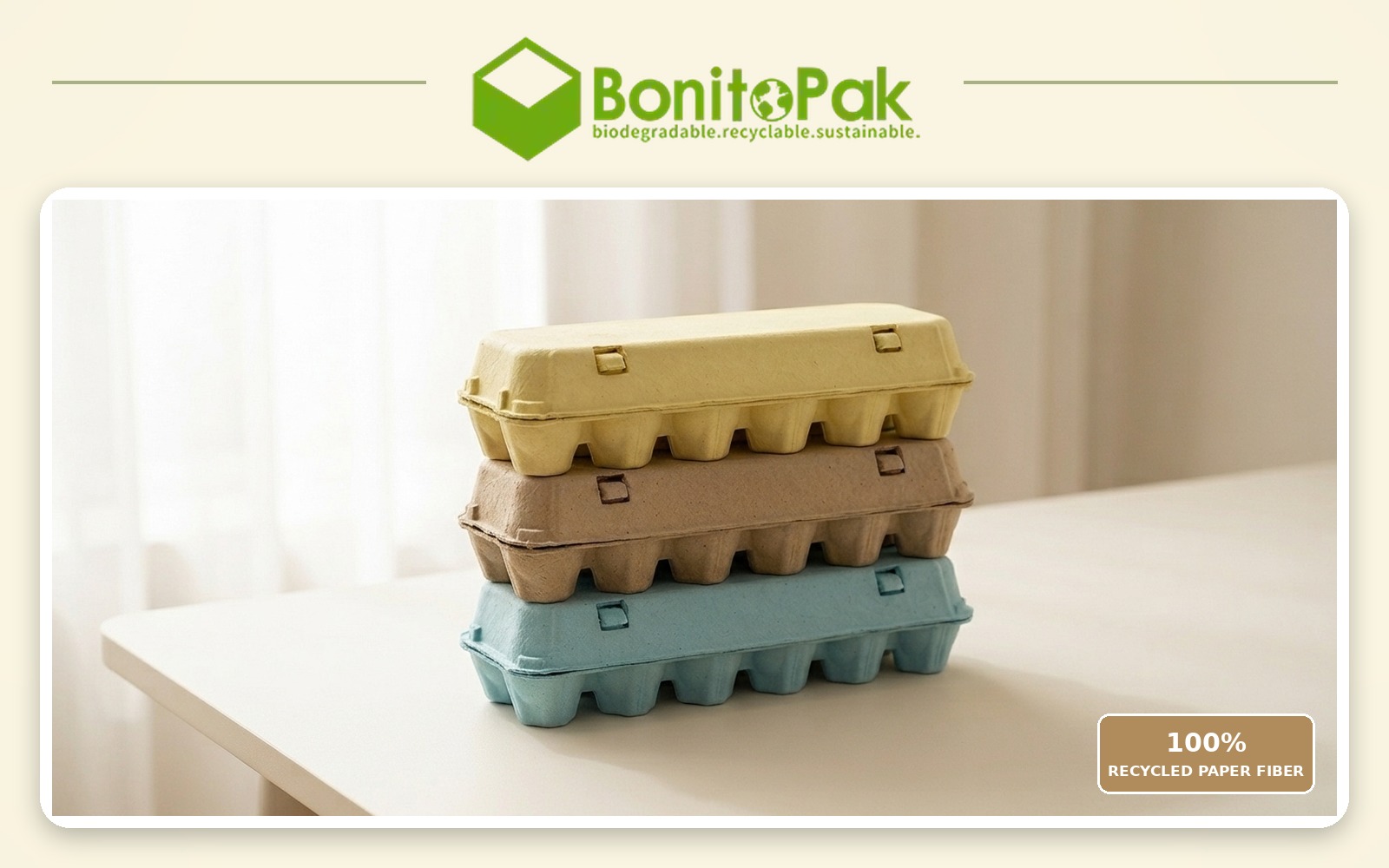
Custom work can also change the finish. Our cartons come in natural pulp plus six stock colors, and we match custom shades to your brand specification. For logos, you can choose embossing, debossing or flexographic print. Embossing builds the cost into the mold, so it does not repeat on every order. Flexographic printing adds a plate charge per color, then a small cost per unit that falls as the run grows.
If you need a size that no stock mold covers, our custom egg carton service starts with your egg weights, your case size and your target count. Send those three details and we will quote both a stock option and a custom one so you can compare.
Your Next Steps for Choosing an Egg Carton Size
Pick your cell count by how you sell, then confirm the cell depth with your own eggs. Start with 12 cells for regular customers, 6 cells for premium and gift lines, and 4 cells for duck, jumbo or specialty eggs.
هذا الأسبوع: weigh 24 eggs and note the heaviest three. This month: request samples of two sizes and run the fit test above. Before your first order: confirm minimums, colors and print method with our team. Fewer carton sizes keep inventory simple for a farm or a packing operation.
Send your egg weights, target counts and case size to leo@bonitopak.com, and we will recommend a carton from our stock molds first. You can also learn more about the factory behind these cartons at بونيتوباك.
الأسئلة الشائعة
Q: What is the standard 12 egg carton size?
A: No single standard applies everywhere. Our dozen carton measures 300 x 105 x 75 mm in the 2×6 layout and 205 x 150 x 75 mm in the 3×4 layout. Always check cell depth against your own eggs, not just the outer size.
Q: What are the six USDA egg sizes?
A: The six sizes are Jumbo, Extra Large, Large, Medium, Small and Peewee. Their minimum net weights per dozen are 30, 27, 24, 21, 18 and 15 ounces (USDA Agricultural Marketing Service, 7 CFR 56.218). Weight defines each class, not shell size.
Q: Do jumbo eggs fit in a regular egg carton?
A: Not always. A Jumbo egg weighs at least 30 ounces per dozen against 24 for Large, so the cell needs more depth. Test your heaviest eggs in a sample. The lid should close with no pressure on the shells.
Q: What does egg carton cell size mean?
A: Egg carton cell size is the diameter and depth of each pocket. Makers cut it for an egg weight class, so quail, chicken and duck cartons use different cells. A cell that is too deep lets the egg rattle, and one that is too shallow stops the lid from closing.
Q: Which egg carton size is best for a farm stand or farmers’ market?
A: Stock 12 cell cartons for everyday buyers and 6 cell cartons for premium and gift sales. Add a 4 cell carton if you sell duck or specialty eggs. Match the cell depth to your largest eggs before you place a bulk order.