By Leo Chan, Senior Packaging Consultant · November 2026
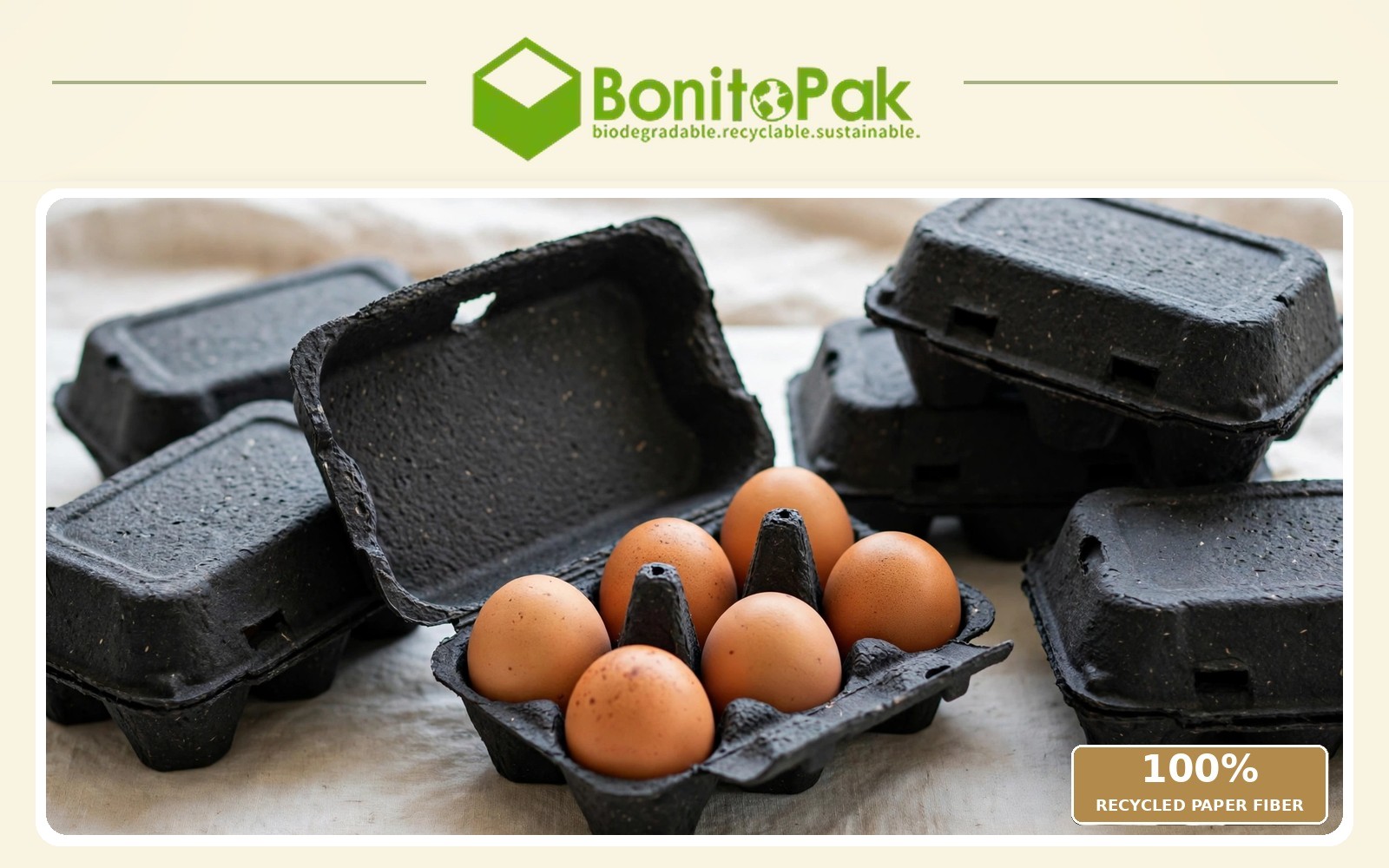
Black egg cartons are molded pulp cartons with black pigment mixed into the pulp before forming, so the color runs through the whole wall and is not a coating on the surface. They give a true black, sharp emboss detail and strong contrast for white, metallic and foil print. Farms use them to position eggs as a premium line, and we make them in counts from 4 to 20.
A black carton looks simple, but the choices behind it change how it prints, how it holds its shade and how it behaves in the field. This guide covers how the color is made, how to brand it, what fiber to start from, where the limits sit, which labels still have to be readable and what to send us when you order from our factory in Dongguan, China.
How Are Black Egg Cartons Made Black?
The pigment is blended into the pulp slurry, then the carton is formed and pressed, so there is no painted or coated layer. If you scuff an edge or tear a corner, the fiber underneath is black too. Our цветная целлюлоза page calls this wet end pigmentation, and it is how every colored carton we make is built.
This matters for three reasons. A scuff does not show a pale patch. The pigment is bound inside the fiber, so there is nothing loose on the surface to rub off onto an eggshell. And no coating or film is added, so the carton stays plastic free. Transfer onto eggs is a sign of a surface coated carton with poor adhesion, which is why we color at the wet end.
The pigment is also a very small share of the carton by mass. A black carton is not a heavy additive product, even if the color looks heavy.
What Is the Difference Between True Black and Charcoal?
True black has the deepest pigment load in our range, and charcoal is a lighter alternative. Charcoal shows more of the base fiber and reads as soft gray black. True black covers the base and gives a flat, solid look. Pick by the effect you want on the shelf.
Charcoal suits a rustic farm brand, where a little texture helps the story. True black suits a modern or premium look, where a clean dark surface frames a bright label. Ask us for both samples, and put them next to your eggs, since a brown egg and a white egg look very different against each.
How Does Black Compare With Other Carton Colors?
Black is the most consistent shade we make and has the strongest emboss and print contrast. Light tints are harder to hold. The table compares black with natural pulp and a pale tint on the points that matter to a brand.
| Point | Черный | Натуральная целлюлоза | Pale tint |
|---|---|---|---|
| Emboss detail | Sharpest in the range | Soft, shows as shadow | Soft |
| Контрастность печати | Strong with white, metallic and foil | Strong with dark ink | Weaker |
| Shade match between runs | Best in the range | Varies with the recycled base | Hardest to hold |
| Sun fade | Slowest | Not applicable | Fastest |
| Pigment load | Самый высокий | Нет | Низкий |
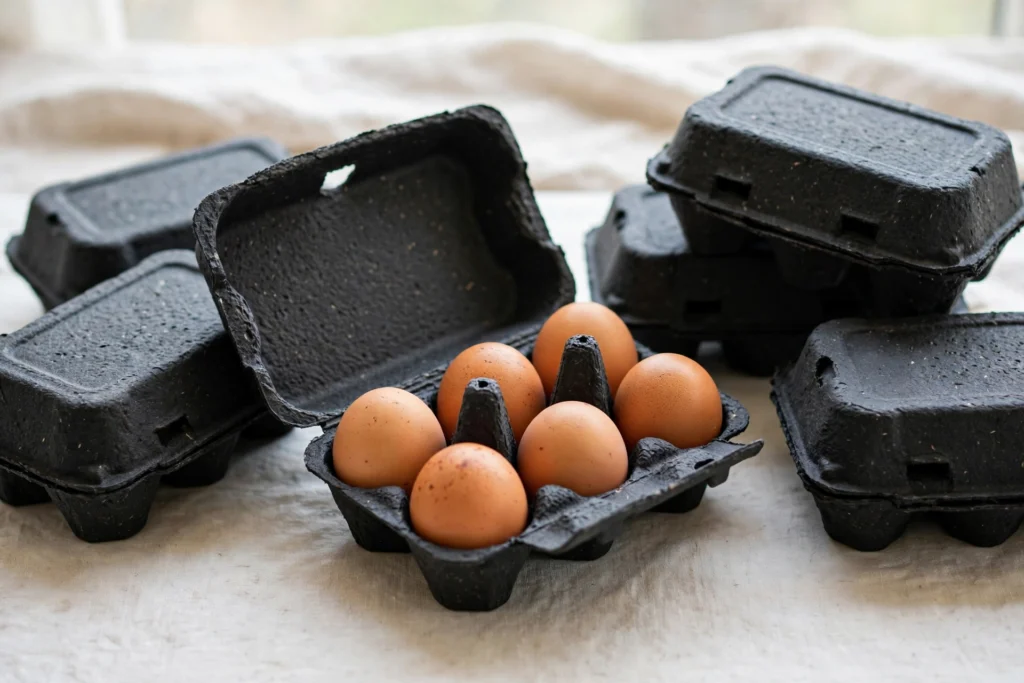
Recycled fiber arrives gray brown and shifts a little from batch to batch. A dark pigment covers that shift. A light tint shows it. That is why black cartons from two different orders look the same, and why we advise a retained physical standard for pale colors.
How Do You Emboss a Black Egg Carton?
Emboss a bold shape and keep the lines thick. Embossed detail on pulp reads through shadow, not through color contrast. Dark pigment holds shadow cleanly at the edge of a mark, so an embossed logo on black reads sharper than on any other shade we form.
Debossing presses the mark in, and embossing raises it. On black, either works. A raised mark catches light from above and a pressed mark holds a shadow, so look at both on a sample under your own shop or store lights before you choose.
Keep to these rules for any pressed logo:
- Use a bold mark, not a fine line drawing.
- Keep small text out. A single word or a short name works.
- Leave empty space around the mark so the shadow is clear.
- Place it on the flat lid panel, away from the hinge and the latch.
Send the logo as a vector file, and we check it against the lid before cutting the mold. For tooling steps and costs, read our custom egg carton mold cost руководство.
What Prints Well on a Black Egg Carton?
White, metallic and foil print read strongly on black, and flexographic print is the usual method. Dark ink will not show on a black base, so plan your art in light colors. A white one color logo on black is simple and sharp.
Continuous tone does not reproduce on pulp. Fiber texture breaks up a photograph on any shade, so a halftone image fails even in white on black. A bold, single color illustration works well. If your brand art has gradients or fine detail, simplify it, or move that detail to a printed label or a paper sleeve.
If you sell more than one egg type, use print to separate them. A white band or a small icon can mark pasture raised, duck or jumbo eggs while the carton stays the same black.
Which Fiber Should You Start From?
Colored pulp can run on any base in our range, so choose the fiber first and the color second. Recycled paper pulp is the usual choice for black, because the dark pigment hides the gray brown of the recycled base, and it keeps cost low. Bleached pulp is the whitest base, and it is wasted under black, so it makes little sense unless you need it for another color.
Our material pages cover bamboo, straw, wood and plant fiber as other bases. Each has its own look and price, and it is a separate decision from the color. If you want a clean story, such as a straw fiber carton, ask for a quote and a sample, because a plant fiber base changes the cost.
For the full range, see our egg carton range, and if egg size is still open, check the cell depth against your largest egg.
Does Black Pigment Weaken the Carton?
Our material page says strength follows the base fiber and pigment does not affect it. Our own blog adds a limit, though: at a deep, saturated shade the pigment load rises, and heavy loading can interfere with fiber bonding. Black has the highest pigment load in the range, so treat the question as one to test and not one to assume.
The practical step is simple. Ask for black samples from the same pulp and press you will use for the order. Load them with eggs, stack them as you ship, and run the same drop and compression checks you use on a natural carton. If a black carton is weaker in your test, we adjust wall thickness or fiber blend before the run. Our full post on what pigment does to fiber strength explains the mechanism.
Will a Black Carton Fade in the Sun?
Black fades less than any other shade we make, but it can dull toward charcoal after months in strong sun. Fading is a proportional loss, and black has far more pigment to lose. Pale tints show fade fastest, and blue and purple pigments rated for compostable use are the least lightfast group.
In a cooler, a fridge case or an indoor shelf, you will not see any change. At an outdoor market, keep stock covered between days and rotate the front row. If your cartons sit in a sunny window display, tell us when you order.
What Must Still Be Readable on a Black Egg Carton?
Required label information still has to be easy to read, so plan a light background for it. In the US, the FDA safe handling statement must appear on the carton, inside a hairline box, with the words “safe handling instructions” in bold capital letters, and the type must be at least one sixteenth of an inch. The FDA small entity guide for shell egg labeling gives the exact wording and placement.
The guide does not address contrast against the background, but a dark carton makes small print hard to read, so the practical answer is a light colored label. Put the safe handling statement, the pack date, your name and address and the egg size on a white or cream sticker or a printed band, and keep the black for the brand mark. Our egg carton label guide covers the full list. We are a manufacturer and not a law firm, so check your state’s rules before you print.
Can You Print “Compostable” on a Black Egg Carton?
Not without a document for your exact product. Our product page describes black cartons as biodegradable, home compostable and plastic free with no surface coating, and it lists no certificate. The pigment is chosen to meet the same breakdown needs as the fiber, but a claim on a pack needs a test report or a certificate that covers the finished carton.
Food contact is a separate point. Our colored pulp page says the pigment must be confirmed for the specific market. Ask us for a written pigment statement for your exact carton before you print any green claim, and print only what you can prove, such as “Made from recycled paper pulp.”
Does a Black Egg Carton Cost More?
Slightly. Black uses more pigment by mass than a light tint, but that is partly offset by fewer rejected batches, since black does not fail shade checks the way pastels do. Stock black carries a lower minimum than custom shades, and the exact price and minimum are confirmed with each quote.
Think about the full cost of the line. A premium black carton usually sells a premium egg, so compare the extra cost per carton with the extra price per dozen you expect. Our guide to colored egg cartons looks at why farms switch.
How Do You Order Black Egg Cartons From BonitoPak?
Email leo@bonitopak.com with your egg count, egg size, logo file and yearly volume, and say whether you want true black or charcoal. We send a sample so you can test the fit, the emboss and the strength with your own eggs. The cell counts we make in black are 4, 6, 10, 12, 18 and 20.
See the specification on our black egg cartons page, or start from the BonitoPak homepage. Price and lead time are confirmed with each quote.
Часто задаваемые вопросы
Will black pigment rub off onto my eggs?
A: No. The pigment is bound inside the fiber and is not a surface coating, so nothing loose can transfer. If a carton does mark eggs, it is a coated carton with poor adhesion. Test a sample with your eggs.
Can I print a photo on a black egg carton?
A: No. Fiber texture breaks up continuous tone on any pulp shade. Use a bold one color illustration in white, metallic or foil, and put photographs on a label or sleeve.
What is the difference between black and charcoal?
A: True black has the deepest pigment load and a flat, solid look. Charcoal is a lighter shade that shows more of the fiber. We can send both so you can compare them with your eggs.
Will black egg cartons fade in sunlight?
A: Less than other colors. After months in strong sun a black carton can dull toward charcoal. Keep outdoor stock covered, and tell us if your cartons sit in a sunny window.
Which cell counts come in black?
A: Our black range covers 4, 6, 10, 12, 18 and 20 cells. Custom cavities are available for special eggs, and we quote them separately from stock molds.
Is a black egg carton as strong as a natural one?
A: Our material page says strength follows the base fiber, but black has the highest pigment load. Test a sample with your eggs and stacking, and ask us to adjust wall thickness if you need to.